
Join Puck to listen to this article
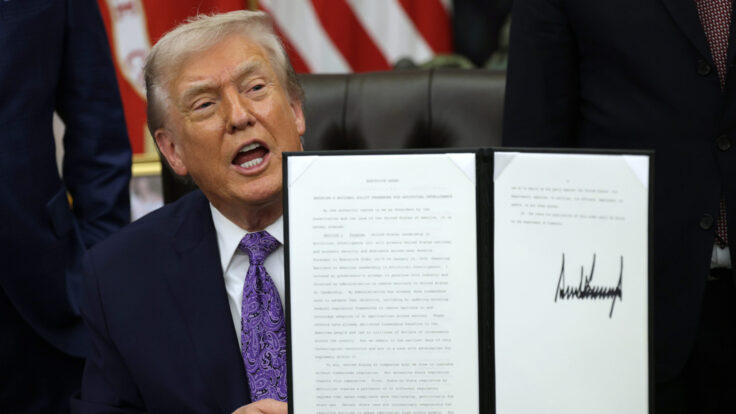
For the past few years, Silicon Valley and Washington have been largely aligned around the notion that America must win the “A.I. arms race” with China. Fears of a second Sputnik moment deepened in 2017, when China’s State Council published a seminal document detailing Beijing’s plans to achieve global A.I. dominance by 2030. In January, the panic spread to Wall Street after Chinese startup DeepSeek launched a free, open-source L.L.M. whose rapid and seemingly cheap development cost U.S. tech stocks about $1 trillion in the course of a single day. The incoming Trump administration quickly adopted the same geopolitical narrative as the largest A.I. developers: A growth-at-all-costs strategy wasn’t just good for Wall Street—it was also a national security imperative.