 |
|
Welcome back to In the Room. I’m Dylan Byers.
|
|
Greetings from The Polo Lounge, where David Zaslav and all the other familiar characters are holding court ahead of Oscars weekend. In tonight’s email, a deep dive into all the angst and anxiety plaguing CNN’s TV natives in Mark Thompson’s purgatorial pre-transformation phase.
But first…
🏌️ Searching for New Nathaniel: It’s been more than two months since Zaz defenestrated his top comms chief Nathaniel Brown, and he still hasn’t identified a replacement. I’m told their internal recruiters have put in calls to several prospects who passed on the opportunity—likely because of Zaz’s all-hours management style and WBD’s upside-down stock price—and are thus still casting about for candidates. “They are at square one,” a source with insight into the matter told me. “People got the call, and yet…,” said another. Here’s a thought: What about Netflix and Time Warner alum Richard Siklos?
⌛ Ackman v. Axel, cont’d: It’s been more than two weeks since Bill Ackman sent his 77-page letter to Axel Springer demanding that Business Insider retract its plagiarism claims against his wife, Neri Oxman, or else be taken to court. Ackman’s side hasn’t heard a peep from Axel or B.I., I’m told, and Axel spokespeople told me they had no update on their response. I hope for both sides’ sakes that their lawyers don’t charge by the hour.
💸 Condé crunch: Condé Nast C.E.O. Roger Lynch has told staff that the company’s revenue was “flat” year-over-year in 2023, which means he missed his goals. I’ll defer to my partner Lauren Sherman, who saw this coming a mile away: “Given everything that’s happening in journalism, this financial performance—even if it’s reliant on some Condé-Adjusted EBITDA formulation—isn’t terrible,” Lauren writes. “And yet, Lynch shot himself in the foot in his early days, bragging about the company’s wins and suggesting that it would be profitable by 2023.” And here I thought the perk of working for a private company was that you didn’t have to set such lofty expectations.
And now, on to our favorite hobbyhorse…
|
 |
| Remembrance of CNN Past |
| A mere six months into Mark Thompson’s tenure as the new C.E.O., the CNN panic rooms are already filling up with agitated and paranoid talent and executives who are second-guessing his new plan. So, well, are they right? |
|
|
|
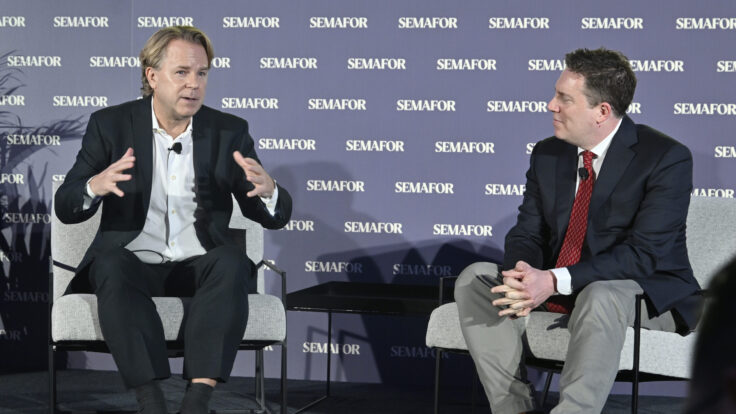
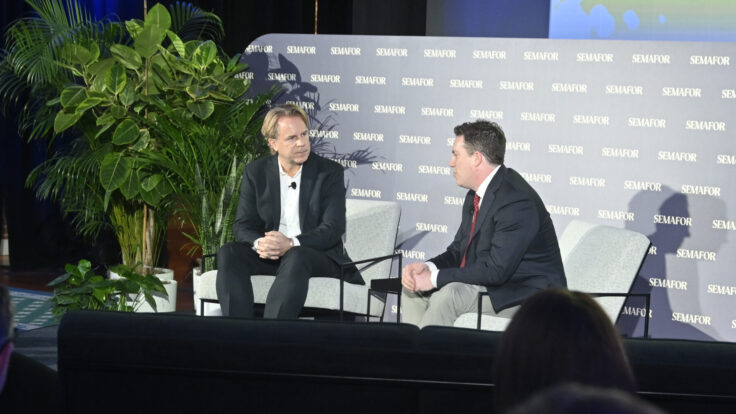
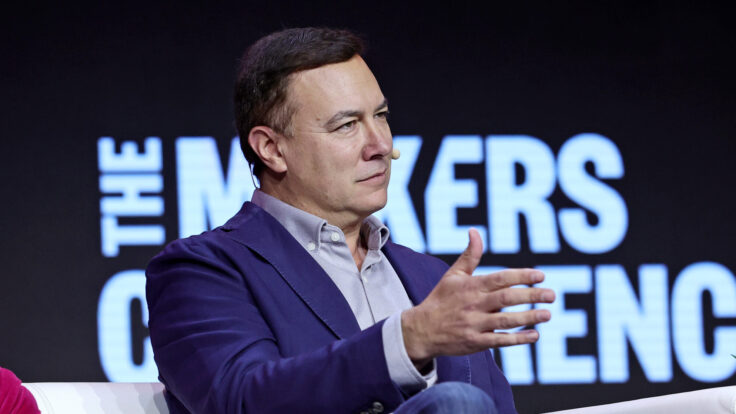
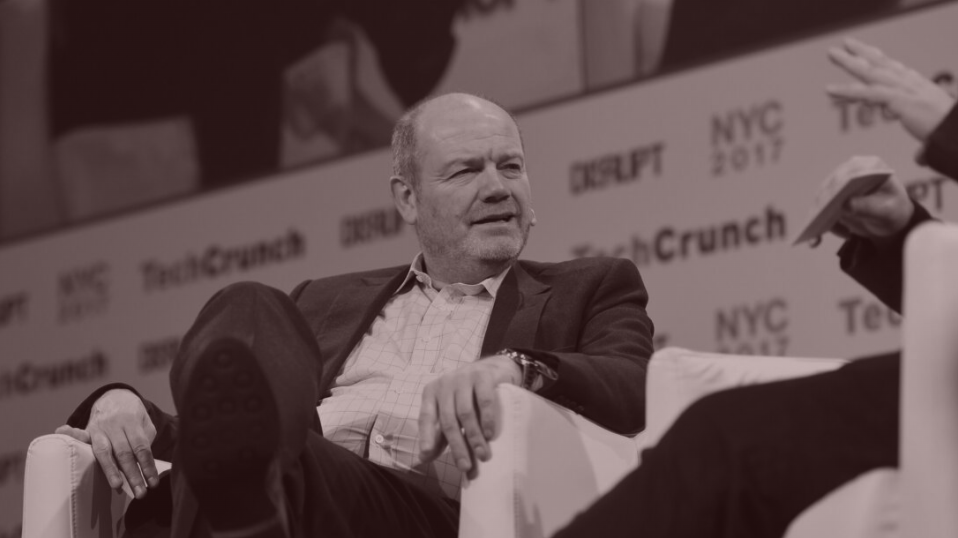
| Around 4 p.m. on Super Tuesday, as CNN was breaking into its prototypical, genre-defining, wall-to-wall coverage of the most important night in this historic-if-predictable 2024 primary season—Wolf Blitzer in Washington, Erin Burnett in New York, correspondents across nearly a dozen states, panelists in hair and makeup, John King readying the Magic Wall, etcetera—network C.E.O. Mark Thompson was at the old Time Warner building, sitting onstage alongside the chief executives of Bumble and IDG at the Blackstone C.E.O. Conference. With an ominous and dark sky behind him, Thompson told a room full of executives that his cable network had stabilized after a very tumultuous couple years, and was strategically tackling challenges and preparing for a promising future—you know, the usual corporate pablum around which an alt asset management firm builds a two-day networking events for their executives and L.P.s.
Alas, the mood back at his network was a tad less optimistic. Of course, Thompson’s arrival some five months ago had been heralded as an inflection point for CNN, following the trauma-inducing ouster of Jeff Zucker, the incautious Zaz-and-Malone takeover, and, of course, the sixteen-month saeculum obscurum of Chris Licht. As a former BBC chief who had successfully executed the New York Times Company’s oft-celebrated digital pivot, Thompson seemed uniquely suited to lead the 24-hour television network into its long-overdue mobile-and-streaming-first iteration.
And yet, CNN veterans are already getting restless. Thompson barely started his new job at the end of 3Q23, and he’s barely been afforded the opportunity to gather an executive team and implement a strategy that, itself, will take subsequent quarters (if not more) to kick in. But a unique quirk of Thompson’s job is that he has the pleasure of leading a company built on the anxieties and endorphins of journalists, show pony performance artists, and sharp-elbowed executives and producers who require clarity, heavy petting, and encouragement. And, thus far, Thompson’s own pablum-filled all-company memos have done little to allay their fears.
Thompson’s insights, articulated in a pair of memos, can be distilled down to a list of five fairly obvious priorities, including defending the linear business amid a transformation. He’s also only made one notable operational hire, Alex MacCallum, a beloved digital growth veteran of the Times and Zucker-era CNN—but who also, yes, was one architect behind the much maligned CNN+ fiasco. Understandably, some people are confused and others are worried that Thompson either doesn’t have a true Innovation Report-level strategy for CNN or, worse, that it might not work. |
|
|
| Strategic pivots take time, of course, especially at a proud global television network with 44 years of linear muscle memory. But Thompson’s unapologetic, no-sacred-cows approach has frayed internal ties, in some cases along generational lines. Indeed, there are still many—mostly younger, mostly digital-first—employees who feel hopeful and optimistic about Thompson’s approach, and relieved that the leadership is finally focused on adapting to the modern world, rather than prioritizing shows that attract a mere half-million viewers (or worse), many of whom won’t be around by the next decade. The freedom to question once-unimpeachable legacy practices in strategy meetings is, to them, a breath of fresh air that they never experienced under Licht, who primarily focused on tweaking show formats, overhauling sets, and moving on-air talent to precisely the wrong time slots—as if any of it really mattered.
At the same time, CNN remains a television-first network, and there are many, many linear natives—the people who host, appear on, and produce the shows; the people whose names you might know—who read between the lines of Thompson’s future-facing memoranda and see little more than impending cost cuts, budget restrictions, and salary reductions. When Thompson says that “change is essential,” they see it (fairly or not) as a preview of the inevitable rationale that he will give to agents Jay Sures or Bradley Singer or Olivia Metzger or Rachel Adler when he has to break the bad news in a future contract renegotiation. These are the people who trade notes on how hard it is to get a salary renewal, and see Jim Acosta’s move from weekends to weekdays not as one journalist’s redemption story, but rather a savvy way of paying weekend salaries for weekday programming. (Disclosure: Singer represents Puck.)
These, too, are the people who still pay attention to the dismal ratings and then, when someone in the hallway wonders aloud whether the network took the right editorial posture toward Trump’s latest provocation, are quick to note with a sarcastic smile that it doesn’t matter, because no one is watching. And yet, they are the same ones who have been around long enough to know the broad revenue picture, and recognize that CNN’s linear business will still power the P&L for years to come, even if things will never be as they were during the Zucker era or before.
Sure, most of these people recognize the necessity of growing the digital product and adapting to a direct-to-consumer world, but they still don’t understand why that needs to come at the expense of a robust linear offering that pays the bills and defines the brand’s reputation. They don’t understand why Mark had to stop trying to compete in mornings altogether, or why he seems content, at least for now, to stay the course with a primetime lineup that, after Anderson Cooper wraps, often fails to match the audience of CNN’s dayside programming. In the first two months of this year, the noontime Inside Politics, hosted by Dana Bash, outrated the 9 p.m. show, The Source With Kaitlan Collins, which averaged just over 600,000 viewers total.
Most excruciatingly, they chafe at the fact that the network is no longer the indisputable leader during major breaking news events and election nights—those moments when, historically, CNN’s unrivaled global infrastructure and quasi-nonpartisan, facts-first reputation made it the first port of call for the nation. Actually, even more excruciating is the clarity—perhaps reached after a second drink downstairs at The Polo Bar—that they have nowhere else to go. Unlike alternative asset firms, of course, there are only a handful of broadcast news networks, and they are in precisely the same pickle. (Some, of course, are privileged to have started early enough in the game to exit with a respectable retirement; to wit: This will almost certainly be Wolf’s last election cycle.)
In this atmosphere, it’s not hard to see how the narrative around Thompson and his strategy can metastasize into an unwarranted caricature—whether he cares about or even watches the network’s programming—that is both premature and unfair and yet truly felt. To these anxious skeptics, his decision to appear on a C.E.O. Conference panel for 30 minutes on Super Tuesday—honestly not that big of a deal; he went back to the office afterward—becomes evidence that he’s not been as involved or engaged in the actual substance and content of the business as they’d hoped.
No doubt, Thompson sees quite a few horizons beyond all this. He’s a seasoned former public market chief executive who has held even more-public jobs. He’s also got the full endorsement of Zaz, who picked him by hand. And, indeed, he’s managed enough organizations to know that many of these wistful nostalgics will not be around long at all. In the meantime, some who have spoken with him privately of late say they interpreted an executive who recognizes that CNN’s current content and audience could be far stronger, but remains focused on the digital future—whatever that may be.
In any event, this week was particularly hard. On Super Tuesday, CNN averaged an audience of just 900,000 in primetime, or between 8 p.m. and 11 p.m., and just 251,000 in the advertiser-coveted 25-to-54 demo—netting less than half of MSNBC’s total audience, and tying their rival in the demo for the first time in history in an arena where they were once dominant. During President Biden’s State of the Union address on Thursday, they averaged 2.5 million viewers, a distant sixth place to Fox News, ABC, NBC, MSNBC, and CBS. (The network claims it was CNN Max’s second biggest day on record, but still won’t disclose the actual numbers). In the narrow-minded and, frankly, pathetic world of TV ratings wars, CNN at least had the distinction of not losing the demo to MSNBC that night (they won by 35,000 viewers). One wonders how much longer they’ll be able to claim even that pyrrhic victory. |
|
|
|
| FOUR STORIES WE’RE TALKING ABOUT |
 |
| Red Carpet War Games |
| Digging into the lucrative business of dressing marquee celebrities. |
| LAUREN SHERMAN |
|
 |
| ‘Michael’ Biopic Murmurs |
| A look at the first Jackson estate-approved biopic to address his controversies. |
| MATTHEW BELLONI |
|
 |
|
 |
|
|
|

|
 |
|
|
|
Need help? Review our FAQs
page or contact
us for assistance. For brand partnerships, email ads@puck.news.
|
|
You received this email because you signed up to receive emails from Puck, or as part of your Puck account associated with . To stop receiving this newsletter and/or manage all your email preferences, click here.
|
|
Puck is published by Heat Media LLC. 227 W 17th St New York, NY 10011.
|
|
|
|