Welcome back to The Varsity 2.0. Today, I am happy to introduce Eriq Gardner as
The Varsity’s regular Monday columnist—and he’s debuting with one of his typically brilliant columns about a lawsuit looking into whether Vince McMahon understated WWE’s value in order to steer his company’s sale to TKO.
As a reminder, the Varsity will continue its Monday, Tuesday, and Thursday schedule. The Tuesday email will be open to all subscribers, but the Thursday issue will be available exclusively to Inner Circle subscribers. And I’ll personally ensure its value
by opening up the contents of my notebook each week—breaking news, executive roulette, corporate intrigue, professional dish, etcetera—and disclosing information that you need to do your job. Click here to join the Inner Circle or upgrade your account.
Pod alert: Guggenheim’s Mike Morris rejoins The Varsity on Wednesday for a no-holds-barred
conversation about where the NFL media rights negotiations stand. Also, make sure to listen to yesterday’s show, where Marchand and I dissected the business of the NFL Draft.
Also mentioned in this issue: Ari Emanuel, Chris Simms, Ted Cruz, Nick Khan, Roger
Goodell, Rodney Harrison, Triple H, Tony Dungy, Brendan Sorsby, Bill Cowher, Matthew Berry, Frank Riddick, Mike Tomlin, Pat McAfee, Jac Collinsworth, Jamal Khashoggi, Andrew Schleimer, Tony Khan, and more…
This issue was created with contributions from
Curtis Rowser. |
- Cruz control: The legal and semi-legal gambling era has generated a seemingly endless litany of questions in the sports world. It’s also provided a nearly equal supply of political hay. I’ve just learned that Ted Cruz’s Senate Commerce Committee is likely to convene a hearing on “integrity in sports” next month, mere weeks after it gathered various stakeholders to discuss the sorry state of professional boxing. According to sources, the hearing will feature
executives in gaming and prediction markets, tribal representatives, and integrity-monitoring professionals.
The news arrives shortly after Texas Tech quarterback Brendan Sorsby checked into a residential treatment program for a gambling addiction, per ESPN. According to the report,
the former Indiana backup bet on Hoosiers football games while he was in Bloomington. All his bets were reportedly on Indiana to win, and he didn’t play in any of those games (and this was before Indiana actually won college football games), but still: an absolutely terrible look. - The 18-game season: A recent debate between NFL commissioner Roger Goodell and former coach Bill Cowher on The Pat
McAfee Show revealed some of the pain points regarding the league’s push to add an 18th game to the regular-season schedule. Cowher argued that any such move should be accompanied by a rule change expanding teams’ active rosters, which are currently capped at 48 players on game days. He further contended that players only have so many reps in a given season, and that a longer regular season would lead to more injuries and a poorer product come playoff time.
Goodell countered that the
contemporary player is better attuned to his limits, and coaching staffs are better than ever at load management. Cowher wasn’t having it. “But the competitive guys, to me, feel like they’re letting their team down,” he said. “So they will not come off the field.” In any case, the 18th game is starting to feel like a preordained outcome at this point, whether the roster gets expanded or not. - A ‘Sunday Night Football’ switcheroo: Last week, Marchand
broke the news that former Pittsburgh Steelers coach Mike Tomlin would be joining NBC’s Football Night in America pregame show for the upcoming season. At first glance, the move looked like a headline hire during what many assume might be only a sabbatical from the sidelines. But as it turns out, NBC seems to be retooling its entire studio operation. “I think they’re making their roster smaller while trying to add star power,” Marchand told me on yesterday’s
episode of The Varsity. “They let go of Tony Dungy, who’d been there for 17 years, and now they’re bringing in Mike Tomlin. … They’ve known that the show rates high because it’s at the end of the Sunday afternoon games, and people turn over for the Sunday night games. But has the show been great? I don’t think many people in the industry think the show’s been amazing. So you add Mike Tomlin. The question with Tomlin is, How long will he do it?”
The roster
shake-up doesn’t stop there. Marchand told me that Jac Collinsworth, Rodney Harrison, Chris Simms, and Matthew Berry were all question marks heading into the season. This morning, one of those questions got answered, as Simms announced that he is officially out.
|
|
|
|
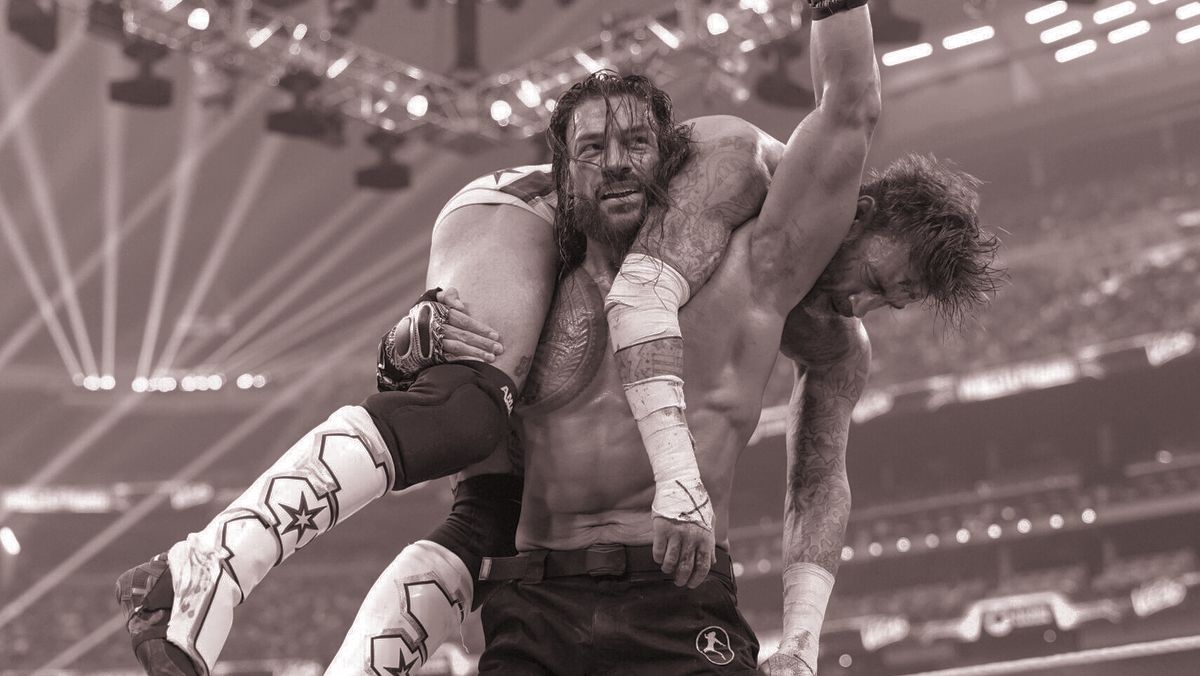
The pro wrestling outfit is flying high thanks to a slew of new deals and WrestleMania’s
recent ESPN debut. But an imminent trial will question whether Vince McMahon undersold the value of the company ahead of the TKO merger that made it all possible. |
|
|
|
You may recall that Vince McMahon, the swashbuckling and cartoonish billionaire WWE
chairman, enjoyed an astonishing comeback in 2022—one that would have defied even the imagination of his old storyline architect and board member Paul “Triple H” Levesque. To wit: McMahon was forced out amid a sexual misconduct scandal, only to reclaim his board seat in time to orchestrate his baby’s merger with UFC into TKO Group Holdings. At the time, McMahon insisted that he alone could oversee a potential sale. But not everyone was happy with the $21 billion deal.
In 2023, shareholders sued—eventually claiming in a consolidated case that McMahon’s comeback wasn’t about saving the WWE, but rather handing it on a silver platter to TKO boss Ari Emanuel, perhaps the one suitor who was willing to keep McMahon in power while solving a few other problems along the way.
When the trial begins, on June 8, shareholders will present the results of a years-long effort to reconstruct the aftermath of The Wall Street
Journal’s reporting that McMahon paid $12 million in hush money to women who accused him of sexual misconduct over a 16-year period. (In January 2025, McMahon agreed to pay $1.7 million to settle S.E.C. charges related to the payments, and blamed his failure to
disclose them on “minor accounting errors.”) Among the most striking artifacts: a September 2022 voice memo in which Ari tried to reassure McMahon by saying he’d spoken with his apparently well-connected lawyer at Latham & Watkins. “Just F.Y.I., everyone at the D.O.J. is former Latham lawyers,” said Ari, adding that an S.E.C. civil inquiry into the hush-money payments was a separate matter, but manageable. “Yes, we can indemnify you and we will,” Ari allegedly said. (At a December deposition, Ari
said he couldn’t recall making the offer.)
All of this happened months before WWE was officially on the market—evidence, plaintiffs may argue, that the sale process was compromised from the start. They are also poised to hammer the WWE’s former board of directors, including Levesque, Nick Khan, and Frank Riddick, for brushing aside other suitors, including Liberty Media, KKR, and Tony Khan’s All Elite Wrestling, without even countering
their offers. The board, they will likely stress, never submitted the deal to a vote of non-controlling, disinterested shareholders. The directors did, of course, approve millions in bonuses.
All of which should make for an unusually colorful merger trial in Delaware—part valuation fight, part referendum on whether McMahon turned a corporate merger into something closer to a personal rescue mission. Did WWE extract the best possible price, or did a controlling figure bend the
process toward a preferred outcome? The plaintiff’s expert estimates potential damages could run as high as $957 million. |
With the trial just weeks away, both sides have begun the pregame ritual of jockeying for position, and
dumping voluminous material into the public record while battling over what testimony the court will ultimately hear. Some of it is quite gossipy. In a deposition, Nick Khan testified that the Saudis refer to McMahon as “father” in their communications because he was among the first American sports executives to do business with the kingdom and, unlike others, WWE stayed the course through the public furor over Jamal Khashoggi’s murder. There’s also a fair amount of color on
WWE’s rising talent costs and the intricacies of media negotiations.
Then there’s the bigger stuff—notably, a technical dispute with broader implications for the sports rights market. At issue is WWE’s valuation relative to UFC, and the assumptions underlying their future media-rights deals. Plaintiffs say WWE was valued using conservative projections: a 1.43x step-up in rights fees, or roughly $670 million annually, despite a Wall Street consensus of 1.73x and internal materials touting
the upside as potentially 2.5x—about $1.18 billion. In a hot live-rights market, the plaintiff’s economics expert concluded, with bidders like Netflix and Amazon circling, WWE shareholders should have ended up with 53 to 57 percent of the equity in TKO, not 49 percent.
Defendants countered that the 1.43x figure was not some merger-window contrivance, but a genuine management forecast developed in the normal course of business and carried forward amid an uncertain media market. These were
bona fide operating assumptions, used for planning and compensation, not litigation. Their own experts said that the plaintiffs’ math flattered WWE while discounting UFC’s strengths, pointing out that the latter better aligns with the growth of sports gambling since the outcomes aren’t fixed. They accused the plaintiffs of ignoring synergies supporting a 51-49 split, even if WWE deserved somewhat more credit on a stand-alone basis.
Most consequentially, defendants want to
introduce post-merger evidence—especially Netflix’s 10-year, $5 billion deal for Raw and the NBCUniversal SmackDown renewal—to show that WWE’s pre-merger forecast was, if anything, optimistic. Plaintiffs, for their part, wish to exclude that material as improper hindsight. The dispute may turn on whether the court views those later deals as an illuminating reality check or an after-the-fact effort to retroactively varnish an old bargain.
As for WWE’s post-merger,
post-McMahon trajectory—now underscored by the outsize numbers that WrestleMania delivered for ESPN last week—the story isn’t as simple as an alternate timeline with Ari out of the picture. Take the Netflix deal, which was hardly straightforward to value, given its opt-outs, extension triggers, and layered international rights. This was one of those “transformational” deals that reshaped WWE’s economics while accelerating Netflix’s ambitions in live sports. As TKO C.F.O. Andrew
Schleimer put it in his deposition, the agreement marked Netflix’s “first foray into appointment programming”—a beachhead that arguably led to Christmas Day NFL games, MLB opening night, and a growing slate of boxing.
It also raises an uncomfortable question for the plaintiffs—whether that deal would have materialized without Ari. WWE and TKO executives will testify that it’s unlikely, while former board members defend the merger from a billion-dollar body slam. |
Thanks, Eriq. See you all tomorrow.
John |
|
|
|
Join Puck’s chief political columnist, John Heilemann, as he roams the corridors of power and influence in America on this
twice-weekly interview show, taking you beyond the headlines with the people who shape our culture: icons and up-and-comers, incumbents and insurgents, moguls and machers in the overlapping worlds of politics, entertainment, tech, business, sports, media, and beyond. The conversations are rich and revealing, unrehearsed and unexpected… and reliably impolitic. A Puck-Audacy joint, new episodes drop every Wednesday and Friday. |
|
|
|
An essential, insider-friendly Hollywood tip sheet from Matthew Belloni, who spent 14 years in the trenches at The
Hollywood Reporter and five before that practicing entertainment law. What I’m Hearing also features veteran Hollywood journalist Kim Masters, as well as a special companion email from Eriq Gardner, focused on entertainment law, and weekly box office analysis from Scott Mendelson. |
|
|
|
Need help? Review our
FAQ page or contact us for assistance. For brand partnerships, email ads@puck.news.
You received this email because you signed up to receive emails from Puck, or as part of your Puck account associated with {{customer.email}}. To stop receiving this newsletter and/or manage all your email preferences, click here. |
Puck is published by Heat Media LLC. 107 Greenwich St., New York, NY 10006 |
|
|
|
|