 |
|
Good evening, and welcome back to In The Room. Tonight, some well-informed analysis on the still-elusive explanation for Tucker’s ouster, and a CNN Trump town hall pregame report.
But first, some housekeeping: In The Room will be off this Friday. I’ll be back in your inboxes next week.
|
 |
| Tucker Theories & CNN’s Trump Revival |
| News and notes on the latest comings and goings in the land of cable news: suspicions regarding the trending explanations for Tucker Carlson’s ouster, and all the internal feels about CNN’s Trump town hall. |
|
|
|
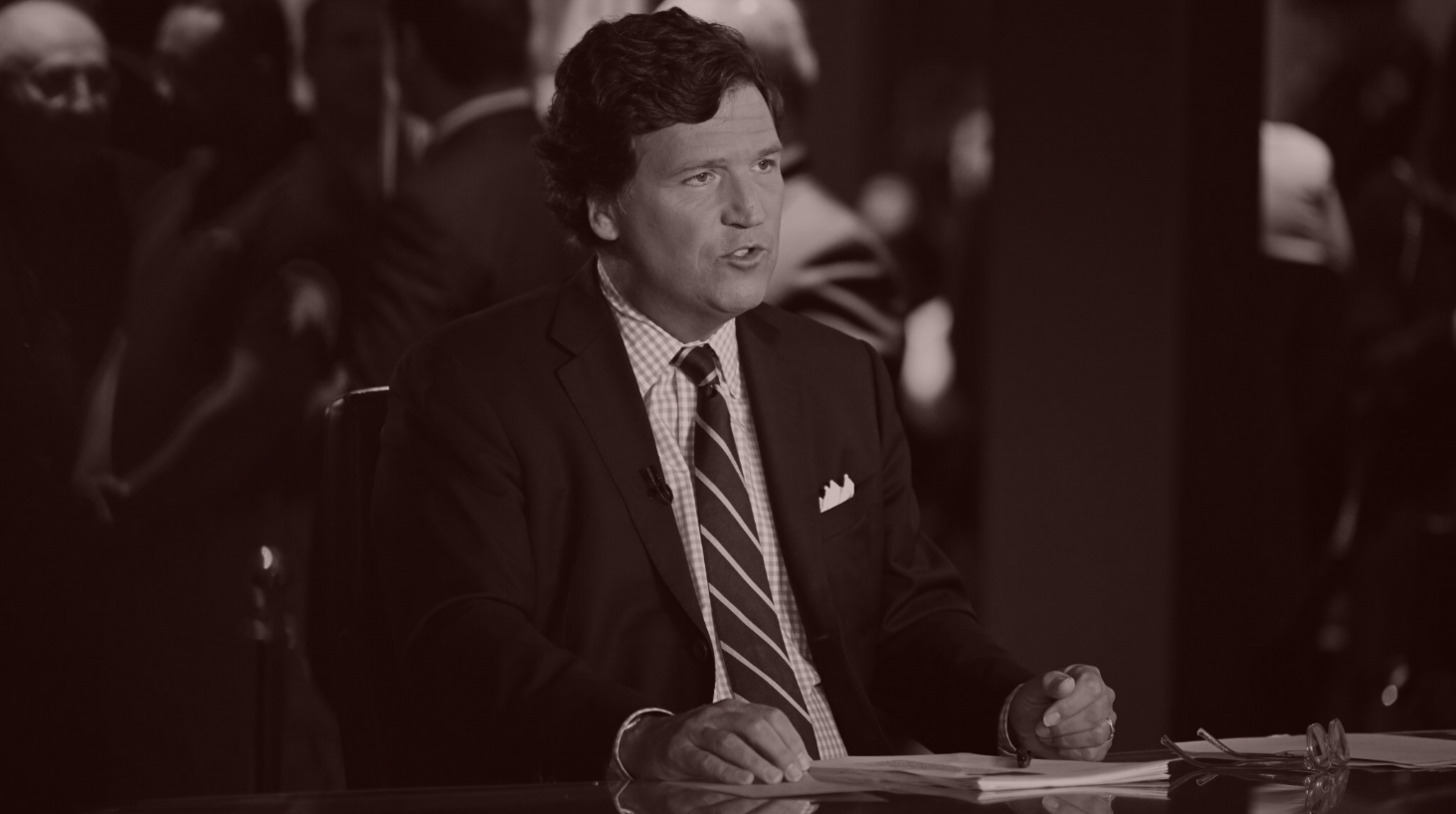
| In the nine days since Tucker Carlson’s expulsion from Fox, there have been a litany of rationales and hypotheses put forth to explain why Rupert Murdoch abruptly cut ties with his most powerful and highly rated host, exposing the business to MAGA-world blowback, tanking the Fox News primetime ratings, blowing up the Fox Nation streaming service, and leaving himself on the hook for about $20 million in salary payments in the process. To date, however, none of the explanations have been wholly satisfying.
One early prevailing theory posited that Carlson was fired because of a misogynistic and insubordinate text in which he used the c-word to describe a Fox executive (longtime Fox P.R. chief Irena Briganti, I’m reliably told). Another posited that Tucker’s texts and emails convinced the Murdochs and the Fox board that he had become too conspiratorial, or too bigoted, or merely too loopy in his on- and off-air worldview. There were also some differences of opinion regarding the war in Ukraine, apparently. None of these quite pass muster, however, partly because few have viewed Fox News as the paragon of organizational management or corporate enlightenment.
On the more conspiratorial side, some have posited that Tucker’s ouster may have been a requirement of the Dominion settlement—a claim Dominion denies, and one that doesn’t pass the smell test: If Dominion had forced Tucker out, wouldn’t they take credit? Wishful thinking, perhaps.
If all the aforementioned explanations feel unsatisfactory, it may be because the Tucker revealed in the Dominion filings—at least, the parts we know about—was more or less the same Tucker who performed before an audience of three million every night, embracing and propagating MAGA conspiracies and channeling populist grievances, whether he believed in them or not, all from the cushy confines of Maine or South Florida. Indeed, the only surprise was that the real Tucker actually claimed to hate Trump (though I guess this isn’t that much of a surprise, either).
The misogyny and insubordination, while unquestionably terrible and certainly a fireable offense at CNN or MSNBC or almost anywhere else, didn’t necessarily seem like the sort of thing that would force the impervious Murdochs to bet the farm. But most importantly, these revelations, along with Tucker’s own deposition, came forward several months ago. Why did Fox wait until the last minute? The board is said to have not taken notice of these revelations until days before the settlement, which, if true, seems worthy of its own examination.
On the day of Tucker’s ouster, I reported that the true cause for his defenestration was likely buried somewhere else in the redacted portion of the filings, vulnerable to exposure by future lawsuits. Late last night, The New York Times proffered a scoop that claimed to have found the smoking gun: a text message in which Carlson, in a moment of candid introspection, tried to make sense of his impassioned urge to see a mob of Trump supporters beat up and kill an Antifa protester.
The text betrayed an undeniably racist worldview—“It was three against one, at least. Jumping a guy like that is dishonorable obviously. It’s not how white men fight,” Carlson wrote—as well as some troubling, if ultimately quasi-reassuring, self-analysis: “I found myself rooting for the mob against the man, hoping they’d hit him harder, kill him. I really wanted them to hurt the kid. I could taste it. Then somewhere deep in my brain, an alarm went off: this isn’t good for me. I’m becoming something I don’t want to be.”
The Times piece reached for closure—the headline in the print edition called it “The Text That Got Tucker Carlson Dismissed”—but on closer inspection it felt like yet another item on the laundry list of not-altogether-satisfying explanations. The text, the Times says, “set off a panic at the highest levels of Fox,” and was the catalyst for Fox’s decision to hire an outside law firm to investigate the star host they would ultimately decide to drop just four days later. Maybe, but it also reads disconcertingly like the first draft of a Tucker direct-to-camera primetime monologue.
Undoubtedly, everything in the Times report is true enough, but it nevertheless still felt like window dressing on the real motivation for Tucker’s termination. Of course, I can’t offer a better explanation yet. What I can say is that sources on all sides of this story—Fox, Dominion, and Team Tucker—don’t exactly buy the idea that this was Tucker’s death knell. |
| The Kaitlan Collins Moment |
|
| On Tuesday, CNN chairman and C.E.O. Chris Licht marked his one-year anniversary with a staff-wide memo trumpeting the network’s myriad journalistic achievements, a branding overhaul, and a couple of new shows, after which he took stock of his own performance so far and his hopes for the year ahead: “I made a promise to set expectations, make the tough calls, fight for the resources you need, and remove any obstacles that keep you from doing your best work,” Licht wrote. “I strive every day to make good on that commitment. I remain humbled and deeply proud to lead the best news organization in the world, and I am incredibly bullish about our future and all that is to come in 2023. Our transformation would not be possible without your grit, dedication, and passion for the mission of CNN.”
Understandably, the memo made no mention of the litany of setbacks that Licht has faced in his first year, from the demoralizing cost cuts to the failed primetime experiments to the mismanaged morning show implosion. As I wrote last week, Licht is charging ahead with the assurances that he still has Zaslav’s backing and at least several a few more quarters of runway, which is admittedly perhaps less than he initially thought.
Nevertheless, Tuesday’s rosy-eyed assessment stood in sharp contrast to another piece of news that came across the transom that afternoon: Last month, for the first time in four years, MSNBC surpassed CNN in the coveted 25-to-54 year-old demo for total day ratings. It was the clearest data point yet proving that CNN is now squarely in third place in the cable news ratings wars—an arena of diminished significance, to be sure, but nevertheless the arena in which CNN is fighting, and where the success of the business is measured. Executives inside WBD can point out that we’re no longer in the era where cable networks cravenly compete over ratings; most of the money comes from carriage fees, and the CNN brand remains so powerful that it will long be a key asset in what remains of linear bundles. But it’s also a bit of a chicken and egg game, and ratings can be a leading indicator of brand decline.
For the next week, of course, Licht and his charges will be almost wholly preoccupied with a newly announced town hall event with Donald Trump, which is sure to be a rare ratings draw for the network. The booking, which CNN producers, executives, and the event’s moderator, Kaitlan Collins, spent months trying to land, finally came together due to a confluence of interests: CNN’s desire to eschew its Zucker-era anti-Trump posture, and Trump’s desire to stick it to Fox News while charging back into the mainstream in the role of the presumptive G.O.P. nominee, leaving DeSantis et al. in the dust. This week, the Times reported that Trump is likely to skip one or both of the first two Republican debates, in part to avoid elevating his lower-polled challengers.
The town hall will be a major test for Licht and especially for Collins. At 31, she is unquestionably the network’s fastest rising star and the primary talent on which Licht is staking his pivot to the middle. Her conservative bona fides (Alabama, a Daily Caller pedigree) are instrumental to Licht’s effort to win over conservatives, and likely played a role in convincing Trump to agree to the town hall. But Collins is also still somewhat untested, and just settling into the anchor role. And Trump, of course, has the power to impact the careers of the journalists with whom he engages for the better, or for the worse.
Needless to say, there are some at CNN, including those who lived through the former president’s public attacks on the media, and the death threats from his supporters, who have very mixed feelings about Licht’s decision to bring an indicted election truther back onto the network. (Lost in the retrospection about the Zucker years is the fact that the Trump administration was a chaos machine, and for all the gripes about Acosta et al., it would have been bad journalism to normalize things.)
Michael Fanone, the United States Capitol Police officer who was assaulted, beaten, tased, and dragged down the stairs by protestors on January 6, 2021, is now a CNN contributor. He told me today that he submitted an op-ed to the network in which he argues that “allowing Donald Trump an open forum on a major television news network is the moral equivalent of putting an AR-15 in the hands of someone mentally unstable.” Fanone said CNN refused to run the op-ed. But, to be fair, Fanone also pitched the piece to The New York Times and The Washington Post and suggested that he be allowed to debate Licht about the idea. (A non-starter, obviously.)
Of course, there’s no way for Licht to reposition CNN as a nonpartisan, all-voices-welcome mass-market news network without treating Trump the same way the network treats the other candidates. Surreal as it may be, Trump is the Republican frontrunner, and that is a fact all media organizations have to reckon with.
Indeed, one of Licht’s primary critiques of his predecessor, Jeff Zucker, has been the way he programmed the Trump show, first enabling the candidate’s early stardom with empty podium footage and then repositioning as the network de la resistance against the president and all his perfidy. But that critique arguably under-appreciates just how challenging it is to cover a candidate who lies and misleads with apparent impunity and nevertheless commands the loyalty of at least a third of the nation.
Licht will now be forced to wrestle with that challenge first hand, and he will have to walk a fine line: remaining noncombative while also adhering to basic journalistic principles of accountability in truth—and, of course, making it interesting enough to command an audience that, one year in, doesn’t seem particularly excited about what he’s selling. Good luck. |
|
|
|
| FOUR STORIES WE’RE TALKING ABOUT |
|
|
|

|
 |
|
|
|
Need help? Review our FAQs
page or contact
us for assistance. For brand partnerships, email ads@puck.news.
|
|
|
|
Puck is published by Heat Media LLC. 227 W 17th St New York, NY 10011.
|
|
|
|