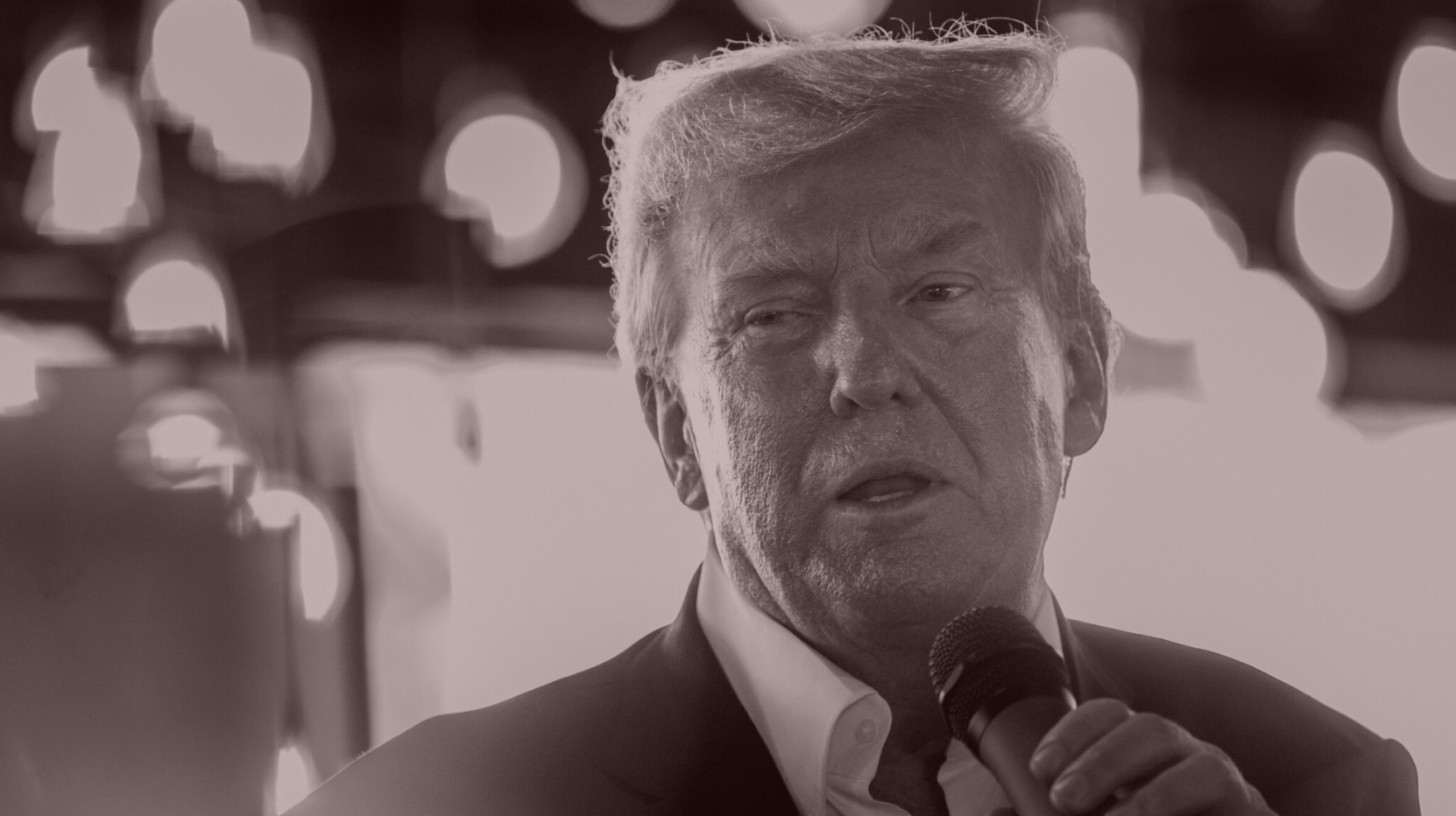
| Over the last several weeks, as Bret Baier was preparing to co-moderate tonight’s Republican primary debate on Fox News, he held multiple calls with Donald Trump to gauge whether or not the G.O.P. frontrunner intended to participate. As The New York Times reported, Baier’s overtures were part of a united effort by network executives and talent to persuade the former president to engage in a forum where he increasingly saw little upside. Fox News C.E.O. Suzanne Scott and president Jay Wallace also traveled to Trump’s private golf club in Bedminster to make their case to the candidate over dinner. In the end, Trump concluded that there was no advantage to sharing his spotlight with lesser-known rivals—nor to making himself more legally vulnerable with an errant gaffe—and instead opted to give a pre-recorded interview to Baier’s old colleague, Tucker Carlson.
In an already chaotic and unconventional campaign season, Trump’s decision has fueled a compelling political-media subplot: Can Fox News maintain its standing as the dominant Republican media ecosystem if the dominant Republican candidate refuses to play ball with them, counterprograms them, and even attacks them on the campaign trail? Eight years ago, Trump’s inaugural Republican primary debate delivered a record-setting 24 million viewers to Fox News. Tonight’s debate was never going to match those numbers, with or without Trump—his novelty has worn off, of course, and the linear market is smaller—but it’s reasonable to assume that his presence, and the fanfare around it, would have delivered an audience at least half as big. Instead, most of the political media insiders I talk to anticipate an audience somewhere around six or seven million, at best.
Fox’s debate dilemma is indicative of a broader challenge that will play out over the course of the next fourteen months, though it’s not at all clear how that challenge will manifest itself. On the one hand, Trump openly besmirches Fox in stump speeches and on his social network. “There’s political profit in pivoting against Fox, which is why Trump is doing it,” one notable conservative pundit told me. “Fox is the Man. That’s not where you want to be with Republican viewers right now.”
Then again, no media entity looks poised to replace Fox News as the conservative media standard bearer this cycle. Tucker’s ouster was a months-long drag on Fox’s ratings, but viewership is rebounding now that Jesse Watters is firmly in place at 8 p.m., befitting a historical pattern wherein the network proves more powerful than the star (see: O’Reilly, Glenn Beck, Megyn, etcetera). Meanwhile, a prerecorded Trump interview that people can watch tonight or tomorrow or anytime is hardly the counterprogramming threat the media has made it out to be. (Politically, at least, Trump’s smarter counterprogramming move is deciding to surrender to the Georgia court on Thursday, overriding coverage of whatever news DeSantis and the other seven dwarves make on stage in Milwaukee tonight.)
Whether Tucker proves more formidable than his predecessors remains to be seen. (He is at least committed to keeping up the competition, even if it elicits the occasional cease-and-desist letter from outgoing legal chief Viet Dinh.) The far more pressing threat for Fox is the broader diffusion of political media that Tucker’s new enterprise represents. Fox is competing with a whole range of conservative media voices across various platforms—Tucker, Newsmax, NewsNation, Ben Shapiro, Ben Domenech, Steve Bannon, Beck, and so on—at a time when conservatism itself is fracturing into disparate niches. The network’s ability to simultaneously appease conservative MAGA fanatics (via Hannity & Ingraham & Co.) while maintaining at least a veneer of credibility (via Baier & Co.) is proving ever more difficult (see: the $787.5 million defamation settlement with Dominion).
More to the point, Fox News is grappling with the diffusion of media at the same time as the linear business is in inexorable decline, rendering it ever less relevant to an electorate that gets its news from myriad sources, often via push notification, and can catch up with the TV highlights on YouTube. Presidential campaign seasons have historically buoyed cable news’ fortunes and restored its relevance, albeit momentarily, and debate nights have proven especially significant for networks given the exclusivity afforded to the host. Indeed, primary debates are the one occasion in which news networks are guaranteed to experience the benefits that NBC Sports or ESPN derive from having exclusive rights to Sunday or Monday Night Football. No one drove that point home so much as Trump in the 2015-2016 debates—after delivering 24 million for Fox News, he delivered 21 million for CNN. But of course, the Trump bump only works if you actually have Trump on stage.
If there is any solace for Fox News, it is the self-evident truth that Trump is famously preoccupied with the linear medium, and, of course, with Fox News itself. As the Times recently noted, “his professed hatred of Fox—and the animus he often privately expresses about the chairman of Fox Corporation, Rupert Murdoch—is mixed with his recognition of Mr. Murdoch’s power and a grudging acknowledgment that the network can still affect his image with Republican voters.” (Trump is notably far less preoccupied with CNN this cycle, no doubt in light of its own ratings declines and accelerated drift toward irrelevance under Chris Licht, and perhaps also due to the absence of his longtime frenemy Jeff Zucker). In any event, the road through the primaries is long, and Trump’s approach to the network will not be zero sum. He may ultimately grant more interviews to Fox News—more Hannity, less Baier, perhaps—and may even participate in future debates, even as he criticizes the network on Truth Social. Such is the state of American politics. |
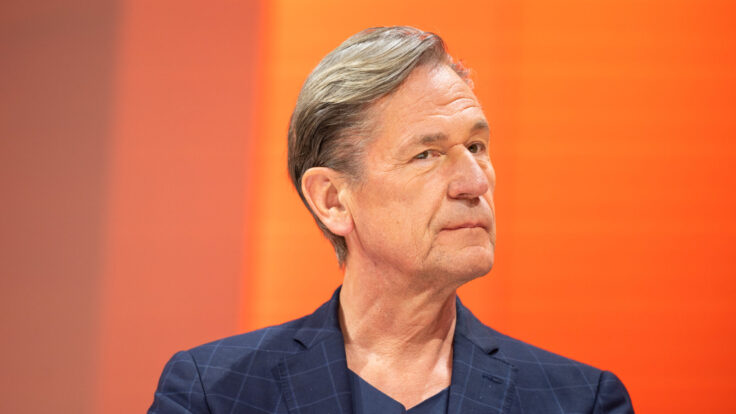
| In other news, David Zaslav’s search for a new CNN chief executive is now well under way. On Wednesday, Semafor’s Ben Smith reported that former New York Times Company C.E.O. and BBC director-general Mark Thompson had emerged as a leading candidate to take over the network. Thompson is one among a small group of candidates who Zaz is considering for the job, Smith reported and sources familiar with the matter confirmed.
It’s not clear whether Thompson actually wants this job, nor whether Zaz will offer it to him, but he’s certainly a logical and inspired choice. In addition to a long history of experience as a television producer and executive at the BBC, Thompson was the lead architect of the Times’ metamorphosis from a bizarrely configured media-and-real estate holding company into a growth-oriented, diversified multi-platform media brand with lucrative lifestyle assets like Wirecutter and Cooking and Games—a metamorphosis deftly continued and accelerated by his successor, Meredith Kopit Levien.
He’s also more than accustomed to dealing with the asylum politics headaches of news organizations. Before he headed to the Times, the paper sent reporters to London to see if he had any connection to the BBC’s Jimmy Savile controversy. Thompson checked out just fine and quickly asserted his authority on the company in a way Janet Robinson could have never fathomed.
Back in March, I wrote that CNN should ostensibly be the Times’ biggest competitor on the global stage given its brand recognition, news-gathering resources, and unparalleled reach on both linear and digital platforms. Achieving that distinction, of course, would require prioritizing digital and streaming investments (even at the expense of the linear product) while diversifying into lifestyle offerings that could sustain a subscription business, à la the Times. CNN+ was actually an attempt to kickstart that effort, however lackluster the initial programming slate may have seemed. (Turning CNN+ into a Times competitor was particularly an idée fixe for Jason Kilar, who in his final days as WarnerMedia chief repeatedly tweeted out Times subscription data even as Zaz & Co. were preparing to kill the service.)
To date, Warner Bros. Discovery has shown no interest in pursuing a Times model. Indeed, Licht spent the vast majority of his thirteen-month tenure tinkering with the linear programming slate, moving anchors here and there with often disastrous outcomes that accelerated the network’s decline, and only alluded to an eventual overhaul of the digital product. (At the time of his ouster, the headlines and aesthetics of CNN.com didn’t seem altogether that different from The Messenger.) As I recently noted, none of these deck chair shuffles, including the recent, mostly unremarkable primetime overhaul, stand to change the fortunes of the declining linear business.
If the job does go to Thompson, it will be a sign that Zaz & Co. recognize what will affect CNN’s fate: not programming or personnel changes, but rather a change to the business model itself. |