
• Washington
  • Wall Street
  • A.I.
  • Hollywood
  • Media
  • Fashion
  • Sports
  • Art
  • Join Puck Newsletters What is puck? Authors Podcasts Gift Puck Careers Events
  • Join Puck

    Directly Supporting Authors

    A new economic model in which writers are also partners in the business.

    Personalized Subscriptions

    Customize your settings to receive the newsletters you want from the authors you follow.

    Stay in the Know

    Connect directly with Puck talent through email and exclusive events.

  • What is puck? Newsletters Authors Podcasts Events Gift Puck Careers
Welcome back to In The Room, my biweekly email on the inner workings of the media industry.
 ‌ ‌ ‌ ‌ ‌ ‌ ‌ ‌ ‌ ‌ ‌ ‌ ‌ ‌ ‌ ‌ ‌ ‌ ‌  ‌ ‌ ‌ ‌ ‌ ‌ ‌ ‌ ‌ ‌ ‌ ‌ ‌ ‌ ‌ ‌ ‌ ‌ ‌  ‌ ‌ ‌ ‌ ‌ ‌ ‌ ‌ ‌ ‌ ‌ ‌ ‌ ‌ ‌ ‌ ‌ ‌ ‌  ‌ ‌ ‌ ‌ ‌ ‌ ‌ ‌ ‌ ‌ ‌ ‌ ‌ ‌ ‌ ‌ ‌ ‌ ‌  ‌ ‌ ‌ ‌ ‌ ‌ ‌ ‌ ‌ ‌ ‌ ‌ ‌ ‌ ‌ ‌ ‌ ‌ ‌  ‌ ‌ ‌ ‌ ‌ ‌ ‌ ‌ ‌ ‌ ‌ ‌ ‌ ‌ ‌ ‌ ‌ ‌ ‌  ‌ ‌ ‌ ‌ ‌ ‌ ‌ ‌ ‌ ‌ ‌ ‌ ‌ ‌ ‌ ‌ ‌ ‌ ‌  ‌ ‌ ‌ ‌ ‌ ‌ ‌ ‌ ‌ ‌ ‌ ‌ ‌ ‌ ‌ ‌ ‌ ‌ ‌  ‌ ‌ ‌ ‌ ‌ ‌ ‌ ‌ ‌ ‌ ‌ ‌ ‌ ‌ ‌ ‌ ‌ ‌ ‌  ‌ ‌ ‌ ‌ ‌ ‌ ‌ ‌ ‌ ‌ ‌ ‌ ‌ ‌ ‌ ‌ ‌ ‌ ‌ 
In The Room
In The Room

Good evening, I'm Dylan Byers.

Welcome back to In The Room, my biweekly private email and the inner-workings of the media industry. Tonight, from the nation’s capital, we go inside The Washington Post to examine its post-Trump identity crisis, and its struggles to keep pace with the Times.

The WaPo’s Post-Trump Blues Continue
During the Trump years, the fantastic owner-editor Bezos-Baron package stripped the Post of its Politico-purge complacency and vied to make it the true national paper of record. So what happens now?
DYLAN BYERS DYLAN BYERS
One of the enduring charms of Washington D.C., where I lived from 2011 to 2014, and where I found myself this week, is the way its drab streets, dimly-lit bars and earnest Brooks Brothers-attired political-media class immediately envelop you in their own cozy myopia. Here, in the shadow of monuments appealing to a broader view of history and the world, is a town where insularity and incrementalism reign; where moods and conversations are determined by the daily news cycle; where an errant quote from either end of Pennsylvania Avenue can set off city-wide alarm; where cable news is still on, and its cast of characters intimately known; where almost everyone is referred to by their first name, because who else could one possibly be referring to; and where little that happens outside of l’Enfant’s four-quadrant grid is worth gossiping about, unless it happens on the campaign trail. Washington may be the heart of international democracy, but it’s also the world’s biggest high school cafeteria—obsessed with itself, its players and its institutions, alike.

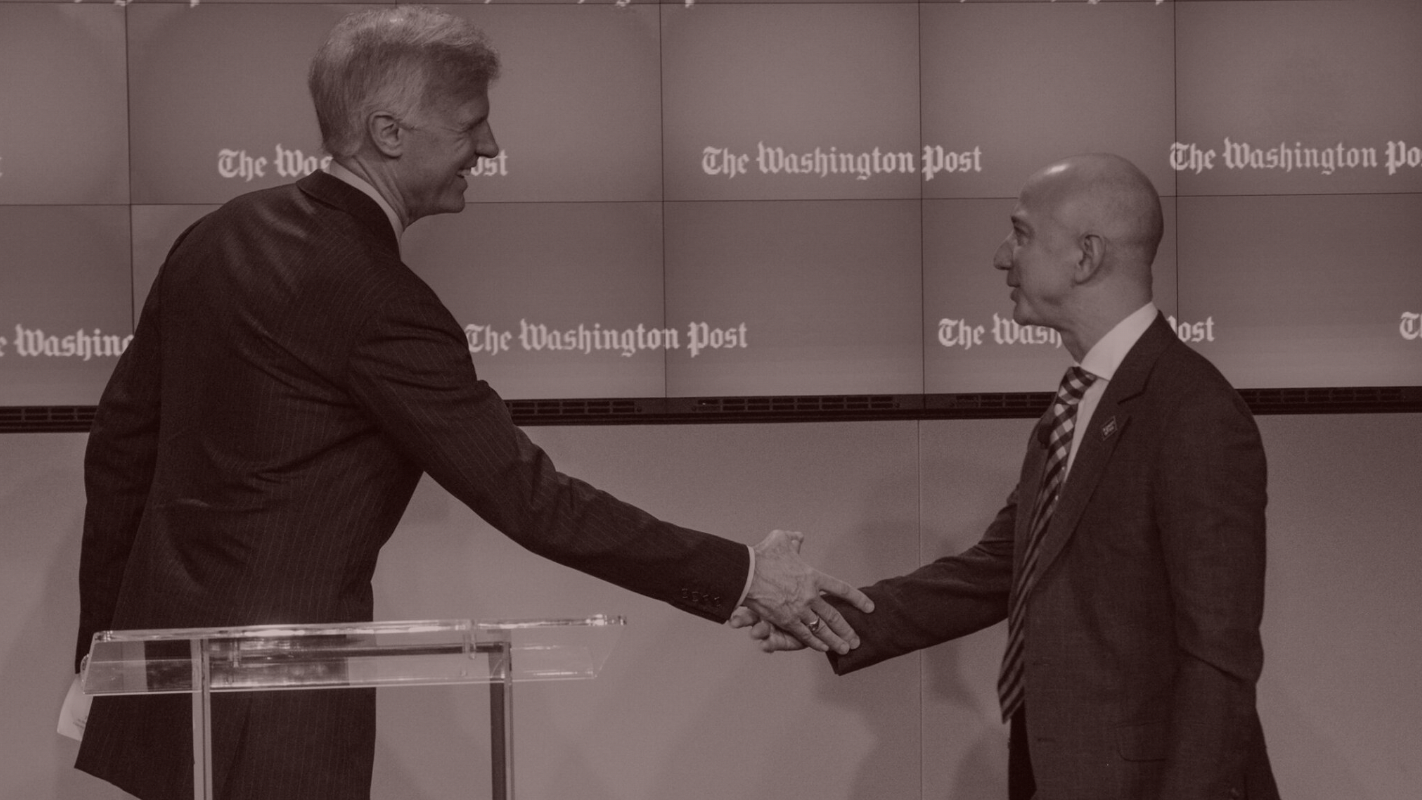
One among these institutions is The Washington Post. After being acquired and resuscitated by Jeff Bezos, in 2013, the company was spurred to record growth by the overwhelming national interest in Trump, and widely celebrated for its editorial achievements under Marty Baron. Now, the paper still romantically linked to Woodward and Bernstein once again finds itself—somehow, bewilderingly—at an inflection point. The challenge this time around is hardly existential; after all, a 145-year-old institution owned by a 145-billion-dollar man, staffed with some of the nation’s best political and investigative reporters, isn’t exactly hanging by a thread. Nevertheless, the Post has challenges of direction and ambition stemming from the very parochialism that defines the town it calls home. And these challenges are amplified when its performance is juxtaposed with its biggest competitor, at least in the cultural imagination, The New York Times.

ADVERTISEMENT
ADVERTISEMENT
We spent $16 billion to enhance safety and security in the past 6 years

That’s enough to build 7 pro stadiums – all to keep our communities safe and create more meaningful connections.

That's just one example of the work we’re doing.

Facebook is taking action to keep its platform safe.

Learn more about our work ahead.

The Legacy Wars
In the national consciousness, the Post shares an exalted place with the New York Times—a status afforded by its historic reporting achievements and its seat in the nation’s capital, yes, but also a status reflecting its romantic portrayal by Hollywood. The Post’s most notable leaders and journalists have been portrayed by Meryl Streep, Tom Hanks, Jason Robards, Robert Redford, Dustin Hoffman and Liev Schreiber, in Oscar-nominated or Oscar-winning films. No such A-listers have been cast to populate America’s collective memory of Punch Sulzberger, Abe Rosenthal and Neil Sheehan—never mind that it was that triumvirate which actually published the Pentagon Papers.

Meanwhile, in reality, the Post has spent most of its history living in the Times’ shadow. With notable exceptions, it has almost always had a smaller staff, a smaller readership, and a smaller claim on every facet of the national conversation not pertaining to politics, policy, and national security. It is, after all, Washington, not New York.

The Bezos-Baron era was one of those notable exceptions, largely because politics so overwhelmed the national conversation. The Post’s digital readership, which was already growing at a rapid clip by the time Trump announced his candidacy in June of 2015, surpassed the Times’ paid audience four months later. Next month, Bezos told Charlie Rose that the Post was “working on becoming the new paper of record”—a direct shot at the Times, the actual paper of record, that became part of the Post’s marketing campaign. Bezos was also ultimately involved in deciding to make “Democracy Dies in Darkness,” a quote popularized internally by Woodward, the first official slogan in the paper’s history, Post sources told me this week.

During the roaring Trump years, the Post grew digital subscriptions at roughly 50 percent year over year, reaching three million subscribers in 2020, triple the paid audience it had when Trump won the election. The Times, which had just over two million subscribers in 2016, grew at a similar clip and closed 2020 with over 6 million subs. Both papers exquisitely took advantage of the marketing, pricing, and technological levers at hand as the news media became infatuated with subscribers in a manner similar to the way Wall Street analysts monitored the growth (and growth at all costs, at least for a time) of the nascent streaming industry.

Meanwhile, the papers understandably milked the spotlight that came from their altruistic competition. They sparred daily over scoops from the Trump circus, and Times and Post reporters turned into national celebrities, with lucrative book contracts and cable news contributor deals to boot. Myriad articles about the revival of the Post-Times rivalry were written, including one particularly long feature in Politico Magazine by Joe Pompeo about the “not-so-bitter rivalry” between Baron and Times executive editor Dean Baquet, friends and fellow lovers of art.

For several years, it genuinely seemed as if this was the beginning of a new rivalry that would endure well beyond Baron and Baquet’s respective tenures. But when the Trump bump ended and Baron left, it became painfully clear that only one of these two organizations had been working aggressively to ensure success in the post-Trump landscape, and the other had not.

ADVERTISEMENT
ADVERTISEMENT
Outside the Beltway
Under former C.E.O. Mark Thompson and now current leader Meredith Kopit Levien, the Times Company has aggressively diversified its business, building out sticky lifestyle products like Games and Cooking and podcasts like The Daily that made it a fixture in its subscribers’ lives, well beyond the core news product. It also became aggressively acquisitive, buying The Athletic for $550 million and Wordle for more than $1 million. It leaned into star-powered editorial products that recognized the affinity and convening power of Sam Sifton, Sorkin, and David Leonhardt. Finally, it launched slick and costly marketing campaigns intended to remind people of all that it had to offer—a shrewd cost-effective top-of-funnel play that gingerly repositioned it as a credential of the college-educated world, a far vaster total addressable market to begin converting. Thanks in large part to these efforts, it now has nearly 10 million digital subscribers and plans to reach 15 million by the end of 2027.

The Post, which has lost readers since Trump left office and now has fewer than 3 million subscribers, never built out similar lifestyle offerings, never pursued big acquisitions, and, with a few exceptions, maintained a marketing strategy largely driven by the philosophy of letting the journalism speak for itself, which hardly makes sense in a direct-to-consumer media ecosystem. The problem for the Post is that, when politics and policy and national security is not the national story du jour, there’s not a whole lot left to speak of, unless you’re a Commanders fan. And, either way, Politico and Axios do a pretty good job on that turf, too. So does, of course, the Times. The Post may be the central media light of D.C.—but what about the other hundreds of millions of people who live outside its borders?

Both the Post’s publisher Fred Ryan and its executive editor Sally Buzbee understand this problem, and concede there is a vast delta that exists between its business and that of its rival to the north, several well-placed Post reporters and editors tell me—a delta, in fact, that could take years to mend. The problem, these sources say, is that they have yet to put forward an aggressive, coherent strategy for figuring out how to bridge that gap—a strategy many believe should have been put in place well before the 2020 election.

The official line out of 1301 K Street is that they intend to grow the core product while expanding into other coverage areas, as evidenced by the recent launch of a health and wellness vertical and an expansion of climate coverage. Sources also talk about a stronger investment in technology and surveillance coverage and accountability journalism in areas like sports and entertainment. (Earlier today, the Post published an in-depth report on the NFL’s failure to promote Black coaches.) The Post has also hired Ben Williams, a veteran of GQ and New York, to oversee features. There are abstract plans to revamp the storied Style section once made famous by Sally Quinn. And the Post is also adding more overseas jobs to expand international coverage and keep the product running 24-7.

Alas, these seem like insufficient editorial bandaids aiming to address more gaping challenges. (The Post isn’t alone here among D.C. media icons. Axios reported this week that The Atlantic, which thrived during the Trump and peak-Covid era, is looking to I.P. generation, perhaps as a way to account for this new age.) All of this speaks to a desire, at least, to grow the Post’s national and global presence and to make it more intimidating outside of Washington. But it’s hardly evidence of a robust and focused strategy for making that happen. These aren’t new products, they’re ancillary beats, which means the Post is ultimately still betting on its political and investigative coverage to grow the business—and betting against the idea that it needs to refashion itself as a lifestyle brand with truly diversified offerings to sustain the journalism. Perhaps that’s possible for the Post, especially with a wealthy benefactor like Bezos behind it. But it is also evidence of that uniquely Washingtonian parochialism, which the Post, for all its recent success, can’t seem to shake.

FOUR STORIES WE'RE TALKING ABOUT
A Clinton Revival
A Clinton Revival
Is the Clinton Global Initiative’s muted return a brand burnishing opportunity?
TARA PALMERI
CNN+ Reveries
CNN+ Reveries
An erudite conversation on the hottest topics in streaming.
JULIA ALEXANDER & DYLAN BYERS
Newsom’s Trojan Horse
The slick-haired governator has aligned against progressives in a bizarre spat.
TEDDY SCHLEIFER
Is Putin Cooked?
Is Putin Cooked?
Julia and Peter dissect Putin’s increasingly precarious position.
PETER HAMBY & JULIA IOFFE
swash divider
Facebook Twitter Instagram LinkedIn
You received this message because you signed up to receive emails from Puck

Was this email forwarded to you?

Sign up for Puck here

Sent to


Unsubscribe

Interested in exploring our newsletter offerings?

Manage your preferences

Puck is published by Heat Media LLC

227 W 17th St

New York, NY 10011

For support, just reply to this e-mail

For brand partnerships, email ads@puck.news

SEE THE ARCHIVES

SHARE
Try Puck for free

Sign up today to join the inside conversation at the nexus of Wall Street, Washington, A.I., Hollywood, and more.

Already a member? Log In


  • Daily articles and breaking news
  • Personal emails directly from our authors
  • Gift subscriber-only stories to friends & family
  • Unlimited access to archives

  • Exclusive bonus days of select newsletters
  • Exclusive access to Puck merch
  • Early bird access to new editorial and product features
  • Invitations to private conference calls with Puck authors

Exclusive to Inner Circle only


Latest Articles from Media

Bari Weiss
Dylan Byers • September 22, 2022
Bari’s Prison of Her Own Design
After a month of contentious delays, 60 Minutes finally aired its piece on the notorious El Salvador prison CECOT. The “hostage standoff,” as one person put it, ended in an uneasy truce that could have been reached a month ago—and without exposing the distrust and division at Bari Weiss’s CBS News.
Mathias Doepfner
Dylan Byers • September 22, 2022
The Politico Succession Games Begin…
An era at Politico has been ending for the last decade—at least since the departures of Mike and Jim, then Jake and Anna, and, of course, the sale to Axel Springer. But with John Harris ascending to the chairmanship, again, it’s finally Axel’s baby. And Mathias Döpfner may be looking outside the mothership for Harris’s successor.
Tony Dokoupil
Dylan Byers • September 22, 2022
Tony and Bari on the Rocks
The sponcon set dressing at ‘Evening News’ provoked predictable outcry at the House of Bari. But are brand partners in TV news just an inevitability at this point?


Ben Smith, Justin Smith Semaphor
Dylan Byers • September 22, 2022
Semafornication
Ben and Justin’s recent fundraise at an 8x trailing revenue multiple, which follows David Ellison’s extravagant purchase of The Free Press, suggests we’ve entered a new era of digital media valuations. Unless we’ve just reentered the old one. Anyway, is Punchbowl next in line?
Tony Dokoupil
Dylan Byers • September 22, 2022
The Tony Accords
Tony Dokoupil’s disastrous debut as anchor of CBS Evening News highlights the uncomfortable truth about Bari Weiss’s tenure: While her politics take center stage, it’s her inexperience that’s her real liability.
Jim Steyer
Dylan Byers • September 22, 2022
Common Sense & Sensibility
A candid chat with Common Sense Media founder Jim Steyer on what lies in the hearts of Silicon Valley’s biggest bigwigs and what the A.I. bros are doing to your children. Plus, thoughts on Sundar, Zuck, and his brother Tom’s California gubernatorial bid.


Bari Weiss
Dylan Byers • September 22, 2022
The Weiss Flag
It’s tempting to view Bari Weiss’s first big blunder—pulling a 60 Minutes segment critical of the administration’s deportation efforts—as purely political, which it may have been. But it may have been the product of something more mundane: Bari doesn’t know how to lead a newsroom.


Get access to this story

Enter your email for a free preview of Puck’s full offering, including exclusive articles, private emails from authors, and more.

Verify your email and sign in by clicking the link we just sent.

Already a member? Log In


Start 14 Day Free Trial for Unlimited Access Instead →


Latest Articles from Media

Journalists
Dylan Byers • September 22, 2022
The 2025 Media State of the Union
The inherent tension of the journalist-as-brand model, the continued erosion of institutional authority, the potential for an A.I. newsroom: Industry leaders weighed in on all this and more at a panel this week to unveil the results of our latest Puck–Orchestra survey.
Justin Smith ben smith
Dylan Byers • September 22, 2022
The Gulf of Semafor
As Semafor expands further into the Gulf, it’s becoming clear that Justin Smith and Ben Smith’s media baby is looking a lot more like the former than the latter.
Jim Lanzone Yahoo
Dylan Byers • September 22, 2022
The Lanzone That Time Forgot
Don’t waste your tears on Yahoo, the Internet 1.0 relic that collapsed into Verizon and then the warm embrace of private equity. C.E.O. Jim Lanzone explains how the Apollo-owned company is poised to make the most of its post-search distribution, and why niche is the new scale.


Bari Weiss
Dylan Byers • September 22, 2022
A Weiss Christmas
While The Free Press is flush with holiday spirit, Bari’s job reinventing CBS News is proving more vexing, amid anchor dreams dashed and the age-old challenge of enacting institutional change.
Bari Weiss
Dylan Byers • September 22, 2022
CNN’s Bari Christmas
In the wake of Netflix’s Warner Bros. coup, the folks at CNN are, perhaps naively, looking on the bright side: They may not have to work for Bari Weiss after all. But times in Spinoffville are going to get tough—and fast.
Olivia Nuzzi
Dylan Byers • September 22, 2022
The Nuzzicracker Ballet
The star-crossed saga of Olivia and Ryan continues its salacious, shameful pas de deux—ensnaring not just Vanity Fair’s new editor but further tainting journalism writ large. Even worse, it elides the real question: Why is a certain pathetic world hanging on every word of a jilted lover’s creepy account proffered without editorial oversight?


Hamish McKenzie, Substack
Julia Alexander • September 22, 2022
Substack Entrapment Theory
Google Zero killed the open web, ChatGPT isn’t replacing lost traffic, and superstar talent is a phenomenally difficult business. Digital media companies trying to stay upright are belatedly turning to creator-first subscription platforms in search of sustainable, niche audiences—without realizing that they’ve seen this movie before.
Get access to this story

Enter your email to get access to one article and free previews of our private emails from Puck authors and editors.

OR

Already a Member? Sign in


Latest Articles from Media

Alison Roman
Dylan Byers • September 22, 2022
Roman Holiday
The internet’s favorite food author finds herself at a familiar crossroads for writers who have become brands unto themselves: trying to balance scale, new ventures, and authenticity while keeping a loyal audience fed… in this case literally.
David Zaslav
Dylan Byers • September 22, 2022
Zaz’s Hollywood Endings
With the final bids for Warner Bros. Discovery under careful consideration, David Zaslav’s tenure as an ersatz Hollywood mogul may be coming to an end. Now, it’s all about the numbers, and which suitors have a glide path to regulatory approval. Just which sunset Zaz will ride into is anyone’s guess.
Olivia Nuzzi
Dylan Byers • September 22, 2022
A Brave Nuzzi World
Between the Bravo-ready mess of the Nuzzi-Lizza imbroglio and Michael Wolff’s Epstein deference, it was a monumentally bad week for media ethics. As journalists, even principled ones, become increasingly central characters in the stories themselves, is this kind of spectacle an unavoidable component of a new media world order?


Gerry Cardinale
Dylan Byers • September 22, 2022
The RedBird Balloon
After a second bid to take over The Telegraph met a particularly British brand of resistance, RedBird Capital walked away from the whole ordeal. Now the 170-year-old paper is back to waiting for a Goldilocks buyer.
Jim Bankoff
Dylan Byers • September 22, 2022
The Bankoff Job
Jim Bankoff is considering a spinoff of Vox’s faster-growing podcast network from its legacy publishing business. While it makes economic sense-ish, what does it mean for the future of brands like SB Nation, The Verge, and… ‘New York?’
Stan Duncan
Dylan Byers • September 22, 2022
Stan By Me
A handful of disgruntled employees confronted Stan Duncan, Condé Nast’s H.R. chief, about the company’s decision to shutter Teen Vogue. There was a video, of course, which captures either a noble moment of employee solidarity or a bunch of entitled staffers willfully unaware of Condé’s dwindling fortunes and the realities of the legacy media business. Either way, how far they’ve fallen.


Mark Lazarus
Dylan Byers • September 22, 2022
MS Doom
Spirits are uncharacteristically high at the post-spinoff MS NOW, but this is still a late-stage linear operation that’s shedding (mostly geriatric) viewers at a steady clip. Despite Versant’s money and Rebecca Kutler’s ambitions, is it just a matter of time before the realities of cable’s decline drag them under?


  • Terms
  • Privacy
  • Contact
  • FAQ
  • Careers
© 2026 Heat Media All rights reserved.
Create an account

Already a member? Log In

CREATE AN ACCOUNT with Google
OR YOUR EMAIL

OR

Use Email & Password Instead

USE EMAIL & PASSWORD
Password strength:

OR

Use Another Sign-Up Method

Become a member

All of the insider knowledge from our top tier authors, in your inbox.

Create an account

Already a member? Log In

Verify your email!

You should receive a link to log in at .

I DID NOT RECEIVE A LINK

Didn't get an email? Check your spam folder and confirm the spelling of your email, and try again. If you continue to have trouble, reach out to fritz@puck.news.

CREATE AN ACCOUNT with Google
CREATE AN ACCOUNT with Apple
OR USE EMAIL & PASSWORD
Password strength:

OR
Log In

Not a member yet? Sign up today

Log in with Google
Log in with Google
Log in with Apple
Log in with Apple
OR USE EMAIL & PASSWORD
Don't have a password or need to reset it?

OR
Verify Account

Verify your email!

You should receive a link to log in at .

I DID NOT RECEIVE A LINK

Didn't get an email? Check your spam folder and confirm the spelling of your email, and try again. If you continue to have trouble, reach out to fritz@puck.news.

YOUR EMAIL

Use a different sign in option instead

Member Exclusive

Get access to this story

Create a free account to preview Puck’s full offering, including exclusive articles, private emails from authors, and more.

Already a member? Sign in

Free article unlocked!

You are logged into a free account as unknown@example.com

ENJOY 1 FREE ARTICLE EACH MONTH

Subscribe today to join the inside conversation at the nexus of Wall Street, Washington, A.I., Hollywood, and more.

START 14-DAY FREE TRIAL

  • Daily articles and breaking news
  • Personal emails directly from our authors
  • Gift subscriber-only stories to friends & family
  • Unlimited access to archives
  • Bookmark articles to create a Reading List
  • Quarterly calls with industry experts from the power corners we cover