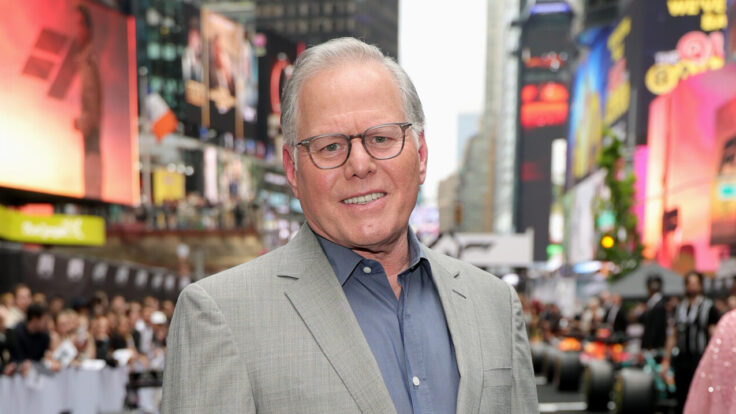
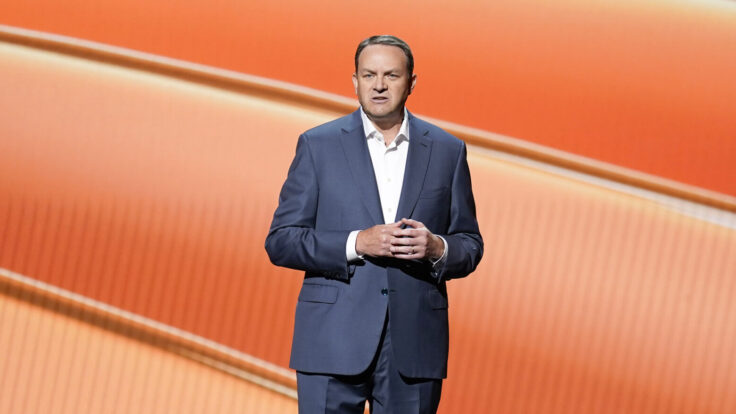
Greetings from Los Angeles, and welcome back to In the Room. David Zaslav
is mulling the second round of bids for Warner Bros. Discovery from Skydance, Comcast, and Netflix. My sense—just sticking my finger in the wind here—is that David Ellison remains in pole position. (Make of this what you will, but he abruptly canceled his scheduled appearance at Andrew Ross Sorkin’s DealBook summit on Wednesday.) Ellison’s bid is also backed by the sovereign wealth funds of Saudi Arabia, Qatar, and Abu Dhabi—a sign of just how much the
political climate has changed in the Trump era.
In tonight’s issue, news and notes on Olivia and Ryan’s never-ending ex-lovers quarrel, a wholly depressing media drama fueled by Ryan’s serial Substack jihad against his former fiancée. The final twist in this saga is Olivia’s almost inevitable defenestration from her short-lived stint at Mark Guiducci’s Vanity Fair. And after that, why even bother to pay
attention?
🦃 Plus, on yesterday’s episode of The Grill Room, Julia Alexander talked to Makena Kelly, senior writer at Wired, about Elon Musk’s curious cameo in the Trump administration, the rise of influencer gatherings over traditional press, and how online fandoms can turbocharge campaigns like Zohran Mamdani’s mayoral ascent. They also explored how creators are reshaping political
media and the tightrope that reporters walk to stay objective through it all. Follow The Grill Room on Apple, Spotify, or wherever you
prefer to listen.
Let’s get started… |
-
CNN goes there: CNN has struck a deal with the prediction market Kalshi to integrate their real-time, public-sentiment probability data into digital and on-air programming. On the surface, this may seem like little more than another set of data points for Harry Enten or John King to point to on election nights, but over time
the implications should be far more significant. As you may recall, I predicted a few weeks ago that news media organizations would start orienting some of their political and cultural coverage around prediction market data, much as ESPN and Fox Sports have integrated betting lines into their broadcasts. In time, that could buoy
engagement—nothing drives interest like having money on the line—and place new value on analysts’ ability to interpret and influence that data. It will be interesting to see who follows CNN into this space.
|
|
|
A MESSAGE FROM OUR SPONSOR |
We keep talking about the war for attention, but we’ve been getting it
wrong. McKinsey’s latest research, based on 7,000 consumers worldwide, shows we often confuse “attention” with “consumption.” Real attention is measurable, valuable, and drives a third of media monetization. This new lens reveals what’s been missing: we misclassify “super users,” overlook key segments, and undervalue media that can drive outsized levels of audience focus and intent. The winners already know — it’s quality of attention, not quantity, that matters to consumers, brands, and the media companies that connect them. Are you fighting the right battles in the war for attention? |
|
|
- Rogan on top: For the first year ever, Joe Rogan is the top podcaster across all major platforms: Spotify, Apple, and YouTube. Alex Cooper’s Call Her Daddy fell from second to fourth place on Spotify’s charts, and was replaced by Steven Bartlett’s Diary of a C.E.O. Mel Robbins took third place on both Apple and Spotify.
- And
finally…: The Chiefs-Cowboys game on Thanksgiving was the most-watched regular-season NFL game in history, drawing 57.2 million viewers to CBS. Yet another reminder, as if any were needed, of the league’s dominance and the centrality of sports in the media ecosystem. Speaking of which, my partner John Ourand invited our partners Eriq Gardner, Julia Alexander, and myself on his Varsity podcast this week for
a special review of the biggest sports-media storylines. Listen here or watch here.
|
|
|
The star-crossed saga of Olivia and Ryan continues its salacious,
shameful pas de deux—ensnaring not just Vanity Fair’s new editor but further tainting journalism writ large. Even worse, it elides the real question: Why is a certain pathetic world hanging on every word of a jilted lover’s creepy account proffered without editorial oversight? |
|
|
On a Sunday night in mid-October, newly minted VF editorial director
Mark Guiducci took Olivia Nuzzi to dinner in Los Angeles. Weeks earlier, Mark had announced that Olivia was joining the magazine as its West Coast editor—a mildly splashy, mildly controversial hire given the prurient R.F.K. Jr. melodrama (perhaps you’re familiar…) that had driven her out of New York magazine, and Washington, and into a self-imposed exile in Malibu. Having failed to lure any other marquee hire to the once-august
Condé title, Mark had at least found a name in Olivia—and, perhaps, a potential character journalist befitting the old Vanity Fair tradition of Dominick Dunne. Perhaps Olivia might penetrate the inner sanctums of Hollywood and Silicon Valley with the same acuity and élan she’d exhibited in D.C., albeit with the help of some serious editing.
Their dinner that night may have been the high-water mark of what is now almost certain to be a short-lived
professional relationship. Olivia, who had joined the magazine on a contract basis in August, had already been an active editor and ideator helping to shape Mark’s vision for the magazine. She was also on the cusp of releasing her new memoiresque tone poem, American Canto, which Mark intended to excerpt in the pages of the forthcoming Hollywood issue. And she was participating in a profile with The New York Times, which seemed uncharacteristically eager to
enable her own self-mythologizing with credulous prose and black-and-white portraiture. After all this, Olivia was expected to join the magazine on a full-time basis in the new year. From that vantage, it probably wasn’t hard for Olivia and Mark to imagine the road to redemption and renewed stardom.
Of course, this was before the excerpt was published, the increasingly vicious book reviews began pouring in, and Olivia’s ex-fiancé, Ryan Lizza, decided to launch a
serialized, bamboo-infested Substack jihad against his former partner. In a needlessly long four-part (so far) series of shameless and un-self-conscious ramblings, Ryan alleged that she had also had an affair with former South Carolina Governor Mark Sanford (which she denies); sought to quash negative stories about R.F.K. Jr. by other journalists (which she also denies); and provided media advice to Kennedy during his presidential campaign, which she acknowledges in her book,
albeit not to the extent Lizza alleges. Anyway, it was made all the worse by the fact that Lizza, too, is not Proust.
By a certain point, however, all thresholds for mutual self-destruction had been willfully abandoned. On Tuesday, Ryan published a “strategy memo” that he claims Olivia wrote for R.F.K. Jr., in June 2024, in which she offered media advice, called him “the best candidate,” and signed off with an emoji-laden “I love you.” In a statement, Olivia told me this
was “yet another lie and attack intended to harm my efforts to resume my professional life.” When asked to clarify if she had written the memo in question, Olivia told me: “I did not write him or anyone on or associated with his campaign a campaign memo.” When asked to clarify if she was the author of the text that Ryan had published, she did not provide an on-the-record answer. |
|
|
A MESSAGE FROM OUR SPONSOR |
We keep talking about the war for attention, but we’ve been getting it
wrong. McKinsey’s latest research, based on 7,000 consumers worldwide, shows we often confuse “attention” with “consumption.” Real attention is measurable, valuable, and drives a third of media monetization. This new lens reveals what’s been missing: we misclassify “super users,” overlook key segments, and undervalue media that can drive outsized levels of audience focus and intent. The winners already know — it’s quality of attention, not quantity, that matters to consumers, brands, and the media companies that connect them. Are you fighting the right battles in the war for attention? |
|
|
Olivia’s initial statement continued: “I made a mistake last year, which I take full
responsibility for, and address honestly in American Canto. This person is not the authority on my actions, motives, communications, or associations in the final year of our relationship, regardless of how much he may have violated my privacy or breached my security in his ongoing obsessive efforts to control me. I tell the truth in American Canto, and I suggest people refer to what I have to say about my own life rather than the distortions or conspiracies promoted by someone
who will not be satisfied until I’m dead or also on Substack.” |
Far, far too much ink has now been spilled on this whole sordid saga, and the
stakes are too low for any of it to really be deemed newsworthy—at least any more so than the tedious spats on a Bravo reality show. Seriously, this isn’t even about journalism or politics anymore; it’s just an interpersonal drama among characters who can only plausibly be considered famous or even interesting by Washington standards. Olivia’s “tell-nothing memoir” has been widely panned—most
insightfully by The Atlantic’s Helen Lewis, most
brutally by The Washington Post’s Becca Rothfeld, and most amusingly by The Ringer’s Brian Phillips. Meanwhile, thanks to Ryan’s ongoing missives, Olivia and R.F.K.’s erotic predispositions—as well as Ryan’s implausible obsession
with bamboo—are now impossible to erase from memory.
If anything has received too little attention, however, it’s Ryan’s own surveillance of his ex-fiancée. Nuzzi filed, then withdrew, a protective order against him in 2024. (At the time, Lizza disputed her “fabricated” claims.) At the very start of his story, he posits that evidence of her tryst simply spilled forth from her backpack. He also allegedly admitted to her publisher that he had recordings of his
conversations with Olivia. (In her first on-camera interview on Tuesday, with The Bulwark’s Tim Miller, Olivia said she was “afraid” and “terrified” of “the man I didn’t marry” and then began crying.) A lesser offense: Ryan’s prose displays some of the same sophomoric style and penchant for overwrought metaphors—seriously, that fucking bamboo—that bedeviled Olivia’s own.
Asked to address his recordings of Olivia, as well as her claim that she was afraid of him,
Ryan told me: “Olivia is not afraid of me, she is afraid of the truth. Stay tuned for Parts 5 and 6, when all will be revealed, including what may be on any tapes.”
In any event, the most damning element of all of this is that, in the end, it’s hard to know who or what to believe. Olivia is admittedly not a reliable narrator and is not even willing to clarify whether she wrote the text that Ryan attributed to her. Ryan is trafficking in allegations and threats without any of
journalism’s traditional checks and balances. As Mediaite’s Colby Hall put it, “What he published is not journalism. It is an assertion of narrative power” on a platform that “requires no editorial approval or institutional scrutiny to publish any of this.” Ryan reports to no one—a perk and a hazard of journalism, or whatever the fuck this is called, in the Substack era.
Olivia does report to someone, of course, but perhaps not for long. Officially, Mark and the
executives at Condé Nast are reviewing the matter and “looking at all the facts.” In fact, I’ve learned that Mark is actively working on a “solution” to the matter that, according to one source, will relieve Olivia of her position. (Condé Nast C.E.O. Roger Lynch did not respond to a call for comment. Reached by text, his communications chief, Danielle Carrig, did not comment and instead asked me to contact the generic email address for the
communications team, which did not respond.)
Some have argued that Mark’s decision to hire Olivia is a blemish on his early tenure at Vanity Fair. Maybe. The truth is that, in the grand scheme of the business, it almost certainly doesn’t matter. Mark may have taken Olivia to dinner that night in October, but he was in town for the celebrity and supermodel-studded Vogue World event on the Paramount lot, and to work on the cover story of the same issue in which Olivia’s excerpt
appeared: an homage to the leading men of Hollywood, the real celebrities of this universe, whose willingness to appear in Vanity Fair has long been the secret sauce that sustains that business. The writers—even the star writers currently capturing national attention by way of a Kennedy-involved sex scandal—are almost beside the point.
All of which, of course, leaves Olivia in ever deepening water as she tries to revive her career. Now she’s already written her
tell-all and cycled through a green editor willing to take a flier on her antics. Maybe, Lizza be damned, there’s only one place left to go: Substack… |
|
|
Join Emmy Award-winning journalist Peter Hamby, along with the team of expert journalists at Puck, as they let you
in on the conversations insiders are having across the four corners of power in America: Wall Street, Washington, Silicon Valley, and Hollywood. Presented in partnership with Audacy, new episodes publish daily, Monday through Friday. |
|
|
A professional-grade rundown on the business of sports from John Ourand, the industry’s preeminent journalist,
covering the leagues, players, agencies, media deals, and the egos fueling it all. |
|
|
Need help? Review our FAQ page or contact us for assistance. For brand partnerships, email ads@puck.news. You received this email
because you signed up to receive emails from Puck, or as part of your Puck account associated with {{customer.email}}. To stop receiving this newsletter and/or manage all your email preferences, click here. |
Puck is published by Heat Media LLC. 107 Greenwich St., New York, NY 10006 |
|
|
|