{{ 'now' | timezone: 'America/New_York' | date: '%b %d, %Y' }} |
|
|
|
Greetings from Seattle, and welcome back to In the Room. Go Knicks!
Now
that James Murdoch has secured the prime Vox Media assets, Jay Penske appears to be in pole position for the remainders—The Verge, Eater, SB Nation, etcetera—though I’m told those talks haven’t yet hit the exclusivity window. Currently Ryan Pauley’s RemainCo will be just that. But Penske, of course, is already a big Vox investor, which gives him some sway over the deal. Meanwhile, I learned this week that another suitor has been putting
calls into Jim Bankoff’s office to inquire about the assets… Byron Allen!
Speaking of which, Byron will stop by The Grill Room next week to illuminate all of us on his $20 million investment thesis for BuzzFeed. As it turns out, it’s really about brand awareness for one of his existing businesses, Local Now. We’ll also go deep on all the deals he didn’t land, and what’s driving his tireless pursuit of media moguldom. It’s a fun
one that you won’t want to miss.
In today’s issue, my partner Julia Alexander makes her formal In the Room debut with a masterful deep dive into the paradigm-shifting changes that Google unveiled this week in agentic search. This new era is forcing publishers to pivot their business models yet again, this time for the robots. So, where does the relationship between publishers and people fit in?
🎙️ Plus, on the latest episode of The
Grill Room, Julia and I expanded on the second- and third-order effects of this new agentic era for digital publishers and the media at large. We also assessed the week’s buying and selling frenzy, from Vox to BuzzFeed; Barbara Peng’s exit from Business Insider; and the latest Bari chatter at Paramount. Follow The Grill Room on Apple, Spotify, or wherever you prefer to listen.
📣 Programming alert: As a reminder, the Wednesday edition of this email will soon move to Puck’s Inner
Circle tier, which may require an upgrade to your subscription. This tier gives you access to all of Puck’s most exclusive insider reporting and insights, as well as our sister brand, Air Mail. It is well worth it and you can afford it. Join here.
Also mentioned in this issue: Marc Andreessen, Mark Thompson,
Roger Lynch, Kareem Rahma, Sam Altman, Lockhart Steele, Nilay Patel, Sundar Pichai, Dwyane Wade, Nick Thompson, Oliver Darcy, Ryan Broderick, Jonah Peretti, Trevor Noah, Matthew Prince, Mark Zuckerberg, Alex Cooper, Liz
Reid, and more.
Take it away, Julia… |
- Nilay on the Verge: As Dylan noted above, the big question still circulating around Jim Bankoff’s divestment of Vox Media centers on the fate of the websites that James Murdoch is not bringing with him in his New York and PodCo acquisition. Some of these sites are mostly valueless from a business standpoint: The Dodo, for example, made sense when Mark Zuckerberg paid out
decent revenue share to publishers during the news feed era. Eater, one of the many websites that Lockhart Steele brought with him to Vox Media in 2013, doesn’t make a ton of sense when stand-alone newsletters are having a moment and Google can find a restaurant tailored to specific preferences, book a reservation, and address allergy concerns with very little effort.
One of the sites that may still have some value is my old stomping grounds, The Verge. Yes, like
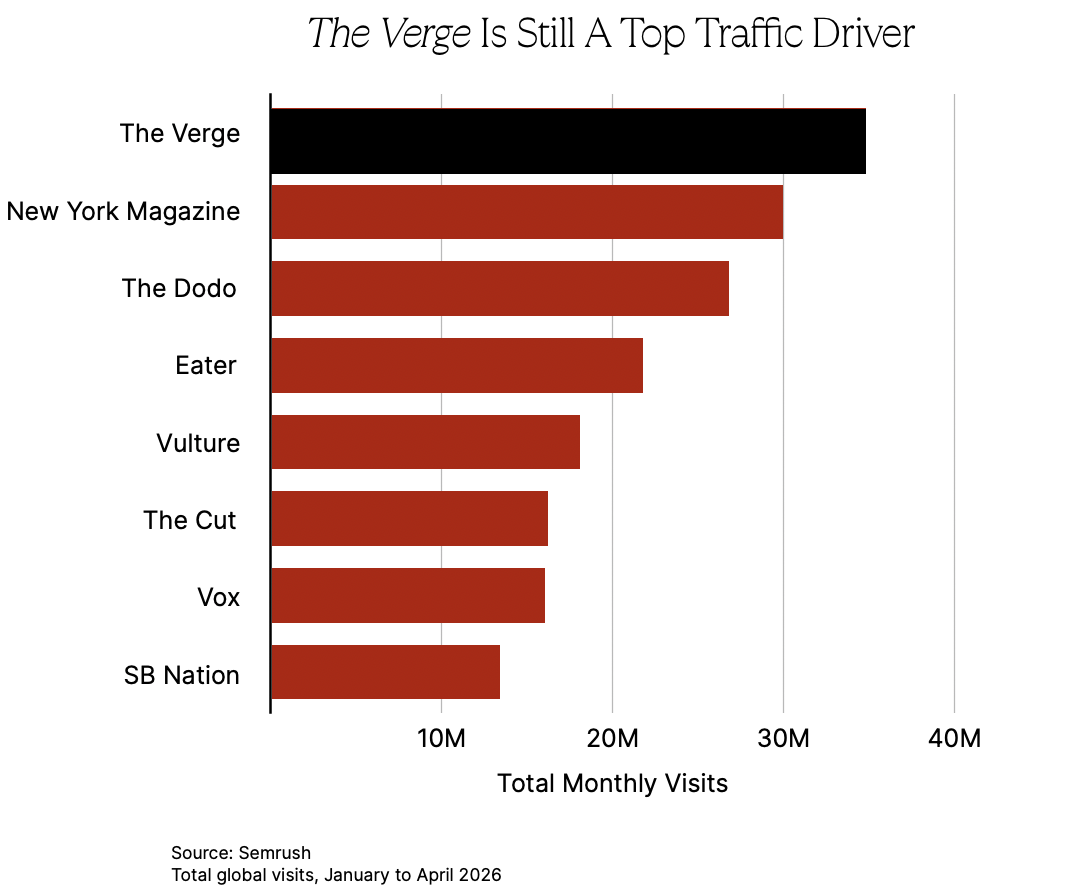
many tech media sites, The Verge’s traffic has suffered a precipitous decline in recent years. But between February and April, The Verge still recorded nearly 35 million unique visitors, per Semrush, placing it above competitors in the consumer tech coverage category like TechCrunch and Engadget, both of which were once owned by Yahoo. (It’s below Wired, which recorded nearly 50 million visitors in the same period.)
|
- This week, Oliver Darcy reported that Verge editor-in-chief Nilay Patel was quietly, if naively, shopping the brand around. Of course, Nilay doesn’t have any say over its future—he’s an employee, not the owner or an investor. Those kinds of decisions are up to Jim and the board, and there’s little appetite in those circles for à la carte deals. And if The Verge really is the relative success story here, it’s hard to imagine Jay and the other
investors would want to spin it out and devalue the rest of the portfolio. (Patel declined to comment.)
|
|
|
|
A MESSAGE FROM OUR SPONSOR |
PEERLESS REFINEMENT With a powerful presence and an endless array of personalized touches, the Range Rover epitomizes modern luxury.
EXPLORE
|
|
|
|
- YouTube’s advertising black hole: During its annual I/O developer conference this week, Google disclosed that YouTube has surpassed 3 billion monthly active users. The news follows YouTube’s announcement at last week’s upfronts that the platform reaches nearly 245 million people in the U.S. alone—or about 70 percent of the country’s population. At this point, YouTube has about 9.5 times as many global monthly users as Prime Video (an
impressive 315 million) and 12 times as many users than Netflix (which has a healthy 250 million).
Obviously, advertisers have been lusting after YouTube since it began dominating Nielsen’s monthly Gauge chart a few years ago. And now, it’s pushing deeper into premium media (exactly where connected TV advertisers are increasingly looking to spend…) with new exclusive shows from Alex Cooper, Trevor Noah, Dwyane Wade, Kareem
Rahma, and others. During YouTube’s Brandcast show in New York last week, the service announced that brands could buy ads directly against these series—which, of course, is how traditional TV advertising works.
You don’t need to be a rocket scientist to understand why YouTube is aggressively courting advertisers in the traditional TV space. According to Media Dynamics Inc., about 43 percent of primetime TV ad spend coming out of the upfronts goes to streaming—up
from 30 percent between 2023 and 2024. Last year, eMarketer found that YouTube accounts for roughly a quarter of all overall gross video ad sales, or about $9 billion in connected TV ad sales. In short, streaming is now an advertising game, and YouTube is the modern incarnation of ad-supported television—which happens to reach about 36 percent of the global population each month. Good luck to everyone else!
|
|
|
|
Agentic search will, at least in theory, spell doom for many of the billions of
sites on the open web, and usher in a strange back-end micropayment marketplace where agents trade commissions piecemeal. But is that theory undervaluing the power of people and the publishers who know how to connect with them? |
|
|
|
Earlier this week, on a sunny California morning outside Google’s Mountain View
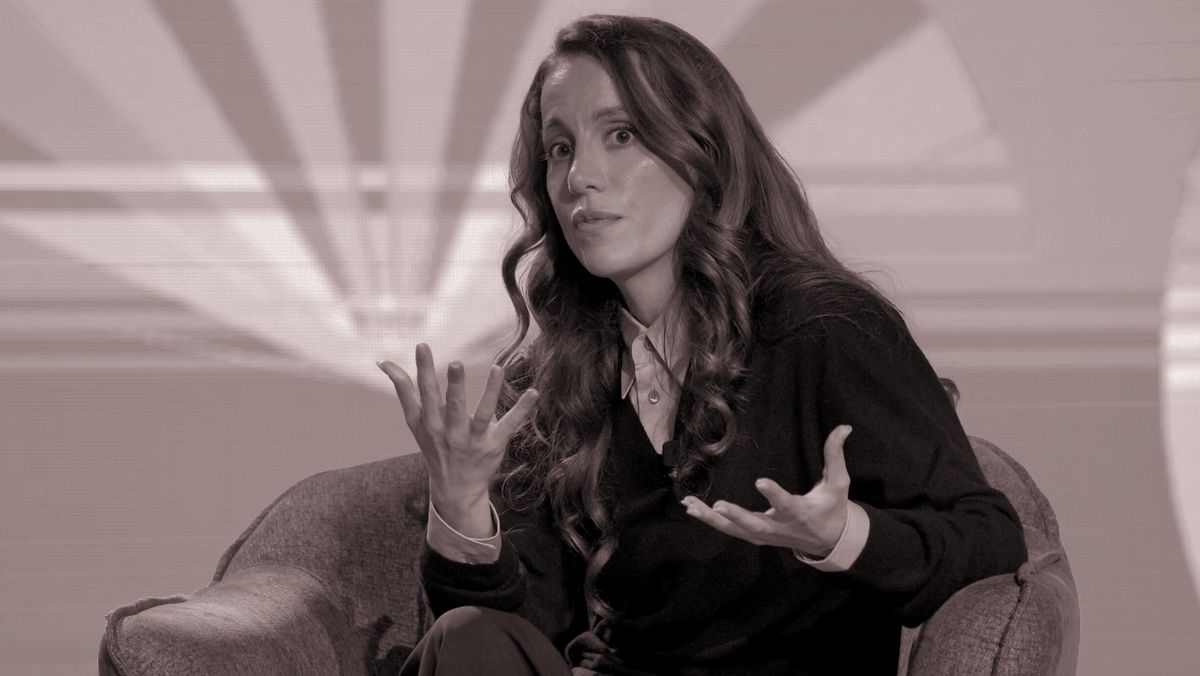
headquarters, C.E.O. Sundar Pichai stood onstage at the company’s annual developers’ conference and offered an unsurprising but nevertheless startling declaration. He proudly touted that search, the business on which the company’s $4.6 trillion market cap was built 30 years ago, was getting an update for the A.I. future. Longtime head of search Liz Reid followed up with the details: Google A.I. will now attempt to personalize each search prompt with follow-up
questions, and throw all of the relevant information into an interactive on-page box with a roundup of links on the side.
In other words, a question like “where is the World Cup” might yield a result that ties in a user’s Google Maps, Google Wallet, YouTube, and previous search history as it becomes “where is the World Cup, what are some of the lowest ticket prices, and which New Jersey transit option is the best for me if I’m coming from my apartment in Brooklyn.” What once spurred 10
blue links to other websites will now surface more YouTube Shorts and ads. Technologists cheered. Publishers passed the antacids once again.
This was further confirmation that we’ve fully entered the era of Google Zero, a term coined by The Verge’s Nilay Patel in 2024 to describe the looming death of search traffic. Google, Facebook, and X have all moved away from sending traffic out to the sea of websites that power the open web in an effort to grow their own walled
gardens, evolving from advertising intermediaries to something like publishers themselves. The shift in strategy contributed to Alphabet’s nearly $90 billion in services revenue last quarter alone, driven by a near 20 percent growth in search.
Publishers, most of which have already spent the better part of the past decade on the back foot, are pivoting once again. Jonah Peretti, who recently announced he was selling BuzzFeed to Byron Allen, has said that
most of the growth from loyal readers now comes from user-generated games. The New York Times is growing, largely based on its bundled games and cooking extensions. At CNN, Mark Thompson’s response to the collapse of cable and the open web is a weather app. James Murdoch’s acquisition of Vox Media and New York magazine seems largely about the podcast network, and the potential for its affinity-driven model to slot into
his growing thought-leader events portfolio. In a TBPN interview last week, Condé Nast C.E.O. Roger Lynch grabbed some easy headlines with his revelation that he’d recently told his underlings to act as if search were already fully dead. (Good luck with all that, Chloe, Mark, and Adam!)
The past 18 months have been particularly telling. By mid-2025, the share of queries that resulted in zero clicks had
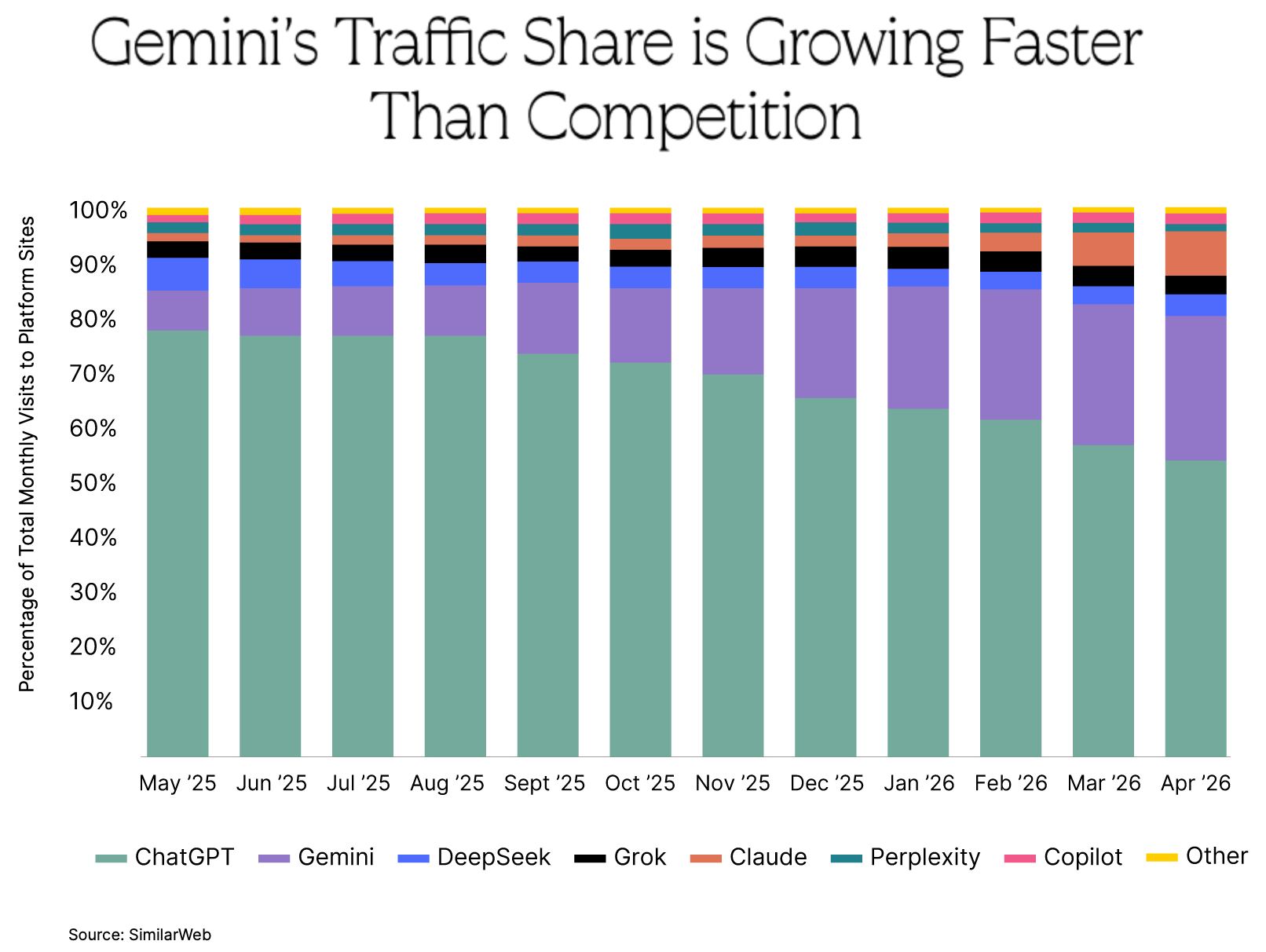
increased from 60 percent at the beginning of the year to nearly 70 percent, while the percentage of traffic referrals to Google Gemini and A.I. Overviews exploded. Between April 2025 and April 2026, traffic to Gemini’s website grew by more than 570 percent, per SimilarWeb. |
Now that Google wants search and Gemini to become even more personalized for the average person,
large-scale publishers need to figure out how to monetize the agentic era’s robot crawlers, especially as they continue to deal with the open web’s collapse. |
Building for those crawlers is a daunting and novel task. Most websites are not going to see
traffic bounce back to the height of referral in the mid-2010s. That means finding new ways to monetize a smaller pool of readers while also maximizing non-human interfacing opportunities within these new Google (or ChatGPT, or Perplexity, or Claude) boxes. Audience developers have tried to game algorithms in the past through search engine optimization, but the new world order requires trying to predict the follow-up to an initial prompt, and then monetizing off owned-and-operated
platforms. |
|
|
|
A MESSAGE FROM OUR SPONSOR |
PEERLESS REFINEMENT With a powerful presence and an endless array of personalized touches, the Range Rover epitomizes modern luxury.
EXPLORE
|
|
|
|
A.I. executives know they have to figure out these back-channel revenue structures with
publishers and website operators. In a recent interview with The Atlantic’s Nicholas Thompson, OpenAI C.E.O. Sam Altman said he believes the future is… micropayments, arguing that publishers can set prices for both publication and author access, so that eventually an agent that wants to read The Atlantic has to pay a variable price (“$0.17 for a summary or $1 for a full article,” per Altman).
It’s not a stretch to imagine how much this
could benefit the connectors of agents and publishers compared to just publishers alone. Micropayments have never worked for news publications because they’re so unpredictable and unreliable—and a one-time $1 transaction doesn’t encourage the same loyalty that comes with an annual $80 fee. In this scenario, companies like OpenAI or Google could theoretically also collect a toll on these payments, taking a small percentage of that micropayment fee, similar to what Amazon does as a
third-party distributor of streaming services.
Perhaps the most optimistic take on the micropayments option is that plenty of companies are investing in this space for publishers. Cloudflare C.E.O. Matthew Prince, who recently said at a Semafor conference that “everything that’s wrong with the world today is Google’s fault,” implemented a “pay-per-crawl” service that would impact up to a quarter of total websites on the internet. New companies like TollBit and
ProRata have created digital tolls and new compensation plans for publishers depending on how often they’re scraped by agents. If agents are seeking out and pulling in information billions or even trillions of times a day, as Sundar boasted onstage, then maybe the pure scale of robotic activity could make some form of micropayments work.
But A.I.’s real threat to the value of news is in pulling in aggregators from different sources and breaking through the paywall, allowing users to just
train an agent to find a summary from a secondary source. Traffic to Google’s Gemini alone has seen staggering growth over the past year as Google places greater emphasis on integrating its leading A.I. model into more of its ecosystem.
Part of the question in this scenario is whether publishers want to solely sit in a supplier position, striking significant licensing deals with large language model companies that renew after an agreed-on period of time, or expand with the new readership
habits formed by agentic use. So far, we’ve mostly seen the former. The Times, Dow Jones, Axel Springer, Condé Nast, and plenty of others have struck licensing agreements with OpenAI and Amazon. This is, in part, because it’s an understood business practice. Building out in-house teams that can focus on developing content and audience strategies around machine-readable content, and taking in swaths of data from L.L.M. partners to better understand what people are searching for and how
it’s different from traditional search, is a larger and far riskier investment. Mainly because it doesn’t always work. |
But let’s not totally ignore the actual humans here. We haven’t been completely replaced—not yet
anyway. The open web is collapsing, but I’m hearing that New York magazine is on track to end the year with more subscribers than ever, and The New York Times is clearly proving that a strategy built around a newsroom can work. However, the pace of growth is likely to change, and executives quietly acknowledge this new reality.
Successful ventures must double down on two factors that A.I. can’t solve for in the foreseeable future: networking and
obsessive analysis. One strategy is investing in talent to reliably keep audiences engaged; another is building products for those audiences that A.I. tools can’t replicate. ChatGPT and Gemini will eventually be able to create a hyperspecific portfolio dedicated to investments and companies that a user wants to keep an eye on, but it can’t create a space for interested audiences to gather, communicate, and interact. X might be able to solve this issue for the A.I. community, who can follow
Altman or tune into Marc Andreessen’s Monitor the Situation or TBPN for a similar experience, but there are plenty of hyper-obsessive niches where community and communication become what audiences pay for each month.
For all that A.I. can do extremely well, knowing what people want to know after the initial query is sent, and contextualizing that around emerging trends, is still outside most models’ purviews. As Ryan Broderick
wrote earlier this week: “We might lose social and search by the time this is all over. Which means that even the chatbots that survive the A.I. bubble will have trouble scraping the public web for new information.”
Ironically, in this new A.I., agentic-first web era, websites and information are needed more than ever. Authority in those sites is also key: Less than 10 percent of adults in the U.S. use A.I. chatbots for news. And among those who do, about 50 percent said they
don’t trust the results, per Pew Research. A new internet era is once again changing the foundational underpinnings, but it still demands useful, verifiable information. In fact, it’s never needed it more. |
|
|
|
Join Puck’s chief political columnist, John Heilemann, as he roams the corridors of power and influence in America on
this twice-weekly interview show, taking you beyond the headlines with the people who shape our culture: icons and up-and-comers, incumbents and insurgents, moguls and machers in the overlapping worlds of politics, entertainment, tech, business, sports, media, and beyond. The conversations are rich and revealing, unrehearsed and unexpected… and reliably impolitic. A Puck-Audacy joint, new episodes drop every Wednesday and Friday. |
|
|
|
A professional-grade rundown on the business of sports from John Ourand, the industry’s preeminent journalist,
covering the leagues, players, agencies, media deals, and the egos fueling it all. |
|
|
|
Need help? Review our FAQ page or contact us for assistance. For brand partnerships, email ads@puck.news. You received this email because you
signed up to receive emails from Puck, or as part of your Puck account associated with {{customer.email}}. To stop receiving this newsletter and/or manage all your email preferences, click here. |
Puck is published by Heat Media LLC. 107 Greenwich St., New York, NY 10006 |
|
|
|
|