 |
|
Welcome back to In the Room, my biweekly private email on the inner workings of the media industry. Tonight, the inside story on Ari and Mark’s WWE deal. Plus, some news and notes on CNN’s return to Trump.
|
 |
| The Art of Ari’s WWE Deal |
| Discussing deal points in a suite at Wrestlemania, a secret meeting at Raine, and an emotional pitch in Stamford: How Vince McMahon scored big and Endeavor took the next step in its leverage journey. Plus, some notes on CNN and Chris Licht 2.0. |
|
|
|
| “Until Saturday, I didn’t even know we had this deal,” Mark Shapiro, the president and C.O.O. of Endeavor, told me today. Three weeks earlier, Shapiro and C.E.O. Ari Emanuel had placed a bid to acquire a majority stake in World Wrestling Entertainment, or WWE, the coveted live pseudo-sports asset that seemed like it could fit nicely into Endeavor’s portfolio, alongside its lucrative Ultimate Fighting business.
Not long ago, the markets derided Shapiro and Emanuel for their interest in red state sports-ish leagues, like UFC and Professional Bull Riders, which Endeavor (then WME-IMG) bought in 2015. But as more streamers have begun dabbling in live sports broadcasting, media rights deals have escalated across the landscape, making even niche sports leagues more valuable. In retrospect, the moves look borderline prescient. And, in this world of so-called combat sports, WWE was undeniably a crown jewel.
The pair outlined their proposal during a meeting with WWE chairman Vince McMahon and C.E.O. Nick Khan at Raine Group offices, in New York, in mid-March, sources involved with the deal told me, and made a more emotional pitch one week later at WWE headquarters in Stamford. Still, they faced stiff competition from at least one rival bidder—John Malone’s Liberty Media, the owner of Formula One—until the very end, and it wasn’t until Saturday night that they signed the term sheet. As Shapiro described it, “it was nip and tuck all the way.”
By coincidence, the deal was finalized while Ari, McMahon and Khan were at Wrestlemania 39 in Los Angeles, the two-day, pay-per-view mega-event that effectively functions as the wrestling world’s Super Bowl. It provided a conveniently cinematic backdrop for the deal’s denouement: the image of Ari and Vince hashing out a deal in the SoFi Stadium executive suite was a made-for-HBO narrative too impossible for some to resist, even if the real particulars were really being handled by lawyers and bankers at the two firms’ offices. Shapiro, who was scheduled to attend Wrestlemania, stayed in New York to close the deal.
Finally, in the small hours of Monday morning, Ari, McMahon and Khan went to WME headquarters in Beverly Hills where they prepared for a morning of calls with analysts and reporters (McMahon did one, then went back to his hotel). Khan had a relatively easy story to tell: the deal is an undeniable victory for WWE, which was eager to find a buyer and has seen its stock rise about 10 percent since the deal was announced. (Endeavor’s stock has fallen by a similar amount.)
Emanuel and Shapiro face a more challenging task with Wall Street. The all-stock deal, which is expected to close by the end of this year, pending regulatory approval, will unite WWE and UFC into a new public company, trading under the ticker TKO, with Endeavor as the 51 percent majority owner. On the one hand, it’s a massive P.R. victory for Endeavor, and furthers Ari’s lifelong mission to transform himself from mere Hollywood superagent and power broker into a full-fledged media mogul. At the same time, it adds an additional burden to Endeavor’s $5-billion-plus in long-term debt, and many investors are struggling to rationalize the $21 billion valuation Endeavor has put on the future combined company. The deal values UFC at $12.1 billion, a 3x multiple on the $4 billion Endeavor paid to acquire it in 2016, and WWE at $9.3 billion, which is significantly higher than its current $7.4 billion market cap. Endeavor stock is down about 10 percent since the deal was announced. “People are just trying to get their arms around the deal,” an ever-confident Shapiro told me. “The revenue opportunities are huge.” (Endeavor is the parentco. of WME, the talent agency, which represents Puck.) |
| Endeavor’s Efficiency Playbook |
|
| In essence, Endeavor will run the same playbook it did for UFC, which has grown considerably since the acquisition, to $1.3 billion in revenue last year. The first target, as is almost always the case with mergers, will be synergies: layoffs and operational efficiencies. Shapiro boasts that Endeavor took out $70 million in costs at UFC one year after it acquired it, and anticipates it can save as much as $100 million on the UFC-WWE tie up. “Anything from H.R. to finance to legal to communications production to distribution and marketing,” Shapiro said. “Across every area, you’re going to find cost synergies; you’re going to integrate and ultimately highlight and appoint the best and brightest teams.”
Shapiro also believes Endeavor’s ownership will make WWE more appealing to media partners when it renegotiates those deals next year. WWE currently has rights deals with NBCUniversal and Fox, as well as a streaming deal with NBC’s Peacock that expires in 2026. “There’s no question that when Nick goes in to renew his domestic deals, having us at the table, with our relationships and our portfolio of assets, will be helpful in the process.” Indeed, WWE has already been a very valuable partner for Peacock, and the power of WME should help, too. Ari famously negotiated record deals for his clients Rachel Maddow and Joe Scarborough at Comcast/NBCU. Khan will have that vegan-avocado-smoothie muscle behind him now, too.
Shapiro also cited additional revenue opportunities in cross-platform marketing, sponsorships, premium hospitality, data analytics, and the growth of WWE’s international presence, among other revenue streams. He also sees some potential for revenue from betting, but concedes that getting the regulatory approval for betting on scripted programming is “a very formidable process.” (The results of every match would have to be kept in a black box, Ernst & Young-in-handcuffs style.)
As for the debt, one suspects that Endeavor will look to sell some non-core assets, such as IMG Academy, and forgo any more M&A for the time being. As my partner Matt Belloni has noted, the decision to shift UFC to a separate unit will put more focus on Endeavor’s other businesses. “Wall Street has always undervalued the WME agency on the theory that its assets could succumb to the charms of Bryan Lourd at any time,” Belloni wrote earlier this week, noting the threat from his agency rival at CAA. “Now the pressure might be raised.”
Of course, Shapiro is more bullish about Endeavor’s position, touting the value of WME, IMG, its live events business On Location, and, this being 2023, its improved position in the Hollywood debt wars. “We’re two-times levered!” he said. “At one point we were 8 times levered! ... It’s cash-flow generative. And the gravy is now we’ve got 51 percent of TKO.” |
|
|
| When Chris Licht became chairman and C.E.O. of CNN, eleven months ago, he immediately tried to distinguish himself from his predecessor. Whereas Jeff Zucker had kept his office on the newsroom floor, micromanaged CNN’s on-air product, and engaged directly with producers, talent and even some rank-and-file staff, Licht set up shop in the executive suite, kept his hands off the chyrons, and delegated high-level decision making through his programming chief.
Most notably, of course, he also sought to enforce a different editorial standard that broadened the network’s aperture beyond the American political circus and tamped down the five-alarm-fire energy that characterized Zucker’s coverage of Trump—from the breathless footage of empty podiums in 2015 to the panic and outrage that ran on CNN throughout his presidency. Licht’s thesis was that CNN’s obsession with Trump, and its willingness to challenge his presidency, was damaging the reputation and value of the brand. (Of course, this thesis doesn’t fully appreciate the harm that would have truly been done to the CNN brand if Zucker had told his broadcasters and producers to instead normalize those batshit crazy years. But alas…)
Even in those early days—including during his first week on the job—I noted that Licht’s management posture was out of sync with his skillset, that he was trying to run away from the true talent that made him qualified for the role. Licht was said to be a wunderkind executive producer, but he had absolutely zero experience as a chief executive. I predicted then that Licht might “try the C.E.O. suit on for a while, find that it doesn’t really fit, and then roll up his sleeves and do what he knows how to do best, which is produce TV.”
And indeed, after a tumultuous run on the business front, including record-low ratings, revenue shortfalls, mass layoffs, and some questionable show launches and trial runs, several sources say Licht has spent more time in recent months occupying the control room and engaging more intimately with the network’s day-to-day news coverage.
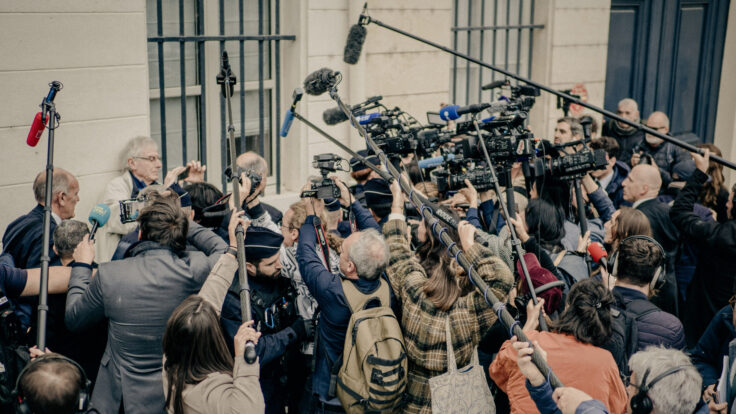
At the same time, Licht seems to have recognized that, at least in some cases, the Zucker programming playbook can yield substantive rewards. This week, CNN has gone all in on the Trump indictment in a manner that befits its historic import—almost all news organizations are doing this, to some degree—but also in a fashion that is at least somewhat reminiscent of Zucker’s CNN, circa 2015. Here, instead of the podium, we have nonstop footage of empty tarmacs, the gates at Mar-a-Lago, the plane landing in New York (captured from a speedboat), the convoy of black SUVs, the throngs of press and protestors, the courtroom doors, etcetera. The CNN anchors and correspondents call the play-by-play while analysts try to provide color commentary and the chyrons trumpet that “SOON: TRUMP LEAVES TRUMP TOWER FOR NY COURTHOUSE,” and then, in a breaking development, switch to announce that “ANY MINUTE: TRUMP LEAVES TRUMP TOWER FOR NY COURTHOUSE.”
This week’s coverage led to a fair degree of consternation from media critics who feared the media had learned nothing from the last decade. And yet it also delivered ratings. In the five hours surrounding Trump’s arrest and arraignment on Tuesday afternoon, CNN drew 2.3 million viewers, roughly five times its current average audience, affording it the now rare distinction of outperforming MSNBC in total viewers. CNN was also the most-watched channel on all of cable television among the 25-to-54 year-old cohort that advertisers covet. It was CNN’s best performance in that time period since the earliest days of the Ukraine war last February, before Licht joined the network. (On that note: the massive turnout for CNN’s Ukraine coverage does somewhat undercut the argument that Zucker damaged the network’s reputation, but that’s for another column.)
Of course, CNN has always thrived when major news breaks. Zucker’s bet was that he could make it thrive in the in-between times, too, in part by turning news events into full-fledged multi-day or multi-week dramas—or multi-year sagas, in the case of Trump. It will be interesting to see whether Licht gives into the temptation of the Trump show now that he’s seen what it can do for the ratings-beleaguered network. Now that Licht is back in the control room and enjoying the thrill of programming, some CNN sources believe that he will try to balance his belief in CNN’s mission and higher calling with his executive producer instincts to create programming that people actually want to watch.
Next week, I’m told, Licht will give CNN’s Kaitlan Collins a trial run in the once-highly-rated 9 p.m. hour. That move raises separate questions about Collins’ future on CNN’s ill-fated morning show, where she’s clashed with co-anchor Don Lemon—who, coincidentally, is dealing with his own headaches after a damning Variety report about his past behavior toward female colleagues. (CNN says it cannot corroborate the allegations described in the piece, which allegedly took place 15 years ago.) But the Collins move also signals that, for the near term, CNN plans to dedicate a lot of time to covering the Trump circus. Perhaps Licht is a little more like Zucker than he initially thought. |
|
|
|
| FOUR STORIES WE’RE TALKING ABOUT |
 |
| Lil Dicky Monologues |
| Comedian, rapper, and actor Lil Dicky on his hit FX show, ‘Dave.’ |
| MATTHEW BELLONI |
|
 |
|
 |
| Streaming Money Squeeze |
| Entertainment guru Matt Ball dissects the next front in the streaming wars. |
| JULIA ALEXANDER |
|
 |
| Elon’s Blue Period |
| A close look at Elon’s pay-for-Twitter-verification scheme. |
| BARATUNDE THURSTON |
|
|
|

|
 |
|
|
|
Need help? Review our FAQs
page or contact
us for assistance. For brand partnerships, email ads@puck.news.
|
|
|
|
Puck is published by Heat Media LLC. 227 W 17th St New York, NY 10011.
|
|
|
|