{{ 'now' | timezone: 'America/New_York' | date: '%b %d, %Y' }} |
|
|
Greetings from Los Angeles, and welcome back to In the Room. In tonight’s issue, news
and notes on a wave of recent talent licensing deals across the media landscape—from Fox Sports to Fox News to The New York Times—and the gradual transformation of legacy mediacos from creators to curators. (I guess they’re finally learning from the platform companies…) Increasingly, the big brands that once controlled the talent and the I.P. are being forced to strike more creative deals with outside partners.
🍸 Plus, on the latest edition of The Grill
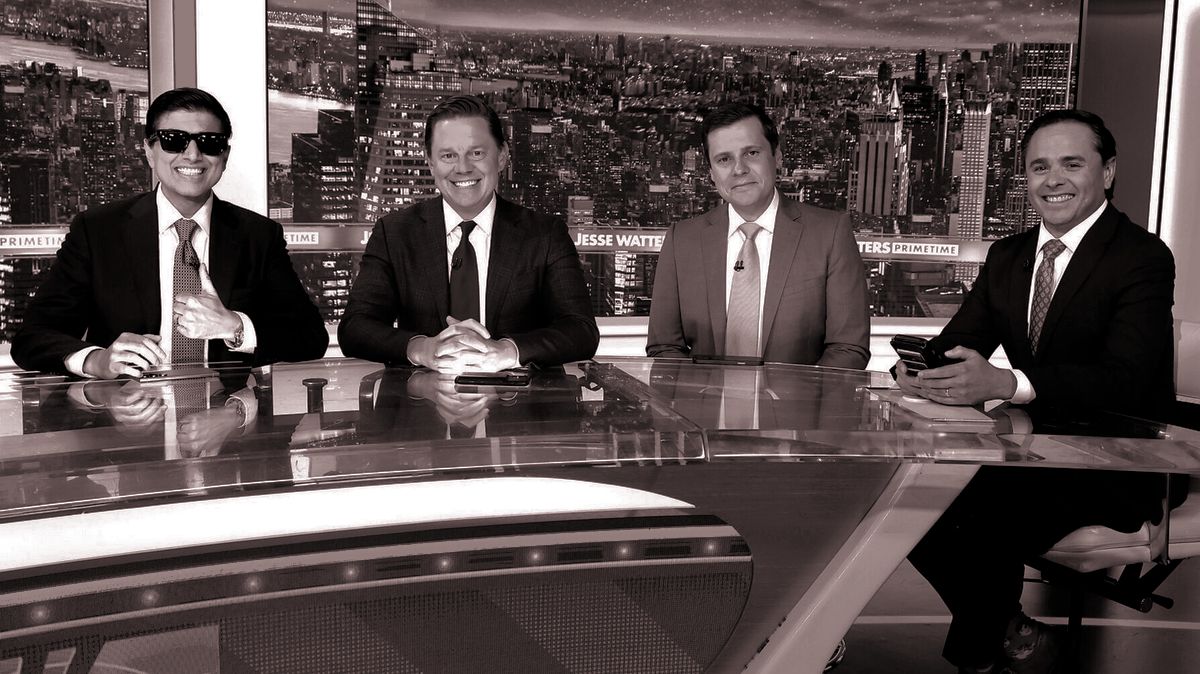
Room, Ruthless podcast co-hosts Josh Holmes, Michael Duncan, John Ashbrook, and Shashank Tripathi (a.k.a. Comfortably Smug) joined me to discuss the origins of the show and their new licensing deal with Fox News. We also dug into their unique approach to politics, the lack of conservative humor in the media landscape, the challenges faced by legacy media, and much more. Follow The Grill Room on
Apple, Spotify, or wherever you prefer to listen.
Mentioned in this issue: David Ellison, Dave
Portnoy, Pat McAfee, Howard Stern, Rachel Maddow, Mark Shapiro, Pablo Torre, Theo Kyriakou, Andrew Ross Sorkin, Jeff Shell, Rashida Jones, Radhika Jones, Jack Blanchard, Kim Godwin, and many more…
Let’s get started… |
-
The Book of David: By now, you’re quite familiar with David Ellison’s opening salvo at Paramount-Skydance: an eye-popping $7.7 billion deal to secure UFC rights for Paramount+. David’s fellow execs are already debating whether this was an admirably ballsy show of force (my partner Matt has more on that) or an irresponsible overspend after
months of rhetoric about “financial discipline.” Either way, this sends a signal that David came to play, and this is the first step in his and Jeff Shell’s long path toward streaming scale.
$PSKY now has the NFL, Big Ten, March Madness, the PGA Tour, UFC, and more—and, going forward, it’s likely to turn its attention to sports rights outside of the U.S. Indeed, it’s probably time to stop doubting the scope of David’s ambition here. He’s playing for a seat at the
big kids’ table, and he is certainly wealthier than everyone else combined with a seat. As TKO Group president Mark Shapiro put it to me: “Like his father, he’s polished, patient, cool as a cucumber, but an assassin when it comes to winning.”
Anyway, I just got out of a media lunch with David, Jeff, other PSKY executives—and a couple dozen other journalists—on the Paramount lot. I will have a lot more thoughts on their grand ambitions this
Friday. - Rashida to the Greek: Back in January, when then-MSNBC president Rashida Jones left the network, I predicted
that “she could probably secure a soft landing as an advisor to a Theo Kyriakou type”—a reference to the Greek media scion and chairman of Antenna Group. Breaker’s Lachlan Cartwright now
reports that Rashida is indeed consulting for Theo at Antenna as he pursues European and U.S.
acquisition targets. Well, how about that...? 😉
- Godwin’s war: While we’re on the subject of former television news presidents, ex-ABC News chief Kim Godwin has taken up the cause against Marva Johnson, the new president of her alma
mater, Florida A&M, and a DeSantis ally suspected of being installed to advance his conservative agenda. As you’ll recall, Kim is a devout FAMU alum who leveraged her position at ABC News to earn the school a million-dollar grant from Disney and stock the summer internship roster with FAMU students. (She also had a penchant for foisting FAMU swag upon ABC News employees.) All this led ABC insiders to suspect that she was trying to position herself for the presidency, or at least
a spot on the school’s board. “Who sent you?” Kim asked in a recent Facebook video protesting Johnson’s appointment. “Why?”
- The Vice price, cont’d: Last week, while noting that Vice had secured a $75 million credit facility, I incorrectly cited Fortress as the
underwriter. In fact, the credit facility is from Western Alliance Bank; Fortress made a separate equity investment. And there are no debts to pay down since that was cleared out in the bankruptcy. Vice says it will use the new investment to “jump-start” $500 million worth of content projects at Vice Studios.
- And finally…. where’s Jack?: “Am I the only one who’s starting to think Jack Blanchard might never return to Playbook?” a D.C.
public affairs strategist asked me this week, noting that it’s been more than a month since the Politico newsletter’s British author said he was “heading off for a little R&R, and to give the kids a chance to reconnect with their grandparents.”
It’s a reasonable question, and one I’ve received in some form or another from other D.C. sources. Of course, Jack only started the job back in January, and quickly drew scrutiny for his lack of familiarity with the machinations of U.S. politics.
(Playbook makes money as a B2B service for opinion leaders on Capitol Hill and K Street, of course, and not as a quasi-Tocquevillian examination of our nation’s strange political customs.) In mid-May, when Politico announced that Dasha Burns would become the newsletter’s chief correspondent, it seemed to signal an impending changing of the guard.
I am reliably told that Jack is dealing with legitimate family-related matters, which warrant respect and discretion. Still,
Politico might benefit from a more formal explanation of his absence, if only so the aforementioned D.C. insiders (and media reporters) don’t keep asking questions. As you may have noticed, this is a gossipy, navel-gazing industry with a strong penchant for cynical speculation.
|
And now, here’s Lauren with the latest from the House of Guiducci… |
|
|

| Lauren Sherman
|
|
- New Vanity Fair
king Mark Guiducci sent out a memo on Tuesday detailing his first stab at restructuring the magazine for a post-S.E.O. world. First off, he’s killing the brand’s digital-only verticals—including The Hive—and hiring three new correspondents for the Style, Hollywood, and Washington sections. In the process of attempting to make the Hollywood content less “tradesy,” three entertainment writers—film critic Richard Lawson and two Hollywood
reporters—were laid off. He also announced that he was hiring a new creative director in advance of a redesign, timed to the Hollywood issue at the end of the year.
Perhaps most notably, though, he announced that Radhika Jones buddies Claire Howorth and Daniel Kile were sticking around. Howorth’s new title is deputy editor, overseeing actual content; Kile—who was up for Guiducci’s gig, by the way—is now the V.P. of global content
strategy, not editing anything (obviously) but serving as a go-between for all the different departments and the business side, too. (As Selina Meyer would say on Veep: continuity with change.)
|
|
|
As legacy companies bleed out and the uneven creator economy spills forth, the
behemoths will be increasingly keen to eschew their own talent to partner with the entrepreneurs. A flurry of recent small deals presage the landscape. |
|
|
In mid-July, just days before Fox Sports revealed its new licensing deal with Dave Portnoy
and Barstool Sports—a long-overdue response to ESPN’s partnership with Pat McAfee—Fox News announced its own licensing agreement with the podcast Ruthless, a proudly smug, own-the-libs banter show hosted by former G.O.P. operatives and strategists. Financial terms were not disclosed, but it’s all upside for the four co-hosts since, like Portnoy and McAfee, they are really just being asked to keep yapping on camera in exchange for more money
and more exposure.
The contours of the deal are simple and mutually beneficial: Fox handles the ad sales, promotes the hosts, and distributes the show on its digital platforms for further commercial exploitation; the Ruthless crew retains control of their business and I.P. while continuing to gab about whatever they want and reaching a new audience. Indeed, in all these deals, the networks’ greatest expectation is that the talent will continue to be themselves, unburdened by the
tropes and formats of legacy media. In the great devolution of broadcast television from a primary medium to one downstream of YouTube, everyone gets what they want in this sort of exchange: Fox gets some cheap inventory, and the Ruthless guys have themselves an extra fee.
Obviously, these are the end days of the era when a team of dozens of producers, researchers, and camera operators prepared feverishly all day—writing and rewriting scripts, drafting interview questions,
booking guests, working around a talent’s biological inadequacies—for an hour of disposable live television. This sort of network foreplay, which exists only in a few pockets, seems silly in the modern media landscape. “We hit the record switch, and what you see is what you get. … At some level, we all do this show every day for our friends back home,” Ruthless co-host John Ashbrook, a campaign strategist and partner at the public affairs firm Cavalry,
told me on a recent episode of The Grill Room. “You’re looking at four dudes who put a USB mic in the side of a computer four years ago, and we’re now in this spot that I don’t think any of us anticipated,” said his partner Josh Holmes, another Cavalry founder, who once served as Mitch McConnell’s chief of staff.
Talent licensing is
hardly novel—Howard Stern struck his nine-figure deal with Sirius more than two decades ago—but it has become especially fashionable at this moment in media, as legacy outlets seek to keep pace with the rise of independent creators on YouTube, Spotify, Twitch, TikTok, et al. Weeks after the Fox deals, The New York Times announced two podcast licensing deals that will add former ESPN journalist and commentator Pablo Torre and The Sports
Gossip Show’s Madeline Hill and Charlotte Wilder to its Athletic shingle, without actually making them Times properties. The Washington Post this week hired former Axios editor-in-chief Sara Kehaulani Goo to oversee a new “creator network” that hopes to build “personality-driven content and franchises” outside the newsroom. I am told that The Wall Street Journal’s Opinion section is similarly looking at
bringing in new contributors who would operate as separate verticals with their own individual subscriptions.
On one level, these deals seem like somewhat panicky, FOMO-inspired, penny antes from old-school professionals who merely want to test the waters of the still lo-fi video and podcast world that, let’s be honest, feels a lot like public access TV. The most pessimistic rendering of this vision is that it’s a supercharged and more desperate execution of the sorts of contributor
networks that once thrived at The Huffington Post and Forbes before undercutting their credibility. (The HuffPo is now deep into its descent curve, while Forbes has made a proper business of itself in Asia through clever non-media revenue lines.) Atlantic C.E.O. Nick Thompson tried his own version of a lightly incentivized newsletter network a few years ago, but that faded out too.
The appeal of these models, however, is profoundly simple
and yet quite significant. Superficially, these partnerships offer growth without fixed costs—the model innovation that allowed social media, with its user-generated content, to eclipse its legacy forebears with astonishing speed and scale. On a deeper level, however, the adoption of this paradigm also hints at a few other lingering realities: These days, the innovation in media is decidedly occurring outside the halls of some of its biggest institutions. Instead of catching up via debt
raises or issuing their own Innovation Report–style manifestos, they’re partnering with the insurgents. |
We’re
Not on K Street Anymore…
|
We’re living through an era when homegrown superstars like Andrew Ross Sorkin,
Rachel Maddow, and Stephen A. Smith are either anachronistic or on their last contract or both. Maddow makes great money, sure—too much, actually—but she’ll never earn Bill Simmons’s windfall from Spotify or Portnoy’s cashout from Penn or whatever the hell Bari Weiss makes in this potential David Ellison deal. Ben Shapiro will make hundreds of millions, and the Ruthless guys
may follow in the footsteps of the Crooked Media founders, who received a landmark investment three years ago from Soros Fund Management.
In this evolving milieu—a true bridge period between industrial ages in the media space—it makes increasing economic sense for media stars to forge their own paths, make it on their own, and then form licensing deals with cost-conscious behemoths that have already built out their sales and marketing infrastructure. Yes, we’re talking about only a
handful of recent deals, but they’re unquestionably leading indicators of an accelerating pipeline. If Fox News has Ruthless, why wouldn’t MSNBC pursue a deal with the likes of Pod Save America or The Bulwark? Punchbowl, the congressional news startup, is launching a weekly podcast show that would conceivably fit nicely with almost any politically focused linear or digital news network. And, as with McAfee on ESPN, it’s not hard to imagine these
made-for-YouTube broadcasts one day being simulcast on legacy linear and streaming networks, as well. And why the hell shouldn’t WaPo essentially curate Substack and Medium for its audience? Kehaulani Goo’s third newsroom is simply following the same arc as television—from a primary platform to being downstream from the creator economy.
The Times deals and Post project, while small in size, seem to reflect the evolution of traditional media companies toward a
more flexible future where they no longer demand control of the talent and the I.P. Instead, they find constructive ways to work with outside partners—who, in many cases, have built their own profitable and self-sustaining businesses, and no longer need the legacy outlets to survive, nor do they view a Times byline or a traditional anchor assignment as life’s highest calling.
Like most evolutions in the media business, of course, this one is obvious and much delayed—likely the
result of risk-averse executives, incessant tut-tutting, and intellectual sophistry. It’s notable that Fox News is alone among the cable news networks in pushing into this space, as its erstwhile rivals at MSNBC and CNN seem to be dragging their feet while being spun out into the Versant-Discovery cable wilderness. Maybe that’s the point. |
-
This deep dive into Larry Ellison’s recent pivot from philanthropy to for-profit investing, from my old friend Teddy Schleifer and his Times colleague Nicholas Kulish. Now the second-richest person in the world behind Elon Musk, Ellison keeps a low profile beyond his affinity
for yacht racing and his private Hawaiian island. (Though, to me, he’ll always be the owner of Indian Wells and the BNP Paribas Open). Obviously, his close ties to Trump, pursuit of TikTok, and son David’s recent takeover of Paramount are garnering him a little more attention.
- This profile of
Omeed Malik, the investor who, among other things, helped finance Tucker Carlson’s media venture and Donald Trump Jr.’s members-only club in Washington. The Free Press’s Gabe Kaminsky chronicles Omeed’s journey “from Hillary Clinton donor to MAGA dealmaker,” and considers what’s behind his newfound affinity for “anti-woke” politics.
- The
bizarre tale of Shannon Muldoon, the Food52 executive who stole more than $270,000 from the company by using the corporate card to furnish her wardrobe, apartment, and personal travel. Her story, by New York’s Charlotte Klein, ends with this glorious kicker: “‘Her last purchase could’ve been her
smartest—a one-way flight to some place far away,’ said a former staffer. ‘She should’ve fled the country when she had the chance.’”
|
|
|
Join Emmy Award-winning journalist Peter Hamby, along with the team of expert journalists at Puck, as they let you in
on the conversations insiders are having across the four corners of power in America: Wall Street, Washington, Silicon Valley, and Hollywood. Presented in partnership with Audacy, new episodes publish daily, Monday through Friday. |
|
|
A professional-grade rundown on the business of sports from John Ourand, the industry’s preeminent journalist,
covering the leagues, players, agencies, media deals, and the egos fueling it all. |
|
|
Need help? Review our FAQ page or contact us for assistance. For brand partnerships, email ads@puck.news. You received this email because you signed up to receive emails from Puck, or as part of your Puck account associated with {{customer.email}}. To stop receiving this newsletter and/or manage all your email preferences, click here. |
Puck is published by Heat Media LLC. 107 Greenwich St, New York, NY 10006 |
|
|
|