Welcome back to The Varsity. I’m John Ourand, and I’m just
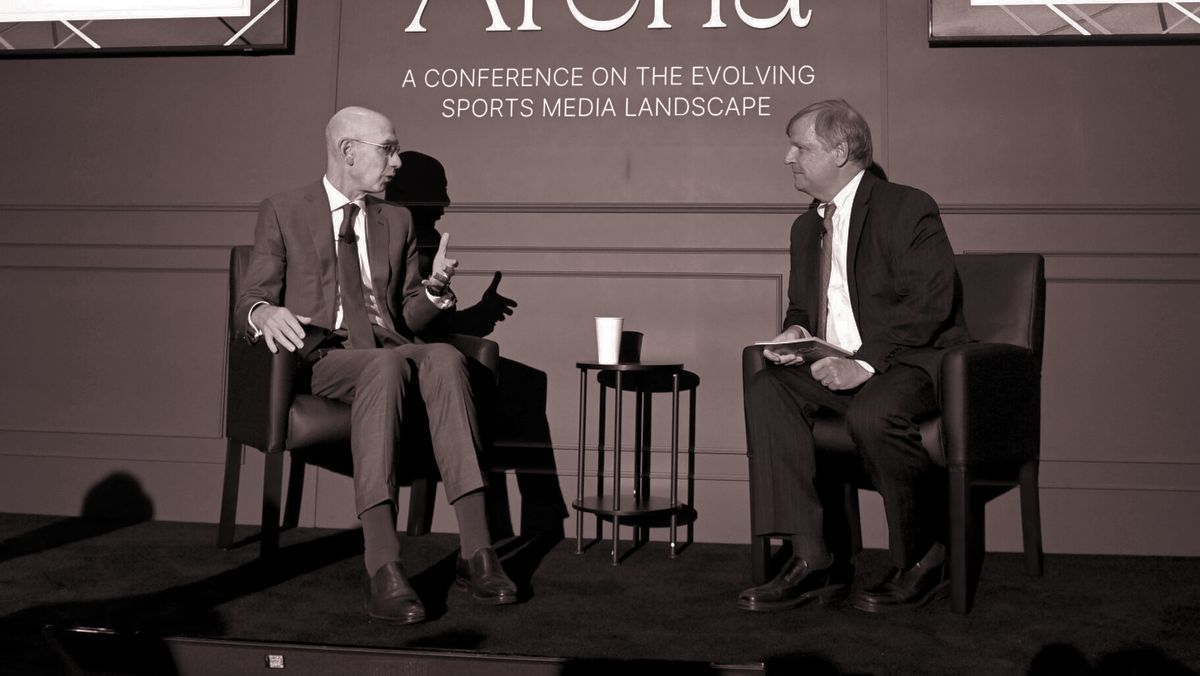
walking off the stage from the hugely successful In the Arena event that we hosted alongside our pals at MoffettNathanson. I don’t want to sound terribly immodest, but it was a truly incredible day filled with insightful conversations with Michael Rubin, Eric Shanks, Adam Silver, Gerry Cardinale, Josh Harris, Derek Chang, Hans Schroeder, Jay
Marine, and many more. Lots of forthcoming deals were teased, new strategies were hatched, and lunch and cocktail hour were filled with effervescent gossip. Honestly, we were overwhelmed by the positive feedback and already looking forward to the second installation. I’ll be sharing some of the content from today’s conference over the next couple of weeks, starting with my chat with Adam Silver, which follows below.
Pod alert: During my
interview with Harris, the Commanders owner candidly shared how he reversed the culture of the organization he acquired from the dreaded Dan Snyder. It was a scintillating conversation, and I’m thrilled to share an excerpt of it on this weekend’s episode of The Varsity.
Okay, let’s get to it…
|
Player of
the Week: Scott Dolson
|
When Penn State fired James Franklin this week, Indiana coach
Curt Cignetti was immediately bandied about as a potential replacement. Today, Scott Dolson, the Indiana athletic director, sought to end all of that speculation, signing Cignetti to an eight-year deal that makes him one of the highest-paid coaches in the land, making $11.6 million per annum. Will that be enough? We’ll see. The contract’s buyout is only
$15 million, which is chicken feed for some of these bigger schools.
|
Down to
the J.V.: Tony Pettiti
|
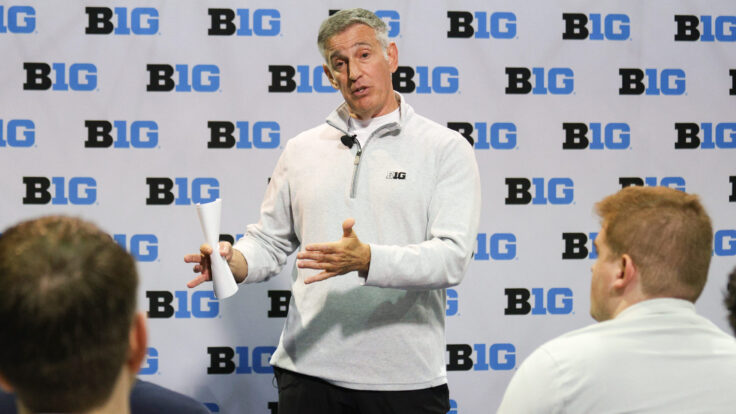
What the hell was Tony Pettiti, the commissioner of the Big Ten, up to with his
plan to collect $2.4 billion in private funding to professionalize his conference? Those plans now appear to be in disarray after trustees from two of the conference’s premier schools, Michigan and USC, questioned the deal. You would have thought that Pettiti would have nailed down unanimous critical support before his plan leaked, but no. The schools had a series of gripes, and ESPN’s Dan Wetzel has a good write-up about
what’s going on. Bottom line: This screw-up underscores the challenges inherent in re-engineering public universities for the demands of private equity.
|
|
|
A MESSAGE FROM OUR SPONSOR
|
Greatness isn't achieved in an instant. It's tested until there is no question — only performance.
|
|
|
- Lakers R.S.N. for sale: As Mark Walter’s $10 billion purchase of the Los Angeles Lakers inches closer to approval, Charter has retained The Raine Group to facilitate a sale of the team’s regional sports network, Spectrum SportsNet. I’m told that the distributor informed the team just this week that it wants to get out of the R.S.N. business. Charter’s rights deal with the Lakers runs through 2032, with an option to extend to 2037. Originally signed in 2012, the
deal has an average annual value of $150 million, the highest in the NBA. The R.S.N. paid close to $200 million for rights this year. The problem isn’t so much the amount of money Charter is paying. It’s more about the length of the deal, especially given the speed of change in the sports media world these days.Charter hasn’t tasked Raine, or any other investment or merchant bank, with helping to sell the Dodgers’ R.S.N., Spectrum SportsNet L.A. Presumably, they’d like to unload the
business given that the R.S.N. is on the hook for an average rights fee of $334 million per year, but I’m told that the only way it can get out of that deal is if Charter itself declares bankruptcy. And that’s not happening.
Either way, an era keeps ending: Charter inherited these R.S.N.s back in 2016 when it acquired Time Warner Cable. And while the company signaled its intent to collect local sports rights in markets where it ran cable systems, Time Warner Cable was never able to add more R.S.N.s. Now Charter, which inherited these channels, is simply trying to divest its portfolio as the industry implodes.
- Apple sports report: Apple’s overall content strategy has remained an enigma to much of the industry. But Eddy Cue, its S.V.P. of services, recently offered some clarity about his company’s live
sports thesis in conversation with my partner Matt Belloni on his excellent podcast, The Town. In short, Apple prefers to own league rights entirely, as it does with MLS and soon will with Formula 1, rather than share them with partners—about what you’d expect from a $3.7 trillion company. “We like looking at sports a little differently,” Cue said. “One of the things that we did with Friday Night Baseball was to learn a little bit about
sports. … MLS is closer to what we want to do, which is to own a sport end-to-end. You don’t have to worry about blackouts. You don’t worry about how to watch. We can do picture-in-picture. We can do all kinds of things that every sports fan wants.”When Matt pressed him on what Apple has learned from its MLB deal, Cue also talked about technical advancements—8K video, graphics, and real-time, onscreen stats. “We’ve tried to innovate in the space,” he said. “We think there’s a real
opportunity to do a lot more innovation in sports. In order to do that, you kind of have to have the complete sport. … The major sports are not giving you all their rights. It just doesn’t benefit them, and I get that. But then, as a sports fan, it’s very, very difficult. It’s not fun to be a sports fan right now—when you have 12 different subscriptions to try to figure out where the game is.”
- Apple’s F1 deal: When my partner Dylan
Byers asked Liberty Media president and C.E.O. Derek Chang about F1’s Apple deal onstage at our In the Arena event, the executive quipped, “It was a great movie with Apple this summer that grossed over $600 million.” Chang, of course, was referring to the ultra-successful Brad Pitt movie that Apple released over the summer.But Dylan, of course, was actually asking about Apple’s forthcoming F1 rights deal, which could
be announced as early as tomorrow, ahead of the U.S. Grand Prix in Austin. I previewed the deal particulars weeks ago: Apple is paying $140 million per year for the rights, a significant upgrade over the $90 million that ESPN is currently forking over. And it looks like F1 is relinquishing control of F1 TV in the U.S. There’s still a question about whether the streamer will be ingested
into Apple TV or simply go dark for U.S. customers. But it’s clear that F1 fans here will have to subscribe to Apple TV to get F1 TV.
- The NFL’s P.E. slow-walk: The NFL was the last of the major U.S. professional sports leagues to allow owners to sell stakes to private equity. And the league is still taking baby steps. While the NBA, MLB, NHL, MLS, and NWSL allow private equity firms to acquire up to a 30 percent interest in a team, the Shield is
holding the line at a 10 percent minority investment. Ken Belson, the Times reporter and author of the forthcoming book Every Day Is Sunday, told me on a recent episode of the Varsity podcast that this behavior fits a familiar pattern where the NFL’s team owners like to watch and learn from their peer leagues. “[Kansas City Chiefs chairman and C.E.O.] Clark Hunt is the sort of financial soul of this,” Belson
revealed. “And he’s very conservative financially, which is what the NFL wants. It wasn’t an accident that Roger Goodell asked Clark to lead the committee to look into private equity, because he knew Clark would never go over his skis and take a risk. Once you allow for 30 percent, you can’t pull it back to 20 percent, or 10 percent. That’s the NFL.” Of
course, the P.E. dynamic will eventually change the ownership dynamic—allowing older dynasties to enjoy some liquidity and perhaps, over time, inject some vitality into the owners’ boxes.
- Lopez on the pitch again: The federal bribery conviction against Hernan Lopez, the Wondery podcast network founder and former C.E.O. of Fox International Channels, which a judge subsequently threw out, has been restored—and he’s only got one more
chance at freedom. My partner Eriq Gardner has the story: “Is it actually illegal to grease foreign officials to score broadcasting rights?” Eriq writes. “That question is knocking on the door of the U.S. Supreme Court, thanks to Lopez, who, when he was at Fox, secured media rights to several major South American soccer tournaments by allegedly working federation presidents in Paraguay, Bolivia, Colombia, Venezuela, Peru, and Ecuador. This led to a federal bribery
prosecution in 2023, a conviction, and then a legal roller coaster. Rather than sentence Lopez, who faced up to 40 years in prison, Judge Pamela Chen dramatically tossed the conviction. However, this past July, the Second Circuit reinstated it.“Lopez, presumably still flush from the $300 million Wondery sale to Amazon in 2020, is represented this time by former Solicitor General Paul Clement. He’s now asking the Supreme Court to take another swing at the
notoriously vague ‘honest services’ fraud statute. Specifically, he’s asking the court to clarify that the statute doesn’t apply to foreign bribery, particularly when no U.S. public official is involved. Here’s the
petition. The justices’ response is due by November 3, and the Trump administration is on the hook to reply. One imagines the president may feel a certain sympathy for Lopez’s position.”
|
|
|
A special live conversation with NBA commissioner Adam Silver about his new $76
billion rights deal and how A.I. will transform his business.
|
|
|
This morning, we welcomed NBA commissioner Adam Silver to our inaugural In the
Arena event, where he articulated his vision of the future of media: one where A.I. is going to change the sports viewing experience in profound ways. Sure, older viewers will still gravitate to the lean-back experience, watching games in much the same way as they have for the past 50 years. But Silver and the NBA are leaning into technology, with betting, commerce, the use of multiple screens, etcetera.
These predictions of the media future are not new—for at least a decade,
industry folks have been talking about buying jerseys during games just by clicking on their TVs. But Silver says the pace of change is moving faster than ever, and that “we’re going to see as much change in the next few years as you and I have seen—maybe with the exception of high-definition—in our television experience in our adult years.” Herewith, my onstage conversation with the commish, lightly edited.
|
John Ourand: With these new media deals—Amazon coming back to
NBC with Peacock, ESPN and their app—what are you most excited about?
Adam Silver: I’m most excited about the competition. Regardless of the platform and the technology, we have an amazing amount of competitiveness in this league that we didn’t have in our past. Seven different champions over the last seven years. Many more teams.
|
|
|
A MESSAGE FROM OUR SPONSOR
|
Greatness isn't achieved in an instant. It's tested until there is no question — only performance.
|
|
|
So you don’t subscribe to the idea that if you have a dominant team, more people would
tune in—love them or hate them?
It’s fine to have dominant teams, as long as they’re dominant because they competed in a fair system, as opposed to because they had deeper pockets or more resources than the other team. Just look at the NFL. I mean, obviously they have a hard cap, but you have teams that have had real dominance, whether it’s skill, part luck, players not getting injured, or a player breaking through in a way that wasn’t expected. I think it’s wonderful. It’s very
different if you have dynastic teams because they’re able to spend that much more than other teams. And there’s no doubt that it’s not a perfect correlation, but it correlates in terms of your ability to spend to cover over mistakes. So going into the season, I’m, number one, excited about the immense amount of competition we have around the league.
What I’m most excited about now is that for a younger generation of fans, in our new national deals, every single game will be available on a
streaming service—Amazon, Peacock, ESPN is direct to home now, including those ABC games. So for the convenience, it’s great that you’re carrying a television with you . You don’t have to get to a TV and you don’t have to subscribe to cable.
Most importantly, I’m excited about the transformation we’re seeing of digital technology and A.I. technology, which is going to allow us to tell stories—what [Fox Sports C.E.O.] Eric Shanks is so good at, what
Dick Ebersol was so good at—to tell better stories around these games, because we’re going to be able to offer the games in so many different ways. Different permutations, customized games, more fields of information, shopping, chatting, betting, gaming—all those things that will create more engagement among the fans. It’s really early days on that. Amazon’s done some really interesting things around the NFL. Peacock did some amazing things around the Olympics. And, of
course, Disney and ESPN.
|
Let’s talk about technology, which is coming so fast now. But it’s taken us a long time to
get here.
When Andy Jassy was still head of AWS—he wasn’t our partner at the time, but he was a fan, and we were building a relationship—he essentially said, “If I look at all my clients at AWS, when I think of the ones who use their expertise to control the top of the stack from a technology standpoint, nobody is going to understand how to produce the NBA as well as you all will, and that you can do so in a way that maybe would’ve been cost-prohibitive
when you entered into your relationship with Turner.”
Tim Cook was making the same point to us. I remember roughly 20 years ago, for every new aspect of our website, somebody would come in and say, “Well, that’s another eight engineers, that’s another 12 engineers. You need a widget now—that’s six more engineers.” I was like, We can’t scale this for one website. We ended up partnering with Turner on that, and they invested enormous resources, because they had the
scale, with their own sites. But essentially, what those two technologists were telling us five years ago is now, with maybe 100 people, you can do what used to take thousands of people, and then you can partner with large technology companies like us.
What does that mean for viewers?
I think it means, in essence, optionality. Let’s just use betting. I think 60 percent of the United States can place a legal bet on a basketball game. So it means that,
number one, if you want to bet—on your phone, you can be following particular fields of information or multiple games at once. It also means if you don’t want anything to do with sports betting, if you have a youngster in your home and you don’t want them to see those fields, it could be password-protected. Click, click, all those fields are gone, and you don’t have to experience any sports betting ads or an announcer commenting on probabilities. If you’re watching Shai
Gilgeous-Alexander—he’s known for his taste in fashion—and you see his outfit as he’s walking in the arena, and say, I like that tie, you can get that. Or if you like his shoes, or you want to learn more about him: He’s from Canada, where in Canada is he from? How did he end up in Oklahoma City? Oh, it turns out he was traded from the Clippers. Ways to better understand the players.
You go to a game in an arena, some people are all in: Don’t talk to
me. I just want to watch the game. In most cases, you have less information than a fan watching at home, because there you’re listening, you can see replays. But now, you see people with their phones out. I see people sitting in front of me and they’re often looking at replays. They’re following it. They may be betting, they may not be. This is sort of fascinating. Or, they may be doing things that have nothing to do with the game. They may be texting with their friend, or they may be on
some other website, or maybe they’re sitting next to a colleague and they’re talking about work.
So if you have an arena with 18,000 people, arguably, it’s 18,000 different experiences. And I think that’s the ultimate goal, when you ask what’s coming with streaming, is to say, I want my own experience.
How is A.I. going to affect what you do at the NBA?
My hunch is A.I. is going to change the sports experience. It’s going to happen fairly quickly.
We’re going to see as much change in the next few years as you and I have seen—with maybe the exception of high-definition—in our television experience in our adult years. It’s going to be amazingly more engaging, and I think it’s one of the reasons that you’re seeing these valuations. The marketplace is saying there’s nothing like this premium, live content that people can experience. And as a result of A.I., people may have more leisure time, too, to engage in these activities.
|
On Peacock’s plan to put analysts next to the bench during NBA games: “I know it’s
smaller $$$ in the grand scheme of things—but those NBC bench reporters are taking two courtside seats for each game?! How much do those seats go for? Depending on the city, matchup, etcetera—could be $1K, $2.5K, $5K, etcetera. That adds up over time!” —A D.C. lawyer
On saving college sports: “I finally saw a Cody Campbell commercial this weekend, and the first thing I noticed was the claim of ‘$4 billion to $7 billion,’ which is a huge range.
I’m in construction. If we told a tech firm that their data center is going to cost $4 billion to $7 billion to build, we’d get laughed out of the room.” — A Varsity subscriber
|
Have a great weekend. See you Monday,
John
|
|
|
Finally, a media podcast about what’s actually happening in the media—not the oversanitized,
legal-and-standards-approved version you read online. Join Dylan Byers, Puck’s veteran media reporter, as he sits down with TV personalities, moguls, pundits, and industry executives for raw, honest, sometimes salacious conversations about the business of media and its biggest egos. New episodes publish every Tuesday and Friday.
|
|
|
An essential, insider-friendly Hollywood tip sheet from Matthew Belloni, who spent 14 years in the trenches at
The Hollywood Reporter and five before that practicing entertainment law. What I’m Hearing also features veteran Hollywood journalist Kim Masters, as well as a special companion email from Eriq Gardner, focused on entertainment law, and weekly box office analysis from Scott Mendelson.
|
|
|
Need help? Review our FAQ page or contact us for assistance. For brand partnerships, email ads@puck.news.
You received this email because you signed up to receive emails from Puck, or as part of your Puck account associated with {{customer.email}}. To stop receiving this newsletter and/or manage all your email preferences, click here.
|
Puck is published by Heat Media LLC. 107 Greenwich St, New York, NY 10006
|
|
|
|