Welcome back to The Varsity. I’m John Ourand, finally back in D.C.
and ready to watch Game 7 of the ALCS.
In tonight’s issue, a candid conversation with Fox Sports C.E.O. Eric Shanks about the looming NFL negotiations, his network’s investments in Cosm and IndyCar, and his musings on the college sports landscape. Up top, a few updates on Paramount’s moves to buy Warner Bros. Discovery, NFL RedZone’s continuing ad creep, and Peter Chernin’s plans to wind down his investment vehicle. Plus, Josh Harris
reveals why he’s committed to the Commanders’ name.
🎧 Pod alert: During our inaugural In the Arena sports conference last week, Michael Nathanson and I asked RedBird Capital’s Gerry Cardinale why he decided to invest in Paramount. His answer surprised the room, and we’ll excerpt our chat on Wednesday’s episode of the Varsity podcast. Also, make sure to
check out yesterday’s episode with Harris. Listen to The Varsity here and here.
Okay, let’s get to it…
|
|
|
A MESSAGE FROM OUR SPONSOR |
Forever at the top of its game, the trailblazing BMW 7 Series. Engineered to win. Learn more at
BMWUSA.com |
|
|
- Fox’s
Game 7 ad sales: As soon as the Mariners’ Dominic Canzone popped out to end Game 6 of the ALCS in Toronto last night, Mark Evans, Fox Sports’s head of ad sales, shot his team an email: “The best two words in sports,” it read. “Game 7.” After all, Game 7s are a boon to sports networks, which generally start to make real money after a series’ fifth game. The climactic game of a series has the highest viewership, and it’s when
advertisers want to push their campaigns. The final games of a series really do put the media companies’ investment in the money.
Tonight’s deciding game will play out slightly differently. Sportsnet holds the Canadian rights, which means that Fox won’t benefit from the Toronto home market. Nonetheless, once Game 7 was assured, Evans’s team had sold 65 units for it. By tonight’s first pitch, I’m told, they’ll have more than 100 units booked. Given all the potential ad breaks,
baseball games never actually sell out: The minimum number of ad units is 74 if there aren’t any pitching changes. During a 16-inning playoff game several years ago, Fox ran a whopping 158 units. - RedZone enshittification: Back in August, the NFL found itself at the receiving end of withering fan pushback over four 15-second commercials that ran over the course of a day on the previously ad-free NFL RedZone—a seemingly innocuous
commercialization that led to a shitload of negative feedback. Naturally, the league tried to downplay the spots as minor and unobtrusive. And yet, over the last month and a half, the number of commercials has continued to climb.
This morning, Sportico’s Jacob Feldman did the Lord’s work and rewatched seven hours of NFL RedZone from this past
Sunday. He found that seven 15-second ads—two from DraftKings, and one apiece from Visa, Mercedes, Lowe’s, Wingstop, and Progressive—and seven L-bar ads, which occupy the sides of the screen but don’t overrun the audio, made it into the feed. And that’s not counting host Scott Hanson’s sponsored segments from Visa, Wingstop, DraftKings, and Mercedes.
Sure, a couple of minutes’ worth of advertising over a seven-hour period may seem like small potatoes. But the anger
emanating from social media is real. Increasingly, fans are frustrated by the difficulty and costs associated with finding and viewing their favorite sport, and they see moves like this as a clear sign that the leagues are more interested in padding the bottom line than enhancing the fan experience. The truth, of course, is that all of this is true. Mediacos are investing more than ever to improve their broadcasts, and they simply need to optimize the return on their investment. - What’s in a name?: Since buying the Washington Commanders two years ago for $6.1 billion, Josh Harris has overseen a complete turnaround—from on-field performance to community outreach—after the moribund and profoundly regressive Dan Snyder era. There’s one thing, though, that Harris doesn’t plan to change: the team name. Indeed, ever since he bought the team back in 2023, it’s been speculated that he might return the Redskins name.
But he was unequivocal at Puck’s recent In the Arena event when I asked him whether he was considering a reversal: “We’re embracing the Commanders’ name,” he said.
He recalled a Monday night game earlier this year against the Bears, when Hall of Famer Darrell Green led a third-quarter chant using a spear. Harris said that was the launch of a new brand campaign. “A commander is a leader of warriors. We start with the Romans, and then we go to the
Native American tribes, and then we go to special forces. … We think being in Washington, [we should] embrace people in the service community. … We’re staying with it.” - Greenfield’s Ellison warning: In a note this morning from LightShed’s Rich Greenfield about Paramount’s
pursuit of Warner Bros. Discovery, the ever-astute analyst wrote that David Ellison might be feeling a sense of urgency to close a deal. The factors, he said, included a favorable regulatory window with the Trump administration and the possibility that more buyers might emerge. But he also warned that big mergers rarely work.
Here’s what Rich had to say: “We struggle to remember a large-scale merger that has worked in the media sector over our 30-year
career. … If the Ellisons have $30 billion of cash burning a hole in their pocket, why not take Paramount private and inject that cash into Paramount to fuel the aforementioned vision David Ellison laid out back in August? Why bother with a complicated acquisition that will saddle the combined company with even higher leverage?” - Chernin over a new leaf: In the latest issue of
In the Room, my Puck partner Dylan Byers’s private email, he looked into Peter Chernin’s investment portfolio, which includes Omaha Productions. Here’s what he wrote: “Peter Chernin appears to be winding down his investment vehicle, with Axios reporting that The Chernin Group will not
raise a new fund. The conventional wisdom among Chernin’s peers is that he’s inching toward retirement—hastened, perhaps, by boredom, age, and the alarm bells going off in Hollywood.”
Dylan continued: “Others note that Chernin started his TCG journey without a fund, and may have preferred it that way. In any event, TCG will now pivot to a holding company structure managing its existing portfolio, which includes Substack, Omaha Productions, North Road, and Food52 (and, previously,
Hello Sunshine, Barstool Sports, and The Athletic). Chernin still has dry powder from his last $2 billion fund, per Axios, so he could still make a few more moves in the media space, but this portends the beginning of the end.”
|
Now, let’s get to Shanks… |
|
|
A wide-ranging conversation between Fox Sports C.E.O. Eric Shanks and
MoffettNathanson analysts Michael Nathanson and Robert Fishman about the forthcoming NFL negotiations, reaching audiences outside of the bundle, the creep of private equity into college football, and much more. |
|
|
You’d be forgiven for still thinking of Fox Sports as a linear TV company, which it
basically has been for the past 30 years. After all, Fox was the last broadcast network to embrace streaming—Fox One didn’t launch until August—and its executives have always been the business’s biggest supporters of the cable bundle. But Fox Sports C.E.O. Eric Shanks has tried to diversify his business in other ways—taking equity interests in the Big Ten Network, IndyCar, UFL, and Cosm, for instance—while his competitors spent billions sucking
each other's eyeballs out in the O.T.T. wars.
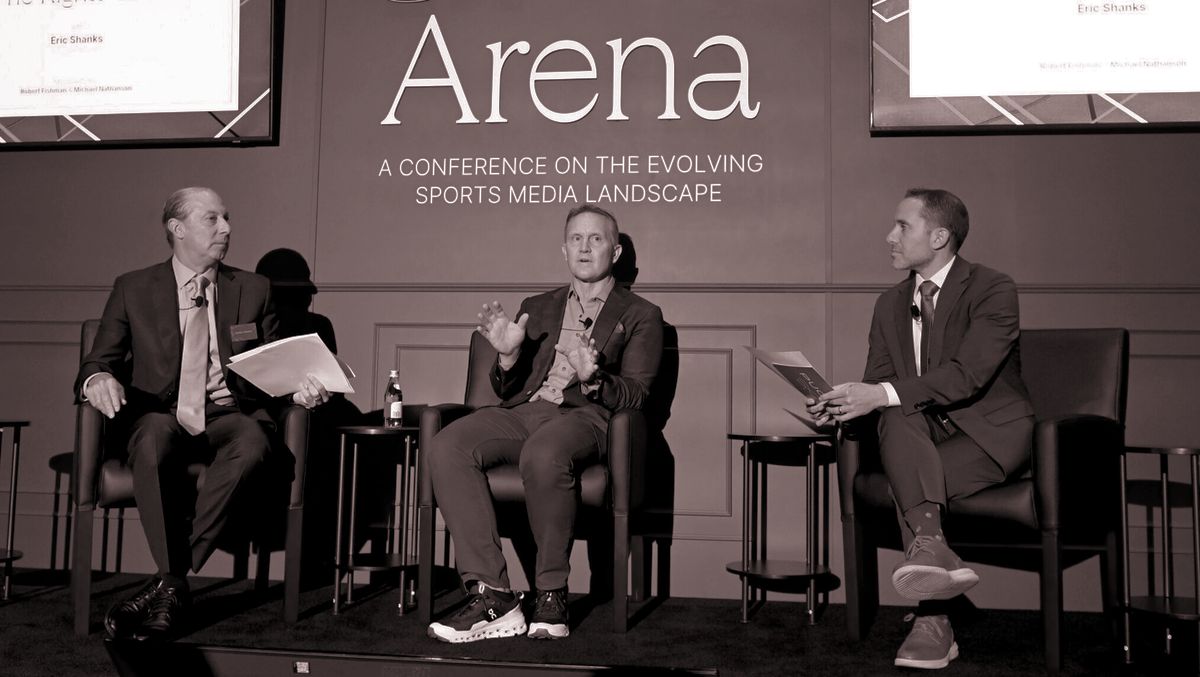
At our In the Arena event, which Puck hosted with MoffettNathanson, Shanks spoke candidly about the evolving sports media business, touched on the forthcoming NFL negotiations, and offered observations about an expanded College Football Playoff. He was interviewed onstage by MoffettNathanson analysts Michael Nathanson and Robert Fishman. What follows is a transcript of that
talk, lightly edited. |
The Late-Stage Streaming
Wars
|
Michael Nathanson: One of our favorite things about Fox is the fact that you guys did not chase the streaming wars. You stood back and said that some of the spending on streaming makes no sense. But now that you’ve launched a streaming product, how does sports play into that?
Eric Shanks: We never really thought about it as streaming—we thought about it as à la carte direct to consumer. When everybody else tested à la carte direct to consumer
before we did, it didn’t matter whether it was linear or streaming. We still are big believers in the bundle. Even the Fox One product is not a sports-only direct-to-consumer service. It’s sports, news, entertainment, all in one bundle. |
|
|
A MESSAGE FROM OUR SPONSOR |
Forever at the top of its game, the trailblazing BMW 7 Series. Engineered to win. Learn more at
BMWUSA.com |
|
|
Remember, when people started looking into direct-to-consumer, it wasn’t about
sports. It was about competing with Netflix. And the Murdochs decided that we weren’t going to be in that game of competing with all the on-demand entertainment services. So we stuck with the bundle. Now we’re just at a point where we have a clear view of everybody else’s successes and failures. And the launch of Fox One, I think, is the right product at the right time for us.
Nathanson: How do you think about serving a market that seems
elusive—the live audience outside of the bundle?
It is elusive. It clearly is ushered in by the digital age of being able to subscribe now and cancel later. Sometimes I feel like these subscription services are kind of like pay-per-view—I need to come in for a month, subscribe for two games, and then I’m going to figure out how to cancel. It’s that elusive group that you’re going after. They are sports fans, but they don’t want to make the commitment.
That’s why I
feel Fox One is the right product at the right time. We clearly have a bundle of sports and news that can be relevant all year long. But we also have really big events—the football season, World Cup, World Series—where the casual fans who may not see the value in the full bundle can come in, and it’s really convenient for them. Then you start thinking about the pricing bundle with ESPN, where you can get a better value. We’re going to do that with more folks. |
Photo: Bryan Bedder/Getty Images for Puck |
Robert Fishman: NFL commissioner
Roger Goodell raised the idea of opening negotiations much earlier than your current contract would suggest. Is this something that Fox would welcome?
I don’t think Fox is unique. With probably every media company that’s in sports, there are things in your core portfolio where you’re willing to talk about an extension at any time. Probably as soon as the last deal was signed, people were looking for certainty, and figuring out what would be the elements that would make the NFL
use that option.
Getting through that option sooner rather than later? It wasn’t really news to us. We’ve probably been talking to the league for a year about how and when we want to engage. There are a lot of chickens and a lot of eggs. They probably have a labor issue. They want to extend the season. They want to think through new packages. You don’t really know who needs to go first, but we’re ready to go.
|
Fishman: Let’s shift to college football. What is the
best outcome for all these power conferences? And do you like the idea of having them align with private equity?
College football is really a national treasure. Fall Saturdays now really feel like the opening weekend of March Madness every Saturday. Ratings are setting records. More teams now with N.I.L. have a chance to make the College Football Playoff and win a national championship. I went to Indiana, so yes, we’re doing great. Without N.I.L., Indiana wouldn’t be in the
conversation.
I believe that the market will eventually figure out N.I.L., either through regulation or legislation. There is regulation on the books now with the N.I.L. clearinghouse. The reason why people think there’s a problem is because a lot of schools front-ran the payments right before the clearinghouse even existed. So the payrolls this year in college football are probably a bit higher than they might be going forward. Time will tell.
With the introduction of
P.E.—I mean, a lot of very knowledgeable people in this room know that P.E. comes into businesses where they think they have an enormous opportunity. I don’t know any P.E. company that is a 501(c)(3). We all know P.E. gets into businesses for certain goals that they have in mind. Our position with the Big Ten and BTN has been long and really prosperous. We’ll see where we fit in if P.E. does eventually come into either a conference or at the school
level.
Nathanson: Do you see a time when the broadcasters of college football all get to share in the postseason?
I’m very much in favor of expanding the CFP. I don’t see any reason why the CFP can’t be 24 teams. You can fit it into the schedule. You can have automatic qualifiers from the different conferences. There’s a good model to expand the playoff, and still allow some of the Group of Five to be able to get in. That would give the
CFP the opportunity to have more networks involved. Still, with 24 teams, you wouldn’t have an enormous amount of games, but I think you can get more people promoting and marketing the playoffs than there are today.
Nathanson: What’s your philosophy with taking equity stakes in leagues?
We’re not a fund. We’re not P.E. When opportunities come up and we think that we can add value and create a like-minded partnership, then we take a good
look at it. Probably the most transformative for the entire industry is our relationship with the Big Ten. The Big Ten Network is now 20 years old, and it’s been extremely fruitful. It set off a string of copycat networks, and I would argue none of them have been as successful as BTN.
We have a portfolio of equity investments that all really harmonize together. We’re partners with RedBird and Mike Repole on the spring football league, the UFL. Most recently, there’s
IndyCar. We think IndyCar has a lot of room to grow—to get it back to where it was in the late 1980s and early 1990s. I’m really happy with our investment in NYRA Bets. There’s Flutter and FanDuel. And then in the live event space, there’s Cosm, which is a really cool new, live experiential event that’s going to have locations all over the country. Those things, to me, all feel like they kind of work together, and we can add more than just cash. |
On Apple’s sports strategy: “I couldn’t help but roll my eyes when
Eddy Cue said that Apple brought innovation to sports by not compressing 8K video as much as others. Revolutionary! Apple’s sports strategy is still pockmarked with contradictions. F1 is U.S.-only—but also, Apple needs to own entire sports like MLS.” —A journalist
On the Varsity podcast episode with Greg Wyshynski: “The biggest issue facing the NHL is that, for the first time in history, you have American stars who are the faces
of the entire league while the American mainstream media is splintering by the month. Not that many teams have an independent beat writer going to road games, and many teams are going through struggles with regional TV rights. Whatever boost the American stars should be giving the league is at best very muted, and at worst is like a tree falling in a forest.” —A podcast listener
On the NFL’s international schedule: “I saw your chat with the NFL’s Hans
Schroeder at your In the Arena event. Can you explain to me how many international games they can air in unique windows? I know airing games in more favorable times for Asia is great, but is any American streamer really going to pay a lot of money for 12 or so games that air at 9:30 a.m. ET, even if they have global rights, plus a couple of games in Mexico/Latin America?” —A Varsity subscriber |
|
|
Ace media reporter Dylan Byers brings readers into the C-suite as he chronicles the biggest stories in the
industry: the future of cable news in the streaming era, the transformation of legacy publishers, the tech giants remaking the market, and all the egos involved. |
|
|
Join Emmy Award-winning journalist Peter Hamby, along with the team of expert journalists at Puck, as they let you
in on the conversations insiders are having across the four corners of power in America: Wall Street, Washington, Silicon Valley, and Hollywood. Presented in partnership with Audacy, new episodes publish daily, Monday through Friday. |
|
|
Need help? Review our FAQ page or contact us for assistance. For brand partnerships, email ads@puck.news. You received this email because you signed up to receive emails from Puck, or as part of your Puck account associated with {{customer.email}}. To stop receiving this newsletter and/or manage all your email preferences, click here. |
Puck is published by Heat Media LLC. 107 Greenwich St, New York, NY 10006
|
|
|
|





_01K820D0D8668KQ6QR8XGDM5B1.jpg)