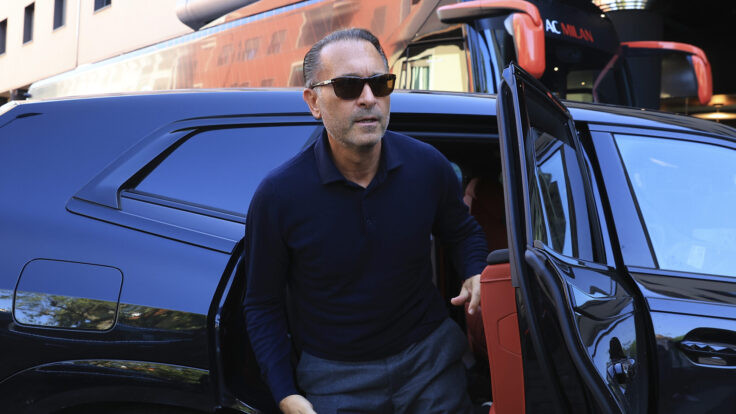
Greetings from Los Angeles and welcome back to In the Room. The Murdoch family succession drama is finally spilling out into public view, and in dramatic fashion. On Thursday, The New York Times Magazine published a biblical 13,500-word article based on 3,000-plus pages of trial record from Reno, where Rupert sought and failed to augment the terms of his trust to ensure Lachlan’s control of the empire. It’s intimate and brutal. Then, on Friday, The Atlantic published James’s equally astonishing version of the drama as told to McKay Coppins, who spent a year speaking to James and his wife, Kathryn, exclusively for this cover story. Don’t settle for any aggregated, CliffsNotes version here. There’s no NFL this weekend, so settle in.
In tonight’s email, insights from my recent Grill Room conversations with Atlantic C.E.O. Nick Thompson and New Yorker editor David Remnick on the coming A.I. revolution and their enduring faith in the power of subscriber loyalty—and even print, yes, print—to help their businesses weather the transformation. Is this a counterintuitive moat, or more magical thinking from an industry desperately in need of enduring innovation?
Mentioned in this email: Ari Emanuel, Rahm Emanuel, Roger Lynch, Jeffrey Katzenberg, Graydon Carter, Lorne Michaels, Susan Morrison, Maureen Dowd, Joe Scarborough, John Berman, Jon Hamm, Pam Wasserstein, Pam Drucker Mann, Ben Terris, and many, many more…
But first…
|
- 🍸 The Grill Room: On today’s episode of the podcast, Feed Me newsletter proprietor Emily Sundberg reflects on her rise as an independent Substacker and the role of authenticity, adaptability, and audience engagement in her success. She also discusses growing her business without any seed money, the potential risks of a fully decentralized media landscape, and her plans to expand beyond Substack. Follow The Grill Room on Apple, Spotify, or wherever you get your podcasts.
- Of Paramount concern: In a real sign of the times, Paramount Global executives who are mulling a settlement with President Trump over his lawsuit against CBS News and 60 Minutes are reportedly concerned that doing so will make them legally exposed to accusations of bribery, according to The Wall Street Journal. Go figure.
- Pure Ari gold: Ari Emanuel got quite punchy during a live taping of the Freakonomics podcast last night, attacking Sam “The Swindler” Altman, dropping some Jeffrey Epstein insinuations about Bill Gates, and defending Elon Musk, whom he described as “a close friend.” Ari also said he confronted Jeffrey Katzenberg over the Democrats’ handling of the 2024 presidential election—hardly a rare occurrence in Hollywood these days—and chided the party for “telling lies” about Biden while “calling everyone liars.” WSJ’s Joe Flint has some of the highlights.
|
|
|
|
A MESSAGE FROM OUR SPONSOR
|
SUGARCANE follows a groundbreaking investigation that exposes a shocking cover up of cultural genocide perpetrated by the church and government, while also illuminating the enduring love, courage and beauty of an Indigenous community. Described by The New York Times as "a must-see film...stunning.” For your consideration in Best Documentary Feature, SUGARCANE is now streaming on Disney Plus and Hulu. To uncover a glimpse of the truth, watch the trailer.
|
|
|
- Rahm comms: On a related note, familially speaking, CNN has signed Ari’s brother Rahm as a senior political and global affairs commentator, which will hopefully spice up the network’s mostly milquetoast commentary. Rahm, of course, was suddenly everywhere earlier this year while waging a shadow campaign for D.N.C. chair, making the podcast rounds with Axe and Ezra as he inveighed against the party for dropping the ball in 2024. He’ll probably find fewer receptive listeners on CNN, but it’s good exposure nonetheless.
- Rating skirmishes: While we’re talking TV, a source flagged that CNN’s News Central, with John Berman, has bested MSNBC’s Morning Joe in the ratings every day this week. As the source noted, this data point probably has more to do with Joe & Co.’s post-November ennui than CNN’s strides (but still!). Meanwhile, in a real sign of the times, Fox’s The Five is now outperforming CBS Evening News—which has as much to do with Fox’s post-election success as CBS’s evergreen struggles.
- Drucker Mann goes Hollywood: Former Condé Nast revenue and ad sales chief Pam Drucker Mann is teaming up with television producer Ilene Chaiken and actress Jennifer Beals to launch Run-A-Muck, a new production company “for queer creators across film, TV, events, and digital media.” Drucker Mann, who will serve as the company’s C.E.O., left Condé last May after years spent tolerating C.E.O. Roger Lynch in the hopes that she might one day get his job. (I wrote about all that drama last spring.) Alas, it sounds like P.D.M. and her co-founders haven’t quite raised the money for their venture yet, according to a friendly notice in Variety, making this the latest example of a former corporate veteran of the old school talking hastily and lavishly about their business before actually building it.
- The next Nuzzi: New York has hired The Washington Post’s Ben Terris to serve as Washington correspondent, the role last held by Olivia Nuzzi—who, as you may recall, left the magazine after her editors discovered that she’d been in an undisclosed, possibly iPhone-only affair with R.F.K. Jr. Good luck to Ben. He has big shoes to fill!
- Hijinks ensue: Finally, this weekend marks the 50th anniversary of Saturday Night Live, which culminates in the highly anticipated special live broadcast this Sunday at 8 p.m. ET on NBC. (The Ringer’s coverage of the anniversary has been reliably strong, including Bill Simmons’s recent gab with my Puck partner Matt Belloni.) This event has been heavily publicized, of course: Lorne Michaels has been profiled in recent weeks by Reeves Wiedeman in New York, Maureen Dowd in the Times, and Susan Morrison, the author of a forthcoming 600-page biography of the SNL creator, in The New Yorker.
In what might have made good fodder for an SNL skit, Morrison got a little more than she bargained for this week when she invited generational peers and associates to an event for her new book. As New York’s Charlotte Klein reports, several notable invitees began hitting reply-all, which snowballed into a running thread that bemused some (Aaron Sorkin, The New Republic’s Win McCormack) and amused others (Jon Hamm, Tina Fey). The chef’s kiss came from fellow Canadian eminence Graydon Carter: “Honestly, I have my own life,” he wrote, “I cannot devote any more time to Lorne…”
|
|
|
|
While publishers file sweeping, indignant (possibly useless) lawsuits against A.I. companies using their work to train their learning models, the industry is at a loss as to what to actually do about their A.I. futures—if there is anything that can be done at all.
|
|
|
On Thursday, while top editors at Condé Nast, Vox Media, The Atlantic, and elsewhere were eagerly awaiting news regarding the finalists for this year’s National Magazine Awards—still a to-do in the editorial department, despite the honor having zero impact on the business—their legal teams were preoccupied with a lawsuit filed that morning in the Southern District of New York. The suit, brought by the News/Media Alliance on behalf of about a dozen other publishers, including Politico and the Los Angeles Times, accused the Toronto-based artificial intelligence company Cohere of stealing their content, using it to train its models, and making much of it free to users who would have otherwise hit the news organizations’ paywalls. When Cohere isn’t repurposing full articles, the complaint alleges, it also violates publishers’ trademarks by attributing “inaccurate” work to the publishers, undermining the standards of their brands. (Cohere has said it “stands by its practices for responsibly training its enterprise A.I.”)
The News/Media Alliance lawsuit is just the latest in a string of litigation brought by media organizations against A.I. firms, including the Times’s case against OpenAI and Microsoft, and News Corp’s case against Perplexity. The suit’s purpose, Vox Media president Pam Wasserstein told the Journal, was to “establish the terms of the playing field for licensed use of journalism for A.I., including for training and also real-time uses. In this case, there’s a very blatant and visible copying of our intellectual property.” Failure to take action, Condé Nast C.E.O. Roger Lynch told the Journal, would mean “the revenue streams available to publishers today would dry up. This is an existential threat to journalism.”
|
|
|
|
A MESSAGE FROM OUR SPONSOR
|
SUGARCANE follows a groundbreaking investigation that exposes a shocking cover up of cultural genocide perpetrated by the church and government, while also illuminating the enduring love, courage and beauty of an Indigenous community. Described by The New York Times as "a must-see film...stunning.” For your consideration in Best Documentary Feature, SUGARCANE is now streaming on Disney Plus and Hulu. To uncover a glimpse of the truth, watch the trailer.
|
|
|
|
Few in the industry would dispute the merits of the case, nor these publishers’ essential need to protect their award-worthy I.P. At the same time, their legal battles with these A.I. firms seem to underscore an even graver threat: namely, the apparent dearth of any in-house innovation to capitalize on, or future-proof their businesses for, a fast-approaching era in which A.I. is likely to fundamentally alter the ways that news is both produced and consumed. Indeed, A.I. is about to become as integrated into our economy as software or mobile technology—its infinite applications and ubiquity are such that we will likely retire the term in a few years, much the same way we no longer bother to say digital. In a world where humans will become taskmasters, media leaders need to be as focused on incorporating the technology as they are intent on regulating its large language models. Lynch isn’t wrong, but the true existential threat hasn’t even arrived yet.
In my recent and manifold conversations with leaders on both the business and editorial side of the magazine industry, it became clear that these institutions are seemingly unprepared for the coming A.I. transformation. Even the leaders who have admirably managed to grow or sustain their businesses thus far seem to now take it on faith that the loyalty of their existing subscriber base will safeguard them against forthcoming changes in distribution, and that even the print product itself—yes, the print product—might be a bulwark against disruption.
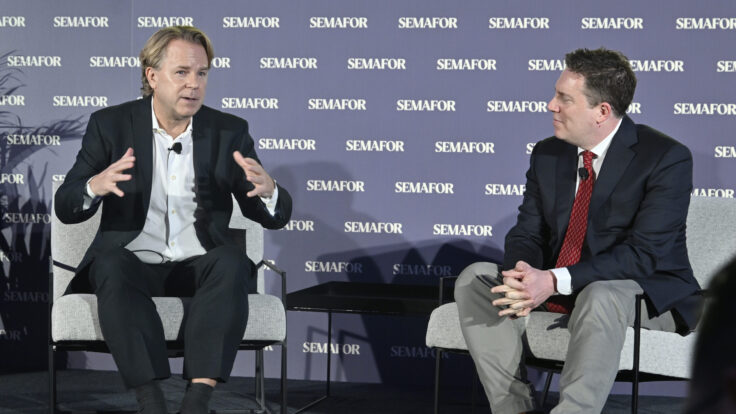
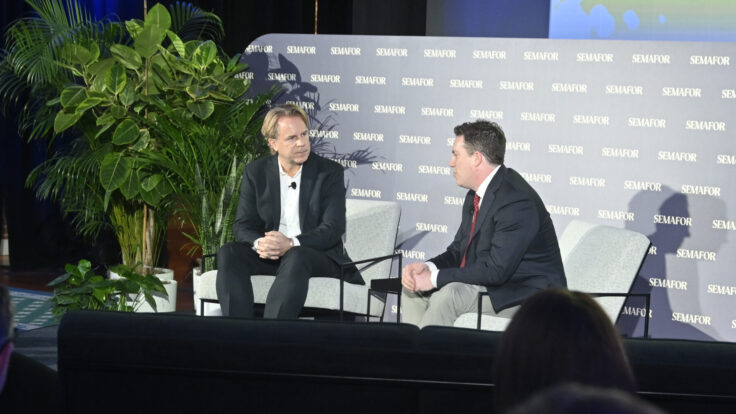
It’s a contrarian thesis, to say the least. Nick Thompson, the C.E.O. of The Atlantic, has spent a lot of time thinking about the A.I. disruption, and told me on a recent episode of The Grill Room that he worries “a lot about a world in which A.I. disintermediates all or many of the relationships that we have with our readers. I worry about a world where TheAtlantic.com goes away. I worry about a world in which maybe email even changes in such a way that … it gets harder to reach individuals, or that it becomes so easy to start a newsletter that summarizes the news, that suddenly there are so many competitors to The Atlantic that our position in the market declines.”
Thompson’s response has been to invest in strengthening the relationship with the subscriber, which he cites as the motivation for The Atlantic’s recent decision to add two print editions each year (from 10 to 12 issues, making it a true monthly). “I should try to develop the strongest direct relationships I can with people where there’s no tech platform and no A.I. platform that can get in the middle of that [relationship],” he said. “One of those things is print. We make the magazine, we put it in the U.S. Postal Service, it gets to your door. So, weirdly, print is kind of a counter-A.I. move.” It’s worth recalling that The Atlantic is underwritten, at least in part, by Steve Jobs’s estate.
Similarly, when I asked David Remnick, the legendary editor of The New Yorker for the last 27 years, how he thought about this challenge, he held up the latest edition of the print magazine: “That’s about as unmediated as you can get,” he said, almost defiantly. “And we produce not a few of these. We do this just about every week of the year, 48 a year.”
|
Of course, neither of these men are so naive as to believe that print alone will safeguard their businesses. These are brilliant guys, after all. Two decades ago, when Thompson was serving as Remnick’s digital chief, they adapted The New Yorker to Internet 1.0—which, as Remnick told me, required dramatic “psychological, editorial, and almost physiological” changes on the part of the staff. “Anybody who tries to predict with any confidence what this business will look like in 10 years is playing a mug’s game. I don’t think it’s possible,” he said. Thompson, to his credit, was clear-eyed that, “if going from 10 issues to 12 issues is the most important thing I do, you fire me immediately, right? It’s not our principal strategy.”
Still, it can be unnerving to hear no real answer to the question beyond print. Remnick cited the advent of A.I.-generated audio versions of the magazine’s stories, while noting, “admittedly, that’s certainly not the be all and end all of A.I. and its future.” Thompson said he and his team are putting a lot of effort into other ideas, but most of it seems to be around optimizing the existing business—such as determining when nonsubscribers should hit the paywall. “Should you be shown just the first 200 words of the article? Should you be shown 300? Should you be shown 100? Should you be shown quotes? Should you be shown summaries? Should you be shown excerpts? A lot of our work is going into testing that.” (Of course, The Atlantic is probably already doing this sort of testing and learning. At any rate, it can.)
Coincidentally, on the same day the News/Media Alliance lawsuit was filed and the National Magazine Awards nominees were announced, I found myself in an off-the-record meeting with a high-level executive at one of the major tech companies. When asked what was occupying his brain space these days, he said: “A.I., A.I., A.I., that’s one, two, and three.” Like everyone in his field, he evidenced total clarity about the fact that the new technology would fundamentally change, well, everything, and that we were only in the earliest, Motorola DynaTAC 8000X phase of its evolution. I have no doubt that Thompson, Remnick, and their contemporaries across the publishing industry have countenanced that fact, but it’s not clear that they have any real plan for what to do about it.
Anyway, for whatever it’s worth, both The New Yorker and New York led the Ellie nominations this year, with seven apiece. This included nods in the highly coveted “general excellence” category, a distinction they shared with National Geographic, ProPublica, and The Verge. The Atlantic picked up four nominations, one for reporting, two for photography, and one for animated illustration. ( The New Yorker’s submission here, for Naomi Fry’s article on Mormon TikTok moms, was far more arresting.) The winners will be announced on April 10. Good luck to all.
As I scrolled through these nominations, I couldn’t help but recall a point that Remnick made proudly. During our chat, he noted that The New Yorker employs some 28 fact-checkers to work on its long-form journalism. Anyone who has worked at The New Yorker knows the profound value that the department provides—elevating writers, assuaging lawyers, correcting the population of Panama or the maiden name of Saul Bellow’s fourth wife. And yet this is precisely the sort of function that A.I. will simplify, perhaps to the point where a future team will manage the software as it passes through dozens of articles all at once. It’s going to be a brave new world, and it may be one that benefits the magazine’s margins, even if it challenges its identity, history, and values.
|
|
|
|
Puck founding partner Matt Belloni takes you inside the business of Hollywood, using exclusive reporting and insight to explain the backstories on everything from Marvel movies to the streaming wars.
|
|
|
|
A professional-grade, insider-friendly tip sheet from John Ourand, the industry’s preeminent sports business journalist, covering the leagues, agencies, media deals, and the egos fueling it all.
|
|
|
Need help? Review our FAQ page or contact us for assistance. For brand partnerships, email ads@puck.news.
You received this email because you signed up to receive emails from Puck, or as part of your Puck account associated with . To stop receiving this newsletter and/or manage all your email preferences, click here.
|
|
Puck is published by Heat Media LLC. 107 Greenwich St, New York, NY 10006
|
|
|
|