Good evening, I'm Dylan Byers.
Welcome back to In the Room, my private email on the inner workings of the American media. Today, I'm taking a closer look at the future of CNN and MSNBC after the firing of Chris Cuomo and the looming exit of Rachel Maddow. Their replacements in the 9 p.m. hour are likely to indicate how CNN and MSNBC can reposition and secure their brands in the streaming era—and, perhaps, the future of cable news itself.
Thanks for subscribing to Puck, and please feel free to reach out anytime. If this email was forwarded to you, you can sign up here.
Thanks, Dylan
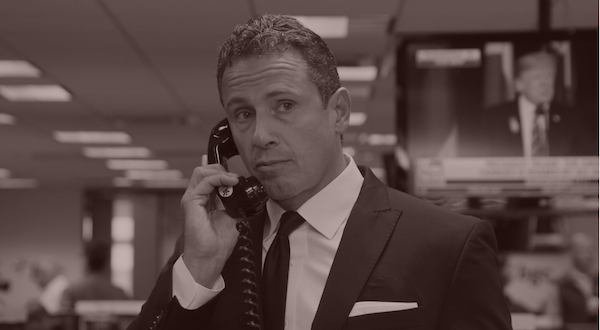
The existential crisis of cable news extends beyond the firing of Chris Cuomo and the exit of Rachel Maddow. Their replacements in the 9 p.m. hour will indicate how CNN and MSNBC can reposition their brands in the streaming era. Cable news, in many ways, has been the last holdout of our enduring media shift from analog to digital. Years after Amazon conquered the publishing market; a generation after Napster and then Pandora and, finally, Spotify vanquished music publishing; and just as Netflix and a coterie of aggressive second-movers decisively overtook broadcast and theatrical entertainment, cable news still survives. Part of this is somewhat miraculous. Indeed, Jeff Zucker almost single-handedly pivoted CNN from the province of warmed-over Eliot Spitzer and Piers Morgan fodder into a mainstage, albeit left-leaning, for the national conversation. At Fox and MSNBC, executives also found ways to prey upon the age-ridden insecurities and tribalism of a shrinking but nevertheless shrill audience. (Fox, with an audience larger than CNN and MSNBC combined, was particularly successful at this tactic.) As our culture pivoted to digital amid the Trump years, each network cleared more than a billion in profit.
The post-Trump hangover, of course, has been less kind. As my colleague Julia Ioffe pointed out in a previous report for Puck, not only are the ratings down precipitously, but the talent is also loose in the saddle. By now, every reader of this column knows that Rachel Maddow will be ascending to a sweeter overall-style deal with NBCU and Peacock worth around $30 million per year. Loyal readers will also know that I reported weeks ago that Joe Scarborough, the anchor talent of MSNBC’s morning lineup, is said to want to be the network’s highest-paid star, craving “$30million + 1!” Chris Cuomo’s recent defenestration merely proves that an era seems to be truly ending. As Politico’s Jack Shafer noted this week, in full-throated Howard Beale mode, a correction is coming. “Do we really want to continue to indulge an aged minority’s irrelevant obsession with who said what on cable news?” Shafer pleaded. “Can’t somebody turn the damn thing off?”
Shafer isn’t wrong that we continue to treat the stars of cable news as household names, even if many have smaller audiences than TikTokers or lower caste Kardashians. But we do so because their cultural impact reverberates beyond the tiny sliver of Americans who are tuned to cable news at any given moment. The symbiotic relationship between cable news bookers and green room addicts on Capitol Hill ensures that television continues to generate the soundbites that feed The New York Times and Twitter and partly set the day’s political-media agenda.
But there’s no question that the bloom is off the rose alongside the broader decline of the linear television model. And the Cuomo affair illustrates a number of under-appreciated points about the business.
First, and perhaps most contextually, both MSNBC and CNN face the shared challenge of monetizing their older audience while hurriedly and simultaneously creating pure-play streaming options for younger viewers in the form of content for Peacock and CNN+, respectively. Both networks presumed that they had years to make the transition while a steady lineup of reliable and familiar stars, built around their franchise players at 9 p.m., held up the fort.
But the sudden departures of Maddow and Cuomo make the core product unusually vulnerable amid the transformation. When the streaming future seemed inevitable, a few years back, both networks had the benefit of leaning on familiar prime-time lineups. That won’t be the case any longer. Changing a 9 p.m. host is like changing quarterbacks in the middle of the season: inevitably, the team’s identity changes in the process. The familiarity that both networks relied on to facilitate their digital transformation very much seems in peril.
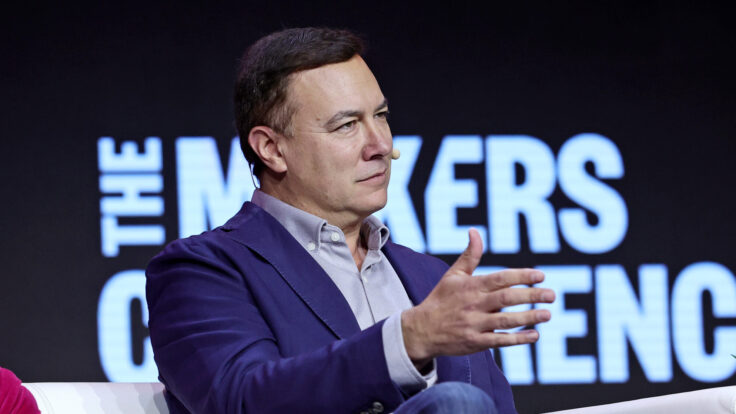
Second, it’s interesting how much of the industry’s future rests in the hands of two guys. After stalwarts like Andy Lack and Phil Griffin left the NBCU organization, current C.E.O. Jeff Shell seems like he will be the key decision-maker in appointing Maddow’s successor, with input from NBC News Group Chairman Cesar Conde, and remaking the lineup summarily. At CNN, of course, Cuomo’s replacement will be largely determined by Zucker. Both decisions are likely to tell us something meaningful about the long-term trajectory of each network. Despite their limited audiences, both are here to stay and will continue to have outsized influence on American politics and culture for at least the next several years, and much longer if they can successfully navigate the pivot to streaming.
That’s a big if. But the streaming piece is obviously important, and yet the transition isn’t always well understood. In reality, these networks are actually already subscription businesses of a kind. In the current, linear business model, CNN doesn’t need huge ratings to turn a profit, because it makes so much money off of carriage fees from cable providers. So long as CNN is considered an indispensable part of the cable bundle—the channel you rarely watch but take comfort in having, in case a bomb goes off or a war starts—it will continue to make gobs of money. In that regard, it’s practically a public utility. Ratings certainly help advertising revenue, which is why Zucker went all-in on poop cruises and missing planes and, most notably, Donald Trump, but low ratings don’t necessarily portend a financial crisis for the network.
In the streaming landscape, however, the calculus changes. The carriage fees go away, and CNN’s value is measured almost entirely by its ability to help drive subscriptions to whatever streaming bundle David Zaslav decides to put on offer at Warner Bros. Discovery. The value-add for consumers will be especially significant given that Netflix, Amazon Prime and Apple TV+ don’t, and almost certainly won’t, have a live news offering. This is why, when thinking about the future of CNN, I keep coming back to what John Malone said about wanting CNN to abandon its heavily opinionated programming and “evolve back to the kind of journalism that it started with.” If you’re selling CNN as part of a streaming package, what’s more valuable: the opinions of primetime hosts and pundit-contributors that only a few million people care to watch, or the world-class international news-gathering and storytelling services for which CNN was initially known?
Lastly, it’s indeed possible that CNN and MSNBC will cater to their base’s instincts for opinionated hosts at 9 p.m. But that will likely be a short term play. When the new world order begins—when the streaming content on CNN+ and Peacock becomes more important than the prime time lineups on the parent networks—you can prepare for a steady diet of trusted, nothing-but-the-facts anchors. Subsequently it will be fascinating to see the second order effects, such as where the more opinionated talents eventually hang their shingles. They will have options, too, of course.
The 9 p.m. question probably won’t be answered at either network until early next year. Which is not to say that Zucker and Shell don’t necessarily already know what they want to do, or whom they want to test out. It’s just that they’re the only ones who know what they want to do, and won’t make those decisions public until next year.
Meanwhile, speculation abounds among the rank and file: Is Nicolle Wallace really going to be the new face of MSNBC? Does Don Lemon move to 9 p.m. at CNN, and does Laura Coates get a turn at 10 p.m.? I am particularly intrigued by Jake Tapper‘s insistence that he has no desire to move to 9 p.m. Many people who know him well say that Tapper, who is ambitious and smart, would indeed love the job, or at least love the offer. Also, his brand of nothing-but-the-facts-ma’am journalism may be the antidote CNN craves. Doth he protest too much?
Given that cable news is still governed by linear considerations, and a linear business model, the new faces of CNN and MSNBC primetime are likely to be somewhat congruent with the current tone and tenor of each network: CNN will find an outspoken and opinionated “truth teller” who claims no affiliation to either party; MSNBC will seek out its anti-Trump, anti-G.O.P. warrior—even if that warrior is a former G.O.P. operative. But my guess is that somewhere in those decisions we’ll be able to discern how CNN and MSNBC envision the future value of their brands in the streaming era.
FOUR STORIES WE'RE TALKING ABOUT 
As with most public breakups, there’s more to this story of the McKay-Ferrell split than bruised egos. MATT BELLONI 
Washington is run by an aging class of lawmakers totally unwilling to relinquish their power. But, actually, is that as bad as it sounds? JULIA IOFFE 
Since leading Youngkin to victory, Roe has effectively rewritten the Trump-adjacent, post-Trump campaign playbook for 2022. TINA NGUYEN 
A tale of the embattled Ozy founder, a turkey club sandwich, and a misadventure in crisis management. WILLIAM D. COHAN 
You received this message because you signed up to receive emails from Puck.
Was this email forwarded to you?
Sent to {{customer.email}}
Puck is published by Heat Media LLC.
For support, just reply to this e-mail. For brand partnerships, email ads@puck.news |


SHARE