Welcome back to The Varsity, Puck’s thrice-weekly private email on the sports media industrial complex. I’m in D.C. all week, trying to keep up with one of the busiest times on the calendar—the vortex of the NBA and NHL playoffs, all with the MLB in full swing. Oh, and a quarter-million football fans are projected to descend on Green Bay this weekend for the NFL Draft. Look out for a shirtless Marchand wearing his cheesehead gear.
🚨 Pod alert: Every single league, team, and media company executive should download yesterday’s The Varsity podcast: San Francisco Giants C.E.O. Larry Baer and Fox Sports exec Ben Valenta outlined the most effective ways to build community around teams, and how those efforts go a long way toward creating lifelong fandoms. On Wednesday, meanwhile, Pro Football Talk’s Mike Florio joins the pod to preview the business around the NFL Draft.
🚨🚨 Inner Circle preview: Julia Alexander will take over tomorrow’s Inner Circle–exclusive email with an informed analysis of YouTube’s opportunity in the sports rights marketplace. Only Inner Circle members can read Julia’s work. So click here to upgrade!
Let’s get to it…
|
|
|
|
A MESSAGE FROM OUR SPONSOR
|
Forever at the top of its game, the trailblazing BMW 7 Series. Engineered to win. Learn more at
BMWUSA.com
|
|
|
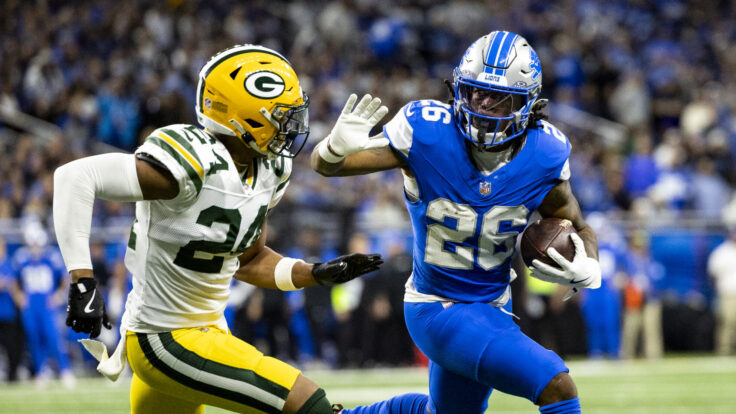
- An NFL Draft rights update: ESPN appears likely to renew its deal for the broadcast rights to the NFL Draft after this season, according to several sources. The network has carried the draft for 46 consecutive years, and has been in talks with the league to extend its agreement since last summer. Adding a new wrinkle to the negotiations, the NFL plans to sell the international rights to a U.S.-based streamer. YouTube, Netflix, and Amazon have all kicked the tires. (It’s not known if any streaming deal for the draft would include the U.S. market, which would allow the streamer to air it concurrently with ABC and ESPN.) YouTube TV and Amazon have also been negotiating to carry the NFL’s opening week game from Brazil, per SBJ’s Ben Fischer. Nothing’s been signed, and there’s no word yet of a formal announcement. But these types of deals fit the NFL’s media strategy of prioritizing reach above all else. ESPN carries the NFL Draft on its broadcast and cable channels, and a streamer could add an international audience with the push of a button.This year’s draft, which kicks off Thursday from Green Bay, is expected to draw 250,000 fans over the weekend. All told, ESPN plans to produce more than 40 hours from Green Bay, with coverage on ABC, ESPN, and a Pat McAfee–led show on ESPN+ and YouTube.
- F1’s media rights tour: F1 has been taking meetings with mediacos interested in its rights package, which become available next year. So far, as Julia Alexander presaged, many of the executives I’ve talked to have balked at the reported $150 million–$180 million asking price, which is a marked increase from the $90 million annual fee that ESPN currently pays.Traditional media executives base their sports rights decisions on acquiring assets that will keep subscribers in the cable bundle. Naturally, they prioritize the NFL, NBA, and college football and basketball. F1 may have a lot of buzz right now, but it’s not in that category. Also, several media executives told me that their hesitancy was not necessarily due to audience size—F1 races regularly attract more than 1 million viewers—but rather the restrictive advertising environment around the races. F1 audiences are famously allergic to in-race ads, which will keep traditional TV companies from shelling out serious money. That aversion could also prevent streamers from stepping forward in a big way. After all, Netflix and Amazon are aggressively bidding on sports to supercharge their commercial businesses.
- ESPN’s college stability: When ESPN hired Artie Kempner to take over as director of Monday Night Football last month, there were some questions about domino effects. After all, Kempner was replacing Derek Mobley, who had left ESPN’s top college football crew to join MNF some three years earlier. At the time, Jimmy Platt had replaced Mobley as director on ESPN’s top college football telecast. But I’m hearing that ESPN is managing for stability. Earlier this month, I’m told, Platt signed a four-year deal to stay with that top crew and work on the NCAA women’s Final Four. For his part, Mobley is expected to stay with ESPN as a director on college football games.
- The P.E. sports spend: Private equity is alive and well on the U.S. sports scene. Arctos Partners has ownership stakes in more than a dozen U.S. sports teams. Sixth Street Partners could own as much as 15 percent of the Celtics. Meanwhile, Ares Capital picked up a 10 percent stake in the Miami Dolphins. The latest, new P.E. fund to make some noise is Cynosure | Checketts Sports Capital, a collaboration between sports business veteran Dave Checketts and The Cynosure Group. The fund will invest at least $1.2 billion in the sports marketplace—teams, leagues, media, tech, facilities—and will be based in New York and Utah.
- A CFP idea: ESPN’s Heather Dinich floated a wild idea in a new column on the precipice of the CFP’s annual spring meetings in Texas: A college football program’s television draw could play a role in determining whether that school actually makes the playoff. To elaborate, the plugged-in college reporter cited a source who acknowledged that some administrators are considering “a model in which each Power 4 league can earn guaranteed spots through a combination of its teams’ overall records—and maybe even TV ratings.” It seems far-fetched, but it is certainly an accurate reflection of the sport’s current moment.The whole column is worth a read to better understand what’s at stake at the meetings. But it’s unlikely that any significant changes will occur. Sure enough, Dinich wrote that “no major decisions are expected.”
|
|
And now, on to the main event…
|
|
|
|
A frank conversation about the future of Major League Baseball fandom with San Francisco Giants C.E.O. Larry Baer and Fox senior V.P. of strategy and analytics Ben Valenta.
|
|
|
|
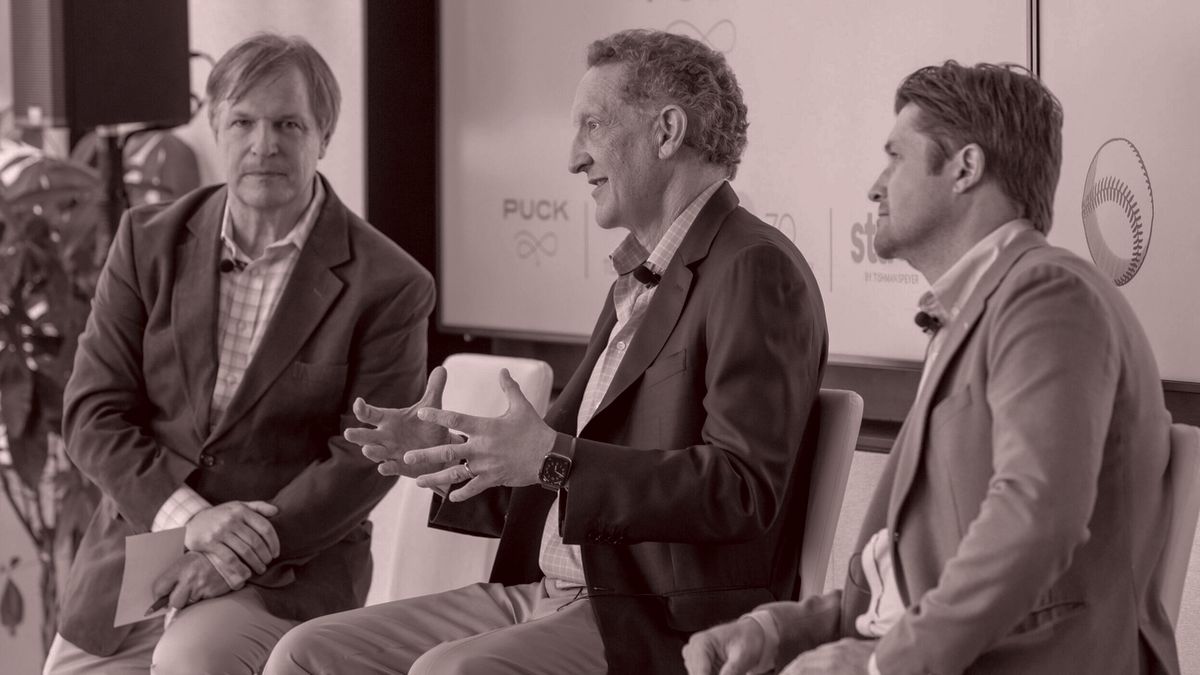
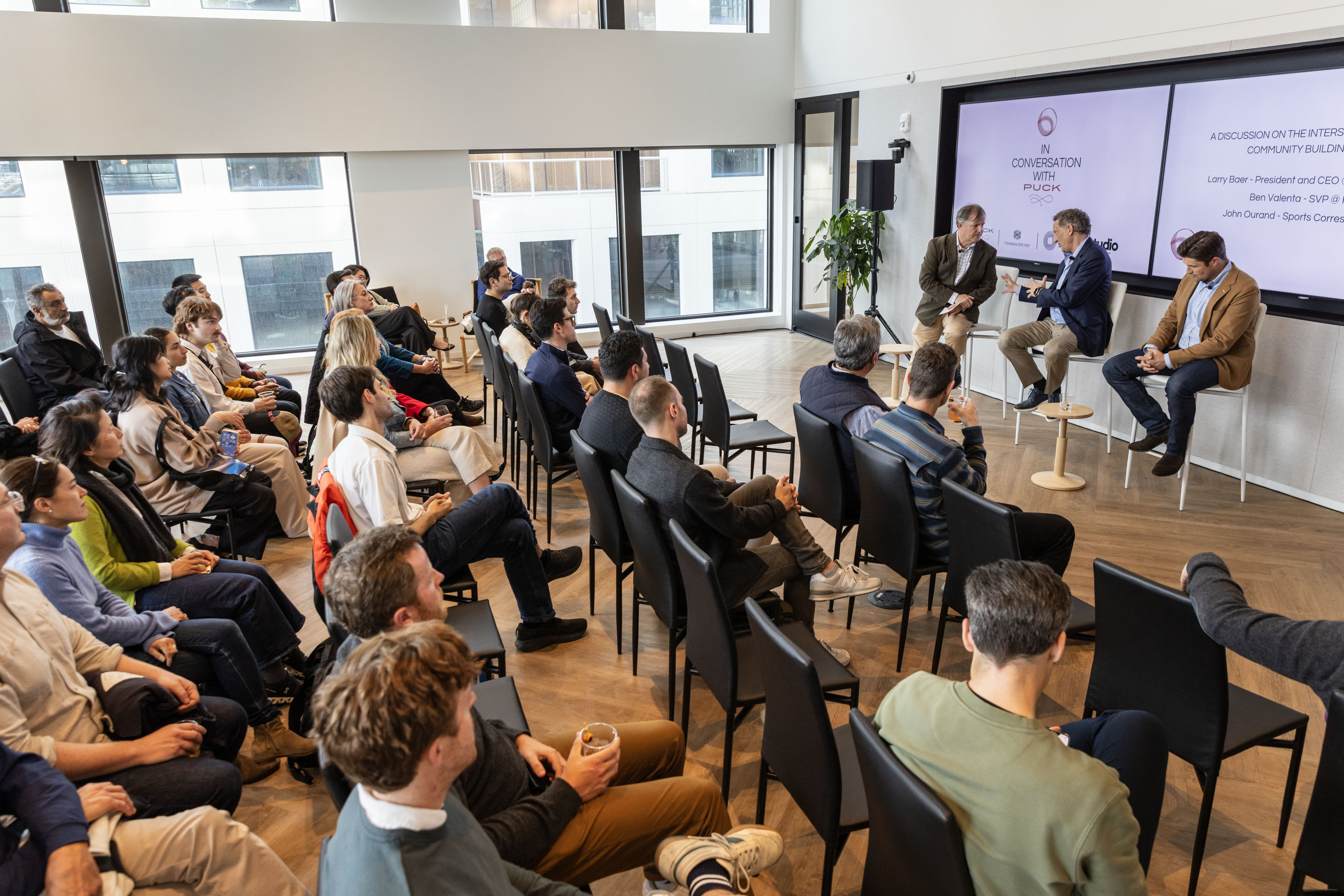
When sports executives talk about ways to attract younger fans, they almost always reach for tactical solutions—from developing social media marketing campaigns to creating Gen Z attractions at the ballpark. But during a talk last week that Puck co-sponsored with Tishman Speyer, at their Mission Rock development, San Francisco Giants C.E.O. Larry Baer and Fox Sports senior V.P. of strategy and analytics Ben Valenta focused less on rights deals or on-field play than on what makes sports fandom meaningful and profound. “Sports is the business of belonging,” Valenta said. What follows is a transcript of our talk, lightly edited as always. I encourage you to listen to the entire presentation on this week’s Varsity podcast.
|
|
John Ourand: This a beautiful space here at Mission Rock, and it follows a trend that’s been happening across the country: Teams have started to build retail spaces around stadiums. What is your strategy with this?
Larry Baer: One of our strategies was partnering with the best developer possible, which is Tishman Speyer. Our group acquired the team in 1993, and a do-or-die project we had was to get a ballpark to replace Candlestick Park. We had wonderful memories there, but it probably was not the place to lead us into the future of baseball, where break-even is around 3 million fans. So when we acquired the team, we basically had committed that we would, with deliberate speed, get a ballpark built.
There were previously four failed ballot measures to build a ballpark with public money. So we went the private route, got the ballpark built in 2000, and as the area was getting developed, the center of gravity was moving toward this part of town. If you were to ask, What was the one thing you would have done over?, it would have been to have an opportunity to expand beyond the ballpark. What we really wanted to do was enhance the neighborhood, because we have a group of community-based investors whose D.N.A. is to do the best thing possible for the city.
|
|
Photo: Katie Ravas for Drew Altizer Photography
|
|
I remember distinctly when you built here, there was no blowback. People were ready to leave Candlestick and come to the middle of the city.
Baer: When we acquired the team, there was really a big groundswell of support for a new ballpark. Our research showed that 75 percent of the voters wanted a new ballpark; and, similarly, 75 percent of the voters said, I won’t pay for the ballpark. So we knew the only real route was to do it privately. A baseball park hadn’t been done privately—arenas had, but baseball parks hadn’t. So we had to go into the upfront sponsorship world, upfront concessions world, and upfront naming rights world, to put together the private piece of it. And a big credit to our investors at the time—Peter Magowan and a group of 18 civic-minded folks who really went into this somewhat blindly. But it was the only way we were going to keep baseball in San Francisco.
|
|
Ben, tell me about how you view building community from a media standpoint. Your view is radically different in its own way, because you’re viewing it as part of Fox Sports.
Ben Valenta: At Fox Sports, one of the things that we focus on is really understanding how fandom operates—and this word “community” comes up. I’ve spent the last 12 years talking to sports fans about why they engage in sports, and oftentimes, the fans themselves aren’t even aware of how embedded the notion of “belonging” and “community” is into their own fandom. And along the way, we developed an insight that to be a fan is to be a part of a community. We have found that the bigger the fan you are, the more friends you have.
When you continue to pull the threads, all this belonging, connection, and interaction is really good for us. Fans are better off. They’re happier, they’re more satisfied with their life. They’re more grateful, they’re optimistic, they’re more confident. They’re more likely to give to charity. They’re more likely to be registered to vote. They’re more trusting of others and institutions. Every wellness marker that we’ve tested shows a positive correlation with fan engagement.
|
|
|
|
A MESSAGE FROM OUR SPONSOR
|
Forever at the top of its game, the trailblazing BMW 7 Series. Engineered to win. Learn more at
BMWUSA.com
|
|
|
|
How does this research help Fox? What does Fox do with it?
Valenta: I want to take a step back from that, because I think there’s a bigger conversation that needs to be had around the strategic framing of the sports business, and how consumers relate to it. Currently, we think about and frame the business through this lens of entertainment. We need to get out of that framing of this business, and think of it as belonging. Sports are entertaining, but they are not entertainment. Sports is the business of belonging. That’s how this business works. If we frame it properly, we’re getting closer to the heart of why consumers actually engage in this space, and why they give their money to businesses in this space.
|
|
It’s perceived that baseball has a problem with an aging fan base, and that baseball has a problem getting butts in the seats. Are those real problems?
Baer: In some ways, we’re the most generational sport; you see multiple generations at the ballpark, where games are played during the summer. But I think we’ve gotta innovate. One of the things that we’re doing at the Giants, and our C.M.O. is really focused on, for example, is connecting baseball to food. It’s about new audiences. I think the pitch clock is helping, and I think there are other innovations coming in terms of play on the field. But I think the most important thing is the outreach to new audiences through social media, and through all the devices we now have. It’s coming with baseball, and we’re seeing some good signs.
|
|
Photo: Katie Ravas for Drew Altizer Photography
|
|
How do you get the younger generation to either watch and stream, or come to the stadium?
Baer: We have to understand that the games are being consumed differently through the media, and we have to figure out ways to deliver it in curated ways and chopped-up form. And I think that’s going to form some rights negotiations. You’ll still have Fox and others doing the full games, but you’re going to have others—whether it’s YouTube or other players that have the hearts and minds of 20-year-olds—that are going to do rights deals that may not relate to just the full game, but pieces of the game.
Valenta: There’s no question that all leagues and teams and broadcasters should be thinking about how younger people are consuming their media, and we need to be offering content on those different platforms. But I still think we can’t skip by the notion that in order for someone to become an engaged fan—in order for them to pay money, and pay attention that is monetizable—they have to have a social network that is activated by that team, league, and sport. That’s the animating life force of this business.
So yes, we should be monetizing highlight rights across different platforms, and we should be where the kids are, no question. But that’s not some silver bullet that creates the next generation of fans. The only way to create the next generation of fans—the only way to mint a new fan—is learned behavior, which requires repetition over time. And that behavior is stickiest when in the context of family-bonding rituals—you get kids young when they’re using the team to bond with their families, and that’s how they become the people consuming content across all these different media platforms.
Cord-cutting is real, and it’s a very clear trend, not just with baseball, but with all programming. Larry, what’s your local media rights strategy?
Baer: I think all the clubs now have more questions than answers. But there’s a lot of interesting experimentation, and we’re doing that. We’re in the middle of experimenting with different pieces of this. We have a great partner in NBC—we’re fortunate to have a strong partner, and we’re experimenting together. We just launched in-market games on Peacock, so you can subscribe.
I think the answers are going to unfold as we go through the next couple of years, and we’ve seen all the new players that are interested and talking to all of us: Apple, Amazon, Peacock, Netflix, etcetera. It’s going to take a little bit of time to sort. These are longer-term deals; our deal with NBC goes through 2032. Obviously, YouTube is having some interesting discussions with lots of folks. I think it’s too soon to understand exactly where it all settles. We also have to think more globally than we have in the past.
|
|
On Mat Ishbia: “Mat Ishbia is a feel-good insurance kingmaker? He runs a mortgage company that his dad started.” —A Varsity subscriber
More on Ishbia: “As a former Michigan State Spartan, I want to correct your assertion that Mat Ishbia is an insurance kingmaker. He took over his dad’s company, United Wholesale Mortgage, which competes directly with Cavaliers owner Dan Gilbert’s Quicken Loans. Gilbert is a Michigan State alum, too, and was the only NBA owner to abstain from voting for Mat as owner.” —A Varsity subscriber
On WrestleMania: “Did you watch WrestleMania on Peacock? It was like if a NASCAR vehicle became a TV show, with ads everywhere, including like nine on the ring itself. Nothing wasn’t sponsored. I saw some of the show on Peacock’s ad-supported tier, and it was borderline unwatchable. Viewers on my tier could not see the backstory packages before each match to know why the two people were about to fight. Instead, we were served commercials.” —A media executive
|
|
|
|
Ace media reporter Dylan Byers brings readers into the C-suite as he chronicles the biggest stories in the industry: the future of cable news in the streaming era, the transformation of legacy publishers, the tech giants remaking the market, and all the egos involved.
|
|
|
|
Join Emmy Award-winning journalist Peter Hamby, along with the team of expert journalists at Puck, as they let you in on the conversations insiders are having across the four corners of power in America: Wall Street, Washington, Silicon Valley, and Hollywood. Presented in partnership with Audacy, new episodes publish daily, Monday through Friday.
|
|
|
Need help? Review our FAQ page or contact us for assistance. For brand partnerships, email ads@puck.news.
You received this email because you signed up to receive emails from Puck, or as part of your Puck account associated with . To stop receiving this newsletter and/or manage all your email preferences, click here.
|
|
Puck is published by Heat Media LLC. 107 Greenwich St, New York, NY 10006
|
|
|
|