Welcome back to The Varsity, where we’re rooting for the Huskies tonight—if only because a UConn
victory would allow me to deploy my favorite chestnut for yet another year. Pray tell: Can you name the last Big Ten team to win the NCAA men’s basketball tournament? Why, it was my own 2002 Terps… back when Maryland was part of the ACC. On the women’s side, of course, the answer used to be my 2006 Terps. UCLA changed all that with yesterday afternoon’s big win.
Pod alert: We’re a little more than two weeks away from the NFL Draft, so I rang up NBC’s
Mike “F’n” Florio for some NFL pillow talk. Also, make sure you listen to yesterday’s episode featuring Kentucky Wildcat legend and former NBA star Jamal Mashburn, who broke down the bifurcated state of college basketball at a time when the N.I.L. maze is causing chaos but the product on the floor has (arguably) never looked better.
More on that below.
This issue was created with contributions from Curtis Rowser.
Also mentioned in this issue: Jalen Rose, Brendan Carr, Bailey Johnson, Rupert Murdoch, Jeff Van Gundy, Danielle Allentuck, Mark Tatum, Josh D’Amaro, Suzy Kolber, Roger Goodell, and more… |
- My
Murdoch monopoly mail bag: I caught some flak from a bunch of people last week—media executives, lobbyists, D.C. insiders—after I noted that Rupert Murdoch may not have been carrying the banner for free-market capitalism entirely altruistically when his Wall Street Journal editorial board published a piece questioning the
merits of the NFL’s antitrust exemption. Indeed, many around the league wondered if the editorial was a brushback pitch, given that Murdoch’s Fox faces a burdensome renegotiation with the NFL over its annual package. One media executive, perhaps speaking for vox populi, pointed out that the exemption has long insulated the league from the market. “Because of its antitrust exemption, the NFL and other pro leagues are exempt from free-market capitalism,” this person said. “If we
were truly choosing free-market capitalism, the exemption would be rescinded and each team would do their own deal.” Instead, the league sells its packages collectively, forcing CBS, Fox, and NBC to take inventory they probably don’t want—Jacksonville games included.
Anyway, the arrangement dates back to 1961, when the NFL convinced lawmakers that weaker franchises would not survive if stronger clubs hoarded the spoils. Now, however, the league has grown into such a commercial behemoth
that some regulators have started to wonder if the imbalance has flipped—with small, local broadcasters needing antitrust exemptions more than, say, the Jaguars. At a recent Semafor event, F.C.C. chairman Brendan Carr asked, “If the NFL teams were able
to collectively negotiate, should the broadcasters, perhaps, be able to collectively negotiate as well?” My suspicion is that the networks will pay Roger Goodell’s upgraded fees and everyone will drop the high-minded questions until the cycle recurs in the 2030s. - UCLA cashes in: South Carolina’s loss to UCLA in yesterday’s national championship game snapped the SEC’s dominant run—it marked the conference’s first season since 2019
without a national champion in football, men’s basketball, or women’s basketball. Meanwhile, UCLA’s victory carried its own bit of history: The Lady Bruins delivered the Big Ten its first women’s basketball title since 1999, when Purdue beat Duke.
In college basketball’s moneyball era, the ledger may matter most—and the Big Ten’s three-week surge translated into a sizable financial dividend under the NCAA’s “units” system, which pays conferences for each game played (with a bonus
for the champion) over a three-year span. According to Sportico’s projections, here are the top five projected conference payouts: Big Ten ($6.42 million), SEC ($5.82 million), ACC ($4.81 million), Big 12 ($3.01 million), and Big East ($1.2 million). - The NBA’s grand tour:
The NBA, long intent on planting its flag across Europe and currently eyeing a 12-city European league in 2027, took a meaningful step toward its manifest destiny last week: More than 120 prospective investors expressed interest in the opportunity, according to reports, with nonbinding bids exceeding $500 million and
valuations for clubs in the proposed league climbing past $1 billion. The auction was a bit of a pageant process, to be sure, in order to separate the real potential investors from the wannabes. Yet the sheer size of it was stunning and underscored the upside. “The level of engagement and the scale of the bids reflect the marketplace’s belief in our proposed model and the enormous, untapped potential for European basketball,” deputy commissioner Mark Tatum said in a
statement.
But the arithmetic, as you might guess, invites a second look. On yesterday’s episode of The Varsity, NBA veteran Jamal Mashburn offered a cooler appraisal of both the valuations and the opportunity. “I think over in Europe, they have to be careful about the anticipation of media rights deals being something similar to the States, because that’s not accurate,” Mashburn said. Just as important, he added, is behavior: “What are people in Europe willing
to pay to go to a game?”
For Mash, the question was not merely economic, but cultural. Europe, he argued, more closely resembled the NCAA market. “Europe is probably more aligned with college basketball, where it’s about the front of the jersey as opposed to the name on the back,” he said. “There are cultural differences in every part of Europe that they need to consider. Certain markets justify [the valuations]. But looking at the economics of it from the standpoint of, can people
really afford it—they have to approach NBA Europe through the lens of actually understanding Europe, and not just inserting ‘NBA’ in front of it with an American perspective.”
|
And now for the main event… |
|
|
|
Layoffs are coming as the sports network deals with cord-cutting, the YouTube TV blackout,
and uncertainty around whether Josh D’Amaro is going to spin it off to Wall Street cheers. |
|
|
|
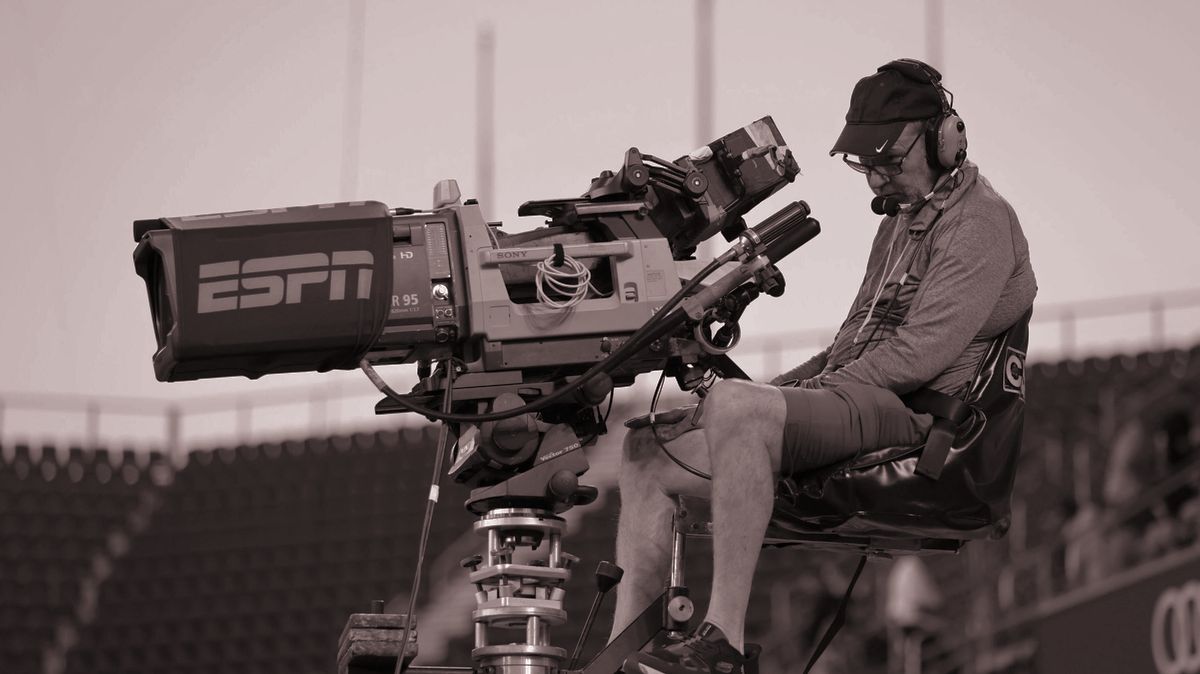
These are uneasy days in Bristol. ESPN has shed 40 percent of its cable and satellite subscribers over the
past decade, declining from 100 million households to 60 million, and the direct-to-consumer service that will make up for only a fraction of those losses is not yet two years old. Monday Night Football, for which the company pays $2.7 billion a year to the NFL in rights fees, could soon get a lot more expensive. There’s also the persistent rumor that the new guy, Disney C.E.O Josh D’Amaro, will spin the business out of the parentco. Now the mood has
been further unsettled by whispers of imminent layoffs.
Of course, this is not uncharted territory for ESPN, where the workforce has grown accustomed to rolling staff RIFs. From 2015 to 2017, the company scheduled three rounds of reductions that affected more than 400 employees. In the fall of 2020, it cut 300 jobs, in addition to eliminating 200 open positions. About two and a half years later, the business infamously endured its highest-profile layoffs—axing around 20 on-air
stars, including beloved talent Jeff Van Gundy, Suzy Kolber, and Jalen Rose. I can now confirm that another round is approaching. I’m told the number will land near 30, with cuts expected in the coming weeks, primarily in off-camera departments.
None of this is especially unexpected for a legacy media business that must balance its traditional needs alongside investments in new platforms. CBS and CNN have both endured recent layoffs as
they, too, recalibrate for a shifting business model, deploying resources where they’re most needed while trimming elsewhere. ESPN is in a similar boat—all traditional media companies are. Given what’s happening across the media industry, it wouldn’t be a surprise to see Disney lay off employees eventually, as well. |
Interestingly, the timing of the cuts can be partly attributed to a somewhat unexpected revenue dip last
fall. Last November, ESPN found itself in an unusually exposed position during a brutal carriage dispute with YouTube TV, which has amassed around 10 million customers and become the country’s fourth-largest cable provider. ESPN’s linear channels, along with the rest of Disney’s portfolio, went dark on the platform right in the middle of football season.
In prior carriage disputes, ESPN had been able to successfully rely on its disproportionate leverage, particularly with Monday Night
Football and college football games dominating its schedule every fall. This time, however, YouTube TV had the juice—it was, after all, a privileged shingle of the world’s largest media company, YouTube, which itself was a shingle of Alphabet, a nearly $4 trillion market-cap colossus. The blackout lasted 15 days—the longest such interruption since ESPN debuted back in 1979. For two full weekends, YouTube TV subscribers were shut out of SEC football and Monday Night Football,
including games featuring the Chiefs and the Cowboys. When the two sides finally reached a YouTube-friendly agreement, Disney acknowledged a loss of a whopping $100 million. Company sources say the coming layoffs are, in part, a response to that financial delta.
Those sources have insisted, I should note, that the coming layoffs are unrelated to ESPN’s more recent dealings with the NFL. Last week, the network assumed full control of the NFL Network as part of a broader arrangement
pertaining to the league’s 10 percent equity stake in ESPN. Executives have consistently said they don’t anticipate any layoffs at NFL Network, which went through its own round of cuts two years ago and now operates with a lean staff.
Either way, that clarification underscores the depths of ESPN’s challenges as it integrates NFL Network, countenances Roger Goodell’s new ask for MNF, and attempts to follow chairman Jimmy Pitaro’s vision of
making its own niche streamer the new hub of sports. Even with its shrinking distribution, ESPN has seen pretty big viewership increases across most of its sports telecasts; it also boasts gaudy numbers on digital and social platforms. And the truth is that ESPN has no choice but to continue to invest in live sports, particularly football. Unlike the old days, however, it has minimal room for error. |
On D.C.’s sudden interest in sports: “Don’t sleep on the idea that CBS is pushing the F.C.C. to look
into the migration of NFL games to streaming services.” —A media executive
On pirated streams: “With sports leagues being on more and more channels, I’ve noticed something: Illegally streaming these games is actually easier than watching them the correct way. In college, my friends and I figured out the good illicit sites for these games because we didn’t have the money for subscriptions. Now we subscribe to many of these streaming services for their TV shows, but we’ve
started illegally streaming more than we did in the past—honestly, because it’s easier to keep a laptop plugged into your TV with an HDMI cable and have a go-to site than it is to search around different apps for a game.” —Signed, “A now-former sports TV anchor”
On The Washington Post’s new sports hires: “Congrats to Danielle Allentuck and Bailey Johnson at the Post. I would bet a fair bit of money that the Sports section has
sold a lot of ads over the years. Hard to know what to make of the profitability of any section today, but cutting all sports seems like a very poor calculation.” —A Varsity subscriber
On MLB in Canada: “Why have I been getting the Spanish audio feed on live games simulcast on MLB Net? Please tell the league that there are two official languages in Canada and neither is Spanish!” —A Varsity subscriber and Canadian baseball fan |
Have a great week. See you tomorrow,
John |
|
|
|
Join Puck’s chief political columnist, John Heilemann, as he roams the corridors of power and influence in America on this
twice-weekly interview show, taking you beyond the headlines with the people who shape our culture: icons and up-and-comers, incumbents and insurgents, moguls and machers in the overlapping worlds of politics, entertainment, tech, business, sports, media, and beyond. The conversations are rich and revealing, unrehearsed and unexpected… and reliably impolitic. A Puck-Audacy joint, new episodes drop every Wednesday and Friday. |
|
|
|
An essential, insider-friendly Hollywood tip sheet from Matthew Belloni, who spent 14 years in the trenches at The
Hollywood Reporter and five before that practicing entertainment law. What I’m Hearing also features veteran Hollywood journalist Kim Masters, as well as a special companion email from Eriq Gardner, focused on entertainment law, and weekly box office analysis from Scott Mendelson. |
|
|
|
Need help? Review our
FAQ page or contact us for assistance. For brand partnerships, email ads@puck.news.
You received this email because you signed up to receive emails from Puck, or as part of your Puck account associated with {{customer.email}}. To stop receiving this newsletter and/or manage all your email preferences, click here. |
Puck is published by Heat Media LLC. 107 Greenwich St., New York, NY 10006 |
|
|
|
|