|
Good evening, and welcome back to In The Room, my twice-weekly look inside the power corridors of the media industry.
I’m back in Los Angeles after a whirlwind 36-hour trip to Washington, from which I managed to pick up a few scoops on the flight home (more below). I also caught up on some podcasts, including, go figure, a brand new interview with incoming CNN C.E.O. Mark Thompson, conducted by his friend and former boss at the BBC, Roger Bolton. Thompson had signaled he’d be avoiding press during his inaugural months at Hudson Yards, but that certainly doesn’t preclude a friendly, philosophical chat on the objectives and obligations of British public broadcasting in the Priti Patel era. There’s no discussion of Thompson’s CNN plans here, but anyone looking for insight into how Thompson thinks about issues like free speech and media bias would do well to give it a listen.
As chance would have it, Thompson was also in Washington this week and staying at the very same hotel, no less. Alas, there were no elevator run-ins. Thompson officially starts at CNN on Monday—he really started weeks ago, of course, and was in D.C. for a CNN sales event—and he’s already winning hearts and minds with his decision to set up shop at a desk in the middle of the newsroom (he’ll use his office for meetings and private calls; hat-tip Oliver Darcy).
As those of you who have been following our CNN coverage well know, these symbolic gestures carry massive significance. Chris Licht’s original sin was vacating his predecessor’s newsroom office for a corporate suite on a higher floor, which presaged his early, misguided attempt to lead the newsroom from a remove. Thompson is telegraphing an intent to roll up his sleeves and work alongside the troops in the trenches—and good on him.
Now, onward: In tonight’s newsletter, fresh scoops on the forthcoming Republican primary debates and the R.N.C.’s MSNBC preoccupations. Plus, an update on Patty Stonesifer’s WaPo C.E.O. search.
|
| Earlier this week, Donald Trump’s advisers called on the Republican National Committee to “immediately cancel” all future G.O.P. debates and “refocus its manpower and money on preventing Democrats’ efforts to steal the 2024 election.” Setting aside the baseless and hypocritical nature of that highly alarmist call to arms, the Trump team’s true intention was likely to try and deny his less popular competitors and would-be cabinet members their democratic right to shout over one another on increasingly dismal live television.
Trump, of course, is hardly the only one wondering aloud about how long this unmitigated shitshow must go on. He currently leads the field by a 45-point spread, per the latest RealClearPolitics national average, and national interest in the debates seems justifiably on the wane. The Vivekquake is subsiding, Chris Christie’s best material has already been used, and as my Puck partner Peter Hamby recently noted, the Glenn Youngkin mirage is fading.
Unfortunately, the show will go on, and rightly so. As one R.N.C. member told the Times, everyone is “entitled to have their day,” and you “can’t go change the rules in the middle of the game”—no matter how substantial the frontrunner’s lead. To date, the debates have taken place in the conservative-friendly forum of Rupert and Lachlan’s Fox media empire, but that will change with the third debate, on November 8 in Miami. Three sources familiar with the matter tell me that NBC News is in late-stage negotiations with the R.N.C.—dotting i’s, crossing t’s, etcetera—for rights to host that debate.
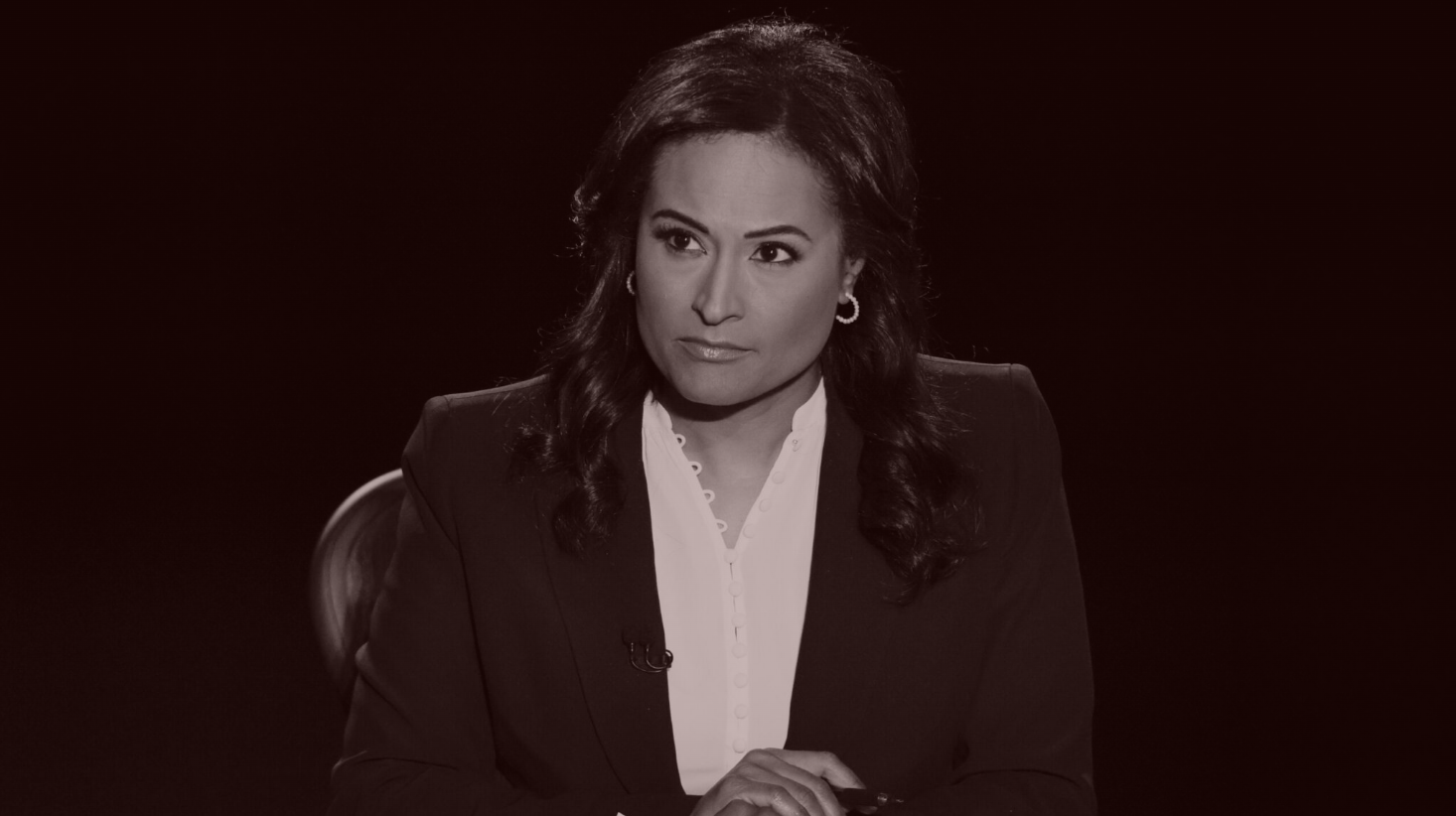
While nothing is set in stone, NBC Nightly News anchor Lester Holt and Meet the Press host Kristen Welker are seen as the most likely co-moderators—an uncomfortable arrangement, perhaps, for Fox’s conservative audience, but hopefully one that leads to a more substantive debate. For the first time this cycle, Republican candidates who have largely embraced an aggressively anti-mainstream media posture will be taking questions from card-carrying members of the establishment—and the sister network of the avowedly liberal MSNBC, no less.
Indeed, there is an amusing detail of the NBC-R.N.C. negotiations that is particularly indicative of this absurdist era in American political history: As part of the negotiations, R.N.C. representatives have sought guarantees that MSNBC will not simulcast the debate, presumably because the Republicans don’t want to be seen as doing any favors for the enemy. Such juvenile preoccupations are perhaps to be expected from a party with a penchant for purity tests, but it is also misguided: in addition to unnecessarily diminishing the total addressable market for the debate, the stricture gives Maddow & Co. the opportunity to counter-program it.
None of that is likely to have any effect on the trajectory of the Republican primary, of course—find me the MSNBC loyalist who might have been swayed by Nikki Haley and I’ll buy your FTX tokens—but it is indicative of the petty late stages of the closing of the American mind. Another amusing detail: The R.N.C. committeeman running the debates that Trump refuses to attend is none other than Dave Bossie, the Trump 2016 deputy campaign manager who later helped the former president contest the 2020 vote count.
In any event, each legacy broadcast partner is likely to get their turn in the spotlight (CNN’s fate remains T.B.D. in light of Republican attitudes toward the network, as I reported weeks ago). Given the rapidly changing state of the industry, it’s possible that these could be among the last presidential primary debates that some of these networks ever host. ABC News is seen as the most likely partner for a New Hampshire debate ahead of the Granite State’s first-in-the-nation primary, sources familiar with the matter tell me. Of course, Disney chief Bob Iger recently signaled his desire and willingness to sell ABC—likely to a Sinclair or Nexstar or private equity firm—and the news network thus approaches its debate amid severe cost cutting efforts that, as I noted earlier this week, have required reporters and producers to be far more disciplined about how they deploy their travel budgets. (True to form, network president Kim Godwin remains on the road: after attending a party for the White House press secretary in Washington this week, she will travel to California next week for Fortune’s Most Powerful Women Summit, in Laguna Niguel.)
Meanwhile, CBS News is vying to host the Las Vegas debate ahead of the Nevada caucuses, my sources tell me. That network’s fate is up to Shari Redstone, who is likely to sell off Paramount in a matter of years, which could prove fateful for the news division. Facing its own budget challenges, CBS’s move to play for the Sin City debate was likely strategically designed with the P&L in mind. Less than a week after the caucuses, CBS will broadcast Super Bowl LVIII from the Raiders’ Allegiant Stadium, and the proximity of the two events will allow the company to double dip on the deployment of its cameras and crews to Nevada. This seems like TV news’ version of when Condé Nast centralized fact checkers and photo departments.
Of course, barring Trump’s return to the debate podium, it’s not clear just how beneficial these debates will be to the networks. Millions of viewers are still very meaningful in this business, but the fourth and fifth and sixth rounds of the J.V. debate team don’t stand to be ratings juggernauts without Trump in the mix. And from an entertainment perspective, the more compelling programming may still be taking place back on Fox. Last month, the network announced that Sean Hannity would host a televised, 90-minute debate between California Gov. Gavin Newsom and Florida Gov. Ron DeSantis on November 30. It isn’t yet Biden vs. Trump, but it may be a lot closer to the main event that viewers and voters are ready for. |
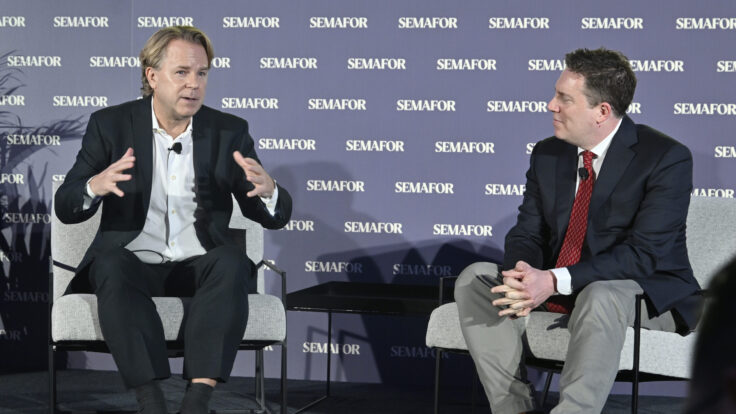
| Back in Washington, Patty Stonesifer’s search for the next Washington Post Co. C.E.O. remains ongoing, and the list of contenders courted-then-aborted grows ever longer while the list of still-plausible candidates remains elusive. Indeed, I was told this week that Atlantic C.E.O. Nick Thompson, who was pursued by Stonesifer and seen as a very plausible contender, is no longer under consideration for the position. He joins a litany of candidates—Politico C.E.O. Goli Sheikholeslami, Semafor C.E.O. Justin Smith, The Economist president Bob Cohn—who took calls from Stonesifer and/or the Sucherman search firm and have since either taken their names out of the running or been deemed unqualified for the position.
As I’ve noted before, this initial candidate yield emphasized the challenges of filling the position. Most of the aforementioned hail from much (much) smaller companies, and none have the gravitas of a Mark Thompson or Meredith Kopit Levien—the lead architects of A.G. Sulzberger’s reinvention of the Times as a subscription-supported news and lifestyle juggernaut, a model Jeff Bezos is presumably hoping to emulate.
Presumably, Stonesifer and Sucherman are already casting the net still further afield. After all, it’s worth remembering that some of the smartest and most effective chief executives often come from outside fields. Thompson arrived at the Times, then a print institution, from the BBC, a television and radio broadcaster, and subsequently transformed it into a digital business.
Then again, the industry’s interest in the search derives, in part, from the fact that the WaPo is not the Times Company. In fact, though privately held, its revenue picture is probably much more similar to Politico (and then some). It’s also a peculiar beast—a national brand in a largely local market; a historical entity with question marks about its future. One question lingering over the search is whether Bezos has a vision for the company and is simply looking for a C.E.O. to execute it, or whether there is a vision at all. |