{{ 'now' | timezone: 'America/New_York' | date: '%b %d, %Y' }} |
|
|
Greetings from Los Angeles and welcome back to In the Room—and a palpably fraught time
in American media. As you may have noticed, Disney’s decision to preempt Jimmy Kimmel’s show amid F.C.C. pressure has touched a national nerve and heightened anxieties about Trump’s overt, Orban-esque crackdown against the media. The blowback to this latest move has been broad and, reassuringly, bipartisan. Beyond the obvious implications for the health of American democracy, the whole fiasco is unquestionably what Bob
Iger would call “a brand withdrawal”—for both himself and the company.
As of this writing, Kimmel remains at odds with Iger and Dana Walden over how he should address the controversy on his show. As my partner Matt Belloni has reported, Kimmel wants to clarify that he never meant to suggest Charlie
Kirk’s killer was pro-Trump, while also criticizing Fox News and others on the right for mischaracterizing his comments. Disney wants something closer to a straightforward and unconditional apology. Underlying all of this is the leadership’s longstanding frustration over how much Kimmel has politicized the late-night show. Sure, it’s their network, and they can do what they want about that. But it probably would have been smart to address that before kowtowing to the
White House. (As if the criticism from Barack Obama weren’t enough, even Iger’s predecessor Michael Eisner has come out of the woodwork to hit him over the move—a real thrill for veteran Magic Kingdom kremlinologists.)
In a stark contrast to Disney’s prostration, the New York Times leadership has been defiant in its fight against
Trump’s $15 billion defamation lawsuit. At a Financial Times event here in L.A. this week, C.E.O. Meredith Kopit Levien said the Times would “not be cowed” by the president’s “anti-press playbook.” At an Axios event in New York, executive editor Joe Kahn said Trump was “wrong on the facts” and “wrong on the law,” and pledged victory in court. Earlier today, Judge Steven Merryday dismissed Trump’s suit for being “decidedly
improper and impermissible” in its length, “vituperation,” and “invective.” (A lawsuit, Merryday noted, is “not a protected platform to rage against an adversary.”) The Times commended him for seeing “that the complaint was a political document rather than a serious legal filing.”
Of course, the Times and Disney play in two different sandboxes, with distinct ownership structures and business models, and different levels of exposure to government pressure. Nevertheless,
it is at least somewhat reassuring to see the Sulzbergers—and, indeed, the Murdochs—stand up against Trump’s meritless lawsuits in the wake of Iger and Shari Redstone’s capitulations. Recall that Iger, who is now enduring another turn in the barrel, was the one who started us down this path when he settled Trump’s lawsuit against George Stephanopoulos. Obviously, this did nothing to get the monkey off his
back.
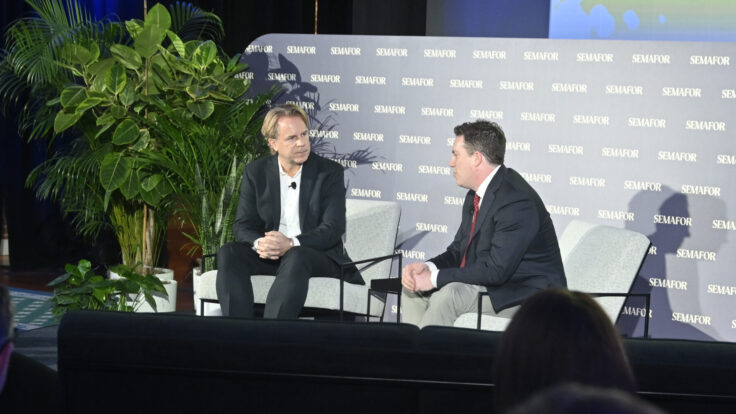
It also helps that the Times, whose market cap today stands at almost $10 billion, has the financial means to resist government pressure. Last week, my partner Julia Alexander and I had the opportunity to sit down with Meredith Kopit Levien in New York for a wide-ranging discussion about the Times’s growing business, and the steps it’s taking to maintain that edge in a rapidly transforming world. In tonight’s issue, I wanted to bring you
some highlights from that conversation—which, in addition to providing greater insight into the Times itself, might also provide a road map for all media companies seeking financial terra firma in these tense and troubled times.
🍸 Plus, on the latest edition of The Grill Room, Julia
and I scrutinized Disney’s Kimmel decision and the thorny questions around media freedom, corporate backbone, and Disney’s brand reputation. We also debriefed on our interview with Meredith and discussed the Times’s evolving strategy. Follow The Grill Room on Apple,
Spotify, or wherever you prefer to listen.
📝 Finally, if you haven’t filled out the new survey for the Puck Private Conversation, powered by our partners at Orchestra,
you can do so here. It’s a great opportunity to influence the discussion around the most pressing questions in the media business today. It’s also fast and fun.
Let’s get started… |
-
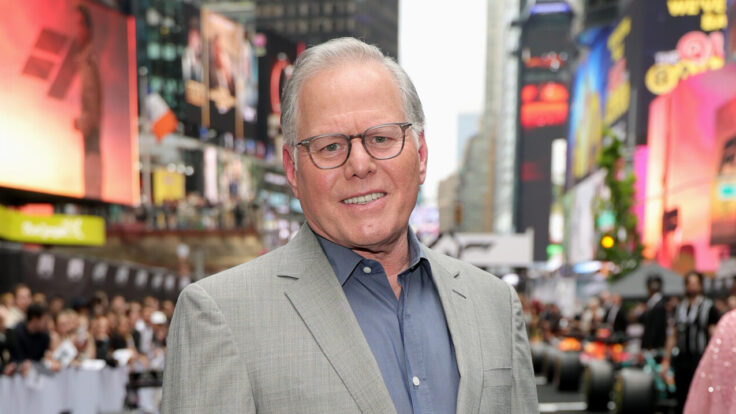
TikTok, tick tock…: President Trump said today that he and Chinese President Xi Jinping “made progress” on “the approval of the TikTok deal,” which suggests that the Oracle-led consortium of investors is moving closer to acquiring the app. Lingering in the background is the longstanding assumption that Larry Ellison’s stake would help fuel his son David’s ambitions at Paramount by enabling him to create a fully
vertically integrated business turbocharged by TikTok algorithms: studio, streaming, social. Sure, it’s a long putt. A little less long now, it seems.
- Versant, con and pro: We finally got our first look at the financials for Versant, the NBCUniversal cable channel spinco composed of MSNBC, CNBC, Golf, and a slew of even-lower-rated channels that will inevitably shutter or go digital-only in a matter of time. In short, according to the S.E.C. filing,
Versant is a still-lucrative business—just under $3 billion in adjusted EBITDA and $670 in net income—that is overexposed to declining revenues, debt, impending cost increases, and, of course, the broader consumer migration away from television. The task ahead for Versant C.E.O. Mark Lazarus & Co. is to position its strongest brands as compelling acquisitions targets in the digital space, or get picked off by private equity. Good luck.
-
All the Nuzzi fit to print: Finally… Olivia Nuzzi, the star political reporter who was let go from New York amid revelations of her months-long, digital sexting and demure-nudes-sharing relationship with Robert F. Kennedy Jr., is returning to journalism after a year in the wilderness. New Vanity Fair editor Mark Guiducci
has tapped Olivia to serve as West Coast editor, “with a focus on events, industries, and culture of the Pacific region, as well as writing for the magazine.”
Olivia’s hire was one of several Mark announced this week. Alas, but for Olivia, these were not necessarily the names Mark had
reportedly been targeting, but perhaps there are more to come. In any case, the chattering classes are very eager for Olivia’s second act. But the reality is that the Hollywood media advertisers that VF relies on were likely turned off by his decision to hire a D.C. person rather than an
awards circuit veteran. Guiducci is making a bold choice, and good for him for doing so. Let’s see if he lives to regret it.
|
|
|
A defiantly optimistic conversation with Meredith Kopit Levien, C.E.O. of The New
York Times Company, on buying The Athletic, the possibility of a Times-powered A.I., and why it’s still all about the news. |
|
|

| Dylan Byers
|

| Julia Alexander
|
|
|
|
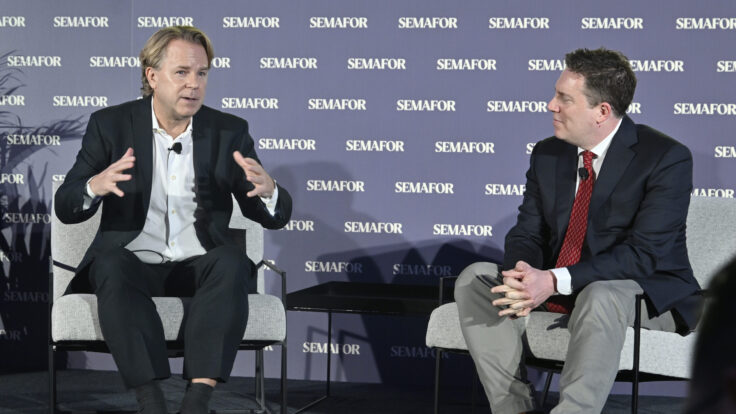
On a recent autumn-tinged day in Hudson Square—basically SoHo West—my partner
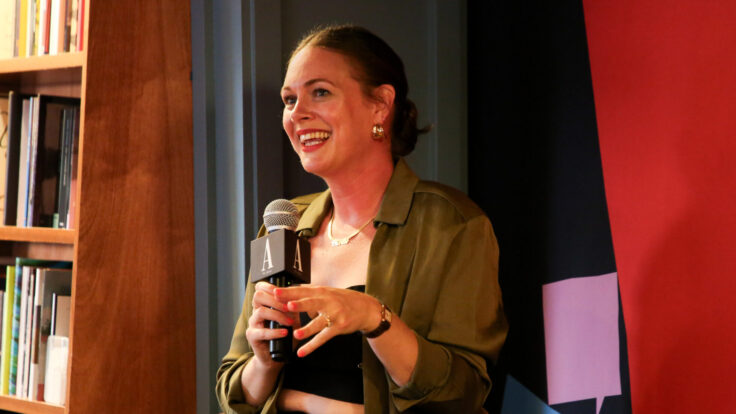
Julia Alexander and I sat down with Meredith Kopit Levien, the formidable chief executive officer of The New York Times Company, for a wide-ranging, 90-minute conversation about the business’s future. Among other things, we covered the fate of the Times bundle, the upside of acquiring The Athletic, how the
Times quietly reinvented itself as a software company, and where A.I. fits into the mix. Here are the highlights, edited for clarity and concision. |
Dylan Byers: I want to start with what should ostensibly be a
very simple question, but I don’t think it is anymore: What is The New York Times?
Meredith Kopit Levien: I think that’s a great question and a fun place for me to start. The New York Times is the preeminent institution of high-quality independent journalism, first and foremost. It is also a set of market-leading lifestyle products that help people make the most of their
lives and passions—the things they do for fun and joy. And it’s an extraordinary interconnected bundle and product experience of things people care about on a daily basis.
Dylan: Calling it a “news company” seems increasingly archaic given what you’ve become. How much of the revenue now is actually coming from the core news product?
News—covering the most important stories in the world with deeply
reported, well-edited journalism—is by far the most value-creating thing we do at The New York Times: value-creating for society, for shareholders, and for the company. People sometimes ask if we’re now a games or lifestyle company. Hard no. News is unlike anything else in its ability to bring in a massive weekly audience. Without it, our other products wouldn’t succeed. Our strategy is to be the essential subscription for curious people everywhere. That rests on three pillars:
world-class news, market-leading lifestyle products, and the bundle. Of those, news is by far the most important. If we don’t get that right, nothing else works. |
Julia Alexander: You had 230,000 new subscribers in the most
recent quarter, with a 6 percent increase in the bundle, 7 percent decrease in news-only. Is that because you aren’t marketing that plan anymore?
Literally, I challenge you to go find, “Can you buy news-only on The New York Times?” It is not a merchandising construct that we’re promoting and hasn’t been for a long time, because we actually think the best experience is buying the whole
thing.
Julia: What’s the main challenge you see in converting registrations to subscribers? And are those new subscribers going to come from a natural progression of converting registrations, or through an acquisition at some point?
Broadly, where do the next subscribers come from? Kill it in the news coverage. Keep covering the world’s most important stories and do that in more formats, make it more
accessible. Keep adding value in every part of the portfolio. Vast resources at the Times go to: How do we show you the next thing that’s going to be interesting? How do we use sophisticated data science and our whole corpus to keep you engaged?
Julia: But does that come in via better algorithmic recommendations? Or via a Wordle, or via The Athletic, which then brings in new behaviors throughout the day and furthers engagement
overall?
The broad answer is all of the above. If you come in to play Wordle, that might lead you to Spelling Bee. Wordle was like this giant megaphone. Same with The Athletic, same with every part of the portfolio. Years ago, we saw that if we can get you to engage with our news on more than one topic area, you’re more likely to pay and stay. That’s still true. And now it’s: If we can get you to engage with more than one product—usually news
plus another—you’re more likely to pay and stay. That’s the spirit behind our new family plan, too. If we can get you to experience the Times with the people you love, you’re more likely to pay, stay, and pay more over time because you find so much value in the product. |
Dylan: The conventional wisdom on The Athletic is that you
overpaid. You’ve since reported that it’s profitable now. Do you feel like you overpaid? $550 million is a lot.
I feel so good about everything about the acquisition, and I feel excited and optimistic. When we acquired it, we said: It’s losing a bunch of money now, it’ll keep losing money for a few years, and then ultimately become accretive to the Times. We got there at least as fast as we said we would. There are aspects of The
Athletic that are upside to the whole enterprise we didn’t even conceive of. I’d buy it all over again.
Julia: And it’s been doing well for the ad business too, right? Digital ads were up just under 20 percent.
Yes, it’s a great ad business. I came out of the news ad business, and it’s just a different game to be in the sports ads business.
Julia: Do you see it as
filling out more of a daily lifestyle? Sports fans might go to The Athletic for updates, ESPN for fantasy, elsewhere for betting. Do you think about what part of a daily lifestyle you’re missing?
The full story has not been written yet of all the ways we’ll serve sports fans. Beat coverage is the core of The Athletic, but we’ve layered on national coverage, product quality, live coverage. We’re conscious of what ESPN does, what fantasy and
betting mean. There are lanes for the Times to play in that will be uniquely ours. More to come. |
Dylan: When the Times
put out the Innovation Report a decade ago, and then executed on it, it created a model for the industry. Why is it so hard for others to emulate when you so clearly laid out the strategy?
I do think plenty of companies are doing a great job; I think the Journal’s doing a great job. A few things at the Times were foundational. The first is that we kept investing in journalism—good times and bad. That’s our whole strategy: Make
journalism and lifestyle products worth paying for, against a backdrop of free alternatives. When I joined in 2013, those were tough years. People said the Times’s best days were behind it, but we kept growing. Why could we do that? Our family-controlled public structure lets us play a long game—creating value for society and shareholders.
The other thing I’ll say is, we’re really good at making software, and we took that really seriously. If I had a particular contribution, it
was, years ago when I was the C.O.O., I said, We are competing with companies that get engagement at a multibillion-people scale. We have to be at that standard to drive engagement. And so we have a thousand people working in digital product development now at The New York Times, and we made a really deliberate effort to say: We’re going to get good at making software. And we’ve taken that really, really seriously too. |
Dylan: Looking ahead, how can you use A.I. to keep you at the
vanguard of the industry?
Three big ways. First: accessibility. We launched automated voice; I take in a lot of my Times running in the morning. A.I. voice is now so natural. Same with translation—over time, A.I. will let us make more journalism accessible in more languages. And then there’s unlocking the corpus: We’ve been producing journalism for 174 years. Imagine having a natural language conversation with The New York
Times.
Second: making the work more valuable. In the newsroom, we’re using A.I. to help reporters sift public documents. It’s a force multiplier—A.I. plus human journalists.
Third: efficiency. If we can process paperwork or customer service more easily, then we can invest more into our core advantages—journalism and the software to deliver it.
Julia: Are you building this in-house or licensing from
others?
Likely a mix. We build the things that should be proprietary, and we buy the things that can be commoditized.
Dylan: And staff impact? Efficiencies mean layoffs. Do you see overall staff growth or reduction because of A.I.?
I’d never say “never layoffs”—I don’t think any C.E.O. should ever say that. This is serious shit and it affects people’s
lives. We’ve laid people off in the business side most of the years I’ve been here because we’re still in a business that’s evolving and changing, and there are things that become less important to the business and other things that become more important. We’re very regularly saying: How do we make sure our resources are going to the most value-creating things we can do for society and for the company? What I am saying is: human first. Journalism is a human endeavor. And we’re really optimistic
that A.I. is going to be this incredible force multiplier.
Listen to the full conversation on The Grill Room. |
|
|
A professional-grade rundown on the business of sports from John Ourand, the industry’s preeminent journalist,
covering the leagues, players, agencies, media deals, and the egos fueling it all. |
|
|
Join Puck’s chief political columnist, John Heilemann, as he roams the corridors of power and influence in America on
this twice-weekly interview show, taking you beyond the headlines with the people who shape our culture: icons and up-and-comers, incumbents and insurgents, moguls and machers in the overlapping worlds of politics, entertainment, tech, business, sports, media, and beyond. The conversations are rich and revealing, unrehearsed and unexpected… and reliably impolitic. A Puck-Audacy joint, new episodes drop every Wednesday and Friday. |
|
|
|
|
MATTHEW BELLONI & KIM MASTERS |
|
|
Need help? Review our FAQ page or contact us for assistance. For brand partnerships, email ads@puck.news. You received this email because you signed up to receive emails from Puck, or as part of your Puck account associated with {{customer.email}}. To stop receiving this newsletter and/or manage all your email preferences, click here. |
Puck is published by Heat Media LLC. 107 Greenwich St, New York, NY 10006 |
|
|
|