 |
|
Welcome back to In the Room, my twice-weekly look inside the power corridors of the media industry. (If someone forwarded you this email, click here to cut out the middleman and get these notes directly in your inbox. You can obviously afford it and probably expense it.)
Tonight, news and notes on Rupert’s non-resignation and Lachlan’s inheritance, the logic behind A.G. and Meredith’s decision to shutter the NYT Sports desk, and CNN’s return to form.
But first…
- End of an Era?: I hear ESPN has decided to shutter its South Street Seaport studios no later than fiscal year 2025 and is likely to shutter its Los Angeles production center as well—inevitable casualties of broader cost-cutting efforts as Disney seeks to manage the decline of its linear businesses. Seaport-based ESPN and ABC staff will relocate to the new building at 7 Hudson Square; if and when LAPC closes, staff will either work remotely or relocate east. End of an era, but probably inevitable for a network that’s already been forced to start calling some of its international sporting events from the headquarters in Bristol. Alas.
- All the Zaz That’s Fit to Print: Sources from New York to Hollywood are buzzing about a forthcoming, multi-bylined New York Times profile of David Zaslav, due to land in October. How many profiles can one guy get? On the other hand, as readers of this email well know, no executive better epitomizes the challenges and priorities of this transformational moment in media. In any event, I’m looking forward to it.
|
 |
| Lachlan’s Dowry |
| Ok, so Lachlan is now officially the last Murdoch standing. What’s next? (Plus, news and notes on the ‘Times’ and CNN.) |
|
|
|
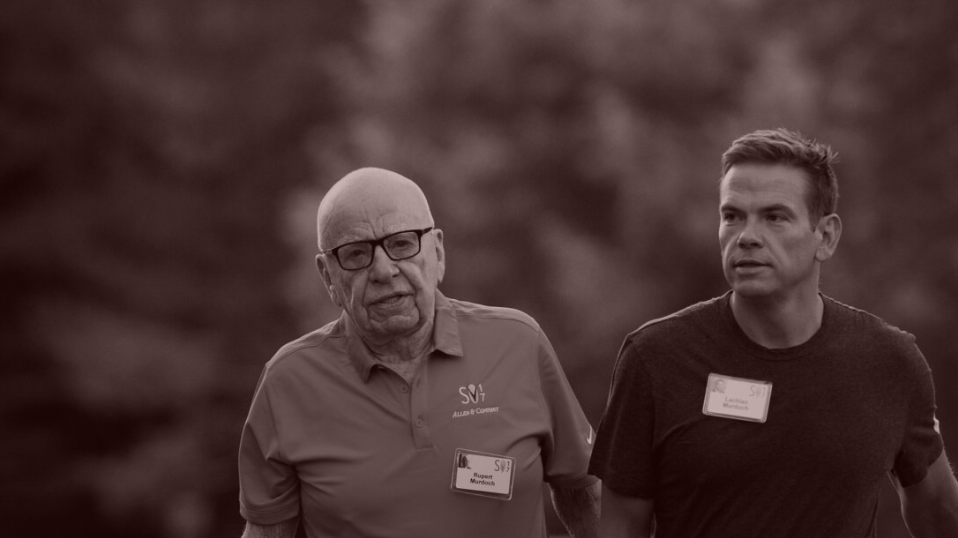
| On Thursday, in a move at once momentous and mundane, the 92-year-old Rupert Murdoch announced he would transition to the role of chairman emeritus at Fox Corp. and News Corp., formally passing the reins of what’s left of his international media empire to his eldest and favored son, Lachlan. The announcement predictably induced a flood of obituaries for Murdoch’s historic ascent from a provincial Australian newspaper heir, seven decades ago, to the incomparable international media baron whose indulgence with oversized-all-caps right-wing populism forever coarsened the civic and political culture in at least three of the world’s leading democracies and, in the inadvertent coup de grace, helped deliver Donald Trump to the White House. Along the way, Murdoch also fleeced Bob Iger for $71 billion.
Of course, Murdoch is not dead, not yet, nor is there any indication—so long as he is of relative health and sentience—that he plans to relinquish his throne. Indeed, Thursday’s announcement effectively formalized a corporate arrangement that has already been in place for years—one wherein Lachlan officially runs the business day-to-day, quarter-to-quarter, while his father, who still controls the company by virtue of his voting shares, weighs in as early and often as he wants and inevitably finds a receptive, deferential audience. “In my new role, I can guarantee you I will be involved every day in the contest of ideas,” Rupert wrote in his memo to employees. “When I visit your countries and companies, you can expect to see me in the office late on a Friday afternoon.”
Which raises the question: Why now? Perhaps it is his health; for every Murdoch associate who tells you he’s “sharp as a tack,” there’s another friend or interlocutor who says his age is really starting to show—“fading,” “addled,” etcetera. And how can it not? He’s 92. Others have posited that Murdoch is trying to distance himself from the company ahead of the impending Smartmatic defamation lawsuit, an interpretation that seems to grossly underestimate the acumen of Smartmatic’s lawyers, who presumably know that Rupert’s post-scandal title transfer will not save him from the witness stand. Among the many ludicrous claims, Murdoch biographer Michael Wolff proffers that Rupert did this because of damning allegations in his new book. Wolff now calls it “the book that took down Rupert.” Not quite, though Rupert’s improbable timing may well furnish his chronicler with another Hamptons house.
One of the more plausible interpretations I’ve heard, best articulated by my Puck partner Matt Belloni on Thursday night, is that Rupert is formalizing the succession plan in order to preserve the company after his passing, when voting power will be divvied up among his four eldest children: Lachlan, James, Liz and Prue. For years, conventional wisdom has held that the more liberal children—led by James, who abhors Fox News, and Liz, who is said to want an exit—will try to stage a mutiny, wresting control from Lachlan in order to cleanse Fox News of its toxicity, and then perhaps sell the company in its entirety.
If Lachlan proves effective as the sole chairman and C.E.O. in the eyes of Wall Street analysts and investors, it may become harder for the martyr heirs to execute such a plan. “Setting Lachlan up as sole chairman and C.E.O. of Fox ... telegraphs to shareholders, the media/political community, and, perhaps most importantly, to his two adult daughters, that these are his wishes, regardless of what silly popularity contest a trust might enable,” Matt writes. “Now, if Prue and Liz side with James and his supposed plan to blow up Fox News into a ‘force for good’—one that would almost certainly cost the company, and the family, billions of dollars in profit—they would be formally rebuking their father, rather than simply installing someone to replace Rupert.”
Alternatively, the most likely scenario may be the least sexy, and most obvious. For much of his seventy-year career, Murdoch reigned over a highly influential global media and entertainment empire with movie studios, television networks, live news and sports assets, newspapers, etcetera—all of which were at the height of their powers, and which afforded him substantial political and cultural influence around the globe. Now, the golden age of film, of television and certainly of newspapers and book publishing has come to an end; across the industry, legacy assets are being managed through structural decline, and in some cases sold off for parts. Murdoch saw this coming years ago, of course, and offloaded what he could to Disney at a sweetheart deal. Had he been able to, I’ve been told by sources familiar with the Murdoch-Iger negotiations, he would have sold the news, sports and publishing assets as well. (One thing HBO’s Succession certainly gets right is the patriarch’s lack of faith in his heirs’ capacity for running the empire.)
What’s left is the influence, but even on that front, the newspapers and tabloids obviously no longer command the authority of yesteryear. Meanwhile, Fox News in the post-Ailes era has become a Frankenstein monster that Murdoch can no longer fully control, fomenting a populist, anti-establishment, anti-factual-reality fervor that, in addition to ushering in Trump (a “fucking idiot,” by Murdoch’s own account) and dramatically bastardizing the Republican party, has forced Murdoch to sustain material consequences, the $787 million Dominion suit most notable among them. Meanwhile, Fox’s influence over conservatives, while still strong, is tested every day by new challengers willing to venture further still into the conspiratorial fever swamps—including, most recently, Tucker Carlson.
Indeed, Rupert’s empire has been carved up, and he’s smaller and less relevant (and older) than before. Weighed against what once was, it’s probably just not all that much fun anymore. And, of course, the day will inevitably come, sooner rather than later, when he or his heirs will have to sell—to whom, though? Elon?—if only because there’s never been a better time to divest linear assets, save for yesterday and every day before. And, by the way, maybe Lachlan is finally ready. Although, all things considered, you have to ask yourself: What is he actually inheriting? |
|
|
| Earlier this week, The New York Times announced that it would shutter its sports desk and give The Athletic’s 400-some journalists full reign over the beat. The move—an attempt to further integrate the Athletic into the Times and justify last year’s still-very-questionable $550 million acquisition—has set off a wave of self-righteous protest among Times veterans and union members mourning the fall of the house that John Kieran built.
The agita is somewhat understandable: The Athletic’s brand of journalism, and its aesthetics, are by no means as distinguished as that of the Times—at least not yet. The experience of clicking through from the Times homepage to an Athletic article still feels like arriving at a Michelin-starred restaurant only to be told you’ve been seated at their fast-casual outdoor pop-up.
On the other hand, the public displays of affection for a relic of a desk that can’t keep pace with new competitors seems like the worst of Times rubber room culture. Times people point to coverage of the doping scandal and concussions with pride—and they’re not wrong. But, the truth is, the last decade plus has seen a cavalcade of innovation in sports media—Grantland, The Ringer, Bleacher Report, Barstool, Front Office Sports, Defector, and most recently, The Athletic—while the Times stuck to its old editorial formats. The determination of A.G Sulzberger, Meredith Kopit Levien and other Times Co. leadership to make hard decisions like this is a reminder that this is still a publicly traded company, not a museum or sinecure for out-to-pasture institutionalists. (By the way, Arthur Sulzberger, A.G.’s dad, used to repeat a mantra like that quite often.)
The challenge, of course, will be turning The Athletic into an influential—and profitable—institution in its own right. And it’s a challenge that entails better writing, less listicles, more ambitious work, and elevation. (These are the growth pains of bringing reformed regional beat writers into the Times fold.) Presumably, that’s why they poached Steven Ginsburg, once a long-shot heir to Marty Baron’s throne, to lead the charge. But judging by the product at present, that still remains an uphill climb. |
|
|
| And finally, a funny thing happened on CNN last night. Abby Phillip, the network’s newest primetime talent, opened her show with a scathing, no-holds-barred assessment of Rupert Murdoch’s influence. His legacy, she said, “is outrage porn, partisan red meat, stoking relentless culture wars.” She then played a six-minute montage of the network’s most egregious and cringe-worthy remarks, intended as a selective compendium of evidence demonstrating “the mess” that Murdoch had made of American culture and politics.
An unapologetic attack on modern-day conservatism, as well as a rival network, Phillip’s commentary felt like something viewers might expect to find over on Rachel Maddow’s MSNBC—or, more to the point, on the CNN of Jeff Zucker’s latter years. That is notable, of course, because, despite recent leadership changes, the network continues to be controlled by the very same people who less than two years ago called for the network to take a more measured, less polarizing approach to their report. One can only imagine what John Malone thought of it.
Earlier this week, I reported that incoming CNN chief Mark Thompson had held meetings and calls with top producers and talent in which, among other things, he encouraged them to abandon the anxieties about editorial bias that weighed on them in the Licht era, expressed a desire to better distinguish the staid primetime hours by taking a “bolder” approach to covering stories, and described himself as “a firewall” between the journalists and the the parentco. It seems they took him at his word. |
|
|
|
| FOUR STORIES WE’RE TALKING ABOUT |
 |
| The Kamala Swap Fantasy |
| Calls to drop Harris from the 2024 ticket are as predictable as they are pointless. |
| PETER HAMBY |
|
 |
|
 |
| Trump’s Imperfect Call |
| Dish on Trump’s furious fundraising request to Peter Thiel, an FTX legal bombshell, and more. |
| THEODORE SCHLEIFER |
|
 |
|
|
|

|
 |
|
|
|
Need help? Review our FAQs
page or contact
us for assistance. For brand partnerships, email ads@puck.news.
|
|
You received this email because you signed up to receive emails from Puck, or as part of your Puck account associated with . To stop receiving this newsletter and/or manage all your email preferences, click here.
|
|
Puck is published by Heat Media LLC. 227 W 17th St New York, NY 10011.
|
|
|
|