Greetings from Los Angeles, and welcome back to In the Room. Ted
Turner, the pioneering media titan and innovator behind the 24-hour news cycle, has died. His ambition and risk tolerance were legendary, as was the sheer audacity of his self-conception. He once told Reader’s Digest that he was “trying to set the all-time record for achievement by one person in one lifetime.”
But his most notable quality was his dedication to manifesting the vision for CNN—which, at the time, seemed absurd and financially suicidal. Ted claimed to have
lived on the office couch for CNN’s first decade, and the network’s own obit notes his penchant for “sauntering into the newsroom wearing a bathrobe.”
It’s hard to spot the entrepreneurs in media today with similar ambition and missionary zeal, but the industry sure could use them. This afternoon, several executives sent me their remembrances of Ted, but I was most intrigued
by this line from Mark Lazarus, the C.E.O. of Versant, who cut his teeth at Turner: “His legacy is not just in what he built, but in how he inspired others to build,” Mark wrote. “The industry will be served well if we can all ‘find our inner Ted.’”
In tonight’s issue, news and notes on James Murdoch’s impending takeover of New York and the Vox Media Podcast Network, which appears to be part of a larger, events-driven influence play.
(Kara and Scott, book your tickets to Basel!) Yes, there’s ample reason to be skeptical of another billionaire-heir media acquisition, but there may actually be a strategic logic here. Either way, there isn’t a better option.
🎙️ Plus, on the latest episode of The Grill Room, political scientist David Sterrett unpacked his latest Media Insight report, which put hard data behind the expanding influence of creators in the
news space. We dug into shifting news consumption habits, the importance of authenticity, and why legacy brands are orienting around star talent rather than institutional identity. Follow The Grill Room on Apple, Spotify, or
wherever you prefer to listen.
Also mentioned in this issue: Ben Shapiro, Shane Smith, Almar Latour, Barry Diller, Bob Iger, Jay Penske, Jim Bankoff, Justin Smith, Katie Hill, Kathryn Murdoch, Lachlan
Murdoch, Laurene Powell Jobs, Meredith Kopit Levien, Pam Wasserstein, Candace Owens, Adam Stotsky, Jeremy Boreing, and many more… |
|
|
|
A MESSAGE FROM OUR SPONSOR |
Starbucks partners can get up to 18 weeks of paid parental leave, even if they work just 20 hours per week. So they don't have
to miss a moment as their family grows - even if they miss out on sleep. |
|
|
|
- The Shapiro shift: Ben Shapiro’s Daily Wire has laid off dozens of employees amid collapsing platform distribution, mismanagement, and deepening ideological fissures in the MAGA ecosystem. A Daily Wire spokesperson confirmed that the conservative media company had “made a difficult decision to restructure the organization, which included layoffs to a number of teams,” primarily at its Nashville production office.
Some of the restructuring can be chalked up to
a strategic shift after the recent departure of C.E.O. Jeremy Boreing, who spent a fair amount of time and capital pursuing costly ancillary film projects, including a historical fantasy series called The Pendragon Cycle. Jeremy stepped down last year, ostensibly to focus on creative content, but presumably because he had lost the room. (Despite his stated cinematic ambitions, Jeremy just launched his own talk show.)
The true cause of Ben’s problems
aren’t operational but ideological. His flagship show has seen extreme audience declines in recent years, sliding from multimillion-view episodes in the Biden era to half a million views today for even its most-popular episodes. Kyle Tharp, an independent researcher, found that Ben has lost 80,000 YouTube subscribers so
far this year, the steepest decline of any major political channel in 2026.
Ben’s competitors in conservative media attribute this to the growing unpopularity of his views—especially his support for Israel—within the MAGA base. Others blame algorithmic shifts that favor more-partisan and conspiratorial programming. (Journalist Ryan Broderick noted that Ben was especially vulnerable to Facebook’s recent platform changes.) It’s also possible that Ben, once an outlier, created a format that was ripped off by a zillion defenestrated conservative TV people and second-rate thinkfluencers who balkanized the market.
Either way, it’s clear that his business is suffering amid a broader MAGA realignment. As you’ll recall, Ben fired Candace Owens for alleged antisemitism two years ago—which, while
undoubtedly the right move morally and philosophically, certainly contributed to the audience fragmentation. Candace is now leading the charge against her former shop, and even claiming, sans evidence, that much of Shapiro’s audience comes through inorganic paid channels. Such squabbles are among the many occupational hazards of playing the partisan media game. - Vice for a price: Vice’s Shane Smith says he is resuscitating the
once-bankrupt mediaco as a “brand partnership vehicle.” In its first partnership, with Adobe Acrobat, Vice will publish reports in Adobe’s PDF Spaces platform, starting with a dispatch from a joint-forces military exercise in Morocco. I don’t begrudge Shane and his C.E.O., Adam Stotsky, for leveraging their relationships with marketers to squeeze what little remains of Vice’s brand equity and parlay it into a branded-content studio. But I’m not sure this
is going to give Adobe the cultural legitimacy or industry sophistication it’s seeking. Leave it to Shane to spot the easy mark, I guess.
- NYT’s new comms chief: The New York Times Co. has tapped NFL and Obama alum Katie Hill to serve as its new global head of communications and external affairs. Katie spent the last five years as comms S.V.P. for the National Football League, and was Obama’s
communications director for the first four years of his post-presidency. Good luck, Katie. I’ll be eager to hear whether serving on the Times’s front lines is easier or harder than the previous gigs.
- And finally…: Barry Diller is back on his “Sell me CNN, already!” shtick. Speaking at the Journal’s Future of Everything event, the media mogul said he’d buy CNN “tonight” if he could, and would love to do
it “before they ruin it any further.” Yes, we all adore Barry (truly), but I have yet to hear an actual plan from him on how he’d save it, or how the incoming ownership group at Paramount Skydance might. Speaking of which… I’m guessing Christiane Amanpour isn’t counting on working
at David Ellison’s CNN.
|
13.1 million: The number of New York Times subscribers
following a 310,000 increase in digital-only subscribers last quarter. The Times is now averaging 330,000 new subscribers per quarter, including print, since the start of last year, and is on pace to meet its goal of 15 million subscribers by the end of next year. Sincere congrats to Meredith and her entire team. Almar Latour and the team at News Corp will report their numbers tomorrow.
And now, the main event… |
|
|
|
The least objectionable of Rupert’s sons is closing on a deal to buy much of Vox
Media in order to complement his current holdings—Art Basel and Tribeca Enterprises—as well as his ambition to build a global TED-meets-Burning Man events brand. Is this the first step toward real cultural influence, or simply his own Penske-esque captive investment? |
|
|
|
This week, after news broke that James Murdoch was finalizing a deal with
Jim Bankoff to acquire New York and the Vox Media Podcast Network for well north of $300 million, I’m told, a source in the market proffered two ways of looking at the acquisition. The optimistic thesis was that James, the liberal-ish outcast of his father’s conservative media dynasty, would use his inheritance to bring “real investment” to the storied mediaco and restore its political and cultural influence—thereby elevating his own status in the process.
Laurene Powell Jobs has done as much for The Atlantic, after all; perhaps James could pull off a similar feat.
The alternate take was that James was merely the new Jay Penske—an heir snapping up subscale “cultural authority” brands to incorporate them into an events-driven, B2B-and-consumer ecosystem. This, too, could be a successful play, albeit decidedly not the outcome that Pam Wasserstein might have imagined for her vaunted
family business, nor a future that Kara Swisher and Scott Galloway might be quite as proud to be a part of. |
|
|
|
A MESSAGE FROM OUR SPONSOR |
Starbucks partners can get up to 18 weeks of paid parental leave, even if they work just 20 hours per week. So they don't have
to miss a moment as their family grows - even if they miss out on sleep. |
|
|
|
The correct answer, as is so often the case, is that both things are likely true. James has been
searching for influence ever since leaving the nest. He lost his first inheritance after Rupert passed the bulk of the empire to Disney, quietly confiding to Bob Iger that neither of his two sons was equipped to run the $71.3 billion company without him. He then lost the remaining Fox fiefdom when his father handed the
reins to the preferred son, Lachlan, who has capably managed a lean, cash-generative linear business while making some selective bets on the post-linear future. But James got a nice chunk of change in the process: billions from the Disney sale, and another $1.1 billion that he and his sisters each got to settle with their dad over the succession plan.
In 2019, James founded his own investment vehicle, Lupa Systems, which went on to acquire majority stakes in the companies
behind Art Basel and the Tribeca Film Festival, and also backed the Indian media investor Bodhi Tree. Most intriguingly, James and his wife, Kathryn, are leveraging the Basel business to create a new Davos-meets-Aspen global ideas festival for their Futurific Institute, a joint venture between Lupa Systems and Basel parent MCH Group.
Speaking to Vanity Fair, a source close to Futurific described the festival as “a contemporary riff on the world’s fair,”
incorporating parts of the Venice Biennale, an evening sale at Sotheby’s, the St. Louis World’s Fair, a TED Talk, and Burning Man. Sure, it has a distinct whiff of Kendall Roy’s “Substack meets Masterclass meets The Economist meets The New Yorker,” but the ambition is real. The inaugural edition is slated to take place in Basel, Switzerland, in 2028. |
It’s not hard to imagine how James might incorporate Vox’s publishing and podcast business into
this global thought-leadership events thesis. Penske certainly provides a template. In recent years, Jay has acquired Dick Clark Productions and a 50 percent stake in South by Southwest, allowing him to transform PMC from a sleepy trade-publishing outfit—Variety, The Hollywood Reporter, Rolling Stone, etcetera—into a vertically integrated culture-and-events empire where journalism serves as the intellectual scaffolding for the higher-margin events and influence
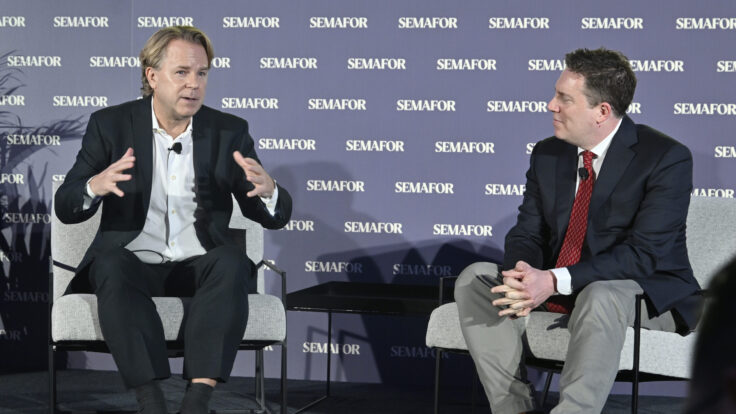
business. (Justin Smith is pursuing a similar vision at Semafor.) One can easily envision James doing the same at Vox: leveraging New York and the podcasts as convening mechanisms for elite communities in tech, politics, finance, etcetera.
Not to be the skunk at the garden party, but the all-important caveat here for James will be the health of Vox’s business itself. As I
reported last month, New York is a $100 million-per-year revenue engine with very thin margins. (At the risk of piling onto one of the most psychoanalyzed father-son relationships on the planet, it needs to be noted that, after forcing out legendary founders Clay Felker and Milton Glaser, Rupert owned New
York from 1976 to 1991.) The podcast network, which brings in $60 million-plus, turns a heftier $20 million-plus profit but is subject to significant key-man vulnerabilities, since Kara, Scott, and just a few other hosts drive the business. It’s also possible that Jim couldn’t get the high-water mark he desired for the audio business, and that James, sensing a vulnerability, got a twofer at a convenient price. Neither would comment.
In any event, that’s James’s circle to square now.
And despite the predictable cynicism surrounding another billionaire-heir media acquisition, there is at least a strategic logic here. James seems smart enough to understand that Vox’s future has less to do with page views than with proximity to influential audiences, powerful networks, and high-end advertisers desperate for signal amid the noise. Whether that produces a durable media institution or merely a very sophisticated Basel cocktail party remains to be seen. But, having to settle for
Vox after losing Fox, at least James appears to get the game he’s playing. That may be the real point of all this—the guy is back in the game. |
|
|
|
Join Puck’s chief political columnist, John Heilemann, as he roams the corridors of power and influence in America on
this twice-weekly interview show, taking you beyond the headlines with the people who shape our culture: icons and up-and-comers, incumbents and insurgents, moguls and machers in the overlapping worlds of politics, entertainment, tech, business, sports, media, and beyond. The conversations are rich and revealing, unrehearsed and unexpected… and reliably impolitic. A Puck-Audacy joint, new episodes drop every Wednesday and Friday. |
|
|
|
A professional-grade rundown on the business of sports from John Ourand, the industry’s preeminent journalist,
covering the leagues, players, agencies, media deals, and the egos fueling it all. |
|
|
|
Need help? Review our FAQ page or contact us for assistance. For brand partnerships, email ads@puck.news. You received this email because you
signed up to receive emails from Puck, or as part of your Puck account associated with {{customer.email}}. To stop receiving this newsletter and/or manage all your email preferences, click here. |
Puck is published by Heat Media LLC. 107 Greenwich St., New York, NY 10006 |
|
|
|
|