Welcome back to The Varsity, live from Puck’s airy South Tribeca office. I’m in town to
toast a bunch of old friends at tonight’s Cable Hall of Fame dinner.
Before we begin, I want to alert you to some pretty cool changes coming to The Varsity next week. I’ve long been a fanboy of Puck’s very own Eriq Gardner, one of the best legal journalists in the country. And, starting April 27, Eriq will take over The Varsity’s Monday column with his typically brilliant analysis on the intersection of sports and the legal system.
That means yours truly will
report and write this private email every Tuesday and Thursday. The Tuesday email will become open to all paid subscribers, and we’re making the Thursday email available exclusively to the Inner Circle, our highest tier of membership that unlocks several perks, including other industry newsletters from Puck authors. Click here to join the Inner Circle or upgrade your account. The genuinely peerless Julia Alexander will continue to contribute to The Varsity, but will also be taking her talents elsewhere across Puck.
🚨 Pod alert: Our guy Marchand is dropping by this weekend, at the tail end of the NFL Draft, to tackle some of the biggest sports media issues, including Mike Tomlin’s move
to NBC, Mark Jones’s exit from ESPN, and (obviously) the latest chatter surrounding NFL media rights. Also, I got a ton of great feedback on yesterday’s pod with NBC’s Jon Miller. Click here or here to listen.
As
always, this issue was created with contributions from Curtis Rowser.
Also mentioned in this issue: Tina Thornton, Scott O’Neil, Brian Rolapp, Mike Cavanagh, Nick Khan, Oscar De La Hoya, Canelo Álvarez, Terence Crawford, Tony Kornheiser, Hans
Schroeder, Jeff Miller, Ted Ullyo, Brendon Plack, Josh Allen, and many more… |
Player of the Week: Tina Thornton
|
It’s not every day that a TV commercial grabs my attention. But ESPN’s “On the Clock”
spot, hyping its first Super Bowl telecast 10 months from now, did just that—from Greeny booing Roger Goodell to Goodell awkwardly hugging the ESPN app. Big hat-tip to Tina Thornton, ESPN’s executive vice president of creative studio and marketing. |
Down to the J.V.: Scott O’Neil
|
Last week, mere hours after Scott O’Neil, LIV Golf’s chief executive, told his
staffers that rumors of the tour’s demise were unfounded, the league’s stream from its Mexico City event went dark for nearly three hours. The following day, O’Neil told TNT that LIV had enough funding to last for this year, but that it needs “to work like crazy … to create a business plan to keep us going.” As that comment went viral, TNT
took the interview off its site, only to repost it later without that comment. Total amateur hour. Down to the J.V., indeed. |
- More layoffs: Earlier today, the PGA Tour gave the pink slip to 56 full-time employees, or 4 percent of its staff, and will not fill another 73 open positions, per SBJ’s Josh Carpenter. Another 30 employees took a buyout late last year. In some ways, it’s no surprise:
Since joining the Tour last summer, C.E.O. Brian Rolapp has tried to pivot the business, pursuing a strategy that involves culling the number of tournaments and setting up a promotion-relegation system.
Of course, as Varsity readers know, ESPN also laid off about 30 employees earlier this month, in part because of the pivot from linear television to streaming. Rolapp was faced with a similar scenario as he pushed through changes to the way the Tour approaches the
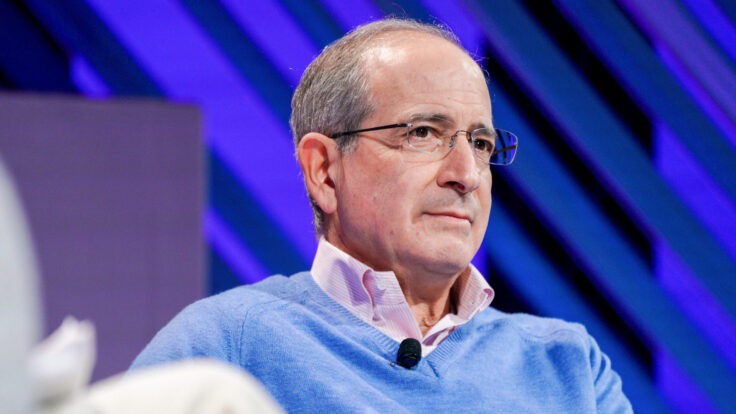
business. - A light at the end of the tunnel: It’s hard to look at Peacock’s $432 million first-quarter loss and think that the streaming service is doing well—especially considering it lost $552 million the previous quarter. But on today’s Q1 earnings call, Comcast co-C.E.O. Mike Cavanagh said that Peacock is “on track to approach profitability for the first time next quarter,” citing its 2 million new subs (it now
counts 46 million total) and 70 percent revenue jump in the first quarter. At least on the surface, “Legendary February”—the planetary alignment of the Super Bowl, NBA All-Star Game, and Winter Olympics—seems to have been a success.
In a report this morning, Craig Moffett lent credence to Cavanagh’s prediction, writing: “Comcast’s
history with Peacock has been that subscribers added during the Olympics and other big tentpole events have tended to stick around. It is, in other words, a strategy that seems to be working.” The report continued: “Peacock is obviously still subscale. Assuming regulatory approval of Paramount’s WBD acquisition, WBD is now off the table as a partner. As we noted last quarter, there may be no obvious partners left. As we’ve noted in the past, however, M&A is not the only way to achieve scale.
Distribution partnerships are another, and arguably a better solution.” - Capitol Hill’s main event: Do you need another example of just how popular the sports business is in Washington these days? Just yesterday, a Senate Commerce subcommittee held a hearing on the future of boxing with WWE’s Nick Khan and former boxer Oscar De La Hoya, featuring sharp exchanges (at least by D.C. standards) in which the two sparred over
the Muhammad Ali Boxing Reform Act, which purports to get rid of all the fragmentation in boxing. De La Hoya testified that such a centralized system “would put corporate profits first, fighters second.”
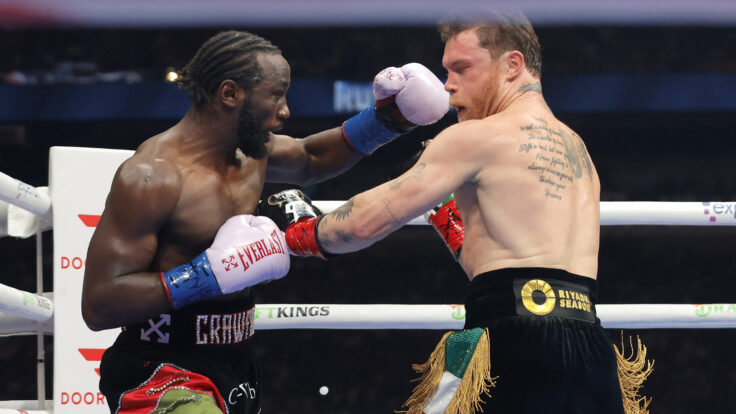
For his part, Khan bashed the current boxing system, referencing the Canelo Álvarez–Terence Crawford fight last September. As you recall, just two months after beating Álvarez, Crawford was stripped of his super middleweight title because
he didn’t pay around $300,000 in sanctioning fees to the WBC. “It would be like if Major League Baseball went to the Dodgers after they beat the Blue Jays and said, ‘We’re going to take this title away from you because you didn’t pay us money,’” Khan said. “They are terrible for the sport. They have ruined the sport.”
|
Now, let’s go to the Capitol… |
|
|
|
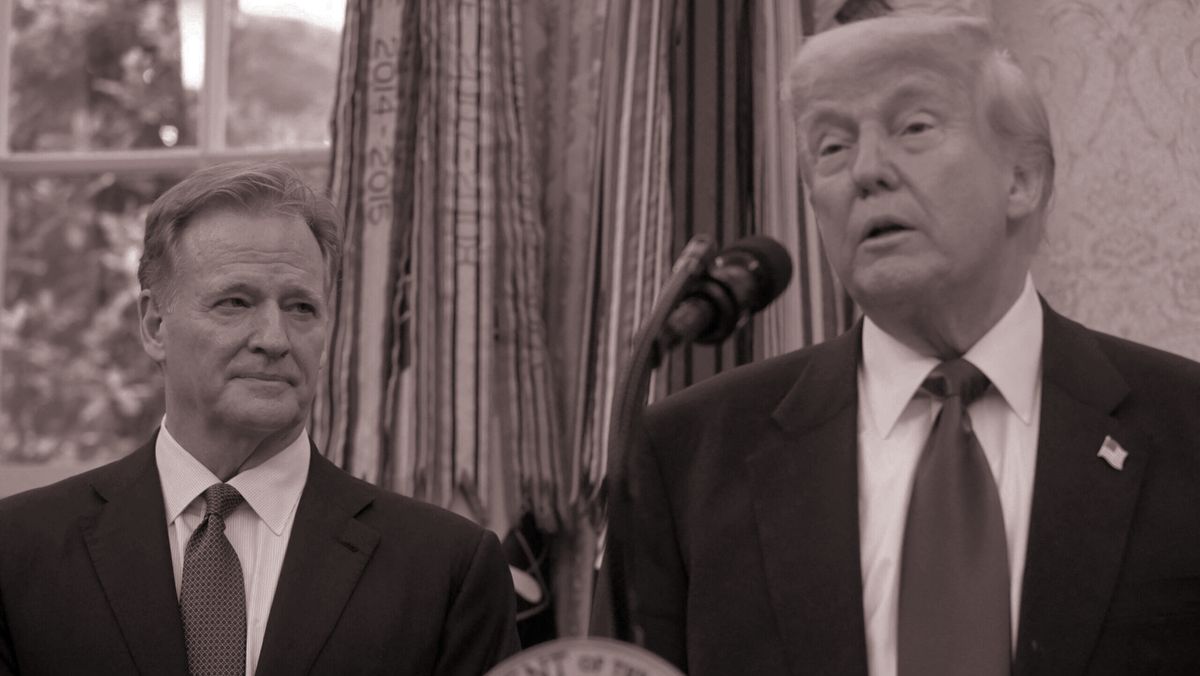
The feds have been breathing down the NFL’s neck all year, and a quartet of league
executives made the pilgrimage to D.C. last week to plead their case. |
|
|
|

| John Ourand
|
|
|
|
This morning, I swung by Tony Kornheiser’s podcast to
discuss the migration of sports to streaming—a longstanding pet peeve for the PTI host, who finds new media both too confusing and too cumbersome. “It’s another example of where I am left behind, and I have to sit in a corner and eat pudding,” the 77-year-old bemoaned on the show.
Kornheiser’s complaints might
seem retrograde to younger, tech-savvy Varsity readers, but they also aren’t new. Fans had been beefing with the atomization of sports long before the F.C.C. opened an inquiry into the NFL’s media rights strategy back in February, or the Justice Department’s investigation, several weeks later, into whether the league has committed antitrust violations. In both public pronouncements and private conversations, regulators and lawmakers have set their sights on the NFL in particular, which has been
looking to reopen its media contracts and potentially sell more game rights to streaming companies.
After spending weeks hearing all that noise, a quartet of top NFL executives—Hans Schroeder, Jeff Miller, Ted Ullyot, and Brendon Plack—traveled to D.C. last week to communicate their message to lawmakers: The league’s media strategy has been rooted in broadcast from the beginning. Despite some packages of games likely
headed to streaming services, the league’s fealty to the airwaves is not about to change. “There’s not a single sports league, or even a broader media property, that does anything close to what we do to distribute our content through broadcast,” Schroeder told me a couple of days after his meeting with F.C.C. staff.
In their conversation with the feds, the NFL execs pulled out the stats that you all know by heart: Every single NFL game, including the ones sold to Amazon, Netflix, and
YouTube, is available on local broadcast stations in the home markets, they noted; plus, 87 percent of NFL games are distributed on broadcast. “That’s been a core of our distribution strategy for a very, very, very long time,” Schroeder told me. Beyond the numbers, the quartet came armed with other talking points, nodding to the fact that even though the NFL Draft had been exclusive to ESPN—a cable channel—for decades, the league pushed to expand its reach to broadcast nearly a decade ago. “We
saw an opportunity to distribute even more broadly, and we put it on Fox [in 2018],” Schroeder said. “Now, we’ve been distributing it on ABC as well.”
Another example they used highlighted how local broadcast stations already are a big part of the league’s media strategy. “To use Wyoming as an example, maybe those stations would get a lot of Broncos games,” Schroeder told me. “But now, because there’s a lot of interest in Josh Allen, who went to the
University of Wyoming, maybe they’ll get more Bills games. That’s a great example of the depth, thoughtfulness, and focus that we have both at a national broadcast network level and a local affiliate level.” |
And yet, demur as they might, it’s also undeniable that streaming has become a big part of
the league’s media strategy. Amazon first started carrying Thursday Night Football all the way back in 2017, and picked up its exclusive rights in 2022. Meanwhile, Netflix, YouTube, and Yahoo have all carried NFL games, and the league is close to completing a deal to sell a five-game package next season to YouTube. Moreover, as the NFL is considering renewing its media rights deals, it’s used the threat from streamers as a way to get traditional broadcast to increase their
bids.
The league dismissed the idea that the five-game package currently on the market is an example of the migration of games to streaming, given that those games were never on broadcast anyway. ESPN carried four of them on its cable channel and one on its streaming service for the past couple of years. When the NFL completed its deal to take a 10 percent stake in ESPN, the rights to those games reverted to the league. “Wherever those games end up, they will have even more distribution
than they’ve had over the past three or four years,” Schroeder told me.
That’s another aspect of the league’s pitch to regulators: The streaming services that have carried NFL games are widely distributed. “Our fans are already spending a lot of time there,” Schroeder said. In fact, a deck the NFL executives used during their F.C.C. meeting showed that there’s more overall video consumption on digital platforms than on linear TV. “When you look at those percentages, and then at our model,
it’s pretty stark,” Schroeder added. “We’re distributing games on broadcast, which is a good model that works for us. But those percentages also paint a picture of why we feel we want to be on these other platforms.” |
On the NFL’s potential five-game deal with YouTube: “If this deal goes through
and the games stay in front of YouTube’s paywall, it will prove that the NFL doesn’t believe its own spin. If the league truly believed in the legality of its pay TV deals, it certainly could have got more from a paywalled streamer. The NFL has to know it’s holding a losing hand.” —A media executive
On D.C.’s interest in the NFL: “Re: the recent Puck story headlined Trump’s Anti-NFL Crusade. For the love of God, it’s not Trump. You know
exactly who it is.” —A sports business executive
On MLB’s NBC deal: “Your podcast interview with Jon Miller was riveting. The part when Miller talked about MLB sacrificing revenue for reach really resonated with me. It’s good to know the long-term health of the game is part of the conversation at that level.” —A media executive |
Have a great weekend. See you Monday,
John |
|
|
|
Join Puck’s chief political columnist, John Heilemann, as he roams the corridors of power and influence in America on
this twice-weekly interview show, taking you beyond the headlines with the people who shape our culture: icons and up-and-comers, incumbents and insurgents, moguls and machers in the overlapping worlds of politics, entertainment, tech, business, sports, media, and beyond. The conversations are rich and revealing, unrehearsed and unexpected… and reliably impolitic. A Puck-Audacy joint, new episodes drop every Wednesday and Friday. |
|
|
|
An essential, insider-friendly Hollywood tip sheet from Matthew Belloni, who spent 14 years in the trenches at
The Hollywood Reporter and five before that practicing entertainment law. What I’m Hearing also features veteran Hollywood journalist Kim Masters, as well as a special companion email from Eriq Gardner, focused on entertainment law, and weekly box office analysis from Scott Mendelson. |
|
|
|
Need help? Review our FAQ page or contact us for assistance. For brand partnerships, email ads@puck.news. You received this email because you
signed up to receive emails from Puck, or as part of your Puck account associated with {{customer.email}}. To stop receiving this newsletter and/or manage all your email preferences, click here. |
Puck is published by Heat Media LLC. 107 Greenwich St., New York, NY 10006 |
|
|
|
|