 |

|
|
Welcome to the latest edition of The Varsity, my twice-weekly private email that covers everything off the field.
A lot of sports business executives are being forced to make a tough decision this weekend: Should they fly to Cleveland for the women’s Final Four or attend the conclusion of the men’s tournament in Glendale? (I imagine that the outcome of tonight’s Iowa-LSU game will impact the calculus a fair bit…) As for me, I will be in Philly for WrestleMania, which I’m expecting to be filled with New York-based sports execs who were sold on the short commute and Nick Khan’s dynamism.
Set your calendar: CNBC, which has been looking to make more of a move into covering the sports business over the past year, will host an L.A.-based conference in conjunction with Kevin Durant and Rich Kleiman’s Boardroom, which just happens to be Puck’s neighbor on West 17th Street in Chelsea. The two groups scheduled their second annual “Game Plan Summit” for Sept. 10. It is described as the centerpiece of a “multiyear partnership.”
Like all my work, today’s email is securely behind Puck’s impenetrable paywall. And remember, we now count by name all the cheapskates who are forwarding this email, and we send your names right to the I.R.S. for an audit. If this keeps up, we’ll subscribe you to Marchand’s new polka dance video series.
Let’s get to it…
|
|
A MESSAGE FROM OUR SPONSOR
|
| |
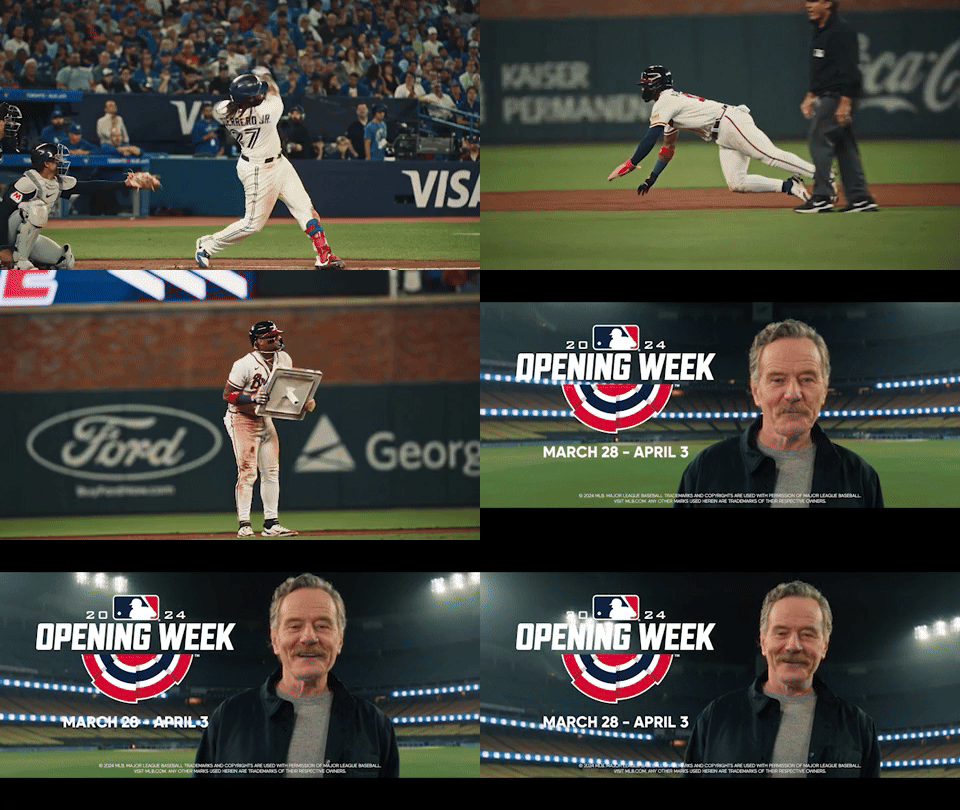 |
Dreams of Postseason glory start now with the beginning of a new Major League Baseball season. Because now is the time where anything can happen, where an unknown can become a household name, and where any team can stake their claim as a World Series contender. Can the star-studded Dodgers reach the World Series again? How about those young Orioles? Are the defending champs — the Rangers — able to become the first repeat World Series champions in over 20 years? It all starts now and you’re not going to want to miss a single moment. Visit any ballpark or go to MLB.com to see what everyone is talking about.
|
|
|
|
|
- Caitlin vs. Angel vs. Paige vs. Juju: If you tuned into ESPN this morning, you would have noticed First Take’s Stephen A. Smith and Shannon Sharpe discussing women’s college basketball in the show’s A block—perhaps the truest sign, particularly on the morning after the men’s final four was set, of female hoops’ significant growth trajectory. Tonight’s Elite Eight games—between Caitlin Clark’s Iowa and Angel Reese’s LSU; and Paige Bueckers’ UConn versus Juju Watkins’ USC—appear to be more anticipated than any men’s tournament game to this point. And while so many are focused on whether the ratings for the Clark-Reese contest will beat last year’s viewership record of 9.9 million, I’m more interested in how the numbers compare to the men’s Elite Eight games from this past weekend.
We won’t have full TV numbers from the men’s tournament until tomorrow, but I would expect the four men’s games over the weekend to average around 7 million viewers. I expect Iowa-LSU notches 8.3 million viewers—far short of last year’s record, which was the tournament’s championship game—but on track to blow away every previous Elite Eight number in the women’s tournament.
What’s your viewership prediction for tonight? Closest to the mark gets a shout-out in Thursday’s edition of The Varsity—and, if I’m feeling generous, a Puck foam finger delivered to your doorstep…
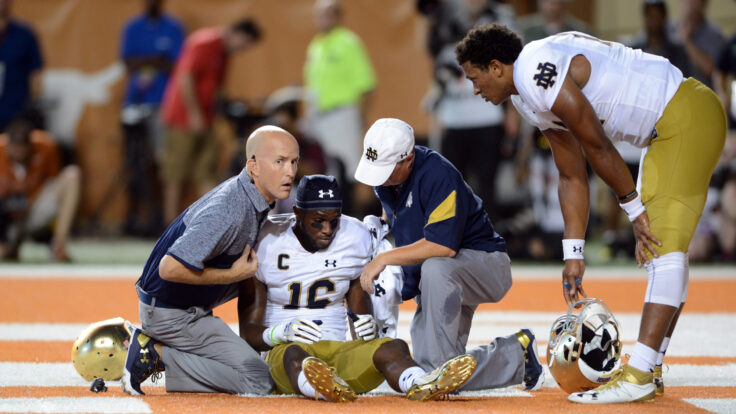
- Independence Day: Pete Bevacqua, the new Notre Dame athletic director and former head of NBC Sports Group, recently sat down with the Irish Illustrated Insider podcast to share his thoughts on the future of college football—and articulate his vision for how his institution, the most important independent in the business, fits into the space.
Bevacqua emphasized that Notre Dame does not want to join the Big Ten or any other conference, and even suggested that the College Football Playoff’s expansion to 12 teams will alleviate some pressure traditionally placed upon an independent institution, which doesn’t benefit from a conference tournament. “The expanded playoffs are a great thing for Notre Dame. It goes a long way toward allowing us to maintain what is such a part of our DNA—being independent in football,” he said. “My anticipation is that it will be 14 teams [eventually]. But in either context, I think we're set up for success there, for sure.”
Bevacqua also discussed his vision for how the N.I.L. phenomenon reshapes the landscape. “We believe firmly that more and more of the operations of N.I.L. are going to move in-house in some form of decree from the NCAA or Congress,” he said. “I think it will, at least initially, stop short of it being permissible for universities to directly compensate student-athletes, but that might happen, too, at some point in the future.”
Of course, Bevacqua has big shoes to fill in replacing the recently retired Jack Swarbrick, who masterfully understood both Notre Dame’s culture and how it needed to adapt to keep the school competitive. And while the expanded CFP will help Notre Dame qualify for the playoffs every year, the professionalization of college athletics and the onslaught of N.I.L. will undoubtedly have a profound impact on South Bend, which remains one of the purest and almost anachronistic distillations of amateur sports—one of the few schools that would never tolerate their football players so much as putting their names on the backs of their jerseys.
- Better Call Kessler: Speaking of all the changes in college sports, make sure that you read my partner Eriq Gardner’s excellent interview with Jeffrey Kessler, a lawyer he describes as “the man who broke the NCAA.” As a lead lawyer in the Alston v. NCAA Supreme Court case, Kessler remains the biggest disruptor in the business. Perhaps the most telling moment in their conversation comes when he says that “we’re maybe halfway down the road” in redefining the economic identity of college sports. Translation: Much more change is coming.
To wit: When Eric asked Jeff where he saw college sports in five years, he responded, “It’ll keep evolving, but it reminds me of the fact that when I started practicing law, there was no free agency in the NFL and there was no free agency in the NBA. It was just barely starting. All the owners said then, ‘Oh, if you allow this, it’s going to destroy the game. Fans won’t like it.’ Guess what? I suspect you don’t even remember the sports without free agency. It’ll be the same thing in college sports.”
- Masters, Inc.: CBS has carried The Masters since 1956—the longest-standing relationship between a network and a sporting event in the history of media. And while the tournament, which tees off on April 8, is billed as “a tradition unlike any other,” it also has a media deal unlike any other. CBS has never had a long-term deal with The Masters in the 68 years that it has carried the tournament. Legend has it that the two have operated on a series of one-year, handshake deals. I can’t confirm specifics—Augusta National is perhaps the most omerta organization I’ve ever covered—but I can tell you that my reporting suggests this legend is largely true and is obviously unique within the business. (ESPN has carried the tournament’s early rounds since 2008.)
Of course, this year’s event will mark the end of Sean McManus’s 28-year run atop CBS Sports. Though David Berson will take over after this year’s tournament, don’t expect anything to change regarding the Augusta deals. For decades, I’ve watched countless hot-to-trot executives try to steal The Masters from CBS and it has never worked, and I suspect it never will. CBS executives have always described it as a partnership more than a media deal.
Expect Berson, who has worked hand-in-hand with McManus for the past 13 years, to continue the tradition unlike any other.
- The Mulkey Chronicles: Kent Babb’s much-awaited piece on LSU coach Kim Mulkey published Saturday morning, and it’s worth reading in full. It’s not a hit job, as Mulkey suggested, but rather a well-reported profile on a subject that did not want to cooperate. Babb’s story got all the attention, but there were other college sports profiles from the weekend that I found just as much fun to read. This Adam Kilgore piece on UConn coach Dan Hurley was great, particularly because it demonstrated the incredible stress octaves that high-level college coaches reach on a daily basis. Another must-read: Bryan Curtis’s profile of Ian Eagle, the CBS announcer who replaced Jim Nantz as the main play-by-play voice for the NCAA Men’s Basketball Tournament, for The Ringer. Curtis chronicles how Eagle—the son of a comedian and a singer—became one of the most-liked voices in the broadcast booth. And, for what it’s worth, Curtis remains one of the most gifted stylists of any sports writer at work today.
|
 |
| Give Me Liberty |
| Nearly a decade after transforming F1 into a juggernaut, John Malone’s Liberty Media is looking to employ the same makeover on its newest multibillion-dollar portfolio toy, MotoGP. |
|
|
|
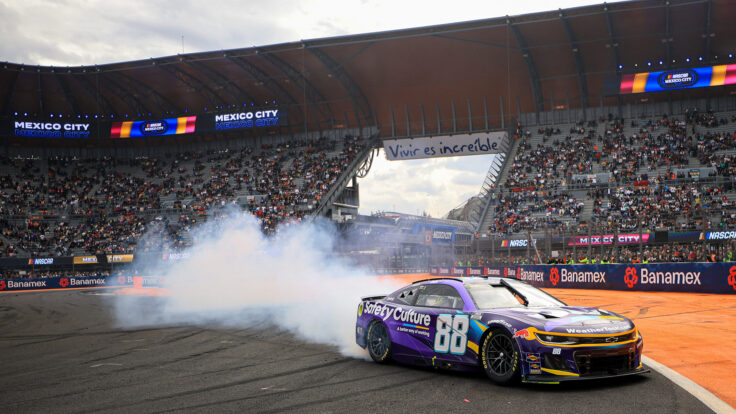
| Back in ye olde days of 2016, media impresario John Malone made one of the least appreciated masterstroke deals of his long and storied career. His Liberty Media, which was then run by Greg Maffei, acquired the commercial rights to Formula One, the cliquish racing competition that seemed to be run as some sort of multibillion-dollar boutique or European heirloom.
At the time, of course, this deal was a real head-scratcher. The rights business for the international open-wheel championship had been run by British billionaire Bernie Ecclestone for four decades, and its economics had been mismanaged and atrophied: Revenue was dropping, media deals were largely visionless, and sponsorship opportunities had desiccated. Perhaps most importantly, American interest in the sport had stalled. So Liberty brought in sports media veteran Sean Bratches as managing director of commercial operations and gave him the remit to turn this shit around.
In particular, Liberty wanted Bratches to evolve F1 from a low-ambition and stay-in-its-lane (no pun intended) motorsports company into, what else, a global media brand—you know, the sort of transformation that was taking place in one way or another at Professional Bull Riding or UFC, among other once-niche sports platforms. The ensuing years, of course, ushered in an F1 revolution: a slew of new media deals, a transformative new Netflix docuseries, innovative sponsorship ideas and categories, and new races in critical growth markets, namely the United States.
Now, Liberty will apply that playbook to MotoGP, which it majority-acquired today from the Spanish company Dorna Sports. Liberty paid $4.5 billion for an 86 percent controlling stake in the motorcycle racing series, which it now intends to transform into a two-wheeled global entertainment edifice of consequence. Similar to Eccelstone’s stewardship of F1, Dorna has owned MotoGP forever—since 1992, at least—and it has had trouble expanding into some large and lucrative markets. The racing series is popular in Italy and Spain, but has remained largely untapped in North America, South America, and Asia. |
|
|
|
|
| Naturally, the MotoGP attempted turnaround will start with upgraded media rights packages. Nearly a decade ago, Bratches memorialized his leadership of F1 by moving its U.S. TV deal from NBC to ESPN despite the fact that Bristol was not paying a licensing fee for the competition. But Bratches made the bet, perhaps quixotically, that ESPN’s airwaves would enhance his sport’s value and lead to a better negotiating position in the future. The gamble paid off brilliantly. About two years ago, ESPN signed a three-year deal worth around $80 million per year.
Not surprising, Liberty executives hypothesize that MotoGP’s global broadcast rights are also undervalued. Just last month, MotoGP left NBC to sign a deal with TNT Sports, which started carrying races live on TruTV.
Indeed, they may find that the sports rights market is drying up for big deals. As I have written ad nauseam, the Pac-12 shut down when it couldn’t find a TV deal, and MLS had to go behind Apple TV+’s paywall in order to guarantee recurring revenue.
But the Liberty brain trust believes fervently that these inclement market conditions are only impacting middle-barbell leagues. The big players, like the NBA, will always thrive. As will, according to their logic, smaller niche leagues. There are places on traditional TV for a sport with growth potential that brings in around $50 million in media rights, they believe. “Walking-around change,” is how one executive described it, especially for a sport whose 45-minute races are an inducement for TV networks and Gen Z audiences.
Malone is probably right. Given the infinite changes to consumer behavior, live sports has become the last bastion of predictable audience; executives generally know how many viewers an event will generate week-in and week-out, and can guarantee those numbers and sell around them. Media companies can aggregate large audiences and monetize them. Everyone does fine. Malone & Co. may not have another F1 on their hands—that would be striking gold twice in a decade—but they’ve probably got a winner, regardless. |
|
|
| “Okay, the new newsletter is awesome (congrats!). But what is with all your fancy words? We sports people like our words the way we like our cable tier placement for our sports networks: basic. Denouement? I’m guessing that’s not a defenseman for the Maple Leafs? I am happy to pay for the great content, but I didn’t know I’d also need to buy a premium subscription to dictionary.com!” —A team owner
“I must have missed my invite to your cool party.” —A global investment executive
“Thanks for the invite to your launch party???” —A sports sales and marketing executive
“You should have had your launch party in L.A.” —A sports executive and a happy Los Angeles-based subscriber to The Varsity |
|
|
See you Thursday,
John |
|
|
|
| FOUR STORIES WE’RE TALKING ABOUT |
 |
| NBC Blame Games |
| On the palace intrigue consuming NBC News post-Ronnaghazi. |
| DYLAN BYERS |
|
 |
| Shari’s Silver Lining |
| Chronicling the latest twist in the Paramount Global bidding wars. |
| WILLIAM D. COHAN |
|
 |
| Tubi or Not Tubi |
| Revealing the alchemy behind Tubi’s Gen Z foothold. |
| JULIA ALEXANDER |
|
 |
|
|
|

|
 |
|
|
|
Need help? Review our FAQs
page or contact
us for assistance. For brand partnerships, email ads@puck.news.
|
|
You received this email because you signed up to receive emails from Puck, or as part of your Puck account associated with . To stop receiving this newsletter and/or manage all your email preferences, click here.
|
|
Puck is published by Heat Media LLC. 227 W 17th St New York, NY 10011.
|
|
|
|