 |
 |
|
|
|
Forward this email to a friend!
|
|
For our second anniversary, subscribers can share the benefit of Puck with an exclusive code (INSIDEACCESS) that gets your network 30% off.
|
|
|
|
|
|
Welcome back to In The Room, I’m Dylan Byers.
|
|
Carriage disputes come, and carriage disputes go—but this presently unfolding, highly public fracas between Disney and Charter has the inklings of a truly transformational moment for both the linear and streaming landscapes, alike. Tonight, my exchanges with insiders on which way the winds are blowing.
|
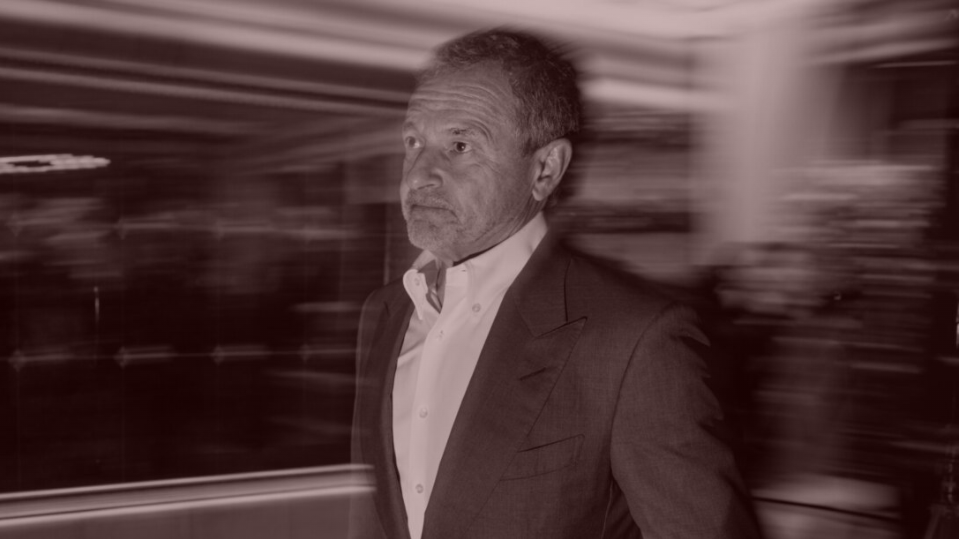 |
| Iger’s ESPN Game of Chicken |
| Notes on the existential reality undergirding Disney’s white-knuckled negotiation with Charter. (“The game is over,” as one media executive put it.) |
|
|
|
| Last Thursday, as I went to turn on ESPN2 to catch my nightly fix of U.S. Open tennis, I received a text from a Puck colleague bemoaning the fact that his plans to watch college football on ESPN had been foiled by a new carriage dispute between Disney and Charter Spectrum, the cable TV operator that serves as the primary provider for both the Los Angeles and New York City media markets.
As I stood there registering his grievance, I looked up to find that we were brothers in arms: my Alcaraz vs. Lloyd Harris match, like his Florida-Utah game, was hidden behind a statement in which Charter admonished Disney for creating “hardship” for consumers. I quickly found my workaround via YouTube TV—I’d like to think my profession justifies these dual expenses, though I’m not at all sure how—and left my colleague to wallow (“I just gave up,” he told me). This week, he also signed up for YouTube TV and, as of this writing, is still trying to cancel his Spectrum subscription. I’ll no doubt find myself on that odyssey soon enough.
Carriage disputes come and carriage disputes go, as Matthew 24:6 states, but the following morning it became evident that this one was different. “We’re on the edge of a precipice,” Charter C.E.O. Chris Winfrey said on a conference call with Wall Street analysts last week. “We’re either moving forward with a new collaborative video model, or we’re moving on. This is not a typical carriage dispute. It’s significant for Charter, and we think it’s even more significant for programmers and the broader video ecosystem.” |
|
A MESSAGE FROM OUR SPONSOR
|
 |
Your health insurance company and their pharmacy benefit manager (PBM) can steer you toward pharmacies that make them more money. How is that possible? Because they own the pharmacy, too. No one should stand between you and your medicine
See what else PBM middlemen are up to. |
|
|
| Shortly after Winfrey’s remarks went public, I got a call from a veteran media executive and loyal reader: “The thing you keep writing about—it’s finally happening,” he said, referring to the inexorable decline of linear media (a preoccupation here, admittedly). “The bottom is starting to fall out of the core business… The game is over.” Another executive called it a “Marlboro Friday” moment, implying it could devastate the value of media companies that own linear networks almost overnight. (It’s worth the Google search.)
It’s quite possible Disney and Charter will come to terms. It’s also very possible that they won’t. And if they don’t, it could indeed be a watershed moment for the entire television industry. In essence, Charter says that it is untenable for Disney to continue to demand higher cable subscription fees now that it has moved its best programming to its streaming services, Disney+ and Hulu, and publicly signaled its intention to move ESPN’s best live sports over the top, as well. In order to justify the rising costs, Charter is asking Disney to provide the ad-supported versions of these streaming services to its subscribers at no extra cost—a move Disney is unlikely to acquiesce to, even if there’s a certain logic to it. If Disney is unwilling to play ball, Winfrey says Charter will simply move on. The profit margins from its Pay TV business, he argues, are no longer high enough to rationalize its continued investment in a declining business.
This is more than the usual eleventh-hour posturing (though it is also posturing, to be sure). Charter, the nation’s second-biggest cable operator after Comcast, is publicly acknowledging that the cable bundle model that has sustained the media business for decades—minting tens of billions of dollars in annual revenues for the likes of Disney, NBCU, Warner, et al., and fat paychecks for their C.E.O.s—is totally broken. More importantly, Charter is declaring that it is effectively indifferent to a future without its pay TV business. And it is doing all of this just as the American football season—the last bulwark against legacy television’s decline—is getting underway. (ESPN holds rights to Monday Night Football and myriad college football games.) “It’s hard to describe the stress right now on the system,” one veteran media executive said. |
| Transformation Complications |
|
| “In economics,” Rudiger Dornbusch once said, “things take longer to happen than you think they will, and then they happen faster than you thought they could.” (Hemingway’s version was pithier.) Heading into the autumn, it feels as though the pace of transformation is about to speed up dramatically, as legacy brands finally abandon their sinking linear steamships for smaller streaming speedboats, destination unknown.
We are in the “everything on the table” era, after all, when Bob Iger is publicly floating an ABC sale and seeking a strategic partner for ESPN, which in turn has declared its intention to move its flagship sports rights—NFL, NCAAF, NBA, my beloved ATP Grand Slam, etc.—over to streaming in a matter of years, if not sooner. Farther down the linear totem pole, Warner Bros. Discovery has said it will start simulcasting some of CNN’s most-watched hours on CNN Max, testing the limits of a longstanding industry consensus that such moves would violate existing pay-TV contracts. “Each company is dealing with their version of this transformational moment,” Comcast chief Brian Roberts said today at a Goldman Sachs conference. |
|
|
| Of course, nothing matters so much as what Disney does with ESPN, which holds the entire cable bundle together. Once ESPN shifts the flagship product to streaming, the total addressable market for cable subscriptions could be driven down to as low as 40 million or 50 million households, at which point every linear network will be forced to downsize significantly, managing their way to irrelevance. And ESPN, which was once subsidized by the de facto private tax every cable subscriber was forced to pay for the right to watch the channel, even if they didn’t care a lick about sports, will now have to adapt to a world where it can only charge the viewers who are actually willing to pay for it. They’ll get my colleague and me to pony up, to be sure. But as I reported in May, even the leadership in Burbank and Bristol know that they won’t be able to charge us enough to recoup the linear losses. Hence the need for that as-yet-to-be-determined “strategic partner.”
You don’t need to be a neo-Keynesian, like Dornbusch, to understand the nightmarish picture emerging across the cable landscape. Carriage disputes may be quotidian affairs, but for years neither the medicos nor the distributors wanted to upend the applecart. Now, however, it’s increasingly clear that Iger isn’t simply operating in the everything on the table era—he’s also effectively entered the IDGAF era of his storied executive career. He’s aware that the frothy industry he helped mold is in total chaos and that he has one of the rare assets—if not the only true asset—positioned to survive the rubble. He’s not here to make friends with guys like Winfrey.
Without getting philosophical, there is an odd poetry in the media business these days as the stewards of these behemoths, sorting through the turbulence, are the very Boomers who created the business—not just Iger but David Zaslav and John Malone at WBD and Brian Roberts, too. (Notably, Malone’s Liberty Media owns a major stake in Charter; Roberts’ Comcast, of course, is the largest cable provider in the country.) On the one hand, no one is more qualified. But on the other, this isn’t the world they bargained for. |
|
|
|
| FOUR STORIES WE’RE TALKING ABOUT |
|
|
|
|
|
|
|
 |
|
|
|
Need help? Review our FAQs
page or contact
us for assistance. For brand partnerships, email ads@puck.news.
|
|
You received this email because you signed up to receive emails from Puck, or as part of your Puck account associated with . To stop receiving this newsletter and/or manage all your email preferences, click here.
|
|
Puck is published by Heat Media LLC. 227 W 17th St New York, NY 10011.
|
|
|
|