Welcome back to The Varsity, our thrice-weekly email on all the
off-the-field deals being cut in the owners’ suites. I’m in D.C., binge-watching The Studio on Apple TV+—Puck’s own Matt Belloni steals all the scenes!—since the Orioles season is effectively over, and Marchand continues to screw up my sancerre preferences.
At deadline: Welcome to the new era of Skydance. The F.C.C. voted to approve Skydance’s merger with Shari Redstone’s Paramount
Global, with the deal closing August 7, per reporting by Puck’s Dylan Byers and Kim Masters. More to come, of course. Expect big changes in news and entertainment. But word is that CBS Sports will remain unaffected.
🎧 Pod alert: Lloyd Howell Jr.’s disastrous two-year reign as the NFLPA’s executive
director ended with his resignation last week, throwing the players association into what ESPN’s Don Van Natta Jr. has described as “the worst crisis in [its] 68-year history.” D.V.N. joins The Varsity this weekend to describe what happened and where the NFLPA goes from here. Also, make sure you listen to yesterday’s pod: My former
SBJ colleague Bret McCormick shows how team owners have shifted their focus from media deals to real estate ventures. |
Player of the Week: Bill Belichick
|
North Carolina announced yesterday that it has already sold out its season and single-game football
tickets. It’s the fastest sell-out in the program’s long history—thanks, no doubt, to their incoming, six-time Super Bowl–winning coach (and, perhaps, some curiosity about how his style will play out in the college game… and maybe even his surprisingly colorful personal life, too). We’ve seen this kind of excitement before. A couple years ago, Colorado hired Deion Sanders, and Fox developed a programming and marketing strategy around the team. Expect ESPN to use
a similar blueprint this fall with UNC. Now, the Tar Heels just need to win some games… |
Down to the J.V.: Pat McAfee
|
The good news, I guess, is that McAfee finally
apologized for spreading a false internet rumor about the romantic life of an Ole Miss student on his ESPN show back in February. Of course, the apology came five months late, and, not surprisingly, it sounded as if it came out of a huddle of lawyers. |
- R.I.P. Hulkster: When I saw that Hulk Hogan died today, at the age of 71, my thoughts went to May of 1985, just a couple months after the first WrestleMania. That was when NBC launched Saturday Night’s Main Event in the Saturday Night Live time slot about once a month, when the show was in reruns. Dick Ebersol, who’d previously worked on SNL, spearheaded the series, which marked the first time that wrestling had
been on a national broadcast schedule since the 1950s.
Ebersol depended on characters like Hogan to popularize the series. After all, Hogan was already a star, with a memorable appearance in Rocky 3, and as the featured performer in the first WrestleMania—teaming up with Mr. T to beat “Rowdy” Roddy Piper and Paul Orndorff. But the broadcast TV series gave Hogan international recognition, along with “Macho Man”
Randy Savage, André the Giant, and Jesse “The Body” Ventura. As Ebersol wrote in his memoir: “At the heart of the success of [WWE] was storytelling. Wrestling was, in effect, a live-action cartoon—with pretend heroes and villains, and rivalries and feuds, best delivered with a dose of humor and fun.” That describes the Hulk Hogan of the 1980s and 1990s. Most recently, of course, he starred with his family in
VH1’s reality show, Hogan Knows Best; toppled Gawker (with financial support from Peter Thiel); and fired up the Trump base at the Republican National Convention last summer. The New York Times obit is the best one I’ve read so far. - We have an MLS TV number!: We’re in year
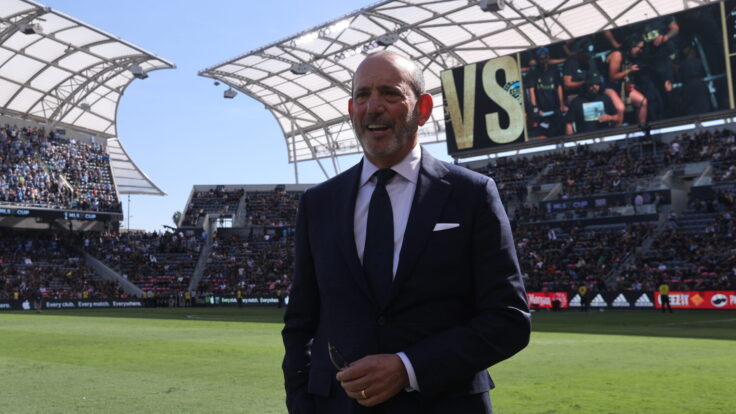
three of the MLS-Apple experiment, and a consistent gripe among league partners has been the lack of transparency in viewership numbers. Yesterday, that seemed to change when commissioner Don Garber, while at the All-Star Game in Austin, said that MLS games were averaging 120,000 unique viewers per match. He said the figure was up 50 percent from last year, and credited cable and satellite deals.
However, those “120,000 uniques” are basically meaningless. Sports
viewership, as Varsity readers know, is compiled on an average minute basis by Nielsen—self-reported “uniques” don’t meet that standard, since this can include viewers who watched one minute of an entire game, or even 30 seconds. Anyway, the 120,000-viewer number is presumably global, meaning the U.S. number is much lower.
After two and a half years of secrecy, the failure to provide real numbers is a missed opportunity. For all we know, there could be a good viewership story to tell
here. Garber promised more transparency moving forward. I hope he follows through. - NBC doubles down: Yes, it may be 2025, and the cable business is continuing to hemorrhage subscribers, but that hasn’t stopped the honchos at NBC from considering the launch of a brand-new, sports-focused cable channel, using rights that currently rest with Peacock, as Joe Flint
reported in The Wall Street Journal.
The concept is in its planning stages, and there’s a good chance that it will never see the light of day. But the idea makes some sense, especially since linear sports channels are still profitable, even as their distribution falls. The idea is so new that some
distribution executives were unaware that it was being considered, and NBC hasn’t really pitched it to the cable or satellite companies that would carry it. If the channel moves forward, its sales pitch would be based on the sports tiers that distributors are increasingly rolling out to mitigate cord-cutting, such as small, genre-focused bundles.
The discussions, it seems, are focused only on a sports tier. The hope is that including sports that had been exclusive to Peacock will
persuade distributors to cut a deal. In general, distributors like the idea. After all, live sports and news are what’s keeping most cable subscribers in the bundle. The main issue, as always, will come down to price, because NBC certainly won’t be giving this channel away for free. - Stadium stakes: On the latest episode of the Varsity podcast, I
asked SBJ’s facilities reporter, Bret McCormick, for his prediction about where new stadiums will be built for the Bears, Browns, and Commanders. In Chicago, McCormick said, all signs point to Arlington Park. “The team owns that land already, which is one of the biggest hurdles for these types of projects,” he told me. The
red flag, however, is that local parks groups have come together to try to kill the deal. “When you cover facilities, you learn that when you hear about local parks groups getting involved, that’s not good, because they’re usually wealthy and have a lot of free time … and they have access to the levers of power.”
In Cleveland, McCormick expects the Browns to trade downtown for Brook Park. “They’ve got support at the state level,” he said. “Brook Park has space. And I just think the team
is dead set on this. I think it’s going to happen regardless of public opinion.” There may be legal challenges, he continued, but that shouldn’t kill the deal. And as for Josh Harris et al. building a $4 billion stadium for the Commanders on the R.F.K. Stadium site, McCormick thinks it’s basically a done deal, despite the threats from Trump. “The key thing is that D.C. picked up control of that site from the federal government,” McCormick said. “So it would take another
law to undo that. They’re in pretty good shape.” - Amazon goes MrBeast mode: Earlier this week, in his must-read private email, What I’m Hearing, my partner Matt Belloni reported that Amazon is paying Jimmy Donaldson, a.k.a. MrBeast, nearly $300 million for just two seasons of his competition
series, Beast Games. Here’s Matt: “Remember, MrBeast also continues to post videos on YouTube. Not a bad deal, though the money includes production costs, so theoretically he could give it all away if he chooses. MrBeast also just shot portions of the second season in Saudi Arabia, part of a larger blood pact—sorry, mutually beneficial arrangement—he inked with the country’s General Entertainment Authority. I couldn’t confirm a number; one source told me the Saudis are
paying MrBeast nine figures, but his rep denied that. The Saudi arrangement could also include an investment in Donaldson’s company, which has been raising money. His company’s president, Jeff Housenbold, has relationships with sovereigns in the region. Still unclear if the losers on those episodes of Beast Games will be tortured or dismembered.”
|
|
|
The NFL is finally close to a deal with ESPN that would give the
league an equity stake in the network, and offer ESPN total control over NFL Network and NFL RedZone. I know regular readers of The Varsity have been reading that sentence for the past 18 months now. But, really, the two sides are closer than ever. |
|
|
Two years ago, ESPN chairman Jimmy Pitaro started reaching out to other network
heads to discuss ESPN’s direct-to-consumer service, which is launching this fall. To ensure the app’s success, and draw the most subscribers, ESPN brass believed they needed more than just the sports content that the network, itself, provided. Pitaro’s plan was simple, as you know: He wanted the service to be a sports hub. If a subscriber to the ESPN app wanted to watch, say, Fox’s production of the World Series, they’d be able to add a Fox Sports–branded stream for $10 or $20 per month, without
leaving the app.
Many other networks actually liked Pitaro’s pitch for how ESPN could supplement their streaming strategies, and offer sports fans one single place to see all the networks’ games. It seemed to be a solid step toward The Great Rebundling. What the network heads didn’t like, of course, was the idea of giving ESPN—which competes with them for viewers and sports rights—so much power over their content. And they sure didn’t like the idea of training fans to go
to an ESPN-branded service for all that expensive content. Who knows (or cares) whether a Red Sox–Phillies game is on Fox or TBS if fans can access it through ESPN? The rival networks were also unwilling to give ESPN access to all their audience data, information that would advantage ESPN during rights negotiations. Maybe there are deals to be had once the service becomes established, but none of the networks were willing to gamble on a streaming strategy for an ESPN-branded service that hadn’t
even launched yet. Anyway, all this dissent led to the aborted creation of Venu, a tortured and legally challenged joint venture between Disney, Fox, and Warner Bros. Discovery.
But the rise and fall of Venu didn’t stop Pitaro from pushing his forthcoming service, somewhat quixotically, as a sports hub. For the past few years, ESPN has been involved in on-again, off-again conversations with the NFL, which has been looking for solutions for its NFL Network, whose fortunes have
risen and fallen with the cable business as a whole. But ESPN brass was interested in more than NFL Network and its seven live games per season: Pitaro also wanted NFL RedZone, which would help realize his sports hub fantasies by offering subscribers live look-ins to games every Sunday.
My sources tell me that an NFL-ESPN deal, which has been in the works in one form or another for ages, is finally coming to fruition, and could be completed before kickoff. The NFL is expected to
take around a 10 percent stake in ESPN, with ESPN receiving total control over NFL Network and NFL RedZone, per CNBC. An ownership stake in the country’s biggest traditional media company is a trade up for the NFL.
For ESPN, getting into bed with the owner of the most popular programming on TV was too good to pass up, especially given the coming battles over the NFL’s rights. The company is now a veritable forever partner, likely edging out other legacy players as the league moves to
streaming. The league, after all, is virtually certain to exercise an out in its media deals, so that it can come to market early. The streamers that covet NFL programming view the primetime packages—ESPN’s Monday Night Football and NBC’s Sunday Night Football—as the easiest ones to poach.
Disney reports its third-quarter results on August 6, which is when analysts expect the company to announce a launch date for ESPN D.T.C. Further down the road, analysts at LightShed
Partners suggest that this deal should make it easier for ABC and ESPN to spin off, noting in a recent report that “the NFL’s ESPN stake should ease investor concerns about the league opting out of its current media rights deal after 2029.” |
On NFL rights: “On the Varsity podcast, Michael
Nathanson suggested that Sunday Night Football and Monday Night Football are likely targets for streamers. But wouldn’t the 4:25 p.m. ET window be even better? Take the Fox or CBS Game of the Week that is usually exclusive, with the exception of one or two West Coast NFL games. Fox and CBS could still maintain their 1 p.m. windows, plus that outlier 4:05 p.m. West Coast game, at an affordable rate, while a streamer gets the mid-afternoon game of the week. It
still limits production costs to one single game, like the primetime packages, but it’s premium inventory, in the spirit of Michael’s theory.” —A sports business executive
On Cosm: “On your most recent podcast, how could you and Bret McCormick not discuss Cosm as the perfect blend between sports media and sports facilities? The company just announced Cleveland as their fifth market, recently celebrated its one-year anniversary since their first one in Los Angeles opened,
and has plans to explore international expansion into London.” —A sports executive
On Netflix’s numbers: “Please stop comparing Nielsen panel data to first-party self-reported data from Netflix and others without at least mentioning they are two entirely different measuring methodologies.” —A media executive |
Have a great weekend,
John |
|
|
Finally, a media podcast about what’s actually happening in the media—not the oversanitized,
legal-and-standards-approved version you read online. Join Dylan Byers, Puck’s veteran media reporter, as he sits down with TV personalities, moguls, pundits, and industry executives for raw, honest, sometimes salacious conversations about the business of media and its biggest egos. New episodes publish every Tuesday and Friday. |
|
|
The industry’s go-to source for unflinching reporting on the trillion-dollar business of artificial intelligence -
perhaps the single most important technology of our time. Ian Krietzberg, the powerhouse journalist behind The Deep View, delivers twice-weekly insights into the latest dealmaking and breakthroughs in A.I., and how the intersecting worlds of finance, entertainment, media, and politics are being transformed in its wake. |
|
|
Need help? Review our FAQ page or contact us for assistance. For brand partnerships, email ads@puck.news. You received this email because you signed up to receive emails from Puck, or as part of your Puck account associated with {{customer.email}}. To stop receiving this newsletter and/or manage all your email preferences, click here. |
Puck is published by Heat Media LLC. 107 Greenwich St, New York, NY 10006 |
|
|
|