 |
|
Welcome back to The Varsity, my twice-weekly private email on all the machinations and personalities driving the sports media business. I’ll be in bucolic Amherst tomorrow to interview former CBS Sports chairman Sean McManus. Sean, who was spotted in Robert Kraft’s suite yesterday in Foxboro, is the executive-in-residence at the Mark H. McCormack Department of Sport Management at UMass. You’ll be able to listen to excerpts of our conversation on the Varsity podcast this Sunday.
Speaking of the podcast, I’ve received a ton of positive feedback from last week’s conversation with MoffettNathanson analyst Michael Nathanson, who prophesied eloquently about the future of linear TV businesses in the streaming era, the fates and strategies of the various participants, and the future combinations in store. You can read much more of our conversation below.
🚨 Meanwhile, hell hath frozen over: Yes, yes, I have been seized by the Christmas spirit and yielded to the pleas of Marchand, who will make his debut on The Varsity next week. I’ll be sure to have him submit his favorite Marchand jokes and respond to many of yours.
🤖 The A.I. broadcaster: Finally, a lot of you responded to my conversation with my colleague Baratunde Thurston about how A.I. is invading the sports landscape—and sports broadcasting, in particular. If you missed that conversation, you can catch up by clicking here.
Okay, on with the show…
|
The Brady Meter: Week 13
Cowboys 27-Giants 20
Grade: Incomplete |
|
| While I won the battle to keep the TV on during our Thanksgiving repast, I once again failed to persuade Mrs. Varsity that my job depended on having the sound up, too. So I didn’t pay as much attention to the azure-eyed, $37.5 million TV analyst—who also happens to own 5 percent of the Raiders—as I have in recent weeks. But I made some calls, and the consensus was that Brady is still getting better each week.
The sports media pros I consulted agreed that Brady’s game analysis on Thanksgiving exceeded expectations, particularly when he dove into the minutiae of quarterback play—a particular feat in a contest featuring a pair of backups. Nevertheless, Brady still has a hard time connecting with ordinary fans. “His persona has been scripted and sculpted for two decades,” as one executive put it. “Football is an everyman kind of game, and he doesn’t come across as every man. That might be where his expertise backfires a little.” |
|
|
- The Harris honeymoon: Back when Joe Gibbs was winning Super Bowls with the Redskins, Jack Kent Cooke’s owners box was the province of dignitaries and machers and members of Congress, plus local muckety-mucks like Larry King, George Will, Ben Bradlee, and Sally Quinn. Alas, the owner’s box became a ghost town after the team moved from R.F.K. Stadium to the sticks in Landover, Maryland, in 1996, a situation that was exacerbated by the flagrantly incompetent Dan Snyder, who bought the team a few years later.
Now, however, the glamour is returning. The Commanders are firmly in the playoff hunt under the ownership of Apollo co-founder Josh Harris, who has leveraged his in-stadium real estate to become the town’s favorite host. On Sunday, he held court with D.C. stalwarts like Fed chair Jay Powell, D.C. mayor Muriel Bowser, the perennially embattled Washington Post C.E.O. Will Lewis, and tennis star and local wunderkind Frances Tiafoe, and the real heavy: my Puck partner Bill Cohan.
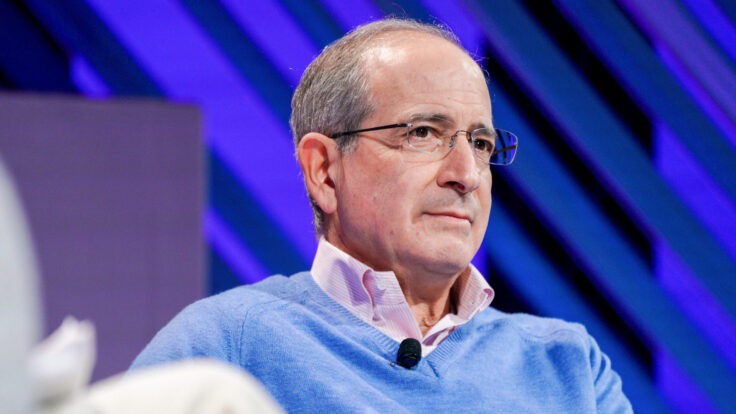
There’s more: NBA commish Adam Silver also made the trip down to D.C. to hang out in the owner’s box. Before kickoff, Comcast’s Brian Roberts and Michael Cavanagh were seen on the field, as were the NFL’s Roger Goodell and Brian Rolapp. But Harris is used to playing host: In addition to owning the Commanders, he’s the managing partner of the NBA’s Sixers and NHL’s Devils. I’m told that he personally invited the assembled eminences.
- Turkey Day scheduling: CBS and Fox have historically held alternate theories about the late-afternoon Cowboys game on Thanksgiving. For years, CBS executives believed that any Cowboys game would rate well, and they decided to keep their powder dry rather than ask for a top-tier contest. Fox, for its part, knows the Boys will draw a crowd no matter how hopeless their playoff prospects, but openly wondered how much bigger the audience would be with a competitive Cowboys contest on Thanksgiving. Could that bring in conference championship game-level numbers?
Thursday’s matchup between the disappointing Cowboys and the pathetic Giants attracted 38.5 million viewers on Fox, the largest TV audience this regular season. Last year, the Cowboys blew out the then-dreadful Commanders on CBS in front of 41.76 million viewers. Both Dallas and Detroit have deep home schedules next year, and the opportunity to go big on Thanksgiving will be there if the NFL decides to schedule it.
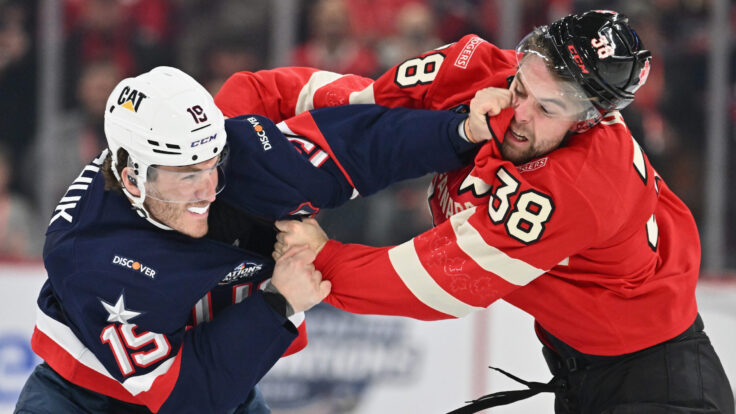
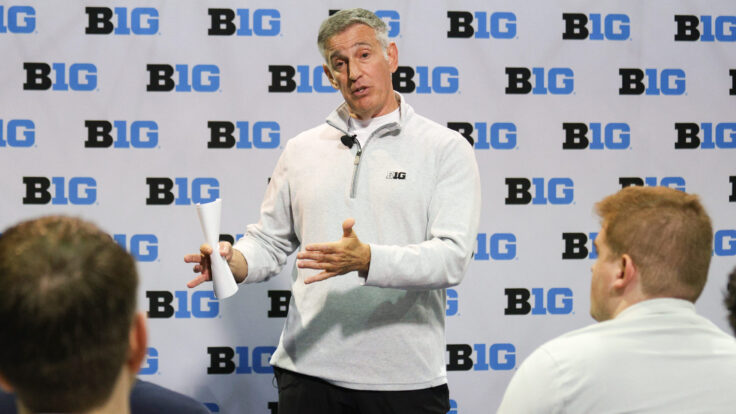
- Boys will be boys: College football’s rivalry weekend featured an unusually high number of postgame fights: A brawl occurred in Columbus after Michigan players tried to plant their maize and blue flag midfield inside the Horseshoe; and similar scenes broke out after Florida tried to plant a flag in Tallahassee, and after N.C. State tried to plant its flag in Chapel Hill. College announcers and columnists responded to these fracases with shock and condemnation. Coaches promised vigilance. Big Ten commissioner Tony Petitti fined U of M and Ohio State $100,000 each for their roles in the skirmish—a slap on the wrist, sure, but a gesture of some significance.
Despite their public comments, various media executives and college officials are much less troubled privately. “The conferences are going to have to penalize the teams and probably suspend some players,” one executive said. “While I personally hate all that stuff, I also don’t get overly carried away with it. It’s not the first time that this has happened. It won’t be the last.”
- SpringHill’s losses: During our recent conversation on The Varsity, Axios media reporter Sara Fischer acknowledged that reduced content spending among the streamers was negatively impacting sports production companies. “You’re seeing these companies hit growth ceilings,” she said. Sara dubbed the merger of SpringHill, LeBron James’s entertainment company, with Ben Winston’s Fulwell73 as “a survival tactic.” I thought of her commentary last night when I read Lucas Shaw’s report that SpringHill lost $17 million in 2022, $28 million in 2023, “and is on pace to lose millions more in 2024.”
SpringHill C.E.O. Maverick Carter sent Lucas an email that essentially reiterated Fischer’s point: “The entertainment market shift in 2022/2023 toward profitability brought rising costs, slower buyer decisions, and impacts from industry strikes, prompting us to recalibrate, including writing off underperforming projects to position ourselves for future growth.”
As Lucas noted, none of this is particularly surprising. SpringHill was among several celebrity-backed production companies that raised money at absurd valuations in the immediate post-pandemic era, but have since underperformed expectations. In fact, Gerry Cardinale’s RedBird Capital acquired a controlling majority in the company at a $725 million valuation in 2021.
- And finally, some people moves…
- Marcoux Samaan resigns: It was a surprise to see that Mollie Marcoux Samaan resigned as LPGA commissioner after less than four years in the job. The precise reason for her departure is unknown, but she didn’t have widespread support among tour players, who were upset over a messy schedule that involved way too much travel. The LPGA has been criticized for not taking advantage of the recent rise in women’s sports, but player purses nearly doubled under Samaan’s leadership.
- R.I.P. Bill Battle: Bill Battle’s obituaries all start with the fact that he served as Alabama’s athletic director about a decade ago, but his sports business legacy was cemented by a visionary company he founded in 1981 called the Collegiate Licensing Co. Battle’s company was basically a prenatal Fanatics that struck licensing deals with just about every college that participated in sports.
- Sports biz at The Athletic: Congrats to my D.M.V. neighbor Dan Shanoff, whom The Athletic has hired to be managing editor of its sports business content, a position where he’ll manage two guys named Marchand and Deitsch.
|
| And now on to the main event… |
 |
| Stream Weavers |
| As they play chicken with their valuable sports content, legacy media companies are projecting out customer behavior, the future of A.V.O.D.s, cash management, and the decline of cable. Michael Nathanson tries to game it all out. |
|
|
|
| During the past five years, as traditional media conglomerates have lurched toward their streaming futures with a mixture of alacrity and trepidation, there’s been some divergence on strategy and tactics. Some companies, like NBCU and Paramount, have made the fateful decision to lean headlong into the future by simulcasting their most precious live sports assets on streaming—a seemingly small gesture that nevertheless grossly undercuts the value of their broadcast networks and cable assets to both consumers and distributors. WBD has followed suit with its motley portfolio.
Fox and Disney, however, have been more judicious about protecting the integrity of their cable bundle. Fox, of course, only dabbles in streaming (outside of its A.V.O.D. play, Tubi). Disney, on the other hand, has had to defend ESPN’s various and manifold sports rights packages. And yet, Disney now seems poised to abandon that strategy as it increasingly simulcasts ESPN’s Monday Night Football on ABC and prepares to launch its burn-the-boats streaming pure play known internally (as you all know) as Flagship. Once that service launches, none of ESPN’s programming will be exclusive to the cable bundle. Fox would be the lone holdout.
Stripping away exclusivity might present as managed economic euthanasia for the cable bundle, which is already in free fall. (In the mid-aughts, around 100 million U.S. households were pay-TV subscribers. Now, it’s around 60 million, depending on your preferred data source.) But MoffettNathanson analyst Michael Nathanson has a slightly contrarian view. On a recent episode of my podcast, The Varsity, Nathanson reaffirmed his belief that the cable business has a floor of around 50 million. We’re obviously approaching that number quickly, and it certainly depends on the tonnage of live sports rights that stay within the pay-TV ecosystem, but it’s nevertheless consistent with Nathanson’s long-held and firmly stated views.
During our chat, Michael offered other perspectives on the shape that the industry will take in the near future. He also opined on Fox’s long-term strategy and whether Flagship will thrive alone or inside a Disney+/Hulu super bundle. The following points are distilled from our conversation, which, as always, has been slightly edited for clarity. |
|
|
| For the past five years or so, people have been asking, Where’s the floor? Back in 2019 and 2021, we thought the floor was somewhere between 50 million and 60 million homes. Right now, pay-TV subs are in the high 60 million range. The bundle works for pay-TV people who love sports. It’s the best way to get sports. You see it in the ratings. The main question is whether that floor holds.
That’s been our recent life mission: to inform the companies who are putting forward these streaming strategies to be more mindful of killing the golden goose. The golden goose is being killed because non-sports fans have realized, rightly, that it’s more efficient and cheaper to find entertainment choices outside the bundle.
The floor has dropped from 100 million down to 68 million homes simply because people who are not sports fans or who are younger have chosen to stream. If you’re a sports fan, you stay in the bundle. And if you are a sports rights holder, your position in that bundle is only getting stronger. Look at Fox’s results relative to AMC, which has no sports. Fox has been able to grow ad share and affiliate fees. They’re pushing sports all the time. If you’re AMC Networks and you have no sports, you’re screwed.
The question we’ve been wrestling with is: How do the next five years play out? Do the people who kept the bundle from really breaking down stick together even further? Or do they rip it apart by going à la carte more aggressively? That would be ESPN and Fox. And ESPN, with its Flagship streaming service, is a huge unknown. How do they price it? Will it be cannibalistic? Or will it be incremental to those who cut the cord? |
|
|
| Over the years, we talked to Fox’s leadership, and they believe strongly in skinnier bundles. Their view is that it makes no sense to launch a virtual channel package at 85 channels for $85. What Fox is playing for is that at some point there’ll be a logical virtual player. Maybe it’s YouTube TV in three to five years if they say, Look, all our viewing data shows the same thing, which is that viewers only want to watch the broadcast nets, the sports-backed assets, a little news once in a while, and that’s it. What Fox is holding out for is the second or third iteration of these virtual bundles that become skinnier because they don’t want to go à la carte and create a Fox Sports app or Fox News app.
They’re benefiting from their strategy. They’re befuddled that these distributors haven’t changed the model very much. All the survey work we’ve done has found that 50 channels for $50 is the sticky point.
We had John Malone speak a couple months ago, and he had this notion of: There’s live and then there’s “random access”—a phrase he used. You need a live bundle and then this random-access layer where people choose what they want away from live. And if I’m Fox, that seems like a logical place to go. Maybe before you blow yourself up and go over the top—everyone but Disney is losing money—you hope that someone shows up with a more rational video bundle. |
|
|
| The challenge for ESPN has always been that they don’t own all the rights to every sport in every season. They have great positions with the SEC and ACC. They have half of NHL and a lot of NBA going forward, but they can’t foreclose competition in any one sport. As a sports fan, I don’t know why you cut the cord and go to ESPN. If you’re a sports fan, ESPN is embedded in a bundle that delivers all the value you need week in and week out.
The broader debate is whether it’s better to embed sports in broader streaming apps, or is it better to create a sports-only app? You have the Peacock and Paramount+ model, where you’re seeing sports inside their general entertainment app. And then you have the ESPN Flagship idea. Does ESPN get embedded more closely inside Hulu and Disney+ as time goes on? The apps themselves are just siloed products. You basically need a storefront to drive traffic inside, and there are so many storefronts on my TV every night, how do I drive your traffic? It’s gotta be using sports, which is what Peacock is showing you. In the next one or two years, we’ll have a deeper conversation about whether an à la carte sports product is the best use of sports in the streaming world. Because I think Peacock and Paramount are going in a different direction than ESPN Flagship at this point. |
|
|
| On Brady’s Thanksgiving performance: “This Brady game is by far his best in the booth. He’s relaxed and seems more like himself. Someone got through to him. I never worked in sports, but did collaborate with a ton of super green talent with potential that were new-ish to TV (ask Byers). Only some really get it and fly. He’s obviously starting to get it.” —A former CNN producer
On my B- Brady Meter grade last week: “Sad to see that grade inflation is as prevalent in sports media as it is in our schools and colleges, John!” —A lawyer who earned every A he ever received
More on Brady: “I’ll take Brady’s silence over Romo’s yammering any day.” —A media executive
R.I.P. Rudy: “That Rudy Martzke column is how I developed my obsession with sports media. There is a direct throughline from me discovering that column when I was in high school in the late 1990s to me subscribing to this newsletter and reading it as soon as I see it in my inbox.” —A Varsity subscriber
On the women’s pro soccer explosion: “How come no one talks about how expansion in the NWSL will water down the league? I know they are getting big checks for expansion franchises, but the on-field product will suffer greatly. Big mistake.” —A former Fox Sports executive |
|
|
Have a great night and see you Thursday,
John |
|
|
|
| FOUR STORIES WE’RE TALKING ABOUT |
 |
| Elon’s DOGE-ball |
| The headwinds facing one of Musk’s initial DOGE targets. |
| ABBY LIVINGSTON |
|
 |
| Magritte Heat |
| Revealing the behind-the-scenes choreography at Christie’s. |
| MARION MANEKER |
|
 |
|
 |
|
|
|
|
|
 |
|
|
|
Need help? Review our FAQs
page or contact
us for assistance. For brand partnerships, email ads@puck.news.
|
|
You received this email because you signed up to receive emails from Puck, or as part of your Puck account associated with . To stop receiving this newsletter and/or manage all your email preferences, click here.
|
|
Puck is published by Heat Media LLC. 227 W 17th St New York, NY 10011.
|
|
|
|