Welcome back to The Varsity. I’m John Ourand, still in Sonoma after a
rejuvenating weekend of sunshine, racecars, and plenty of blended pinots.
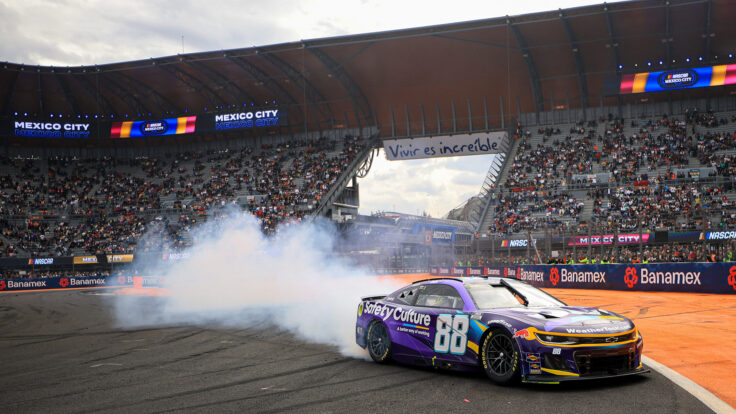
It was great seeing everyone at the Sonoma Raceway yesterday for NASCAR’s Toyota/Save Mart 350. The annual race is NASCAR’s best in terms of hospitality, which explains why the region was littered with sports sponsorship and media executives all weekend. For the record, I took in the race from the course’s Turn 11 suite, munching on duck confit and sipping sauvignon blanc—where’s the sancerre,
Marchand!!—not a typical NASCAR experience, I know….
Thanks to all the sports business glitterati who turned up for the private dinner that I co-hosted on Saturday night with NASCAR commissioner Steve Phelps at Enclos in downtown Sonoma. Tonight, I’m sharing part of my conversation with the commish (also posting on the Varsity podcast later this week).
At deadline: Jacksonville developer
Patrick Zalupski has agreed to buy the Rays from Stu Sternberg for $1.7 billion, per The Athletic’s Evan Drellich and Ken Rosenthal. The deal should be completed by September. Sternberg bought the team in 2004 for $200 million. Nice return!
Let’s get to
it…
|
- F1’s conundrum: When I attended a financial industry conference earlier this year, I was initially taken aback by how much the investor community was interested in Formula 1’s U.S. media rights negotiations. The domestic market is certainly lucrative, but it’s hardly the most important for F1, which is a global juggernaut.
The investors’ interest, of course, was rooted in the fact that F1 is publicly traded. Sixty percent of the revenue that Formula 1 generates goes to the
teams; the rest stays with the league. That certainly helps explain why F1 appears certain to take Apple’s $150 million annual offer over ESPN’s $80 million–$85 million deal. If F1 were to accept ESPN’s offer, its stock would get crushed.
There is, however, a renegade faction close to the sport that advocated for F1 to bite the bullet and accept the smaller offer from ESPN. A large chunk of the revenue for the organization and its teams comes from sponsorships, and those partners want
races to air on broadly distributed platforms. ABC and ESPN, which would carry the tentpole races, have broad distribution that Apple TV+ does not. But amid this revenue-relevance conundrum, F1 is likely content to placate its shareholders for now and bet that the world’s most innovative company figures this streaming thing out. - Welcome to the new ESPN: Sports media executives always talk about fiscal discipline when it comes to sports media
rights—even as the prices of those rights have soared. But the F1 offer is the second time this year, following the whole MLB soap opera, where ESPN exercised restraint. Interestingly, I’ve learned that F1 executives believed ESPN would increase its bid once they had another deal in hand and likely leaked the story about Apple’s interest to the Financial Times to generate some pressure. So the league was surprised when ESPN chairman Jimmy Pitaro didn’t move off his
initial bid. “It’s all about cost containment in Bristol these days,” one source told me.
- Disney’s sports growth: Meanwhile, Pitaro’s discipline with media rights is playing well in financial markets—so much so that MoffettNathanson’s Robert Fishman, in a report released this morning, cited the deals that ESPN didn’t make as one reason why he expects sports revenue to rise 3 percent and EBITDA to grow at a 1 percent compound
annual rate from 2024 to 2030 as the pivot to digital progresses. But that forecast “also factors in ESPN becoming more selective in the sports rights deals that are able to generate the appropriate returns not only on advertising but more importantly for affiliate fee negotiations going forward.”
- Netflix and sports: Netflix posted impressive numbers for its Friday night bout between Katie Taylor and Amanda Serrano,
with the women’s championship boxing match attracting an average-minute audience of 6 million globally, and 4.2 million in the U.S. No matter how you spin it, these are huge numbers, and yet more evidence of Netflix’s ability to eventize moments, from Christmas NFL games to a washed-up Mike Tyson fight.
The one red flag comes from how Netflix counts its audience. The company cited numbers from VideoAmp, which tends to run higher than Nielsen. The rest of the
business relies on Nielsen numbers, which makes direct comparisons difficult. But even if a Nielsen number came in lower, it likely wouldn’t be that much lower. So add this fight to the list of reasons why leagues and conferences will keep begging Netflix to invest in their rights. - Betting on bets: The rise of legal sports betting has provided more benefits to leagues than just new revenue streams. They also see it as a way to cater
to their most avid fans, Fantasy Life founder Matthew Berry told me on the Varsity podcast yesterday. “It’s taken a while to get here, but at this point all the leagues understand how important [gambling] is,” Berry said. “It is a fan base that needs to be catered to. Studies have shown that if somebody plays fantasy sports, they’re twice as likely than an average sports fan to watch more games, buy more tickets, buy more merch. So all the leagues, in their own way,
embrace it in a big way and push it.”
Of course, the leagues are also catching up with the times. Sports gambling is legal in 38 states plus Washington, D.C. Legalization, many have argued, has helped regulate the industry and made it easier to root out bad actors, like Jontay Porter, whom the NBA banned for life for suspicious gambling activity. “People have been betting on sports since sports started, so the idea that now all of sudden, because of the proliferation of
sports betting ads, players are more susceptible? That has always been an issue,” Berry said. “The more regulated the industry is, the better it is. It’s much easier to catch players or people that should not be betting. … Sports betting should be legalized in all 50 states. It should not be a state issue. It should be a national issue.”
|
And now, on to the main event… |
|
|
While Formula 1 seems to be grabbing all the headlines these days—from the wildly successful
Hollywood movie to a rich new potential rights deal with Apple—NASCAR has quietly reinforced its position as the dominant domestic motorsport. Not gonna lie, as the kids say, it’s not even close. |
|
|
F1 may attract a lot of attention, and a decidedly high-net-worth crowd, but its domestic TV
viewership is a far cry from the numbers NASCAR puts up. In fact, ratings for NASCAR’s second-tier Xfinity Series, which The CW carries on Saturday afternoons, are similar to those of its more cosmopolitan European competitor. But the audience for NASCAR’s premier Cup Series races, on Sundays, triples F1’s American viewership. “I think the breadth of what NASCAR has surprises people,” NASCAR commissioner Steve Phelps told me on Saturday, the day before his Toyota/Save Mart 350
race. “TV viewers in aggregate for our top Cup Series, our Xfinity Series, and then Truck Series are significant. And by themselves they’re really good numbers.” (Disclosure: Puck and NASCAR partnered on a live event around the race.)
Phelps, who joined the Varsity podcast this week, spoke of competition from F1 and IndyCar, as well as the flood of private equity that his sport is attracting and the ongoing, very public antitrust suit filed by Michael Jordan’s
23XI Racing and Front Row Motorsports. What follows is an excerpt from our conversation, lightly edited as always. |
The F1 Comparisons & P.E. Plays
|
John Ourand: It looks like F1 is heading over to Apple. F1 gets a lot of
press for a successful movie and Drive to Survive. IndyCar has had a lot of buzz in its first year with Fox. Are they competitors?
Steve Phelps: I don’t think so. They’re in a different subset. If you go back five or six years, motorsports was really struggling. F1 wasn’t doing very well. IndyCar wasn’t doing very well. We were in a slow, steady decline for about a decade. But since 2019, that’s changed. We celebrate F1’s
success. We celebrate IndyCar’s success on Fox this year. It’s a positive thing if motorsports is growing. If you consider that we’re the top of the heap of motorsports domestically—and we are, by a wide margin—it’s a good thing.
But our audience isn’t F1’s audience. The crossover is really only 6 percent. IndyCar is probably in the mid-20 percent range. We are different brands. F1 is all about restricted access. Ours is all about accessibility. Our fans can stand on pit road, where the
cars are. The other part of accessibility really is about the cost to attend a race. Going to an F1 race is incredibly expensive. Fans can get NASCAR race tickets for $30 to $50. Typically, parking is free. Fans can walk in with a cooler filled with their favorite beverages. That doesn’t mean that one is better than the other. It just means they’re different, with different audiences and different accessibility. We lean into the Americana that we are.
What’s your strategy around
private equity?
That’s really at the team level, not at the governing body level. They’re investing in teams, and they’re investing in what we call charters [which essentially guarantees that a team can race in all NASCAR Cup Series races]. Charters are not franchises, but they allow for a fixed amount of money that teams know they’re going to get. It goes across all teams. They get a say and a stake in the governance of the sport, and we will listen to what they have to
say, but it’s nothing more than that. It’s not an equity position in NASCAR. And I think that’s an important distinction.
Why are they investing?
Over the past five years, the charter values have gone up by a factor of 15. Private equity is helping drive the cost of the enterprise value of those charters. Private equity doesn’t get into things to lose money. They don’t get in it to have enterprise value go down. They get in it because they think it’s a good
investment. They’re very savvy buyers, and they are seeing growth in the sport, and they believe that the enterprise value of these charters is gonna continue to increase. |
Why does private equity think the value of charters will continue to
increase?
For starters, we had charter extensions last year. The amount of money that NASCAR provided as part of these extensions really went up significantly. Every dollar that we got incremental to our new media deals went to our race teams—every single dollar, plus money that came out of NASCAR’s pockets and the tracks’ pockets to give to the race teams. We did that to try to make sure that there was a balance so that race teams would be profitable. Profitable race teams put
on better racing.
What is P.E.’s role then?
They’re providing three things to the race teams. They’re providing expertise that the race teams don’t have. A lot of these private equity folks that are coming into NASCAR own part of NFL, NBA, NHL, or Major League Soccer franchises, and they’re bringing different ideas to those race teams. They’re also providing capital, which is a good thing for the owner of these particular charters. In many
cases they’re bringing sponsorship. If we are gonna continue to grow, and I believe we will, it’s by thinking differently.
Right now, you’re seeing college conferences consider allowing P.E. to take small ownership stakes of the actual conference. Could that ever happen to NASCAR?
We are privately held by the France family, and we’re not interested in selling. We’re thrilled that P.E.s are coming in with the race teams. That’s certainly not
something that we are entertaining at this point.
You’ve been going through a big antitrust suit with Denny Hamlin and Michael Jordan’s 23XI and Front Row Motorsports, which own three charters apiece. A judge said he hopes for some sort of settlement. What’s the likelihood of that?
I don’t know what’s gonna happen. The lawsuit is supposed to be an antitrust lawsuit. I don’t believe it’s an antitrust lawsuit. I think it’s just
a contractual dispute. We had 13 of the 15 charter holders representing 32 teams sign. On balance, if there are winners and losers to the charter extension, I think the teams won. The number one thing the teams wanted was more money, which is exactly what we gave to them. We’re either gonna settle or we’re gonna go to court. Do I think we’d be willing to entertain a settlement? Yeah. To date, they have not come with anything. I don’t even know what their demands are. I don’t even know what
they’re suing for. |
On Apple and F1: “Is it your understanding that Formula 1 would still be able to offer F1 TV in the
U.S.? That’s a big factor in the apples-to-apples comparison to current ESPN rights.” —A Varsity subscriber
[Ed. note: That hasn’t been decided yet, but SBJ’s Adam Stern reported that F1 management “is aiming to continue F1 TV in the U.S.”]
On the
college power structure: “While Greg Sankey may want the same thing as Tony Petitti, the SEC coaches have different ideas. They voted to keep eight conference games instead of moving to nine. You’ve made it sound like the Big Ten and SEC are aligned, but it’s not that black and white.” —A Varsity subscriber
On WBD’s AEW deal: “One other aspect of that deal that wasn’t mentioned: WBD holds a minority ownership stake in AEW.” —A
journalist |
See you tomorrow in the Inner Circle,
John |
|
|
Finally, a media podcast about what’s actually happening in the media—not the oversanitized,
legal-and-standards-approved version you read online. Join Dylan Byers, Puck’s veteran media reporter, as he sits down with TV personalities, moguls, pundits, and industry executives for raw, honest, sometimes salacious conversations about the business of media and its biggest egos. New episodes publish every Tuesday and Friday. |
|
|
The industry's go-to source for unflinching reporting on the trillion-dollar business of artificial intelligence - perhaps the
single most important technology of our time. Ian Krietzberg, the powerhouse journalist behind The Deep View, delivers twice-weekly insights into the latest dealmaking and breakthroughs in A.I., and how the intersecting worlds of finance, entertainment, media, and politics are being transformed in its wake. |
|
|
Need help? Review our FAQ page or contact us for assistance. For brand partnerships, email ads@puck.news. You received this email because you signed up to receive emails from Puck, or as part of your Puck account associated with {{customer.email}}. To stop receiving this newsletter and/or manage all your email preferences, click here. |
Puck is published by Heat Media LLC. 107 Greenwich St, New York, NY 10006 |
|
|
|