Greetings from Los Angeles, welcome back to In the Room, and congrats on making it to the weekend. For tennis fans, it’s finals weekend at Indian Wells, which, if you’re at home, still requires a subscription to Tennis Channel to watch.
🍸 In tonight’s issue, Wall Street Journal editor-in-chief Emma Tucker discusses her first two years at the Journal—evolving the historic business, and navigating management changes, tough choices, and the future of the news media—in an excerpt of our rollicking conversation from The Grill Room. (Also on Apple, Spotify, or wherever you prefer to listen.)
Mentioned in this issue: Jeff Bezos, Jim VandeHei, Rupert Murdoch, David Maraniss, Sarah Wynn-Williams, Will Lewis, Mark Thompson, Jean-Paul Jassy, and more…
Let’s get started…
|
- Murdoch milestone: For the first time ever, Fox News beat all of the broadcast networks in Monday-Friday primetime ratings last week—yet another notable data point for the network’s enduring dominance amid the industry’s broader decline. Though, as I noted last month, what’s truly notable about Rupert Murdoch’s cable news business in the Trump 2.0 era is how palatable it’s become to blue chip advertisers. Trump’s ascension as a tolerable establishment figure has elevated his favorite TV network, too. As the analyst Rich Greenfield noted, Fox News now counts Liberty Mutual, Procter & Gamble, Expedia, Nestlé, Allstate, JPMorgan Chase, Intuit, Verizon, and UBS among its more than 100-plus blue chip advertisers. Perhaps they’re all trying to get their message in front of the audience of one the same way their growing fusillade of lobbyists spent decades wielding power on the Hill. Maybe they’re trying to avoid ending up on a list of companies “boycotting” Trump-aligned outlets. Either way, this is a much more efficient spend.
|
|
|
|
A MESSAGE FROM OUR SPONSOR
|
Medicines are the one part of health care where costs go down over time.
America’s intellectual property (IP) system is designed to make medicines more affordable for patients through innovative research, brand competition and lower-cost generics. Today, 90% of prescriptions are filled with lower-cost generic and biosimilar medicines.
Learn more.
|
|
|
- How to juice book sales: Meta is trying to stop one of the company’s former employees, Sarah Wynn-Williams, from making allegations against the tech giant by seeking to block the distribution and publicity for her new tell-all, Careless People, which Meta has dismissed as “a mix of out-of-date and previously reported claims about the company and false accusations about our executives.” The rub is that the book has already been published—it hit shelves Tuesday—and the most damning accusations have already been picked up by the national media.
Unsurprisingly, Meta’s attempt to block Wynn-Williams’s book ex post facto is instead only drawing more attention to it. (Maybe rethink that strategy, folks.) Earlier this week, an arbitrator sided with Meta and determined that Wynn-Williams was in violation of a nondisparagement agreement she’d signed with the company. But Meta’s attempts to get the book pulled from shelves has proven less successful because the arbitration order has no bearing on the book’s publisher, Macmillan.
On Thursday, Macmillan’s lawyer, Jean-Paul Jassy, told me the publisher would continue to publish the book: “The order isn’t about truth or falsity at all. This is about suppressing an author’s speech that is unflattering. Meta just doesn’t want anything remotely negative said about them,” he said. “The book was thoroughly vetted, and Macmillan stands behind its contents. Meta’s campaign is an affront to every notion of free speech and a free press. It is more important than ever for Macmillan to promote, publish, and distribute this very important book for the world to read, and that is exactly what it will do.”
- Maraniss’s Irish goodbye: In my most recent missive on The Washington Post, I included a parenthetical noting that, while Pulitzer Prize winner David Maraniss had publicly protested Jeff Bezos’s renovation of the Opinion section, he was not among those who had quit. Indeed, Maraniss declared two weeks ago that he would never write for the paper again, but gave no indication that he intended to resign from his role as an editor on a small monthly contract—and there had been no announcement to that effect.
Well, Maraniss emailed me today to inform me that he did indeed tender his resignation from that contractual arrangement by way of an email to the head of newsroom recruitment, telling her not to send any more monthly checks. Upon looking into the matter, the Post front office managed to confirm the same. So, add him to the manifest.
|
|
|
|
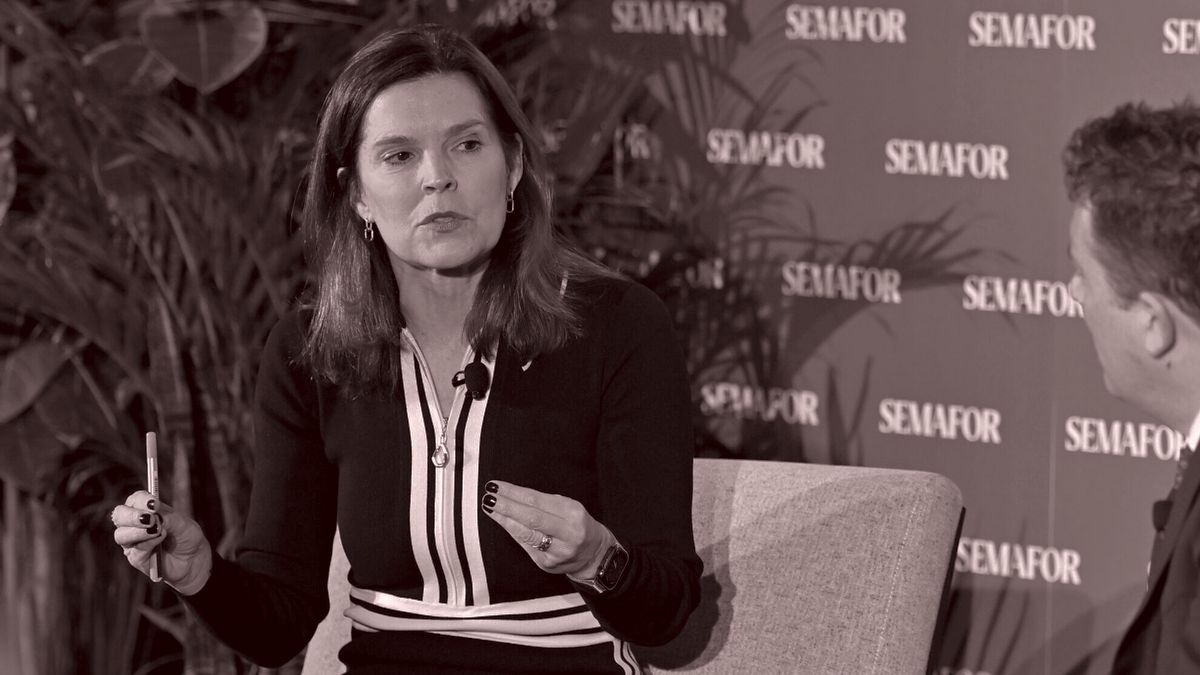
Emma Tucker arrived at The Wall Street Journal a couple years ago to replace the complacency of the Matt Murray era, with a mandate to make a product that was feistier, less academic, totally data-driven, and, sure, maybe even a little British. Naturally, her newsroom covered her office in Post-it notes and gave her plenty of grief, but it kinda worked.
|
|
|
Last spring, in a memorably feeble display of newsroom defiance, disgruntled staffers at The Wall Street Journal marched to the office of Emma Tucker, their then new ish editor-in-chief, and stuck brightly colored Post-it notes to the glass wall protesting her restructuring of the U.S. news desk, which included the elimination of fewer than a dozen staffers. The gesture epitomized both the reticence that Journal staff felt toward Tucker, and their inability to do much about it. A veteran of Fleet Street, Tucker had been hired as a change agent, with a mandate to make the stodgy business broadsheet edgier, faster, and less erudite, and she had no qualms about culling. (Though, had she been able to get away with it, she probably would have culled more, faster.) Anyway, she wasn’t in her office that day, and by the time she returned, the Post-it notes were gone.
In nearly every subsequent restructuring—the international desk, the Washington bureau, and, most recently, the technology unit—Tucker has garnered controversy and ignited fears that she was scaling back from those coverage areas. Quite the contrary. Months after the D.C. cuts, for instance, she poached top talent from The Washington Post and Politico—a move she is likely to repeat on the tech desk, as well.
Now, more than two years into her tenure, the Journal is decidedly a punchier and more engaging read. “I find the paper more interesting, more expansive, more likely to hook me with an unexpected headline, and more built for the modern business reader who is interested in lots of business-adjacent stuff,” Jim VandeHei, the co-founder and C.E.O. of Axios, told me. “It has an edge and identity now, because she has an edge and identity.”
At a time when many of her fellow British expats have been struggling to refurbish America’s legacy media companies— Will Lewis at The Washington Post, Mark Thompson at CNN—Tucker is succeeding. The Journal now counts more than 4 million subscribers, remains profitable, and has again claimed a stake on the zeitgeist. “I think she’s the one Brit who came over and got it right,” one veteran media executive noted.
On the most recent episode of The Grill Room, my twice-weekly podcast, Tucker joined me to discuss her transformation of the paper, the delicate art of change management, and the future of the news business. Herewith, a portion of that conversation, lightly edited for clarity.
|
|
Dylan Byers: For the person who doesn’t read the Journal every day, what was your thesis coming in?
Emma Tucker: It seemed to me that the Journal occupies this incredible lane in U.S. media. The specialism of the Journal is business, finance, economics, and geopolitics, and it’s a huge advantage in the digital landscape to have that lane, because “digital” rewards specialization. [When I came in], they were producing great journalism, but in a way that was somewhat more geared toward the media environment from 10 years ago.
And to be fair, I think one of the differences between journalists from outside the U.S. and inside the U.S. is that in other parts of the world, journalists and newspapers have had their backs up against the wall for a long time, because competition is so much fiercer. Whereas, here in America, you’ve got the advantage of this monstrously huge market that has supported publications like the Journal for a long time without them having to really think too hard about the challenges that are coming down the line.
Even since I’ve gotten here, the media landscape has changed beyond recognition. It’s so much more competitive. Now, newspapers and the big
established brands no longer own the news at all. The news has been meritocratized; you can get it wherever you want. So within that sphere, the Journal has to be something very distinctive and very special. And what I’ve really called upon the newsroom to do is really think about the audience first and foremost. If you’re thinking about the audience, you’re going to deliver journalism that they find useful, compelling, and relevant, and that they will come back to. Our relentless focus on readers and the audience is working. On the metrics of engagement, and how long people are reading the Journal—they’re on an upward trajectory, as are our subscriptions. And I think that’s good in an environment that’s otherwise pretty gloomy around the media.
|
|
|
|
A MESSAGE FROM OUR SPONSOR
|
Medicines are the one part of health care where costs go down over time.
America’s intellectual property (IP) system is designed to make medicines more affordable for patients through innovative research, brand competition and lower-cost generics. Today, 90% of prescriptions are filled with lower-cost generic and biosimilar medicines.
Learn more.
|
|
|
|
Does your goal of customer acquisition and retention govern how you make editorial decisions across the board? And how does that business calculation influence the editorial process?
There’s this real issue at the moment with people switching away from the news, and I think that’s on us to solve. My answer to that is thinking really hard about what people find useful and what they find relevant. So the newsroom is thinking about that, and nothing’s off the table. There was some mischaracterization when I got here that this was about clickbait; it’s absolutely the opposite of that. It’s giving people stories and journalism that is useful, that helps them understand the world, business, and finance. And by doing that, readers are coming back to us. If people are reading us more, then they’re less likely to cancel their subscription. And we need those subscriptions to fund the newsroom, and we need to grow the base of people who are taking out those subscriptions. And that means thinking really hard about not just one audience, but what a broader audience wants from us.
While staying squarely in that lane of business, finance, etcetera, you’re also giving more content that is edgier, sexier, and frankly more interesting.
You call it edgy and sexy; I would just call it distinctive. We simply can’t give people stories that they’re getting everywhere else. And even when there is a big story out there that everybody’s covering, we’re thinking about, what’s the Wall Street Journal angle? And actually, at the moment, so many of the big stories that are breaking are absolutely core trust—whether it’s all the news around tariffs, what’s going on in Ukraine, the future shape of the economy… These are absolutely playing to our strengths. So we’re able to create stories, or do journalism, that appeals very much to our subscribers, but also people coming to us sort of with intent. So the audiences that are coming to us are not just random, broad audiences. They’re people who are like, I better go see what The Wall Street Journal has got to say about that, because I can trust them.
|
|
You know better than anyone that it has not been all smooth sailing. You had a mandate to change the paper, and you’ve done that. There were a number of layoffs in the Washington bureau, and then down the line you announced a number of hires. You have now laid off a number of folks on the tech side in San Francisco and New York. Can you explain your strategy on the tech side, and why the layoffs were necessary?
First of all, the idea that The Wall Street Journal is stepping away from tech coverage is just ridiculous. It’s for the birds. It’s quite the opposite. Everything that we’ve done is to bolster and improve our tech coverage. The changes I made in San Francisco are in keeping with all the other changes I’ve made across the newsroom. The point being: I set out a strategy, and then I said we need a structure to support that strategy—and this new strategy is about modernizing the newsroom. It’s about bringing in the skills that we need, some of the skills that were lacking when we got here. It’s about raising the metabolism of the newsroom and getting in people who are absolutely top of their game.
This is not about headcount. This is about restructuring a newsroom to get it in shape for this very competitive world that we find ourselves in. The restructures are painful. They’re challenging; they’re difficult. I certainly wouldn’t choose to do them, but I’m doing them because they’re the right thing for the paper.
What are you looking for that those folks weren’t providing?
I wanted to take a whole new approach to tech. It’s in everything we do; tech is everything now. It’s the big companies, it’s the big titans, but it’s also shaping our lives. It’s A.I. It felt to me that we need to take a slightly more flexible and ambitious approach to how we cover it. And to that end, we needed people who are able to break stories and produce the big, ambitious, enterprise-style coverage that plays so well with our readers.
Do you feel like some of the folks who may have initially taken issue with some of your decisions are now on board, after you point to the growth in your metrics—or do you still feel resistance from the newsroom when reorganization happens?
I think it’s a bit of both. It goes without saying that there’s a bit of resistance, because people don’t like seeing their colleagues leave. That’s just being human. But I genuinely feel like the newsroom is on board with what we’re doing. There probably is resistance out there, but if there is, I don’t feel it in the way I did when I first got here. I feel like they’re excited by the results as well. They’re doing better journalism. We’re breaking more stories. We’re presenting things better. We have higher engagement. People are talking about what we’re doing more. Why wouldn’t they love that?
Could you look at someone like Will Lewis at The Washington Post (formerly at the Journal) and offer some sort of thesis of how that business should be run?
Well, from what I hear, there’s a strategy there. They’re putting things in place. Like I said earlier, if you have a niche in digital, it’s much easier. So that’s our big advantage here. The Washington Post, like many of the other big titles, is a general news provider. And I think that transition has been difficult because so much of what newspapers used to offer as a package has been disaggregated online. So it’s a heavier lift for them to come up with a distinctive offering. But all the signs are that they’re doing that. And it’s good—we need strong media brands out there. Competition is good, and I wish them well.
|
|
|
|
A professional-grade rundown on the business of sports from John Ourand, the industry’s preeminent journalist, covering the leagues, players, agencies, media deals, and the egos fueling it all.
|
|
|
Need help? Review our FAQ page or contact us for assistance. For brand partnerships, email ads@puck.news.
You received this email because you signed up to receive emails from Puck, or as part of your Puck account associated with . To stop receiving this newsletter and/or manage all your email preferences, click here.
|
|
Puck is published by Heat Media LLC. 107 Greenwich St, New York, NY 10006
|
|
|
|