Welcome back to The Varsity. I’m John Ourand. As you’re reading
these words, I’m on my way up to New York: CBS Sports is hosting a media event at its Times Square offices tomorrow—which was originally supposed to be an NFL preview, but I suspect David Berson and team will be fielding a lot of UFC and David Ellison–adjacent questions instead.
🚨 Thank you!: We’ve been blown away by the reaction to In the Arena, our October 16 sports media conference with MoffettNathanson. In fact, the ticket allotment that we set aside for our Inner Circle members is completely sold out. And the event itself is nearly fully subscribed. Please click this link or contact me directly if you want a ticket or a small tranche for your team. And the rumors of the Marchand ventriloquism opening act are pure nonsense!
(Andrew, stop spreading these lies at the expense of Puck’s credibility! And make sure the car greets me outside Penn Station with the Olivier Leflaive Montrachet Grand Cru—the ’99, not the ’98!!)
🎧 Pod alert: Varsity regular Sara Fischer rejoins the pod on Wednesday to make sense of all the sports rights news from the past fortnight: WWE, UFC, NFL, ESPN, Paramount… you name it. Also, make sure you listen to
yesterday’s pod with college football analyst turned entrepreneur Josh Pate. Josh is a smart guy who offered a unique perspective on where the college business is headed.
Finally, before we begin…: I want to highlight my partner Matt Belloni’s perspicacious analysis regarding the NFL’s decision
to consummate a deal with ESPN. He cited the long game. “Given that the broadcast landscape will likely consolidate around three or four global and digitally native streaming services—three of which, Prime Video, YouTube, and Netflix, are already in business with the league—NFL commissioner Roger Goodell actually needs to prop up his legacy partners if he wants them to survive and be able to afford football,” Matt
wrote. “So, in some ways, investing in Disney/ESPN is an unsubtle middle finger to Big Tech, or at least a check on its power.” (As always, make sure you’re subscribed to What I’m Hearing, Matt’s incredible
private email on the entertainment industry.)
Okay, let’s get to it… |
|
|
A MESSAGE FROM OUR SPONSOR |
Forever at the top of its game, the trailblazing BMW 7 Series. Engineered to win. Learn more at
BMWUSA.com |
|
|
- The Big
Four’s federal issues: You’d be forgiven if you yawned when you read that the House Judiciary Committee sent letters this morning to Big Four commissioners Roger Goodell, Adam Silver, Rob Manfred, and Gary Bettman requesting briefings
on broadcasting market policies and blackout exemptions—i.e., the secular reality that sports media rights are moving to streaming. It seemed like more of the usual political theater, after all. (Committee chairman Jim Jordan, a former collegiate wrestling champ and coach, is adroit at optics full nelsons.) But a number of heavyweight lobbyists told me this afternoon that the commissioners should take the request seriously. After all, this marks the
second time in three months that Congress has looked into the migration of sports from linear TV to streaming. Back in May, Sen. Ted Cruz’s Commerce Committee held a hearing on the matter.
Anyway, we all know that major sports are continuing their largely one-way emigration from linear—yes, today’s Paramount-UFC deal is a notable exception—but this is an exploitable issue for populists within both parties, as my Puck partners regularly document. (Sign up for The
Best & The Brightest here if you want to really understand the issues, you philistines.) Everyone I know complains about having to subscribe to half a dozen streaming services to watch games that used to be available in only one cable bundle. But the TL;DR from the lobbying world is that this issue isn’t going away anytime soon… even if the NFL, MLB, NHL, and NBA
won’t be renewing their rights deals during this Congress, or even the duration of the Trump administration. - Venu’s return: Whenever he talks about ESPN’s direct-to-consumer service, Jimmy Pitaro always acknowledges his desire for the app to act as a sports hub. If users want to watch the World Series, in this aspirational vision, they can go to Flagship (sorry, old habits die hard), click on a Fox icon, and pay to
watch the ballgame without ever having to leave the app. In this scenario, ESPN would orchestrate a rev split with Fox (like Apple TV and Amazon do with premium streaming channels within their apps) and pick up crucial data on user habits.
Alas, none of ESPN’s peer companies is willing to make this sort of deal, at least not yet. But we are starting to see traditional media companies cooperate more as they compete against the streamers. Just today, Fox and ESPN announced that they were
bundling their direct-to-consumer offerings as more of a marketing effort to get subscribers—it’s two-thirds of the posse that once made up Venu (née Spulu… again, old habits). Starting in October, both the ESPN app and Fox One will be made available for the bundled price of $39.99, or $10 less than their combined price. (ESPN is $29.99 and Fox One is $19.99.)
The retail price for the dearly departed Venu was $42.99, but that would have included programming from Warner Bros.
Discovery, too. - College football’s future: I was surprised by college football analyst Josh Pate’s answer when I asked if he supported the concept of a Power Two, a.k.a. the Big Ten and SEC, in the sport. Pate, who hosts a college football show that is now distributed by On3/Rivals and Yahoo, said he doesn’t mind the idea as long as it restores regional rivalries. “My theory has always been that those big two were headed for a parallel
AFC-NFC situation,” Pate told me. “What I hope it means is that we get to a place where the SEC and Big Ten acquire what they need to acquire. It may be that one gobbles up the remaining valuable assets in the ACC, and the other one gobbles up the remaining valuable assets on the West Coast and in the Big 12.”
Pate continued: “As long as there’s a button that we can press at the end, and once they get to their 24 or 32 teams, they reasonably divide everything up. College football has maps
drawn on it. We used to call those conferences, and they used to be regionally based. As long as we can get back to that, I don’t think the casual fan really cares if they’re watching a Florida State game and they’re in the ACC, but it’s property of the SEC.” - ESPN’s podcasting mistake: During a recent appearance on Semafor’s Mixed Signals podcast, former ESPNer Pablo Torre made an interesting observation about his old
employer. Torre, an ascendant podcaster, acknowledged that ESPN had essentially forfeited a potential foothold in the nascent sports podcasting business by letting the likes of Bill Simmons, Dan Le Batard, and Colin Cowherd walk out the door. In some cases, of course, these talents ran into institutional challenges: More than a decade ago, ESPN suspended Simmons for three weeks because he called Goodell a liar on his podcast.
Five years ago, Le Batard openly defied Pitaro’s no-politics edict on his show, which led to a very public meeting between the two to clear the air.
Torre didn’t bring up those specific incidents, but he did distill the main challenge born of the disparate incentives that have emerged in the post-monoculture era. ESPN, for example, works with league partners and aims to appeal to the broadest audiences; creators, meanwhile, are compelled to be their authentic selves, which is
central to their success but can be at odds with an organization’s pursuit of capturing the biggest slice of the pie.
But, to hear Torre tell it, everyone sorta won. Simmons sold The Ringer for hundreds of millions while Le Batard’s Meadowlark Media, which produces Pablo Torre Finds Out, may be on the same trajectory. “If you were to collect all of those guys and just do the math on that, ESPN legitimately let over a billion dollars walk out the door,” Torre said. “They missed, I
would argue, the future of sports podcasting that was already in-house. But the economics of why they let it go was because it was still fractional compared to their actual interests. … It was a mathematically justifiable choice about what their business really is.” - Ellison’s McLaren: Wall Power, Puck’s private email on the art business,
had a report from Monterey Car Week that interested me. In yesterday’s edition, Julie Brener Davich reported that RM Sotheby’s is selling “a 1997 McLaren F1, known as
The Silicon F1 because it’s never left the Bay Area, which is expected to bring in more than $23 million.” The Silicon F1 was originally owned by Larry Ellison, who is rumored to have acquired it for just $1 million. Per Julie, the overall car market is down from its Covid peak in 2021, but the top three auction houses (RM Sotheby’s, Christie’s Gooding, and Broad Arrow) are expected to bring in $467 million this week.
|
Now on to the main event… |
|
|
A couple days into his new gig, David Ellison announced his
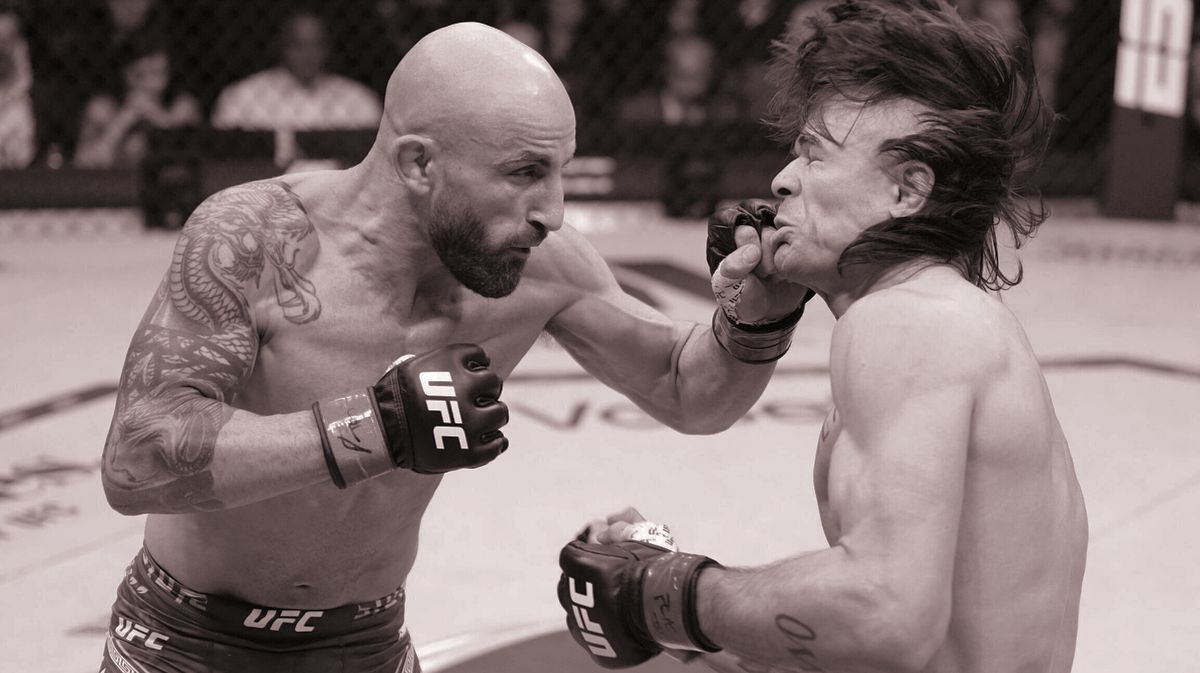
transformational $7.7 billion UFC deal. Sure, it won’t make Paramount+ profitable, but it will turn the service into a major player—as MLB and the NFL are likely taking note. |
|
|
Paramount’s seven-year, $7.7 billion UFC coup had its genesis, perhaps fittingly,
last September in a luxury box at the Las Vegas Sphere. TKO’s Ari Emanuel and Mark Shapiro were hosting Disney’s Bob Iger and Jimmy Pitaro for a UFC pay-per-view event. Jeff Bezos was also present, and so was David Ellison—still nearly a year away from taking control of Paramount, but already
plotting how to reshape the business. That night, Ellison made his ambitions clear to Emanuel and Shapiro: If his takeover succeeded, he was interested in the media rights to UFC for Paramount+. It was an offhand remark between principals, but it set the stage for one of the sports media world’s most stunning deals in recent memory.
Of course, this all seems like a lifetime ago. In the 11 months since, Ellison faced a relentless series of headaches—some foreseeable, some very much
not—in order to close his deal: shareholder threats, regulatory mishegas, the 60 Minutes turmoil, etcetera. For its part, TKO wasn’t ready to negotiate in earnest at the time, either. After all, ESPN’s 90-day exclusive window, which wouldn’t even start until after the new year, ran until April 15. And it would be immediately followed by a 30-day exclusive period that Netflix had negotiated with TKO as part of its WWE deal. After productive talks, Netflix extended its window by 15 days,
but by Memorial Day, there was still no UFC deal in place. Netflix remained interested in only part of the package, while ESPN stayed in the mix. Emanuel and Shapiro also entertained interest from Amazon, Fox, Apple, and, yes, Paramount. |
|
|
A MESSAGE FROM OUR SPONSOR |
Forever at the top of its game, the trailblazing BMW 7 Series. Engineered to win. Learn more at
BMWUSA.com |
|
|
Before their first formal meeting with Ellison’s team, on June 3, right in the swirl
of Trump’s war on CBS News, TKO executives still couldn’t be certain that the Paramount-Skydance merger was going to close. And even if they took an optimistic view, they assumed that New Paramount’s focus would be on UFC’s 30 fight nights rather than its 13 pay-per-view events. Indeed, many in the industry assumed that UFC would split rights into multiple packages among multiple outlets in order to meet its financial goals. Paramount’s team signaled grander ambitions, but
Shapiro left that meeting still believing that Paramount wanted only some of the rights.
It wasn’t until last week—around the time Skydance completed its acquisition—that Ellison made it clear: Paramount wanted everything: the fight nights and the pay-per-view events. “Then it became a 48-hour sprint to close out the deal,” Shapiro told me this afternoon. “We had the opportunity to keep it all together and give our fan base one-stop shopping—at what happened to be the
right price, with the right team, and the right strategy. It was a recipe that was too good to pass up.” |
For Paramount, the deal underscores its commitment to investing in top-tier content to
bolster its subscale streamer. Just last month, the company inked a $1.5 billion South Park agreement. (My partner Julia Alexander will have more on the attendant synergies in tomorrow’s exclusive Inner Circle issue.) And for leagues like Major League Baseball (whose rights are up in 2028) and the NFL (which can opt out of its current deals in 2029), the message is clear. “You have to be opportunistic,” Shapiro said. “Ellison is still going to clean things up in the
house, but it’s not going to slow him down from doing what he has to do on offense.”
TKO, meanwhile, will retain UFC’s international rights across 210 countries, sold through IMG, with roughly one-third of those rights up for renewal each year. It also keeps two minutes of ad inventory from every fight. LightShed Partners’ Rich Greenfield predicted this deal would happen, noting that he expected Ellison to invest more heavily in sports once the Paramount-Skydance merger
was finalized. “I sensed a very strong desire from David Ellison and his team at Skydance that they were not playing a short-term game,” he said. “They were thinking very aggressively about how to build a 10-year winner in this space.”
Greenfield pointed to the South Park deal and Paramount’s poaching of Cindy Holland from Netflix to run direct-to-consumer as evidence that this strategy extends beyond sports. “They have a service that is lightly watched in
Paramount+, and they are focused on changing this from a lightly watched service to a major player,” Greenfield said. “And that’s going to be all types of content, not just sports.” |
On ESPN’s NFL deal: “Let me get this straight: The NFL now has firmer control
over its own distribution destiny (a rarity in pro sports) while strategically propping up a legacy partner at the perfect time, which will help seed the field of deep-pocketed bidders come opt-out time. Meanwhile, Disney has turned a potentially declining cable asset into something with a real growth trajectory/digital future (unlike Versant, WBD’s cable split, and whatever happens at Paramount) while scoring a horde of new NFL content for its D.T.C. launch. Are we underrating just how
good of a deal this is all the way around? And is this not the most definitive strategic win of Bob Iger’s second tenure?” —A Varsity subscriber
On ESPN’s WWE deal: “The one concern I would have for ESPN with the WWE deal is that wrestling fandom isn’t as sticky as sports fandom. It’s cyclical. WWE has had a hot few years since poaching Cody Rhodes from rival AEW, but we’ve seen the first signs of fan interest heading backward thanks to
some creative missteps recently. The return of Brock Lesnar has sparked some questions too, given he’s named in the Vince McMahon sex-trafficking lawsuit. WWE is effectively too big to fail or not be number one in wrestling. But that doesn’t mean a rival company can’t get hot again.” —A journalist
On all those ABC simulcasts: “I work in local cable ad sales (those 2 minutes each hour you would see a local car commercial) and read with
great interest about the increase in Monday Night Football simulcasts on ABC to six from three. As a local-ad seller, these simulcasts hurt because we want ESPN to have exclusivity in these games so our advertisers get the largest audience, and it’s not shared.” —A local-ad sales executive |
|
|
Ace media reporter Dylan Byers brings readers into the C-suite as he chronicles the biggest stories in the
industry: the future of cable news in the streaming era, the transformation of legacy publishers, the tech giants remaking the market, and all the egos involved. |
|
|
Join Emmy Award-winning journalist Peter Hamby, along with the team of expert journalists at Puck, as they let you
in on the conversations insiders are having across the four corners of power in America: Wall Street, Washington, Silicon Valley, and Hollywood. Presented in partnership with Audacy, new episodes publish daily, Monday through Friday. |
|
|
Need help? Review our FAQ page or contact us for assistance. For brand partnerships, email ads@puck.news. You received this email because you signed up to receive emails from Puck, or as part of your Puck account associated with {{customer.email}}. To stop receiving this newsletter and/or manage all your email preferences, click here. |
Puck is published by Heat Media LLC. 107 Greenwich St, New York, NY
10006 |
|
|
|