Greetings from Los Angeles, and welcome back to In the Room. You may have heard that
Larry Ellison sold his home in Pacific Heights for $45 million—a tenth of a percent of the $40.4 billion he’s
pledged to his son David’s bid for Warner Bros. Discovery. I had the privilege of attending a party at that house some 15 years ago and, while watching the sun set over the Golden Gate Bridge, was regaled with details of his legendary dispute with his neighbors over the redwood trees obstructing his view. A fun anecdote to dust off for those on
the burgeoning Ellison beat.
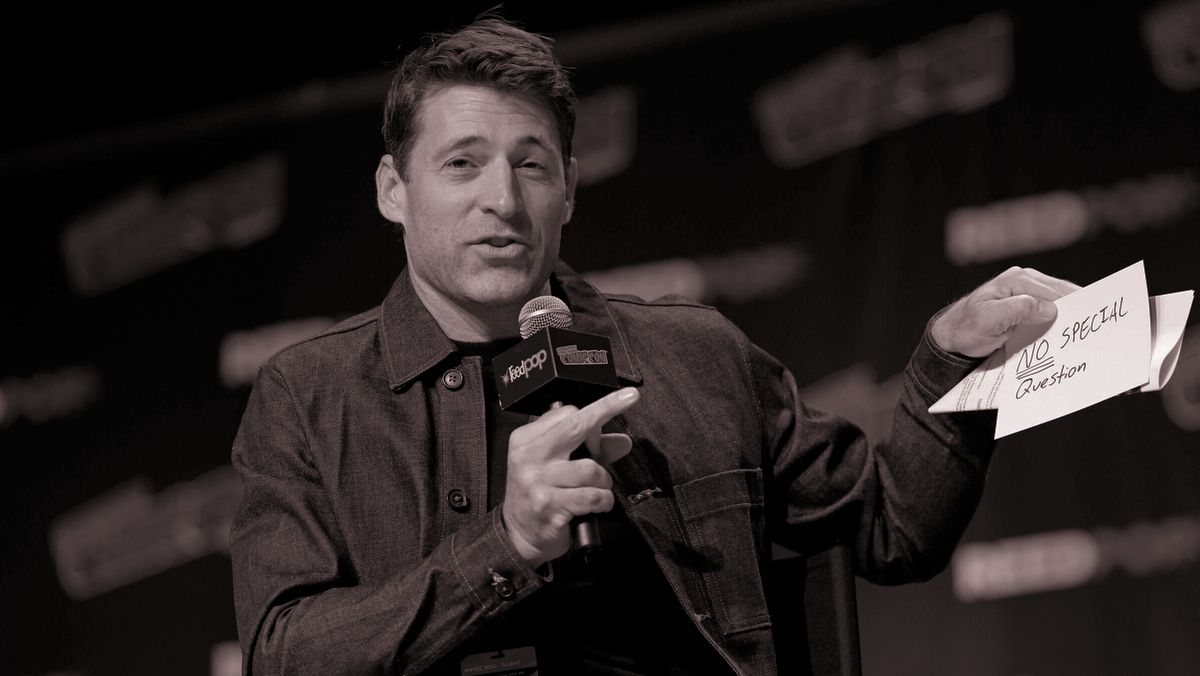
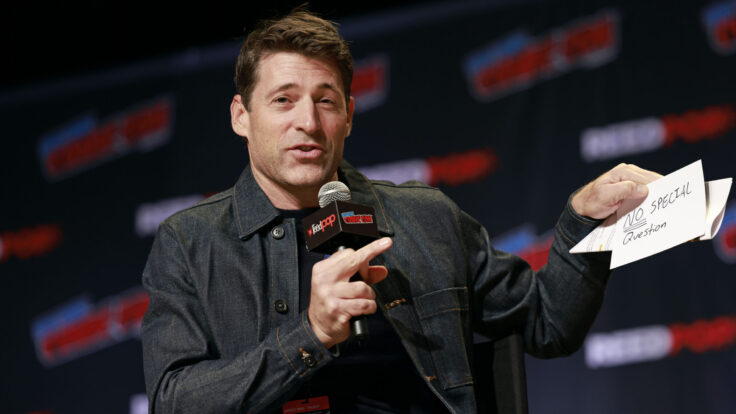
In tonight’s issue, I’ve got fresh news and notes on the latest schadenfreude-inducing fuck-ups at Bari Weiss’s CBS News. Her new star anchor, Tony Dokoupil, has suddenly found Free Press religion—saluting Marco Rubio, both-sidesing January 6—but his ham-fisted debut underscores broader chaos at the organization that starts in the front office.
🍸 Plus, on the latest episode of
The Grill Room, Puck’s Matt Belloni joined Julia and myself to chart the latest updates surrounding the Warner Bros. Discovery bidding war between Netflix and Paramount. We also dove into Hollywood’s accelerating A.I. anxiety in light of Disney’s pact with Sora 2, the upcoming film slate for 2026, YouTube’s rights deal with the Oscars, and more. Plus: Matt’s pick for Hollywood’s hero and villain of the year. Follow The Grill Room on
Apple, Spotify, or wherever you prefer to listen.
Mentioned in this issue: The Davids, the Smiths,
Ted Sarandos, Tony Dokoupil, Bari Weiss, Will Welch, Arthur C. Brooks, Bret Baier, Jake Sherman, Anna Palmer, Victoria Wolff, Anderson Cooper, Katy Tur, Kim Harvey, Norah O’Donnell, Scott Pelley, Tom Cibrowski, Chris
Licht, Kim Godwin, Nellie Bowles, Dickerson & DuBois, George Clooney, and more.
But first…
|
-
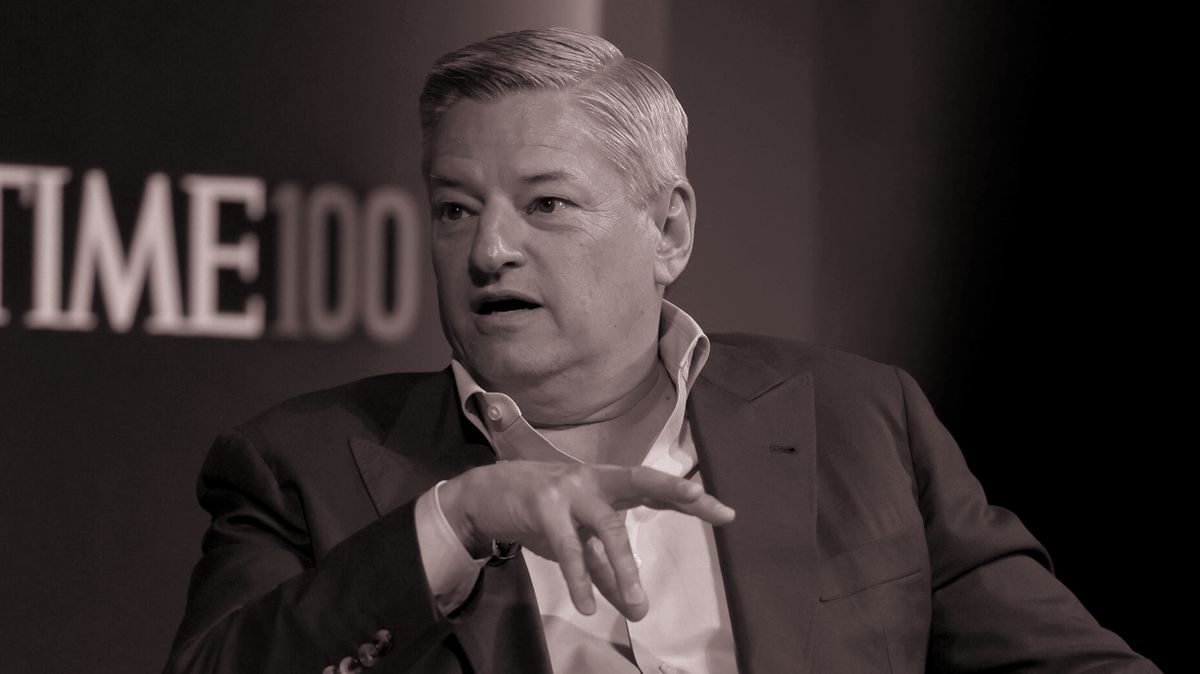
Dance of the Davids: David Zaslav and the Warner Bros. Discovery board have once again rejected David Ellison’s bid for the company, which comes as no surprise. The two sides remain at odds over the value of the Discovery Global stub, which obviously affects how one interprets the proposals from both Paramount ($30 per share for the entire company) and Netflix ($27.75 per share for Warners without the cable assets). In short, Zaz thinks the stub is worth at
least $3 a share, while Ellison thinks it’s worth $1.40, as my partner Bill Cohan recently revealed. (Bill has another incredible piece on this stub drama tonight. Always read Dry Powder, his private email.) And the fact that
Versant’s stock has dropped 25 percent since going public on Monday has only emboldened Ellison. Yes, I know this is a false equivalence and there are certain sell-off obligations, but try telling that to the Paramount Skydance team.Anyway, Zaz is standing firm and signaling to Paramount that it’s time to put up or shut up—as in, match the Netflix deal, pay the breakup fee, and then put more money on top. Meanwhile, Zaz and WBD remain antsy about Ellison’s ability to close the deal given
how levered he’d be by taking on all that debt. (Of course, this may be posturing, too.) As Rich Greenfield put it, “Why would the WBD board terminate a signed deal with Netflix, which has a strong balance sheet that is gushing cash, absorb termination fees and debt-related costs, and accept a highly leveraged offer from Paramount on the hope that the financing is ultimately achievable to get to closing?” Fair question.
There’s been a lot of noise in recent months around
the relationships and emotions of the players involved here. Ted Sarandos and Greg Peters being photographed on the Warners lot—a totally normal thing for buyers to do—was nevertheless seen as a taunt. One Paramount source quipped to the New York Post that WBD had proffered so many excuses for rejecting their offers that they’d eventually complain about the paper the offer was printed on. In truth, these are businesspeople, and the deal will ultimately
come down to the money—and who is willing to not only offer, but guarantee, more of it. (Disclosure: Through our recent acquisition of Air Mail, Zaz is a de minimis investor in Puck; RedBird, Ellison’s partner, is a minority shareholder.)
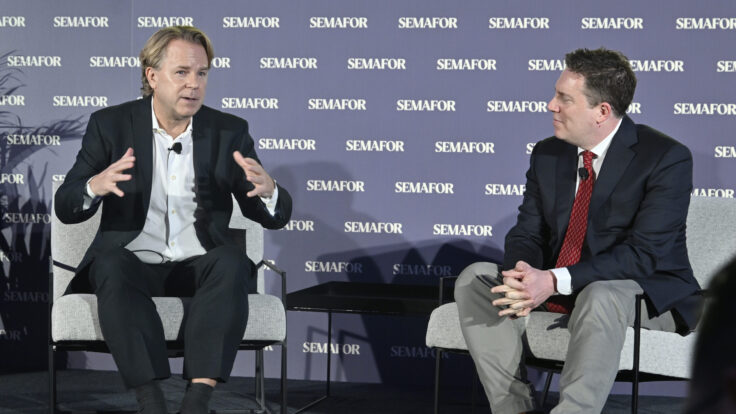
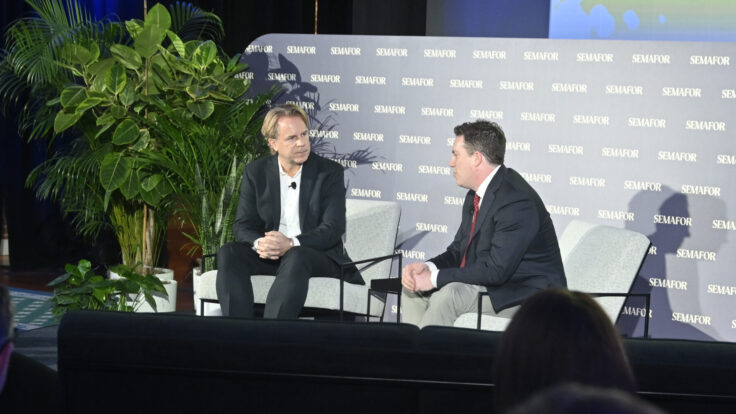
- The Smiths go higher: Justin Smith and Ben Smith have announced a new $30 million raise for Semafor that values their events-driven media enterprise at $330
million—a staggering 8x multiple on trailing year revenue. As you know, Semafor generates the vast majority of its revenue from a D.C. conference and various international partnerships (most notably in the Gulf), which is hardly the sort of stable, scalable engine that usually warrants this kind of capital. With this round, Semafor has now raised approximately $74
million in three years—a lot for a modern digital media entity.Good for those guys, no doubt, but the raise was notable for a number of reasons beyond the frothy valuation. Much of the capital appears to be coming from individuals rather than institutional investors, a dynamic that often implies a lighter touch on diligence and return profile. (Antenna, notably, is essentially a family office.) And while a premium valuation can be flattering, it also imposes real strategic constraints:
It heightens the pressure to “get in the money,” narrows the field of credible acquirers, and, paradoxically, can make the business less—not more—appealing to potential buyers.
Anyway, we’ve clearly entered the Bari Weiss multiple era, which is good for everyone, I guess. (One imagines that Jake Sherman and Anna Palmer’s Punchbowl has been courted at a similarly high multiple.) Media startups are now like sports teams: a very few quality assets that are
coveted by a very few highly motivated buyers—a supply-and-demand ratio that continues to drive valuations ever higher. Meanwhile, it will be interesting to see whether synergies emerge between the company and Antenna principal Theo Kyriakou, who has a large trove of media assets across Europe and the Middle East. Fortunately, Justin and Ben have both agreed to join me on The Grill Room later this month, where they will presumably justify the math.
- Bari’s other baby: Speaking of Bari, The Free Press this week revealed that it now has 2 million subscribers—paid and mostly unpaid, of course—and announced a number of new hires, including Arthur C. Brooks of The Atlantic. Brooks, as you may know, is one of the nation’s most prolific purveyors of the optimized angst thinkpiece: “Will GLP-1s make us happier?” “How does artificial intelligence change our understanding
of love?” “Has the modern world warped our understanding of meaning, purpose, and joy?” Laugh if you will, but it’s worth noting that these were frequently among the most-trafficked articles at The Atlantic and a cornerstone of their social media campaigns. I assume they’ll be similarly meaningful for the FP.
- Will of the world: GQ editor Will Welch is leaving Condé Nast to join Pharrell and his
supermanager-C.E.O., Penni Thow, at a yet-to-be-named holding company in Paris, where he’ll work across the celebrity’s various businesses. As my partner Lauren Sherman notes in her indispensable private email, Line
Sheet, “Welch’s endgame was always a kind of unknown: He is only in his mid-40s, but has been working at GQ for 19 years, and in the editor-in-chief role for the past eight. During his tenure, he transformed GQ from an increasingly out-of-touch everyman’s bible to a niche publication for fashion obsessives, reflecting the way the culture was moving.”In short, the GQ job “was starting to feel like a dead end,” Lauren writes. “Many thought he might be in
line to succeed Anna Wintour in the chief content officer role, and perhaps he’ll return to the fold when (and if) she ever steps down. For now, though, he’s taking what could end up being a sort of nebulous job to hang out until the next real thing comes along.”
- And finally…: Congrats to Victoria Wolff, née Floethe, on earning her New York Times Style
profile, which charts her rise from Vanity Fair researcher and tabloid footnote to lifestyle influencer and “mastermind” behind her husband Michael Wolff’s own embrace of Substack and Instagram. (Old dogs, new tricks.) The salient detail here for the self-publishing crowd: Michael says he’s bringing in more than
$600,000 a year through his Substack newsletter.
|
|
|
Tony Dokoupil’s disastrous debut as anchor of CBS Evening News
highlights the uncomfortable truth about Bari Weiss’s tenure: While her politics take center stage, it’s her inexperience that’s her real liability.
|
|
|
On Monday, during his maiden voyage as anchor of CBS Evening News, Tony
Dokoupil was about to wrap a segment on Nicolás Maduro with some presumably brilliant geopolitical commentary when the producers instead posted an image of Senator Mark Kelly. Flustered, the newsman teed up a segment on Governor Tim Walz, before pivoting again: “To other news, as you just heard… to other news now, to Governor Walz… No, we’re going to do Mark Kelly,” he said.
In the instantly viral clip, which you may
have seen, Tony then regrettably amplified the flub—“First day, first day, big problems here”—before waving the white flag entirely: “Uh, are we going to Kelly here? Or are we going to go to Jonah Kaplan?” he asked the producers. Seconds of silence, then: “We’re doing Mark Kelly…”
Shit happens, as Shakespeare said, but the Dokoupil blunder drew predictably heavy, if slightly hyperbolic, fire against the backdrop of all the recent Bari
Weiss player-hating—her controversial preemption of a 60 Minutes segment, her Erika Kirk misfire, her naive Bret and Anderson poaching efforts, etcetera. Admittedly, Tony brought some of it on himself. Days earlier, he’d channeled Bari’s warmed-over anti-media schtick into his own mission statement about the need to restore “trust,” throwing his fellow travelers—including his wife, MS NOW anchor Katy Tur—under
the bus in the process. He’d also promised to be “more accountable and more transparent than Cronkite,” yet couldn’t seem to muster a modicum of his predecessor’s composure. In his early broadcasts, Tony has also developed a newfound sycophancy for the Trump administration— saluting Marco
Rubio, both-sidesing January 6—effortlessly showcasing the malleability of people who get paid to read teleprompters.
And he hadn’t really even rehearsed. Like Bari, Tony was expected to hit the ground running. He arrived at Evening News without his own executive
producer, and is still in his courtship phase with existing E.P. Kim Harvey. (Presumably, if this becomes a mess, she’ll be the first to go.). Former Evening News anchor Norah O’Donnell famously rehearsed her entire show every night before going to air. The ill-fated Dickerson-DuBois duo practiced their show for months before it even debuted. Tony, by contrast, was still writing his geopolitical commentary minutes before he went
live, per sources familiar. The copy was haphazardly pasted into different parts of his script and that of his producers, hence the asynchronicity. (They cleaned it up for the official version that’s now online.)
The day one fumble offered fresh fodder for eager critics. Some even suspected defiance by a staffer manning the teleprompter—which, given the vibes on West 57th
Street these days, couldn’t immediately be ruled out. In truth, however, this wholly forgivable screw-up was merely the latest manifestation of a problem that has bedeviled Bari since her arrival—namely, that TV news is actually really hard, and it requires mastery of myriad organizational and managerial skills that aren’t often learned on the fly. Bari may be ambitious, competitive, and capable of both working 18-hour days and successfully exiting a company for $150 million.
But as I’ve often noted in these pages, she’s also not a seasoned executive. The morning after Tony’s debut, she was running late for the 9 a.m. editorial call and had to start by phoning in from her office before joining in person, according to CBS News sources.
Surely everyone has learned their lesson; Tony did rehearse ahead of the next evening’s broadcast, and CBS News president Tom Cibrowski was on hand in the control room to ensure no repeat
errors. But, in the end, Weiss is accountable for Tony’s success. After the 60 Minutes scandal, Scott Pelley admonished her for treating the show like a “part-time job”—which, frankly, it is (ask Anderson). In truth, Pelley misdiagnosed the problem. Bari isn’t doing too little, she’s doing too much, and learning the hard lessons along the way.
|
Obviously, Bari has infinitely more runway than Chris Licht or Kim
Godwin—strivers who presumably dreamed of running a network or a news division. Weiss, for her part, probably never even countenanced the opportunity until the Skydance negotiations got real. Bari’s critics tend to discount the view from David Ellison and the rest of the Paramount management team. The CBS News they inherited was already in terminal decline, and they certainly didn’t hire Bari to save it—in fact, preserving its legacy would have been a
financially disastrous decision.
Instead, the Ellison & Co. thesis for CBS News is rational enough: The three broadcast networks have long converged around the same distribution platform and a center-left ideological locus. If you’re the perennial third-place, money-losing network, pivoting to a wide-open center-right lane with a digital media entrepreneur makes quite a bit of
sense, particularly in America circa 2026. Of course, executing on that will take time: per CBS, Tony’s debut episode was up 9 percent in total viewership and 20 percent in the demo compared to previous Monday broadcasts. But it was also down by hefty double-digit percentages when compared to every previous anchor debut going back to Katie Couric.
Anyway, past network news scandalettes have proven that things get worse before they get better. Even if Bari has Ellison’s
support, she’s vastly outnumbered by her employees, none of whom were consulted on this vision shift. Many staffers were discouraged by her decision to engage in a public spat with George Clooney (“CBS News doesn’t do that,” one told me.) And they have been especially turned off by Bari’s wife, Nellie Bowles, using The Free Press to mock the “public meltdown” over the aforementioned 60 Minutes scandal. (Nellie also tweaked a media reporter for obsessively covering Bari’s every move, which was actually kind of funny.)
Bari doesn’t put much stock in the soft leadership aspects of the job. She privately chafes at the laziness and mediocrity of some staffers and has told multiple people that she’ll fire anyone who isn’t willing to work hard and get on board with her leadership, per sources
who heard her say it directly. (Presumably, she doesn’t think it takes 40 people to make a TV show.) Staffers also say she has at times been visibly frustrated by how hard it is for her bookers to land big-name guests—a task, as you’ll recall, that she has often taken up herself by pulling out her phone in meetings and texting sources directly. Finally, for a journalist who claims to champion a free press—and who once
published an audio recording she obtained of an internal CBS News meeting—she seems remarkably miffed by the leaks coming out of her own shop. (Bari did not comment for this piece.)
Your read on these details is, of course, a Rorschach test. Surely Ellison & Co. could do without these headaches—but, from their vantage point, Bari is doing just fine,
has every right to be frustrated with the existing complacency, and probably has license to fire whomever she wants. And this drama is merely a minor nuisance amid the quest for an $108 billion deal. It’s hard to imagine them buckling anytime soon: Whether or not she can program 20 minutes of error-free television per day, Bari enmeshed herself with the mogul class by proving that she didn’t care what other people thought—defenestrating herself before others could. That’s what the money is for,
and these guys know that better than anyone.
|
|
|
A professional-grade rundown on the business of sports from John Ourand, the industry’s preeminent journalist,
covering the leagues, players, agencies, media deals, and the egos fueling it all.
|
|
|
Join Puck’s chief political columnist, John Heilemann, as he roams the corridors of power and influence in America on
this twice-weekly interview show, taking you beyond the headlines with the people who shape our culture: icons and up-and-comers, incumbents and insurgents, moguls and machers in the overlapping worlds of politics, entertainment, tech, business, sports, media, and beyond. The conversations are rich and revealing, unrehearsed and unexpected… and reliably impolitic. A Puck-Audacy joint, new episodes drop every Wednesday and Friday.
|
|
|
Need help? Review our FAQ page or contact us for assistance. For brand partnerships, email ads@puck.news.
You received this email because you
signed up to receive emails from Puck, or as part of your Puck account associated with {{customer.email}}. To stop receiving this newsletter and/or manage all your email preferences, click here.
|
Puck is published by Heat Media LLC. 107 Greenwich St., New York, NY 10006
|
|
|
|