 |
|
Welcome back to The Varsity, my private email on the big money in the sports business. I’m writing this from my hometown of Washington, D.C., where I am anxiously awaiting Kent Babb’s story on Kim Mulkey. Thanks to Mulkey for putting that story on my radar…
Before we begin, I want to highlight this James Fanelli story in the Journal on poorly behaved D.C. Little League parents, which flew around some of my group texts that have been dormant since the Obama administration. About a decade ago, you see, I was a volunteer coach for the very same league in question—we even made it to Little League World Series regionals in Bristol in 2012. I found every single one of the accusations in the story to be completely believable—stacking rosters, using out-of-boundary kids, etcetera. You could come up with a billion reasons why adults would act so poorly around a kids’ game, but I was taken by the father who admitted the extraordinary high that his family experienced when watching his son pitch on ESPN. That sort of allure, if not appropriately processed, can turn an otherwise sane parent into a total psychopath.
Remember, The Varsity is now behind Puck’s impenetrable paywall, so sign up here to ensure you’re getting the full issue in your inbox. Remember, a subscription to Puck will make you smarter, wealthier, kinder, friendlier and more youthful. And if I find out that you’ve been forwarding this private email to your friends or colleagues, I’ll be sure to sign you up for Marchand’s poem-of-the-day secret Substack.
Today’s edition includes a rare on-the-record interview with Diamond Sports C.E.O. David Preschlack, news from the NFL owners meeting in Florida, and my view of Peter Angelos’ legacy.
Let’s get to it…
|
| Starting Five: Opening Day Edition |
|
- The R.S.N. Battles…: TV executives are now quite accustomed to the gripe among consumers that they can’t figure out how to watch various games, given all the competing streaming platforms and micro-platforms. In order to help make a little sense of the madness, ESPN recently committed to providing links to games on three regional sports networks (NESN, SportsNet Pittsburgh, and Monumental Sports Network) on its website and app. ESPN, of course, is not housing those streams—rather, the business will redirect authenticated subscribers to those R.S.N. streams, which can only be viewed in-market.
Obviously, the worldwide leader in sports is not providing this service altruistically. ESPN, which has a growing interest in local sports, has entered an experimental phase as the R.S.N. business enters its death spiral. After all, the network’s NBA rights negotiations have partly revolved around local streaming opportunities. ESPN is also likely to explore an out clause in its $550 million MLB contract after this season so it can contemplate local streaming rights. Its partnership with these three R.S.N.s may help inform its future strategy as it wades further into this business.
- Non-Shohei MLB storylines: The MLB season starts in earnest Thursday. Outside of the still vexing Shohei Ohtani scandal, here are the three most compelling media storylines:
—Last year, MLB found success by creating a new early Sunday window (games start around noon locally) for games streamed exclusively on Peacock. Meanwhile, the NBC broadcast network also carried a number of games. MLB and NBCUniversal have been unable to work out a new deal for that package, however. MLB is still talking to various media companies about picking up the package, but here we are, just three days before the start of the season, and there’s still no deal in place.
—MLB heads into the new season with plans to produce and distribute games for the Padres, Diamondbacks, and Rockies. In the meantime, all eyes are on Diamond Sports, which owns the rights to 12 MLB teams, and is in the process of coming out of bankruptcy. The league’s strategy for replacing local TV revenue will have far reaching effects on all teams and their salary structures.
—As I noted above, sources have told me that ESPN is likely to exercise an out in its MLB contract at the end of this season. The network does not want to get out of the business of baseball, so don’t expect ESPN to walk away from Sunday Night Baseball. But ESPN wants to be able to get more for its $550 million annual deal, which is where the league’s local rights situation could come into play.
- The NFL P.E. fantasy: NFL franchise valuations, as everyone knows, are at an all-time high and show no sign of abating. Last year, former Apollo Global Management co-founder Josh Harris bought the Washington Commanders for a record-high $6.05 billion. As I reported last week, the Dolphins were valued at $7.5 billion as part of a now-dead process to sell a minority stake to Citadel C.E.O. Ken Griffin.
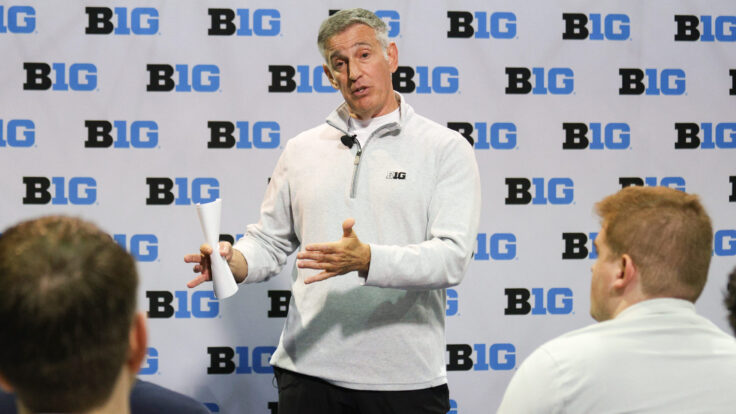
Historically, NFL ownership has been the province of ultra-high net worth individuals. Now, the NFL has begun exploring whether to allow teams to sell ownership positions to institutional investors—to private equity firms, in particular, as other leagues allow. The league has set up a group of high-powered owners (Arthur Blank, Robert Kraft, Clark Hunt, Jimmy Haslam, Greg Penner) to develop a plan that it could present to other owners by this week. As SBJ’s Ben Fischer reported, the owners likely won’t vote on the idea during this week’s meetings, in Orlando, but could get around to it in May. Many expect the league to allow PE firms to buy into teams, which should provide a number of owners the opportunity to enjoy liquidity events while remaining in control. Bringing in private equity, too, will optimize the deal pipeline for any owner that does eventually get itchy.
- If a tree falls in the streaming economy…: Nobody is watching Apple TV+. In his excellent private email last week, my partner Matt Belloni called Apple TV+’s teeny viewership—0.29 percent of all streaming viewership, according to Nielsen’s Gauge report—“the funniest and most underreported story in Hollywood.” Given Apple’s MLS and MLB deals, it’s also an underreported story in professional sports’ front offices.
As Matt points out, Apple TV+’s numbers are “waaay below bottom-tier streamers Paramount+ (1.1 percent of viewership) and Pluto TV (0.8 percent), and neck-and-neck with Discovery+ (0.24 percent), a service that was largely subsumed by Max and is not marketed at all.” The 10-year, $2.5 billion MLS-Apple exclusive was heralded upon its announcement in 2022. But I’m increasingly concerned that the burgeoning league will find itself locked in a pair of golden handcuffs, with only hardcore fans paying for the service. Of course, what the league needs most are new fans, not pre-existing ones.
- R.I.P. Peter Angelos…: As a lifelong Orioles fan who covers sports business for a living, I fielded several texts and calls over the weekend to discuss the legacy of the team’s late owner, Peter Angelos. I tried to be charitable, but that was largely impossible. In a business sense, Angelos held almost no sway at the league level—one of the reasons Camden Yards hasn’t hosted an All-Star game since 1993—a month before Angelos bought the team for $173 million. Speaking as a fan, the on-field results were terrible. Sure, like me, you could blame the Jeffrey Maier tragedy for robbing Ripken of a championship. But, on a more prosaic level, the team often stunk, was cheap, and remained complacent.
Angelos, a self-made man who donated a lot of money and time to the city of Baltimore, lived a rich life. He had a sterling record as a lawyer. But, as is so often the case, he was unable to translate his private sector success into life as a pro sports owner. David Rubenstein, the team’s new owner, promises to be much more successful, especially with a young and loaded roster.
|
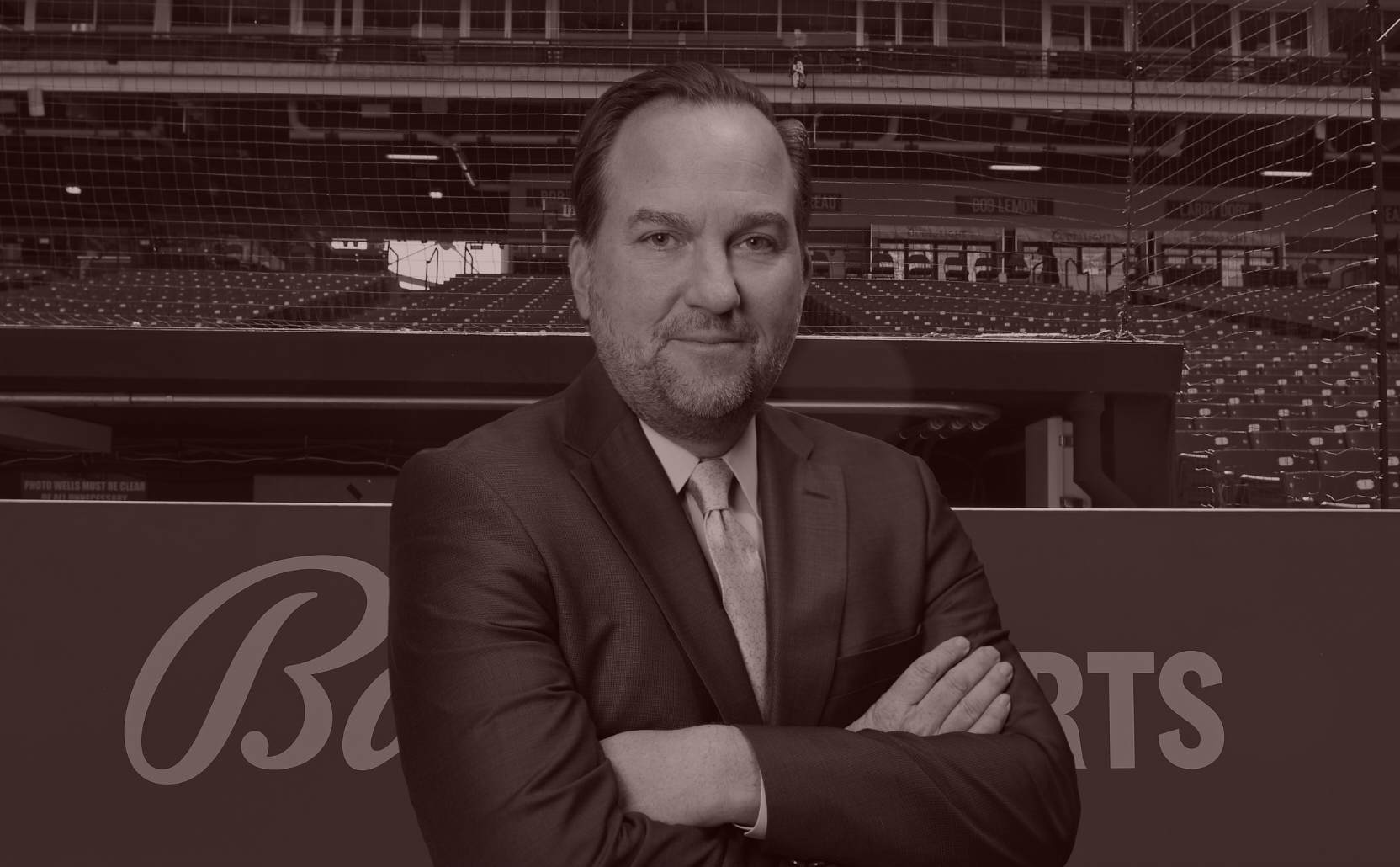 |
| Preschlack in the Sky with Diamond |
| After rescuing Diamond Sports Group from bankruptcy, C.E.O. David Preschlack now faces the unenviable task of cutting deals with various cable providers and leagues to satisfy the courts that this thing is a going concern. Here, for the first time, he chatted candidly about his burden. |
|
|
|
| The star-crossed fate of Diamond Sports Group is a well-known saga to faithful readers of The Varsity and avid consumers of the regional sports network cinematic universe. But for the uninitiated, allow me to retell a gruesome story in brief: Diamond, once the under-loved leftovers of Rupert Murdoch’s $70+ billion sale of the 21st Century Fox assets to Disney, had been left for dead amid the underwater economics of the local sports broadcasting business—one in which its rights payments overwhelmed its local TV revenues. A year ago, the company filed for bankruptcy. Then, in mid-January, came a lifeline: Diamond worked out a $115 million deal with Amazon, combined with a $450 million debtor-in-possession financing from its creditors.
Now, the hard part truly begins. In order to satisfy its creditors, Diamond needs to secure long-term deals with three of the country’s biggest distributors (Comcast, Charter, and DirecTV) while working out agreements with the NBA and NHL to distribute games in local markets. Closing any of these deals requires a high degree of execution. Closing them all virtually simultaneously amid the financial pressures is a Herculean task. Nevertheless, Diamond has to file its business projections to the bankruptcy court before a hearing scheduled for April 17. “We were able to enjoy it for 24 hours,” Diamond C.E.O. David Preschlack said about signing the Restructuring Support Agreement in January. “Then we needed to start preparing to scale Mount Everest again.”
I sat down with Preschlack recently for his first on-the-record interview in months. During our hour-long talk, he projected a lot of confidence about getting these deals done, emerging from bankruptcy, and putting Diamond back together. “We need to figure out what the art of the possible is with our three largest distributors, and we need to figure out what the art of the possible is with the NBA and NHL,” Preschlack said. “We’re in active discussions with all five parties. We’ve got some time here—albeit not a lot—which is going to have a direct correlation on whether or not the company’s going to be able to emerge from bankruptcy.” |
|
|
| Preschlack’s pitch is a simple one. Everyone in the business—distributors, the leagues, the teams—are better off with a fully intact Diamond Sports Group. Distributors are loath to have local broadcast network groups, like Scripps, Sinclair, or Nexstar, come in and buy up the local rights and sock them for higher affiliate fees in their retransmission consent negotiations. Similarly, teams will not want broadcast groups swooping in to buy up those rights on the cheap. “Given our rights portfolio and given our partnership with Amazon, we’re best positioned to innovate the fan experience in a meaningful way,” Preschlack told me. “Diamond, in the near and long term, is the best economic engine for our team partners to drive maximum value.”
For Diamond, the NBA deal is the key since the local rights talks coincide with the league’s broader national media deals, and it has expressed openness to combining them. Preschlack is hoping that the NBA will want to keep the R.S.N. business afloat, considering that it still prints money for teams. He’s also hoping that Amazon’s role as a local rights partner will be a deal sweetener for the league.
Major League Baseball, on the other hand, has taken a harder stance with Diamond than other leagues. The league, which is the most vulnerable to R.S.N. disruption, took over the production and distribution for the Padres, Diamondbacks, and Rockies, and stands ready to reclaim any other team rights that Diamond might give up at the end of 2024. “There are open lines of communication. We keep them up to speed on the developments of the company,” Preschlack said when I brought up MLB. Then, he conceded, “The business plan that the creditors and Amazon have invested in does not contemplate any additional future direct-to-consumer rights from any Major League Baseball team.” That could present a problem down the road, however, as MLB historically has been the growth engine behind the R.S.N. business. During the 2022-23 seasons, for example, MLB posted a gross audience of 407 million—a much higher figure than either the NBA (122 million) or NHL (77 million).
Then there’s the distributors, a business that Preschlack knows well, having spent the first two decades of his career in ESPN’s affiliate sales group. Comcast, Charter, and DirecTV have had opportunities to do long-term deals with Diamond over the past year. But in each case, they kicked the can down the road, opting for short-term deals. Comcast, in particular, has been driving a hard bargain in its most recent R.S.N. deals, placing the channels like the Mid-Atlantic Sports Network on lightly penetrated digital tiers. In some cases, executives tell me the R.S.N.s will see a one-third cut in affiliate revenues from these new deals. “There are a few component parts to any deal that are really meaningful,” Preschlack said. “One is the length of the deal. Another is the level of carriage. And another is the rate.”
Preschlack then reverted to his main message: the leagues, teams, distributors, and fans will be better off with Diamond Sports operating as a healthy company. “Diamond is, by far, the best mechanism for maximum reach,” he said. “Relative to the core business, a flip of the switch and we are in 100 percent of the territories as defined by the leagues. You can’t say that about local broadcasters.” Oh, and Amazon, Amazon, Amazon… “And then digitally,” he said, “I mean there’s no better company in the direct-to-consumer business than Amazon. They will stream at a massive scale, and fans will benefit.”
Sure, Preschlack has a plan to get Diamond out of bankruptcy, and he has a pitch to convince leagues and distributors to help. The key to his success, however, will come from whether the leagues and distributors are ready to move on from the R.S.N. business, or whether they’d rather maintain the status quo. My bet is on the status quo. |
|
|
| “If the NFL’s Brian Rolapp questions the value of the Spulu bundle, he really ought to take a hard look at the NFL+ offering at $15 per month. Also, remind him you can buy Sunday Ticket without subscribing to YouTubeTV.” —A former network executive
“A thought about the Ohtani scandal: a major difference between legal and illegal sports betting is that with the former you have to put up the money before placing a bet, while in the latter that’s not true. So it’s unlikely that the interpreter would have gone so far in debt had betting been legal in California.” —A sports organization executive
“FYI… Stan Kroenke owns the Rams stadium and all 300 acres around it, too.” —An NFL executive, responding to my reporting about the surprisingly few number of team owners who also own their stadiums and the real estate in the surrounding area.
“You have gone from hanging out at CBS’s March Madness media luncheon to the French ambassador’s residence. What a career.” —The Athletic’s Richard Deitsch via X.
“I really liked your note about Peacock retaining subscribers after the AFC Wild Card game because I was definitely one of them. I actually stayed because of the WWE content. It makes me wonder if Netflix will do something similar in the live sports department to bring more subscribers in before they launch Monday Night Raw in January. Who am I kidding though? I don’t think Netflix needs the extra help at the moment.” —A Puck subscriber
“I jumped at the chance for free Dodger games, but the offer stated I needed both Spectrum Mobile and Spectrum internet. I've had Spectrum internet for 20 years, but spent most of yesterday switching my phone from Verizon to Spectrum. It was not an easy process, but I should have done this a long time ago, as Verizon was charging me $75, and Spectrum Mobile is only $30. I am thrilled to get Dodger games for free, at least for one year. I was literally an hour away from signing up for MLB.TV, even with no Dodgers. Now I don’t have to.” —A Puck subscriber
“How much do you think the ESPN flagship app will cost? I would say a minimum of $24.99 per month. They will have all the content. They can overpay for it and then set the price.” —A Puck subscriber |
|
|
See you Thursday,
John |
|
|
|
| FOUR STORIES WE’RE TALKING ABOUT |
 |
|
 |
|
 |
|
 |
| Hollywood Mailbag |
| Yellowstone rumblings, Elon’s no-show, and much more. |
| MATTHEW BELLONI |
|
|
|
|
|
 |
|
|
|
Need help? Review our FAQs
page or contact
us for assistance. For brand partnerships, email ads@puck.news.
|
|
You received this email because you signed up to receive emails from Puck, or as part of your Puck account associated with . To stop receiving this newsletter and/or manage all your email preferences, click here.
|
|
Puck is published by Heat Media LLC. 227 W 17th St New York, NY 10011.
|
|
|
|