Greetings from Los Angeles and welcome back to In the Room. I’ve just returned home
from the Paley Summit in Menlo Park, where the parlor game du jour was guessing what share price David Ellison will end up paying to get Warner Bros. Discovery. Like me, most folks believe Skydance’s acquisition of the asset is inevitable, will cost much less than $30 a share, and doubt whether the other suitors are really real.
So, in tonight’s issue, I wanted to take you inside those conversations and the prevailing wisdom about what’s
actually afoot with the Warner Bros. Discovery sale. Then, a readout of my recent conversation with Sarah Longwell, the publisher of The Bulwark, on the Never Trump business and whether she and her partners might see a Bari Weiss–level exit.
🍸 Plus, on the latest edition of The Grill Room, Julia Alexander and I discussed Paramount’s impending WBD takeover, The New York Times’s plunge
into shortform video, YouTube’s next pivot, and much more. Follow The Grill Room on Apple, Spotify, or wherever you prefer to
listen.
Mentioned in this issue: David Zaslav, David Ellison, Sarah Longwell, Trump, Bari Weiss, Jeff Bezos, Bret Baier, Oliver Darcy, Lachlan Murdoch, Brian Roberts, Adam Silver, and many more…
Let’s get started… |
-
Hold your Bret: Before you get too excited… no, Bret Baier is not going to CBS News. Status’s Oliver Darcy raised some eyebrows Thursday night when he reported that Bari Weiss had expressed interest in bringing the Fox News anchor over to the broadcast network, possibly to helm Evening News. A minor roadblock here: Bret is locked into a $14 million-a-year contract with Fox through 2028, and there’s no way that
Lachlan Murdoch would let him out of it. Presumably, Bret wouldn’t have much interest in leaving the number-one cable news network for a job on a third-place broadcast network, anyway—especially when his show already frequently beats Evening News in the ratings. (I’m not sure CBS would let him work part-time from Palm Beach, either.)
Bari has actually floated around a dozen names of people she’d like to bring in, and there are certainly more plausible targets.
I’m told that Scott Jennings, the conservative CNN contributor, paid a visit to CBS earlier this week. - CNN’s Doha dance: CNN International has launched a new multiplatform initiative called CNN Creators, centered on four young journalists living in Doha, where the network recently established a new operation at Media City Qatar. (The project is helmed by Vice alum Andrew Potter.) Given that the inaugural episode simply
features the foursome wandering through the Souq Waqif and marveling at the food and wares—more Innocents Abroad than Anthony Bourdain—some CNN insiders have questioned whether this was a quid pro quo with Qatar. I asked CNN’s P.R. chief and was told: “This is not sponsored content. We are working with Media City Qatar on the provision of facilities and technical support for our facility there. Anything related to CNN editorial content is fully controlled and
funded by CNN.” Okay.
|
|
|
A MESSAGE FROM OUR SPONSOR |
Brand protection at the speed of culture. When it comes to the fast-moving world of social media, yesterday’s context can become today’s controversy. As platforms evolve, keeping your brand safe demands protection that moves just as fast. Zefr empowers brand leaders with the control, transparency, and insights to maintain media quality and
consistency across evolving social platforms, ensuring your message aligns with your brand values, no matter what’s trending. Stay one step ahead with Zefr. Test Zefr |
|
|
- NBA parlay: This week’s NBA betting scandal has been a blemish on an otherwise stellar rollout for the league and its media partners, who tend to push the DraftKings and FanDuel promos quite aggressively. But while it may ignite greater scrutiny of Adam Silver’s (prescient) embrace of legalized gambling, it’s highly unlikely to slow its growth. Indeed, as my partner John Ourand
reports, sports media types who deal with the NBA remain largely unconcerned, since “legalized sports betting has made the system more regulated.” And anyway, John writes, “The horse is already out of the barn. While acknowledging that these types of stories can lead to long-term consequences, sports betting is legal in 39 states, and it will
take a lot more than a couple of indictments to stop that momentum.”
- And finally…: Did you see the donor list for President Trump’s new White House ballroom? It includes all the big tech firms run by the titans who stood behind Trump on the inauguration dais, as well as several private donors,
including Blackstone’s Stephen Schwarzman, Tampa Bay Bucs owners Edward and Shari Glazer, and the Winklevoss twins. But the most notable name on the manifest may be Brian Roberts’ Comcast, given the president’s attacks against Roberts on Truth Social.
|
“This Whole
Dance Is Just About David”
|
During a reporting trip to Menlo Park this week, I found myself ensconced among the Sun
Valley crowd, all of whom were chewing over the same question: Will it be $24? $24.50? $25? More? In the days since David Zaslav formally hung the “For Sale” sign on Warner Bros. Discovery, his fellow media execs and friends at the Polo Bar and Polo Lounge have been feverishly debating what share price Zaz could get. But as for whom he’ll be getting it from, the collective wisdom was mostly unanimous: David Ellison.
Officially, Zaz rebuffed
Ellison’s repeated majority-cash advances—at $19 a share, then $22 a share, and finally $23.50 a share—in order to review “strategic alternatives” due to “unsolicited interest” from “multiple parties.” As this crowd sees it, the reality is probably more nuanced: Despite limited interest from parties beyond the Ellisons, Zaz convinced the board that he could get a better deal, and got the green light to go see if there was a market (or try to create one), even as he was being told that he’d
ultimately have to sell.
Upon announcing the sale, new parties miraculously seemed to come out of the woodwork: Comcast, Netflix, Amazon. Surely, they’re all doing their due diligence. But most insiders sense that Comcast can’t acquire it because of the political and regulatory hurdles, and that Netflix and Amazon don’t actually want it—at least not at the asking price. Meanwhile, as I
noted earlier this week, Paramount has a strong case to make that it is the best bet for shareholders, in part because it offers the cleanest regulatory path. (Indeed, Trump has effectively already blessed the deal).
Presuming all that’s true—and I think that’s mostly on the money—then what comes next is effectively a game of chicken. Zaz will try to gin up the
perception of demand for a post-split WBD at something closer to the ideal $30-a-share figure that some Wall Street analysts have floated, while the Ellisons try to convince shareholders that they’re really the only game in town. Depending on how that plays out, the share price offer could fluctuate marginally around the mid-$20s. But no one in Menlo actually believed it would get anywhere close to $30. Indeed, the most common answer among the parlor game participants was exactly what had
Ellison already offered: $23.50.
But perhaps the most telling detail from this whole back-and-forth so far is the fact that at least one of Ellison’s proposals included an offer to make Zaz co-C.E.O. of the combined company. No one views that as anything other than a face-saving measure for Zaz, who would presumably remain in that position for a year at best without real control. But even that may reveal one of the sticking points that has caused this process to drag on. As one source
told me about the offer to Zaz, “What that really tells you is that this whole dance is just about David.”
And finally, my conversation with Sarah… |
|
|
Since the early days of Trump 1.0, The Bulwark has evolved into a
hysteria-free, self-sustaining home planet for conservatives-in-exile, where the ethos, according to publisher Sarah Longwell, holds that democracy cannot be saved “from behind a paywall.” Now, she’s contemplating a Free Press-level exit, too. |
|
|
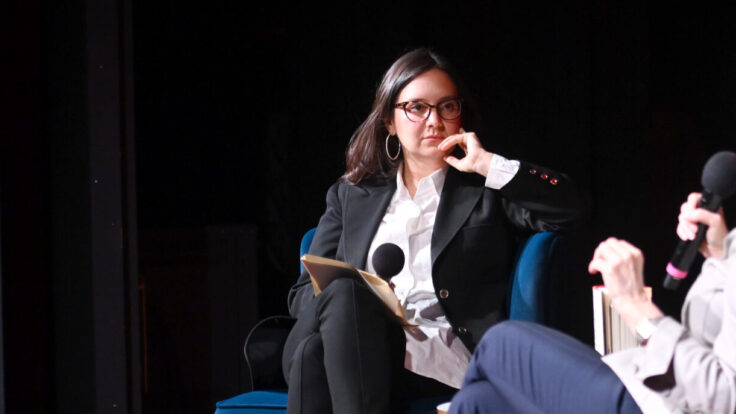
Seven years ago, political strategist Sarah Longwell led a band of
like-minded Never Trump conservatives to launch The Bulwark from the ashes of its forebearer, The Weekly Standard. At the time, the Substack-based outlet was viewed as a small but growing pillar of the so-called #resistance media. Now, in Trump’s second term, as much of the news industry has taken a less combative, or at least more nuanced, approach to his administration, The Bulwark has become the veritable home base for defenders of liberal democracy who’ve found
themselves politically homeless.
Longwell & Co. have quietly built what many in the industry now recognize as one of the most intriguing experiments in political media. And in the wake of Paramount’s $150 million acquisition of Bari Weiss’s Free Press, many wonder whether The Bulwark might be in for a similar windfall.
On a recent episode of The Grill Room, Longwell joined me to discuss it all: The Bulwark’s unique economics, the realities of growing a
digital media business in an era defined by consolidation, and this peculiar political moment that’s made The Bulwark both essential and, perhaps, more viable than ever. As always, this excerpt has been slightly edited for brevity and clarity. You can listen to the conversation in its entirety here. |
“Legacy Media Is Not Meeting the
Moment”
|
Dylan Byers: You guys launched The Bulwark in 2018 in
the heat of Trump’s first presidency, as a sort of merry band of Never Trumpers. Seven years later, we’re living through yet another Trump era, albeit a very different one. How do you feel about the way that The Bulwark’s mission has shifted over time?
Sarah Longwell: I don’t think any of us at The Bulwark ever thought that Trump was finished, full stop, except for maybe the two days after January 6. But once it became clear Republicans
were going to resurrect him, we always had our eye on the fact that the party was changing—and whatever illusions we might have had in the early days of taking the party back and restoring the conservative movement were laid to rest.
We view ourselves now, firmly, as a pro-democracy publication that has a politically diverse audience, as well as a pretty politically diverse staff. But the one thing we won’t compromise on is that we’re not going to normalize Trump. We’re not going to act
like this is just normal politics or a normal place for the Republican Party to go. And we’re gonna be clear about the fact that we think it should be fought. We’ve always been mission-oriented, but I guess that mission has shifted a bit as the world’s changed. |
|
|
A MESSAGE FROM OUR SPONSOR |
Brand protection at the speed of culture. When it comes to the fast-moving world of social media, yesterday’s context can become today’s controversy. As platforms evolve, keeping your brand safe demands protection that moves just as fast. Zefr empowers brand leaders with the control, transparency, and insights to maintain media quality and
consistency across evolving social platforms, ensuring your message aligns with your brand values, no matter what’s trending. Stay one step ahead with Zefr. Test Zefr |
|
|
The day after the 2024 election, I wrote a piece about how there would be no
resistance media wave this time around—no Trump bump like we first saw at places like The Washington Post and The New York Times. But you’re still occupying that space. Does it feel lonelier this time around?
I wouldn’t characterize this as resistance media, and I think that’s maybe a slightly shallow interpretation of what we’re doing. It’s sort of like saying
we’re still just “Never Trump media.” The Bulwark has sustained its success; it hasn’t been a flash in the pan. It’s been something that’s continued to grow all throughout the Biden years. We doubled our revenue last year, and I think we’re going to double it again next year. We’ve built a SEAL team of reporters. We’re pioneering in what we’re doing on YouTube, on podcasts, and obviously on Substack. I feel like we’ve done something different than just Never Trump, resistance media.
To
your point… Whether it was social media companies like Facebook or whether it was Bezos 1.0 when he was at The Washington Post, people were so shocked by Trump back then that they did stand up to him, and there was sort of an elite movement against him. This time around, whether it’s law firms or universities or those media companies, many of them have decided not to fight. There’s no doubt that is one of the reasons for our growth—not just because people are looking
for resistance-type media, but because they feel like legacy media is not meeting the moment, and they’re looking for somebody who is. |
From a business perspective, how do you think about capitalizing on this moment?
What more can you do from here?
We just got back from a sold-out show in New York. And before that, we did a sold-out show in D.C. We’re going to these big venues, and people are craving these live events, so we’re definitely going to push into more of that. Part of it is we’ve built more than an audience; we’ve built a community. And communities are a lot stickier than audiences are. And all of this ties to the personality-driven media, which is
where I think the general media environment is going.
I don’t think of us as a Substack publication. We’re a big ensemble, and we’ve become this bigger media company. For us, Substack is a distribution tool for our newsletters, the same way iTunes and Spotify are a distribution tool on the podcast side, and YouTube on the video side. We try not to live in any one of those spaces, but we want to meet everybody where they are. We’re multiplatform, and we are trying to grow in all of those
streams. And we’re also thinking about what it’s going to look like when people start to reaggregate.
There are people who talk to us about buying us; there are people we talk to about buying them. Everybody in this independent space sees things cracking wide open and is trying to figure out how to become the future. That’s all I think about; I want to be the largest independent media company out there. We’re constantly assessing what are the best tools and opportunities and innovations
that allow us to move forward and do that.
So when you look at David Ellison and Paramount buying The Free Press for $150 million, do you ever contemplate a similar exit, where someone who is politically aligned with The Bulwark acquires you?
Yes, well, first of all, what Bari Weiss did with The Free Press has been enormously useful for us. She gave us an amazing comp. We’re similarly sized companies, so I want to see those
numbers. Let’s be honest, the $150 million for The Free Press is kind of a silly number, because they weren’t buying the media company; they were buying Bari.
At The Bulwark, we care about two things the most: influence and control. The Bulwark is paid for by advertising, subscribers, and events. We don’t need a big corporation telling us what to do. We manage to have most of our content be free, while still having a massive subscription model. It’s free because we want to have influence
on the conversation. You cannot save democracy from behind a paywall. And yet, because we’re mission-based, and because people want to be part of the community, they come behind the paywall for content like The Secret Pod, which has been a massive revenue stream.
It’s very difficult for some publications to balance how you paywall content and build subscriptions, and then have influence on the broader conversation. I feel like The Bulwark is unique in that we find a way to
straddle that line.
If you look at a business like The Free Press, which I believe is doing between $15 million and $20 million in annual revenue, the vast, vast majority of that was from subscriptions.
When I say we’re comparable with The Free Press, we are, but our makeup is different. We’re doing a little over $12 million in subscriptions, but we’re doing a lot more on the advertising
side, as well as events, as well as audio. We have a very diversified revenue stream.
In addition to the money she made on The Free Press deal, Bari now also has control over the editorial direction at CBS News. Can you see a similar situation happening with The Bulwark?
I could see it. I think a lot of these linear folks are looking at these new media properties and wondering if these guys can solve their problems. The Bulwark’s
North Star is, Don’t re-create the failing model. The business we’re in is the business of building something new. I don’t want to be mean to linear television, but it’s just a reality that it’s a declining medium. I don’t know that you gain more influence jumping on the declining medium. I think you have more influence if you figure out how, in this chaotic, disaggregating moment, to build the new thing. I don’t know if jumping on the back of one of the dinosaurs is the way to more
influence. |
|
|
Join Emmy Award-winning journalist Peter Hamby, along with the team of expert journalists at Puck, as they let you
in on the conversations insiders are having across the four corners of power in America: Wall Street, Washington, Silicon Valley, and Hollywood. Presented in partnership with Audacy, new episodes publish daily, Monday through Friday. |
|
|
A professional-grade rundown on the business of sports from John Ourand, the industry’s preeminent journalist,
covering the leagues, players, agencies, media deals, and the egos fueling it all. |
|
|
Need help? Review our FAQ page or contact us for assistance. For brand partnerships, email ads@puck.news. You received this email because you signed up to receive emails from Puck, or as part of your Puck account associated with {{customer.email}}. To stop receiving this newsletter and/or manage all your email preferences, click here. |
Puck is published by Heat Media LLC. 107 Greenwich St, New York, NY 10006
|
|
|
|