 |
|
Welcome back to In The Room, I’m Dylan Byers.
|
|
In tonight’s issue, fresh reporting around some of the early themes that will define Mark Thompson’s CNN—in particular, what becomes of “The Quad” interim leadership team that bridged the gap between the Chris Licht era and this new chapter, and how their talents square with Thompson’s vision for the network. Plus, notes on a right-wing media booking skirmish over Volodymyr Zelensky.
|
|
|
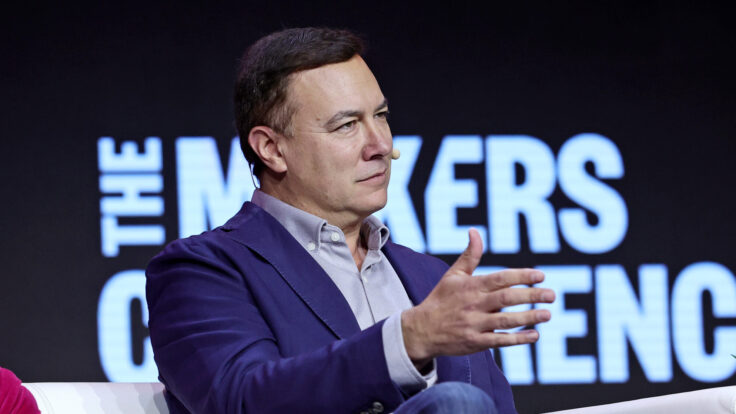
| On Friday, incoming CNN chairman and C.E.O. Mark Thompson spent the full day at Hudson Yards headquarters for about eight hours of presentations and meetings with CNN’s chief digital officer Athan Stephanopoulos and other members of the network’s digital team. This was just one of several appointments on Thompson’s calendar as he prepares to formally take the reins of David Zaslav’s news network on October 9. He’s had meetings and conversations with dozens of the network’s top executives, producers, and on-air talent in recent weeks, paid a visit to the Washington, D.C., and Atlanta bureaus, and also attended this week’s News & Documentary Emmys, where CNN picked up nearly a dozen awards—a rare and important victory for a network that is suffering from historically bad ratings.
For some at the organization, however, Friday’s digital meeting felt particularly loaded with import. While most of Thompson’s meetings have focused on the flagship linear product, he has also telegraphed in private conversations that he is committed to a long-term transformation of CNN’s business model, presumably based on the playbook he ran as C.E.O. of The New York Times Company—a foundation of subscription and annual recurring revenue, that gives rise to a multiplicity of other revenue streams. Thompson’s strategy might seem quixotic for a business that still relies on cable carriage fees, but many at the Times thought he was batshit crazy a decade ago—and look how that worked out.
Anyway, that plan, which Thompson says will take several years to complete, would try to break CNN free from its linear-first mentality and turn it into a digital-and-streaming-first news brand that also happens to produce a linear feed. And at a roughly 3,500-person company populated with linear veterans and digital natives alike, such a vision can inspire different feelings in different people.
In most years, CNN rightly touts itself as the number-one digital news website in the world. Nevertheless, the digital product has always taken a back seat to the far-more-lucrative linear product that, in its heyday, drew more than a billion dollars in annual revenue. Unsurprisingly, the most powerful people at CNN have therefore always been the television people—the programmers and producers, the talent massagers, etcetera. Jeff Zucker was a programmer and executive from broadcast television’s golden age who relied on a team of broadcast veterans, many from ABC News, who then went on to work for his successor, Chris Licht, an executive producer steeped in morning television and late night. Even the members of the quadrumvirate interim leadership group—“the Quad”—are largely linear-first types.
With Thompson coming in, there has been a lot of scuttlebutt inside Hudson Yards over how the Quad will fare in the new era. On the one hand, his direct reports offer just the experience and linear fluency that may be instrumental to the network’s near-term success; on the other hand, they are hardly the most likely candidates to help him achieve his broader, long-term vision of digital transformation. Amy Entelis is a talent whisperer with a passion for films and documentaries; Virginia Moseley is a hard-charging (and somewhat polarizing) Washington producer with blinders for politics and breaking news; Eric Sherling is a lifelong linear programmer; and David Leavy is a Discovery comms and operations guy steeped in Zaslav’s cable-centric worldview, who was essentially dropped into the network post-Licht to quell the natives. None of them have any real digital experience.
As I’ve noted before, none of these television veterans stand to have the same authority they once enjoyed as the economics of ratings and ad sales play second fiddle to the digital and streaming strategies. Their talents, while still highly valued, are no longer going to be the core business. It thus stands to reason that their ability to endure at CNN in the long term will depend on their ability to adapt to Thompson’s new vision—which doesn’t just require learning a new language, but recoding their very DNA.
On Friday morning, as Thompson’s digital meeting was getting under way, the quadrumvirate sent out their customary weekly note, highlighting some of the linear coverage and congratulating the network on its Emmy wins. At the bottom, they added a note that felt very much like a sign-off: “As CNN’s interim leadership team, we want to thank each of you for your steadfast dedication to our journalism and work these last several months,” it read. “It has been our true honor to lead the organization during this time, and we’re each looking forward to working with Mark to take CNN into the future. As we said on day one, our goal was to remove the barriers and distractions that made your jobs harder, refocus on the unparalleled work you are producing every day, and offer open and regular lines of communication to ensure that you feel invested and engaged in our path forward. We hope we have delivered on that promise and know how proud we are of all of you.”
It was an elegant conclusion to the most bizarre chapter in CNN’s history. As for what comes next, only Thompson really knows. |
|
|
| This Sunday, barring an eleventh-hour deal or a Senate measure to punt the deadline, the U.S. government will shut down for the first time in nearly five years. In addition to wasting billions of dollars, depriving federal employees of their paychecks and further eroding trust in government, the shutdown could also disrupt American aid to Ukraine at a time when Ukrainian President Volodymyr Zelensky’s forces are waging a tenuous counter offensive against Russia and staring down the barrel of a long, cold winter. And that is largely because a small group of hardline, pro-MAGA House Republicans—Matt Gaetz, Marjorie Taylor Greene, etcetera—are signaling that they will oppose any funding bill that includes further aid to the war-torn nation, even though the majority of their colleagues support that.
Meanwhile, on the campaign trail, Trump and his would-be successors—Ron DeSantis, Vivek Ramaswamy—are rallying against Ukraine funding. My Puck partner Julia Ioffe has gamed out the potential consequences of turning off the Ukraine aid spigot and, needless to say, none bode well for Kyiv.
The fissures in the Republican party over Ukraine are mirrored in conservative media circles, where they have taken on outsized influence. Indeed, nothing tested Rupert Murdoch’s bond with Tucker Carlson at Fox News so much as the host’s flagrant Putin apologias and opposition to American aid for Ukraine. Now banished from Fox and broadcasting on Elon Musk’s X, Carlson’s anti-Zelensky rhetoric has become so vehement—he has called the Jewish president “sweaty and rat-like”—that it is once again being repurposed on Russian state television as Kremlin propaganda. And, alas, Fox’s would-be challenger, Newsmax, has dabbled in pro-Putin, anti-Zelensky viewpoints from hosts and guests alike, seemingly to shore up support from the far-right audiences that found safe harbor there while Fox was undergoing its post-Jan. 6, pre-Dominion settlement identity crisis.
In this context, a recent calculation by Zelensky is perhaps telling. I’m told that during his visit to the U.N. General Assembly last week, Zelensky had arranged to sit down for interviews with CBS’s 60 Minutes, NPR, CNN, Fox News and Newsmax to make the case for sustained U.S. aid to Ukraine. After learning about Zelensky’s plans to sit down with CNN, Fox reached out to Zelensky’s camp to lodge a complaint: the network had been under the impression that Zelensky’s Fox interview, with Neil Cavuto, would be a cable news exclusive—indeed, they’d even prepared a promo touting as much. (Sources close to each side strongly disagree over whether an exclusive was ever promised, but no matter.)
Fox News sources say Zelensky’s decision to sit down with CNN and renege on the exclusive led them to forego Cavuto’s sit down with the Ukrainian president and stressed that Newsmax played no role in their decision. But three other sources with knowledge of the Zelensky team’s deliberations tell a different story. They say Fox News effectively gave them an ultimatum: If you sit down with Newsmax—or anyone else—you’re definitely not sitting down with Fox. Those sources say the Zelensky team then deliberated over the merits of sitting with Fox News or Newsmax and ultimately decided on the latter—not because it has a larger audience (it certainly doesn’t), but because they believed it had greater currency with the hard-right, anti-Ukraine aid Republicans that Zelensky was trying to reach. In the end, Zelensky went to Newsmax, and the rest is cable news booking war history. Whether that was the right calculation is an open question—Van Susteren’s show averages a mere 220,000 viewers; again, a tenth of Fox’s audience—but it is perhaps indicative of the lay of the conservative media landscape.
In many ways, Ukraine, like Trump and Jan. 6, is yet another litmus test for hard-right conservatives—and another challenge for Fox News as it seeks to maintain its influence over an increasingly fractured party. Fox remains the preeminent cable ratings leader, a powerful mouthpiece for conservative and anti-liberal talking points, and, thanks to Bret Baier, it has garnered exclusive, landmark interviews with the likes of M.B.S. and Netanyahu in recent weeks.
And of course, no Fox challenger on the right—not Tucker, not Newsmax—have built a base of support that comes anywhere close to rivaling Fox’s institutional power. The metrics Tucker loves to crow about are, in truth, an apples-oranges comparison; Newsmax draws a tenth of Fox’s television audience (though they claim to have a massive and hard-to-verify digital following of 40 million). Nevertheless, the fracturing in conservative media is very real. |
|
|
|
| FOUR STORIES WE’RE TALKING ABOUT |
|
|
|

|
 |
|
|
|
Need help? Review our FAQs
page or contact
us for assistance. For brand partnerships, email ads@puck.news.
|
|
You received this email because you signed up to receive emails from Puck, or as part of your Puck account associated with . To stop receiving this newsletter and/or manage all your email preferences, click here.
|
|
Puck is published by Heat Media LLC. 227 W 17th St New York, NY 10011.
|
|
|
|