 |
|
Welcome back to In The Room. I’m Dylan Byers.
|
|
In tonight’s email, a vibe check on CNN agita after the Mark Thompson treatise, ahead of Virginia Moseley’s ascension, and against the backdrop of yet another Trump-centric news year.
But first…
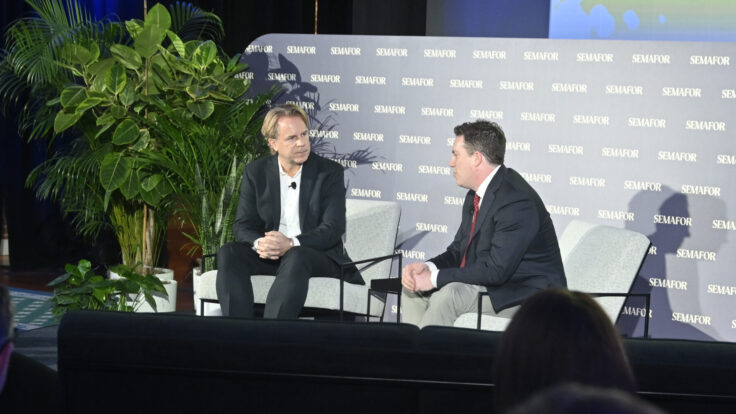
📹 Semafor’s video pivot: Semafor has abandoned its initial plans for a video business after determining it was too difficult to turn that into a profitable revenue stream. (Many other publishers imbibed this lesson years ago, of course, though Jimmy Finkelstein has pitched MessengerTV to investors as a ploy to save his failing business.) The startup has parted ways with head of video Joe Posner, I’m told, and hired Alan Haburchak, who will produce video around Semafor’s burgeoning live events business. Reached in Davos, Semafor co-founder Ben Smith told me the startup had “seen enormous momentum around events” and was “ramping up events video like crazy” in advance of its World Economy Summit in April. Meanwhile, Posner told me he is relaunching his independent production company, Fire-Works, where Semafor will be a client. “We’re so proud of what we've done with Joe, excited for him, and plan to do more together,” Smith told me.
🗞️ Los Angeles Times layoffs: Just days after executive editor Kevin Merida’s abrupt departure, the Los Angeles Times is planning to lay off at least 100 journalists, or more than 20 percent of the newsroom—the biggest round of cost-cutting since Patrick Soon-Shiong acquired the paper five years ago. The Times itself reports that the company is now losing between $30 million and $40 million a year, making it one of several media organizations owned by wealthy benefactors that is sustaining significant annual losses. Jeff Bezos’s Washington Post lost about $100 million last year, while The New York Times reports that Marc Benioff’s Time lost around $20 million. Laurene Powell Jobs’s Atlantic is also not profitable.
|
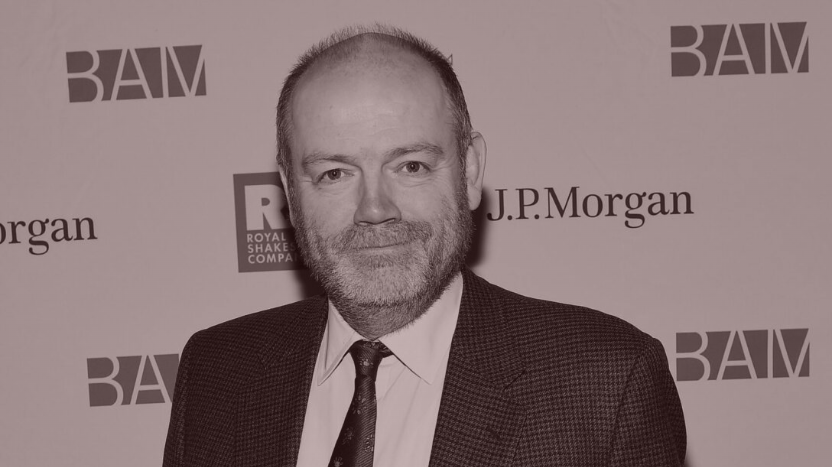 |
| After the Thompson Manifesto |
| A spirited and polite disagreement evinces CNN’s new lay of the land, old anxieties, and the latest power dynamics. |
|
|
|
| On Thursday, CNN C.E.O. Mark Thompson opened the network’s 9 a.m. editorial call with one final nod to “CNN’s Future,” the 2,300-word appel aux armes that he’d sent to employees a day earlier, calling on the company’s TV natives to abandon their complacency, recapture their swagger, and prioritize digital growth. As Jerry Maguire might have noted, Thompson’s document was a mission statement, not a memo, and the manifesto has been mostly well-received by his new charges, even if his thesis was a bit obvious—indeed, he probably articulated some version of this to David Zaslav months ago, before he got the job—and, more importantly, wanting for specific solutions. In any event, Thompson has at least pointed the tanker in the right direction, reorienting a 44-year-old, 24/7 linear news network around a new digital mission, and re-enlisting its innovative digital product chief, Alex MacCallum, to help navigate the course. At the top of the morning meeting, Thompson reiterated his commitment to this new vision and promised more conversations about the still ambiguous plans in the days to come.
Alas, network veterans had more pressing and sublunary matters on the brain: namely, the nearly decade-old predicament regarding the journalistically appropriate posture toward Trump. Since Thompson’s arrival in October, CNN had once again started airing the former president’s campaign rallies and courthouse press conferences, a marked departure from the network’s often defiant refusal to amplify his falsehoods. As recently as last summer, Jake Tapper had declared that CNN wouldn’t take Trump’s courthouse remarks live “because, frankly, he says a lot of things that are not true, and sometimes potentially dangerous.” This, of course, was a course correction from the heady days of 2016 when CNN, rightly or wrongly, leaned into the cultural phenomenon of a phony billionaire mounting a long-shot campaign for president.
More recently, however, the pendulum has swung back again. Not only has CNN returned to airing Trump’s remarks live, the network has even engaged in some of the pre-campaign rally, empty-podium hype-building it was widely criticized for during the 2016 primary. On Wednesday, Tapper himself cut off a panel discussion to broadcast Trump’s latest comments from outside the New York courtroom where he is once again on trial for defaming E. Jean Carroll, making CNN the sole network to carry those remarks live. (Et tu, Jake?)
Thompson isn’t keen on ivory tower editorial philosophizing; he has encouraged CNN employees to spend less time second-guessing their news judgment and fearing their own shadows. Nevertheless, he was aware that several network veterans did care to engage on this issue. A few minutes into the meeting, he defended taking the remarks live because Trump was the Republican frontrunner, after all, and the network had a journalistic duty to put him on air.
At this point, Jim Murphy, the senior vice president of programming, cut in and argued for greater discretion. The two men then went back and forth for several minutes, Thompson arguing that everything Trump said was of political importance, and that it was an abdication of journalistic duty to decide what the public was entitled to see, while Murphy cited the risks of broadcasting Trump’s propaganda. At the conclusion of this civil but spirited symposium, Virginia Moseley, the editorial chief, declared it “an important debate” but kindly asked that everyone keep it in-house. |
|
|
| This vignette may hardly warrant a footnote in the CNN history books, but it is nevertheless illustrative. During the first 100 days of Thompson’s tenure, he and Moseley—mostly Moseley, really—have led the 9 a.m. call with little to no input from others, save for CNN law enforcement analyst and ex-NYPD aide John Miller (go figure). Murphy’s cri de coeur thus became something of a thing among the CNN rank and file on Thursday, and an informal survey of said personnel suggests that they share Murphy’s concerns. As one source with insight into this debate told me, “Mark is on his own on this one. Jim was speaking for the masses.”
However that debate shakes out, it is a reminder that Thompson’s responsibilities to the organization are by no means limited to a business model revolution (his term). He must at the very least placate and in the best case inspire the thousands of journalists and producers whom he has asked to join him on this mission. And doing so will require not just talent assuagement—Thompson compliments Anderson a lot—but also instilling a sense of loyalty and shared purpose among the rank and file. Indeed, one indisputable truth about CNN, as evidenced by the near-universal fealty toward Jeff Zucker and the ubiquitous contempt for Chris Licht, is that effective leadership requires winning both minds and hearts. (Neither Zucker nostalgia nor Licht trauma have abated at Hudson Yards, by the way.)
It is thus also notable that Thompson has elevated Moseley to the top role of executive editor overseeing domestic, international, and digital, and that he has entrusted her with so much power. Moseley, a consummate Washington insider and TV news veteran, is indisputably brilliant and passionate about her job, but she also inspires very mixed feelings among CNN employees. A sizable and influential contingent of Washington-based producers, anchors, and political correspondents—Tapper, Wolf, Kaitlan, etcetera—respect and admire her greatly. Feelings about Moseley outside of the nation’s capital can be less charitable, and recently found their most acute and mean-spirited articulation in a New York Post item declaring her an “asshole” and a “tyrant.”
Yet that portrayal, no matter how cruel, didn’t come out of nowhere: Nearly a dozen CNN employees have complained to me about Moseley in the last year, though none has proffered an illustrative anecdote to justify the ascribed sobriquets. All of which is to say, warranted or not, her reputation precedes her, and yet another topic du jour among CNN rank and file is whether Thompson failed to see that, or whether he saw it and concluded that, given her talents, her influence and her experience, it didn’t really matter.
In any event, perhaps the more pertinent question is whether a TV veteran like Moseley, who has spent 40 years in Washington journalism—10 at CBS News, 18 at ABC News, and 12 at CNN—can help facilitate Thompson’s brave new pivot to digital. At present, she represents the rearguard of the entrenched linear forces, and the embodiment of legacy Beltway journalism in which one’s career is defined by their sway and aptitude with anchors, big bookings, and 90-second taped packages. That may be fine for now—after all, the pivot is not happening overnight, clearly—but her ability to adapt and evolve on this front will undoubtedly prove more crucial to CNN’s future, and her own, than whether or not she’s able to internalize and execute The Seven Habits of Highly Effective People.
Of course, many CNN veterans are likely to need some coddling in the months and years ahead. Even before Thompson took this job, some were wringing their hands over what his arrival would mean for the network’s investments in the core live news product that has defined the network since its inception. (On Thursday, NewsNation president and ABC News alum Michael Corn sought to capitalize on this angst with a memo to his own employees, declaring that “the once formidable CNN has announced it is in large part abandoning its focus on television news and focusing instead on the business of digital.”)
In fact, live video will remain central and essential to CNN’s digital offering. Nevertheless, Thompson’s mission statement contains a tacit affirmation that the economics of cable news are eroding. The days when an up-and-coming on-air talent might hope to renegotiate their contract every three years until arriving at a high-seven- or even eight-figure anchor salary are gone. In their place are less-expensively produced shows anchored by less-expensive talents who may yet prove that it was misguided to pay anyone millions of dollars to wear makeup and read a teleprompter in the first place. Production teams and business units will almost surely be consolidated. Thompson has implied that staff cuts shouldn’t be seen as inevitable, though he’s left the door open for them. In any event, the money for the yet-to-be-determined digital initiatives will need to come from somewhere.
On some level, however, the 9 a.m. contretemps was evidence of a larger dynamic. Murphy may be representing the masses—a cohort with enough heft and political acumen that management responded to their complaints about Licht—but Thompson doesn’t need people to agree with him. He’s got the track record, vision, and WBD support to say the quiet part out loud. And he’s also got the sangfroid and professional wisdom, as demonstrated in his memo, to know how to reorient an organization without really saying anything at all. |
|
|
|
| FOUR STORIES WE’RE TALKING ABOUT |
 |
|
 |
|
 |
| Murdochs in M&A Land |
| Breaking down the other fantasy media deal percolating on Wall Street. |
| WILLIAM D. COHAN |
|
 |
|
|
|

|
 |
|
|
|
Need help? Review our FAQs
page or contact
us for assistance. For brand partnerships, email ads@puck.news.
|
|
You received this email because you signed up to receive emails from Puck, or as part of your Puck account associated with . To stop receiving this newsletter and/or manage all your email preferences, click here.
|
|
Puck is published by Heat Media LLC. 227 W 17th St New York, NY 10011.
|
|
|
|