{{ 'now' | timezone: 'America/New_York' | date: '%b %d, %Y' }} |
|
|
|
Greetings from Yakima, happy Memorial Day, and welcome back to In the Room.
In
tonight’s edition, a sneak peek at my extensive and very candid conversation with Byron Allen about the strategic rationale behind his surprise acquisition of BuzzFeed. We discussed Byron’s faith in free streaming and his wild YouTube comparison, pay-for-play late-night deal, and lifelong pursuit of true media moguldom.
🎙️ For those who want to enjoy the entire hour-long conversation on The Grill Room, follow us on
Apple, Spotify, or wherever you prefer to listen.
📣 Programming alert: As a reminder, the Wednesday edition of this email will soon
be moving to Puck’s Inner Circle tier, which may require an upgrade to your subscription. This tier gives you access to all of Puck’s most exclusive insider reporting, including our sister publication, Air Mail. It is well worth it, and you can afford it. Join here.
Also mentioned
in this issue: Rupert Murdoch, Kevin Hart, Eminem, Adam Sandler, Jack White, Chris Rock, Seth Meyers, Steve Buscemi, Reed Hastings, Dave Chappelle, Berry Gordy, Jonah Peretti, Ray Kroc, Stephen Colbert, and
many more. |
-
The Colbert report: Kudos to Stephen Colbert for mastering the choreography of his exit from The Late Show. Twenty-four hours after signing off at CBS, Colbert popped up on the Michigan local access show Only in Monroe—the very same venue where he’d guested before taking over The Late Show, 11 years ago—with an episode featuring Jack White, Eminem, and Steve
Buscemi. CBS initially tried to block YouTube users from posting clips of the show by sending copyright infringement notices, but later relented while saying that the network would review the situation. It’s great press for Colbert, who is launching his own YouTube channel.
|
|
|
|
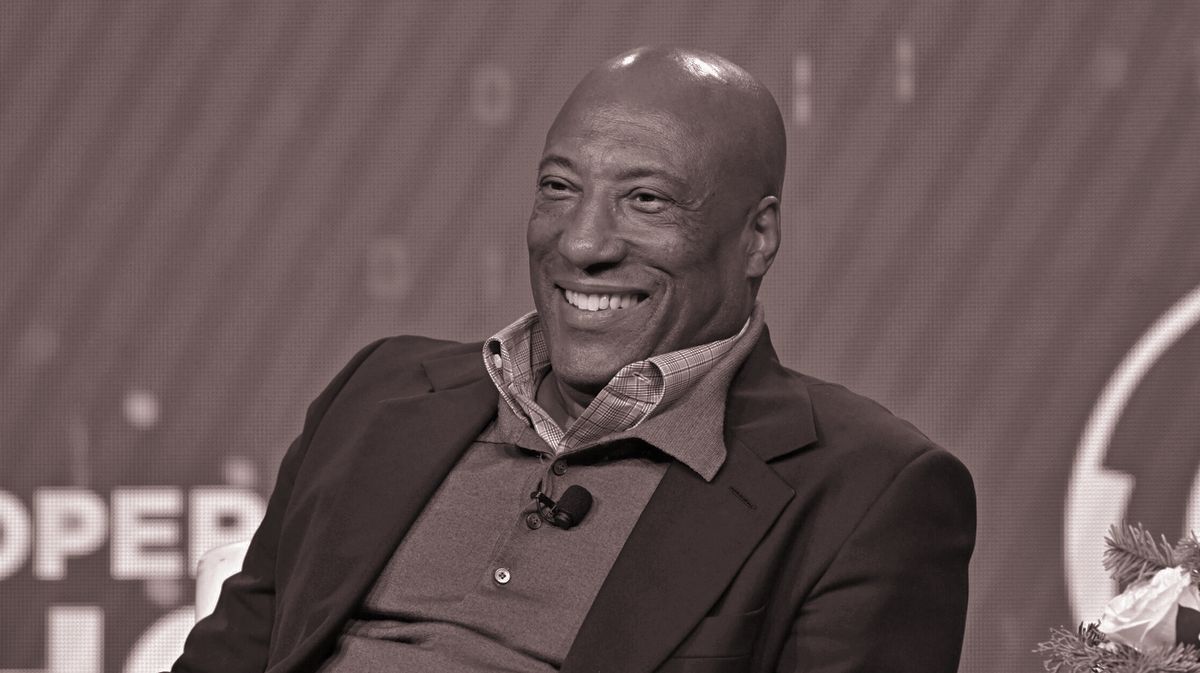
Byron Allen, the stand-up comic turned consummate media-deal hunter, defends his
post-Colbert CBS late-night deal, his investing philosophy, and his ambition to somehow make BuzzFeed a YouTube competitor. |
|
|
|
Byron Allen, the sui generis comedian turned media entrepreneur,
has long cultivated ambitions far grander than the actual scale of his empire—flirting with bids for major entertainment companies, talking openly about competing with Big Tech, and positioning himself as a consolidator of the legacy television business. Which is why his recent acquisition of a controlling stake in BuzzFeed initially struck many bankers and media executives
as somewhere between baffling and deeply on-brand. Even with the heavily caveated deal structure—just $20 million in cash plus a promissory note secured by the stock itself—Allen is still paying a premium for a near-bankrupt publisher whose audience and advertising business have largely evaporated.
But, as Byron explained in a wide-ranging discussion on The Grill Room this week, the logic becomes somewhat clearer when viewed through the prism of Local Now, his existing free
streaming platform. More than a traditional media acquisition, BuzzFeed appears to be a branding and awareness play: a cheap but still recognizable consumer internet brand that Allen can layer atop his broader streaming ambitions. Allen has already floated plans to transform BuzzFeed into a free TV “super-app” spanning news, weather, entertainment, and user-generated video—a vision that invokes YouTube even if, despite Byron’s grand ambitions, BuzzFeed can never realistically compete with
it.
The delta between BuzzFeed and YouTube “is massive,” Byron acknowledges here. “And that’s why I love it. I don’t want to chase a lemonade stand. I want to chase $3 trillion.”
Herewith, a brief preview of our extensive hour-long conversation on The Grill Room, edited for brevity and clarity. For those who want to enjoy the whole thing, follow The Grill Room on Apple, Spotify, or wherever you prefer to listen. |
“Honestly,
It’s a Nothingburger”
|
Dylan Byers: You shocked everyone this month with the news that
you are acquiring a majority stake in BuzzFeed. Can you walk us through what you’re spending to acquire the asset?
Byron Allen: BuzzFeed is a phenomenal brand. It’s one of the original platforms to have videos go viral. They announced about a month ago that they had financial issues … not enough cash to exist. And I quickly stepped in and said that I love what you’re doing, I love the brand, I love your market position, and I’m happy to
invest capital here to shore up your balance sheet.
We agreed that I would immediately put in $20 million of capital and a $100 million promissory note at 5 percent interest only, due and payable in five years. And I bought 40 million shares at $3 a share as the stock was trading in the neighborhood of 60 to 70 cents per share. So I paid a super premium at $3 a share to get those 40 million shares and approximately 52 percent of the company and the majority of the board
seats.
What is the thesis here? What are you actually trying to build?
I invested a little over $150 million in a streaming app called Local Now, which uses artificial intelligence and proprietary software to curate, aggregate, and stream super hyperlocal news, weather, sports, and traffic geofenced to the user’s zip code. We’ve won [Digiday’s] best streamer twice against phenomenal streaming platforms like Netflix, Amazon, Hulu,
Paramount+, Disney+. But nobody knows about Local Now.
So I said to Jonah Peretti, who I think is great—he’s a visionary, he’s very creative, he’s super smart—“Look, I want to make BuzzFeed a free streaming video service on top of what you’ve already built. I don’t want to change anything, nothing. All I want to do is be additive.”
I had dinner one night with Reed Hastings, the founder of Netflix. And I said, “Hey Reed, what keeps you up at night?”
And he said, “YouTube.” He said, “Yeah, Byron, if YouTube starts to deliver premium content, how do I get people to pay me XYZ per month?”
And I said, “We’re going to add 30,000 movies, TV shows, and documentaries. We have about 650 FAST channels, including Johnny Carson and Kevin Hart and People magazine and Architectural Digest. And we’ve added about 400 ABC, NBC, CBS, and Fox affiliates to Local Now. I want to bring that technology to
BuzzFeed, and I want BuzzFeed to become a premier free streaming service.” I said, “Listen, when it was announced, from this moment on, we’re chasing YouTube.”
YouTube generates $60 billion annually. The delta between the two companies is massive.
I agree. It is massive. And that’s why I love it. I don’t want to chase a lemonade stand. I want to chase $3 trillion.
So if we achieved 1 percent—$600 million. If we achieved half
a percent, $300 million. The market cap of BuzzFeed is infinitely greater than the $40 million or $50 million that it is today. We are not in the lobby with BuzzFeed. Let me be very clear. We are in the basement four floors down. So we’ve got a lot of headroom above us.
How should we think about New BuzzFeed? Is it a TV company, a U.G.C. hub, a mix of the two?
It’s an intersection of content and technology using A.I. to have all of
that converge and work together in symphony. You will see a lot more: infinitely more streaming, video streaming direct to the consumer and user-generated. Advertisers are not chasing text. They are chasing video. You’ll see BuzzFeed comedy. You’ll see BuzzFeed weather. You’ll see BuzzFeed podcasts. You’ll see BuzzFeed sports. It will be a super-app.
They’re already doing BuzzFeed shopping, which was a pleasant surprise for me. I believe they’re moving about a half a billion a year in
products. And I think we can do even much better than that.
It seems like what you’re really investing in is what you’ve already built with Local Now, and BuzzFeed is essentially a branding and marketing vehicle for it.
You nailed it, my friend. That is it. Local Now is like: Who cares? The branding wasn’t sexy, but the technology? Spectacular. When I bought it, they said, “Well, you’re probably gonna want to shut it down, it’s
losing $25 million to $30 million a year.” I was like, “Are you kidding me? It’s genius. There’s no way I’m shutting it down.”
Since you bought BuzzFeed, the stock is up about 130 percent. What do you think the market is reacting to?
I think people see a big brand, and I think they see a big opportunity. I think someone would be ill-advised to bet against free streaming. BuzzFeed is one of the few vehicles in which someone could
invest in free streaming, publicly traded, and artificial intelligence. Honestly, it’s a nothingburger. I’m not thinking about where it is today. I’m thinking about where it’s going to be in a year from now, two years from now. I won’t be happy until it gets to $1,000 a share. And even then I’m not sure I will be happy. |
Let’s talk about Comics Unleashed and your CBS
deal. Do you worry about the trajectory of late-night television generally?
No, absolutely not. Late night is about a $500 million to $600 million-a-year business. Now we are two-thirds of that business. What you can’t do is spend $110 million to $120 million on Colbert and $30 million to $40 million on After Midnight. It doesn’t work if you’re spending $150 million to $170 million on content and promotion. So let me pay
you millions of dollars, and let me deliver you two shows that we already know are doing well.
According to Nielsen, in 43 of the 56 markets, we are beating our competition, Seth Meyers. He’s been on the air for 10-plus years. We’ve been on the air for eight months. And if you look at retention through the commercial break, for some of these talk shows, it’s only 75 percent. The retention for Comics Unleashed through the commercial break is 97 percent.
The
way I designed the show, I said to the comedians, “I don’t want any political humor. I don’t want any racist humor, homophobic humor, antisemitic humor, sexist humor. Just do good, clean comedy that’s relatable and makes everybody feel included.” Comedy built everything that has been built in media. Who gave us streaming? Dave Chappelle, Chris Rock, Adam Sandler. Comedy builds everything.
You’ve made bids for BET, ABC, and
Paramount, twice. What are you ultimately trying to build?
I’ll tell you what I told my wife when I met her, 25 years ago: I’m building the world’s biggest media company. Strap yourself in. We’re going for a hell of a ride.
When I saw Berry Gordy and I saw what he did with Motown and ownership, I said, “This is my path. We must own something.” And when I saw Berry Gordy
sell Motown, and he had every right, I cried, because I felt, as Black people in America, we don’t own anything, and we must own our businesses. We must have a seat at the table, especially in media, because that addresses how we’re produced and depicted and seen around the world.
Money is never an issue. There are trillions of dollars looking for good deals. The hard part, the true commodity, is finding a good deal and having the expertise and the management to shepherd that
investment and return it. That’s the challenge.
And for people who remain skeptical of the BuzzFeed deal?
I started a company from my dining room table in ’93. I’m in business with pretty much every television station in the country and most advertisers. I could not build this company, make it one of the largest privately held media companies in the world, without one word: “integrity.”
I promised the industry I would
deliver that show no matter what. And I did. So if I say I’m coming through, you would be ill-advised to bet against me. I’m a 65-year-old overnight sensation. And we haven’t even begun. Ray Kroc didn’t start McDonald’s until he was 55, and Rupert Murdoch did not come to America until he was 55. We’re about to take it to the next level. |
|
|
|
A professional-grade rundown on the business of sports from John Ourand, the industry’s preeminent journalist,
covering the leagues, players, agencies, media deals, and the egos fueling it all. |
|
|
|
Join Puck’s chief political columnist, John Heilemann, as he roams the corridors of power and influence in America on
this twice-weekly interview show, taking you beyond the headlines with the people who shape our culture: icons and up-and-comers, incumbents and insurgents, moguls and machers in the overlapping worlds of politics, entertainment, tech, business, sports, media, and beyond. The conversations are rich and revealing, unrehearsed and unexpected… and reliably impolitic. A Puck-Audacy joint, new episodes drop every Wednesday and Friday. |
|
|
|
Need help? Review our FAQ page or contact us for assistance. For brand partnerships, email ads@puck.news. You received this email because you
signed up to receive emails from Puck, or as part of your Puck account associated with {{customer.email}}. To stop receiving this newsletter and/or manage all your email preferences, click here. |
Puck is published by Heat Media LLC. 107 Greenwich St., New York, NY 10006 |
|
|
|
|