{{ 'now' | timezone: 'America/New_York' | date: '%b %d, %Y' }} |
|
|
|
Greetings from Indian Wells, where the temperature is hot and the tennis is
sublime, and welcome back to In the Room.
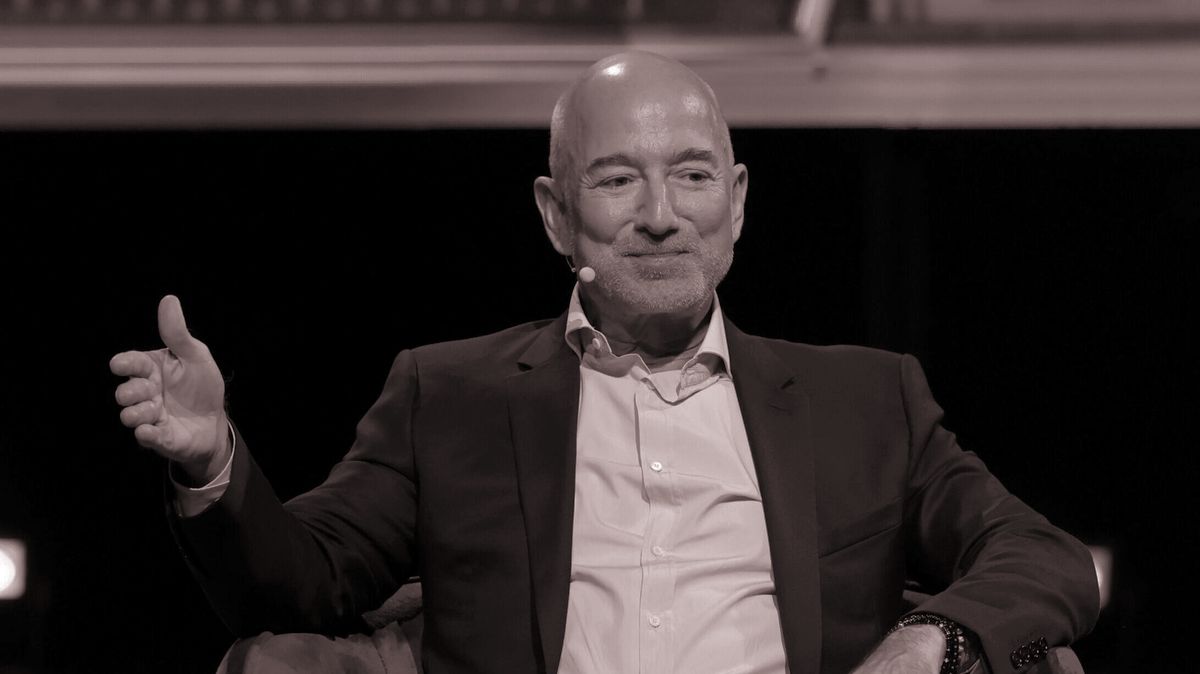
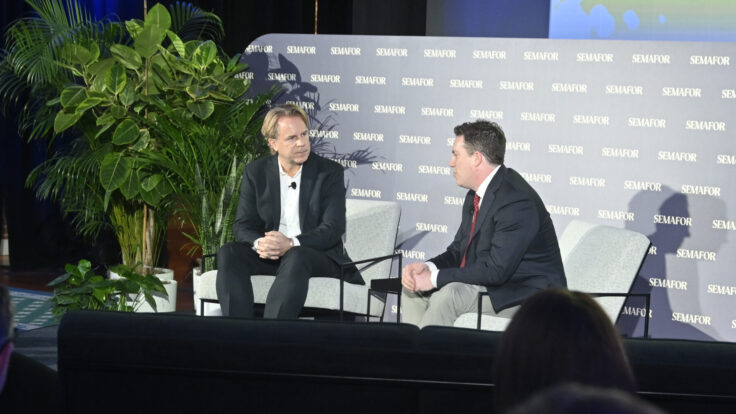
In tonight’s issue, a readout on Jeff Bezos’s surprise four-hour Kalorama summit with The Washington Post’s top executives, editors, and journalists, which featured a lengthy lunchtime Q&A session about the Post’s recent failures, Jeff’s relationship with Trump, and his enduring commitment to the beleaguered paper.
🎙️ Plus, on the latest episode of The Grill
Room, Julia and I explored the myriad implications of the Paramount–Warner Bros. marriage: what it means for streaming, who wins and loses in a CNN-CBS combination, whether Jeff Shell gets the axe, and how David Ellison will deal with that massive pile of debt. Follow The Grill Room on Apple,
Spotify, or wherever you prefer to listen.
Also mentioned in this issue: Pete Hegseth, Bari Weiss, Will Lewis, Jonah Peretti, A.G. Sulzberger, Fred Ryan,
Jeff D’Onofrio, Matt Murray, Jeremy Adler, Hannah Natanson, Rich Greenfield, and more… |
Things You Should Know...
|
-
A hug from Hegseth: Defense Secretary Pete Hegseth very publicly gave his seal of approval to David Ellison’s takeover of CNN this week while dismissing their report stating that the administration had “underestimated” Iran’s response to U.S. missile strikes. “The sooner David Ellison takes over that network, the better,” he said. Notably, the remark came after CBS News chief Bari Weiss booked Hegseth on 60 Minutes for a rare interview. (Also,
I can’t wait ’til someone alerts Hegseth that the Ellisons have partners: Nearly $30 billion in equity may be syndicated among three Middle Eastern sovereign wealth funds.)
On a related note, Axios recently published a report in which anonymous administration sources criticized Bari’s decision to hire former Liz Cheney spokesperson Jeremy Adler as her new CBS News comms chief. (The report preempted CBS’s own announcement of Adler’s hire.) As media
analyst Rich Greenfield put it, “Why does the White House think they are running H.R. for Paramount/CBS?” Needless to say, the administration’s feelings about CNN and CBS have complicated Ellison’s effort to convince journalists that he’ll maintain the networks’ editorial independence. - Peretti problems: BuzzFeed chief Jonah Peretti has warned that the onetime unicorn, which infamously nearly sold to Disney,
can’t fund its cash obligations for next year and is exploring “strategic options” to position itself for profitability. “We believe there is a gap between the value of our individual assets and our market capitalization that suggests significant unrecognized upside,” he said. The Journal noted that BuzzFeed has operated at a loss since its inception. It ended last year with $8.5 million in cash and an accumulated deficit of nearly $680 million.
Perhaps BuzzFeed’s assets—HuffPost, Complex, etcetera—are worth more than the market cap. After all, that market cap is currently a staggeringly minuscule $26 million. But if Peretti sells those assets in a distressed sale, what will remain of BuzzFeed Inc? Alas, it seems like the end of this story is
being written. - And finally…: A new report from Growtika notes that Google referral traffic to Wired, The Verge, CNET, and other leading tech news sites has declined by 58 percent since 2024. It’s yet another data point in the Google Zero story—wherein the rise of A.I. summaries has decimated traditional search traffic to
publishers—as well as a sign of the enduring challenges for matrixed media organizations where talent, sales, and growth functions aren’t unified into the business. In any event, Wired may be in a more robust position than some of its peers given its subscriber base, but it seems like its much ballyhooed revival may have also been short-lived.
|
|
|
|
It had all the trappings of a turning point for The Washington Post, with
dozens of executives, editors, and reporters summoned to Jeff Bezos’s local manse for an unhurried, candid, even conciliatory discussion about what’s gone wrong with the paper since the centibillionaire bought it in 2013. But what attendees say they didn’t discuss is how to save it. |
|
|
|
On Thursday, Jeff Bezos opened the doors of his stately Kalorama mansion to more
than 30 Washington Post executives, editorial leaders, and journalists for a four-hour summit on the state of the paper—a rare chance to access not just the owner himself, but financial data and editorial strategy not typically divulged to the scribblers on the newsroom floor. Given the Post’s recent seismic misfortunes and indignities, and Bezos’s limited bandwidth, the meeting was near universally interpreted by the journalists present and their colleagues back on K Street as
a bellwether for the paper’s future.
In the Bezos tradition, the day began with the silent reading of a six-page memo from interim C.E.O. Jeff D’Onofrio, which outlined the Post’s financial story dating back 20 years. In the Bezos universe, the famed “six-page” memo format often includes appendices with charts and footnotes that can significantly extend their length; D’Onofrio’s ran to 23 pages and provided what one source described as a “full, under-the-hood
look at the paper’s business and finances.” Attendees made notes in the margins and then, as another source put it, “We all sat around in oversize chairs and couches—including Jeff B.—and had our discussions.”
Later, in the afternoon, executive editor Matt Murray would share his own memo outlining the Post’s new embrace of a data-driven editorial culture, which included detailed reader engagement metrics: what people are reading, what they’re not, and
what he and his team are doing about that. Among other things, this session gave Matt the chance to justify his controversial decision to shutter entire sections at the paper despite the fierce emotional blowback. To wit: Post Sports may have a storied legacy, and at least a dozen Athletic- or ESPN-caliber journalists, but—at the risk of invoking he who shall not be named—truly, people were not reading their stuff.
Most notably, the sessions were punctuated by a lunch—a
choice of steak or halibut, served on china emblazoned with the Washington Post logo—during which Bezos stood for the entire hour-and-a-half duration and invited Posties to ask him anything. The most obvious and pressing question came from Hannah Natanson, the enterprise reporter whose phone and laptop were recently seized by the FBI: Why do you still want to own the Post?
Here, Bezos acknowledged that he was an imperfect owner given his “many outside
interests.” (“You could do worse,” he quipped.) Many friends and family members had encouraged him to sell, he said, and he’d received offers from at least seven prospective buyers. But, describing himself as both principled and stubborn, he said he still believed that the Post was an important institution that needed to be saved.
Bezos also accepted some responsibility for the decline that began under former publisher and C.E.O. Fred Ryan in the wake of
the first Trump administration. Senior leadership had been “asleep,” he said, and he had not been involved enough to recognize the mistakes. Specifically, he noted that Ryan continued to add staff even as the financial situation became increasingly dire, when he should have implemented a hiring freeze while assessing the problem. But he refuted the idea that the Post owed its earlier success to Trump alone. The “Trump bump” explanation was “too passive,” Bezos said.
“The world is always interesting; it’s up to us to go find the stories.”
In regard to the recent layoffs, Bezos said he hadn’t dictated the targets of the cuts, but simply asked Matt to “follow the data.” He reiterated here that the Post would always be responsive to the data: If a coverage area or newsroom initiative wasn’t working, why continue it? Though he made an exception for investigative journalism, which he described as a cornerstone of the Post that
should be maintained regardless of performance. When asked to address the ouster of Will Lewis, he said he did not want to comment on personnel. |
No organization is a monolith, and Post employees’ reactions to the meeting were mixed.
Most folks I spoke to commended Bezos for taking so much uninterrupted time to field their questions and praised Post leadership for giving such a detailed account of how they were trying to monetize the journalism. Others saw it as a symbolic gesture that was unlikely to change the Post’s fortunes. A not insignificant number of Post staff continue to see Bezos’s recent moves through the prism of his diplomacy toward Trump. Fielding those questions, Bezos said that
Trump had “warmed” to him in the second term, but noted he’d had relationships with presidents dating back to Clinton. As Status noted this week, he was also pressed on Amazon’s $75 million investment in the Melania documentary. Bezos said he had no part in the matter and did not discuss it with Trump, but suggested the film would eventually turn a profit.
Perhaps the most notable aspect of the meeting, however, was how short it was on details about
what’s to come. At one point, D’Onofrio said he was working on the turnaround portion of the strategy and told employees to “stay tuned.” But those who remain at the Post after years of successive layoffs, buyouts, and defections have been staying tuned for half a decade now. Historically, Bezos’s very rare visits with Post leadership have steadied their nerves—his calm authority and the Kalaroma trappings can be a powerful salve—but only for so long. Ultimately, the
failures of his successive publishers to save the paper are a reflection on his own aforementioned imperfections as a media proprietor.
While Bezos was fielding questions in Washington, New York Times publisher A.G. Sulzberger revealed that the paper had more than doubled the size of its newsroom, to 2,300 journalists—and more than 3,000 if you include Opinion columnists, Athletic staff, and other newsroom-adjacent operations. The Post now has fewer than
500 journalists. As I’ve noted on many occasions, they’re not really comparable businesses. After all, the Times generates more in quarterly profits than the Post does in topline annual revenue. And the Post is never going to be the Times, even if Bezos once harbored that vision. Today, he imagines something smaller, nimbler, more focused, befitting the industry’s broader trajectory. But what does that mean for a legacy media brand like the
Post playing in a heavily saturated political market—and how is it going to get there? What, exactly, is Bezos trying to save?
Indeed, some of this will emerge in D’Onofrio’s strategy document, perhaps his answer to the biblical Innovation Report. But the first decision Bezos has to make, of course, is whether to keep D’Onofrio around to execute his own plan. |
|
|
|
Puck fashion correspondent Lauren Sherman and a rotating cast of industry insiders take you deep behind the scenes of
this multitrillion-dollar biz, from creative director switcheroos to M&A drama, D.T.C. downfalls, and magazine mishaps. Fashion People is an extension of Line Sheet, Lauren’s private email for Puck, where she tracks what’s happening beyond the press releases in fashion, beauty, and media. New episodes publish every Tuesday and Friday. |
|
|
|
Puck’s daily political newsletter from Washington on what’s really happening in this town, from the White House to
the Pentagon to Capitol Hill, K Street, and the campaign trail. |
|
|
|
Need help? Review our FAQ page or contact us for assistance. For brand partnerships, email ads@puck.news. You received this email because you
signed up to receive emails from Puck, or as part of your Puck account associated with {{customer.email}}. To stop receiving this newsletter and/or manage all your email preferences, click here. |
Puck is published by Heat Media LLC. 107 Greenwich St., New York, NY 10006 |
|
|
|
|