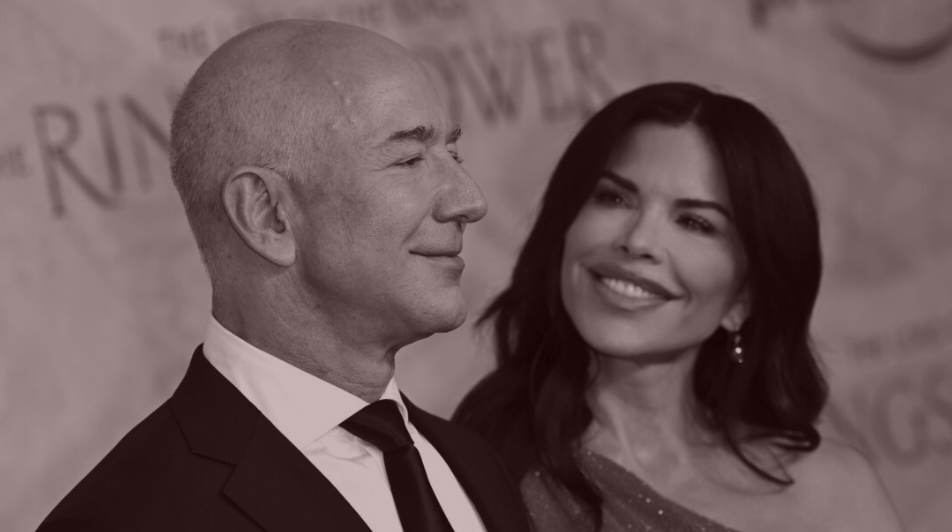
| Jon Kelly: Dylan, Jeff Bezos recently announced that he was marrying Lauren Sanchez and launching a new $500 million yacht, Koru, which features a mermaid-esque sculpture of Sanchez, Titanic-style. Yes, sure, I’m happy for Bezos and Sanchez, who can do whatever they please with their wealth and time, but this latest public display of devotion must also trigger the long simmering anxiety within the Washington Post Company—that Bezos seems focused on his personal life and may be content with the Post’s retreat to second place in its perennial rivalry with The New York Times, which poaches its talent with regularity these days. At the end of Q1, Times Company C.E.O. Meredith Kopit Levien brought over Joy Robins, the Post Co.’s C.R.O., as global chief advertising officer. Killer move.
There’s been a lot of frustration on K Street in the last year, including your reporting about a rift between C.E.O. Fred Ryan and executive editor Sally Buzbee. Bezos visited the building earlier this year and spoke with leaders across the company, temporarily quelling the discontent. What’s the view from the inside these days?
Dylan Byers: So, remember when I reported on that conversation between Brian Roberts and David Zaslav in which they lamented how their respective cable news assets accounted for a mere 5 or 6 percent of their businesses, but 90 percent of their headaches? I think it’s safe to say The Washington Post accounts for a far smaller part of the Bezos empire, and an infinitesimal percent of his headaches.
I’m not discounting the fact that owning the Post frequently brought Bezos into Trump’s crosshairs, and may have cost Amazon’s cloud computing division a $10 billion Pentagon contract. I only mean to say that I don’t think he loses much sleep over the subscriber churn, the revenue misses, the staff defections or the general water-cooler malaise that has permeated the newsroom ever since they fell out of pace with the Times. To level-set, Bezos spent twice as much on this new 417-foot, Sanchez-adorned schooner as he did on the Post. He seemed poised to spend 24x on the Commanders, and may yet on the Seahawks.
Presumably he’s more preoccupied with the superyacht’s midnight blue paint job, or the view from the mizzenmast, than he is with the paper’s LTV-CAC ratio. And, indeed, this is what Post staffers have long feared: that their owner would be too distracted not just by Amazon and Blue Origin, but also by his moguldom—mooring Koru outside the Hotel du Cap, a forthcoming marriage, etc.—to preoccupy himself with the quaint concerns of their second city newspaper.
When Bezos visited the Post headquarters for a two-day listening tour, in January, there was a sense among those who met with him that he was finally paying attention and intended to take some sort of action. The assumption, muttered in hushed tones and on disappearing Signal threads, was that his scrutiny might lead to a gentle defenestration of Fred Ryan, the Post Company publisher and C.E.O. After all, Ryan has long been blamed for the paper’s post-Trump troubles: the failure to establish the Post as a competitive player outside of politics, policy and investigative coverage; the inability to diversify the business, à la Kopit Levien, into a multifaceted, always-on lifestyle brand; the decision to drag his feet on a number of acquisition targets. (Though in his defense, the Athletic’s over-expensive acquisition and not-frictionless integration into the Times may yet prove that some of his caution was warranted.)
Four months on, however, there’s no indication that Ryan is going anywhere. Just today, he announced a new A.I. taskforce that presumably reports up to him. So the status quo holds, apparently, much to the chagrin of some Posties. If anything, the fallout from that summit was a reminder that honey badger reporters are brilliant at many things, but mind reading centi-billionaires is not always one of them.
Anyway, the Post still produces a lot of great journalists and it will continue to do award-winning work on the politics and policy front through the 2024 election and beyond. But the ambitions feel notably diminished. The Baron-era bravado, the 50 percent year-over-year growth, Bezos’s triumphant promise to supplant the Times as the new paper of record—those days seem like a distant memory.
Jon: The Times reported over the weekend that The Messenger was already enduring some start-up pains: friction between staff members, confusion about the mission, an early aggrieved editor departing, etcetera. Ben Mullin followed it up yesterday with a tweet reporting that another editor had left.
How do you assess the early stage personnel departures? I confess I’m more interested in seeing how The Messenger, which is following a vaguely 2010s-era programmatic advertising playbook, responds to an ad and consumer marketplace that’s shifted away from social and search engine disintermediation, and instead emphasizes reaching obsessive fans, key opinion formers, and affinity-based audiences. (The pendulum swings… after all, these media entities were once called magazines, and they were lucrative annual recurring revenue businesses in yesteryear.) What’s your readout from the House of Finkelstein and Richard “Mad Dog” Beckman?
Dylan: The best assessment of The Messenger comes from its own already-former politics editor Gregg Birnbaum—a two-time colleague of mine at CNN and NBC—who quit last week in protest of what he described as “the rapacious and blind desperate chasing of traffic” by “the nonstop gerbil wheel rewriting story after story that has first appeared in other media outlets in the hope that something, anything, will go viral.” Or perhaps the already-former breaking news editor Kristen Bender, who similarly protested that “repurposing other reporters’ work” is “not journalism.”
Let’s say, for the sake of argument, that there’s a business to be built off of this callous clickbait aggregation machine sprinkled with a dash of original reporting. If so, you don’t need $50 million in investment capital and 550 journalists, let alone the 150 journalists they’ve already hired, to do it. And bear in mind that some of these reporters are being offered as much as half a million dollars a year. That is an insane amount of overhead for this kind of copy, the vast majority of which could probably be written by A.I.—if not today, then in a matter of months. Anyway, as you note, it just seems like a website designed for a very different era of digital publishing. And if it were merely a clear-eyed and cold-hearted economic play, I might understand it. But instead it goes against all the conventional wisdom about how to succeed in journalism.
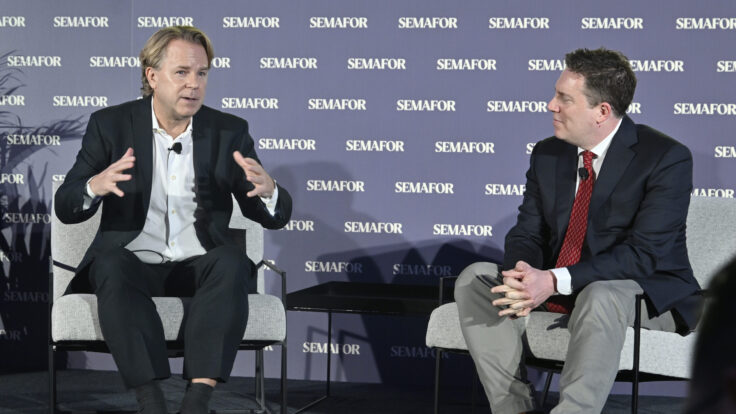
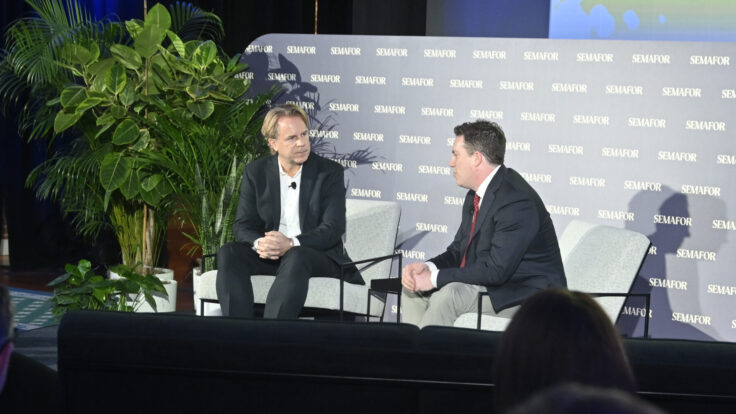
Jon: Ben Mullin also reported in the Times today that Semafor’s Justin Smith and Ben Smith raised another $19 million, and appear to be pivoting (or sharpening their focus) ever so slightly into live events, which comprise 50 percent of ’23 booked revenue. They also seem to be tightening the aperture: Upon launch, Semafor seemed to try to go after those 200 million or whatever English-speaking college-educated denizens; now they appear more focused on elite audiences.
Here are my three takeaways. First, $34 million is a lot of money for a one-year-old company; it will set a significant valuation, which will create a burden to get over the preferred. Second, and relatedly, it buys them a lot of time to fulfill their mission, and the lack of institutional investment firms apparently involved in the round (the new investors are largely UHNWI and family offices) offers a sense that there will be support and latitude to allow them to get there on their schedule. Third, Semafor began its life in the market as a large-scale consumer brand and appears to be underscoring the power of niche. We’re all learning from each other in this new business, and I bet Jimmy and Mad Dog are paying attention.
Dylan: I think I’ve come to a place where I’m willing to stop focusing on the disconnect between the Smiths’ ambitious pre-launch bluster and just focus on what the business is, which is exactly what you described: a hyper-focused, multi-niche brand that is going to need a lot of time to scale. And I guess the $34 million helps lay more runway. But why do they need that much money? And what does it actually tell us about their current financial state? That’s a helluva lot of capital to take on in one year, and it raises questions about their valuation. But yeah, godspeed.
Jon: Obviously we can’t not discuss CNN. Now that Kaitlan Collins is anchoring the network’s 9 p.m. hour, what should we expect from her show and Poppy Harlow’s program, post-Lemon, in the morning? Chris Licht has moved his deck chairs, but he hasn’t solved his problems. Does this get him there?
Dylan: Kaitlan will at least bring stability to CNN’s prime-time hours, which have been pretty listless in the 18 months since Chris Cuomo’s dramatic termination and certainly since Don Lemon’s thinly-veiled demotion to the morning show. If Licht’s New CNN were in better shape—if this pivot to the middle hadn’t been beset by staff revolt, programming misfires, and death by a thousand other cuts—then you could envision a scenario in which Kaitlan’s 9 p.m. might achieve some relative success as cable’s home for a thoughtful, elevated, and unbiased reflection on the day’s news.
But in light of CNN’s current predicament, it’s just as likely that this will be a respectable but unremarkable hour that has more Republicans and nevertheless fails to move the ratings needle. In a worst-case scenario, a promising but inexperienced journalist will reveal that she’s not ready for prime time, and the ratings will go down even further. (One hopes that Licht won’t force her to try her hand at those Tapper monologues.)
In any event, this is indeed a rearranging of deck chairs, and it’s highly unlikely to reverse CNN’s fortunes, or Licht’s. And I do think Chris’s fate is tied to Kaitlan’s, and vice versa. I know Zaz & Co. are projecting total support for Chris, but no one gets to blow up mornings and run multiple failed prime time experiments and alienate the vast majority of their staff and then claim everything is fine because, hey, look over here, Charles Barkley and Gayle King will soon be co-hosting a weekly show.
As for Poppy, she won herself a promotion to the top spot on a failed morning show, a throne among the detritus of a disaster. It’s a Pyrrhic victory.
Jon: CNN has devoured the media attention, but the bigger story, as you’ve noted, has been this rise in the ratings from Newsmax. Is this network now a credible threat or acquisition target?
Dylan: Newsmax is benefitting from a perfect storm: Tucker Carlson’s firing, which is hurting Fox’s primetime hours, and CNN’s aforementioned ratings slide. In the historic battle for the incredibly small number of mostly sixty- and seventy- and eighty-somethings who actually watch cable news, this is at least a momentary threat to CNN—not because serious people will start thinking Newsmax is more influential than CNN (it’s not), but because it further depletes morale at Hudson Yards when Anderson Cooper is coming in fourth place to Eric Bolling.
Of course, the real threat to all of these organizations is the inexorable decline of their business models. After all, the existential threat to cable isn’t ratings, it’s the decline in carriage fees, prompted by O.T.T.ers and cord-cutters. As for Fox News, it faces a far more significant threat from Elon Musk, who is refashioning Twitter as the new conservative town square with the DeSantis campaign launch, the new Tucker show, The Daily Wire inventory, etc. It’s too soon to tell whether this will endure—Fox is a unique force, and Elon can be fickle—nevertheless it does feel as though the political-media winds are shifting.
Jon: When we were talking on The Powers That Be, you made a brief mention of the end state of the Murdoch dynasty, a likely putative sale. In the spirit of the end of Succession, what do you think will happen? The company is more vulnerable than ever to litigation, Murdoch is late in his dotage, and there are all kinds of rumors about the siblings’ revenge fantasies. What’s going to happen?
Dylan: The conventional wisdom among media executives I’ve spoken to is that the Murdochs will sell the company in a matter of years. I mean, hell, Rupert would have sold it to Disney back in 2019 if he could have. And I can’t imagine Lachlan wants to wait around for the day when, upon his father’s passing, the other siblings are entitled to equal say over what happens to it (no doubt James has some thoughts about refashioning Fox News). But the evergreen question is, who will buy it?
These are profitable but declining assets, and the toxicity of Fox’s politics make it unpalatable to all the conventional Hollywood and Silicon Valley players. So, private equity? In any event, unlike Succession, there’s no obvious GoJo. |