{{ 'now' | timezone: 'America/New_York' | date: '%b %d, %Y' }} |
|
|
Greetings from New York in October, the most sublime expression of autumn, and welcome back to In
the Room. I’m on my way back to Los Angeles for a few days, then venturing up to Menlo Park for the Paley International Council Summit, where I’ll be interviewing YouTube C.E.O. Neal Mohan. If you’re there, let’s grab some time on the sidelines.
Meanwhile, I’d like to commend my Puck partner John Ourand and esteemed
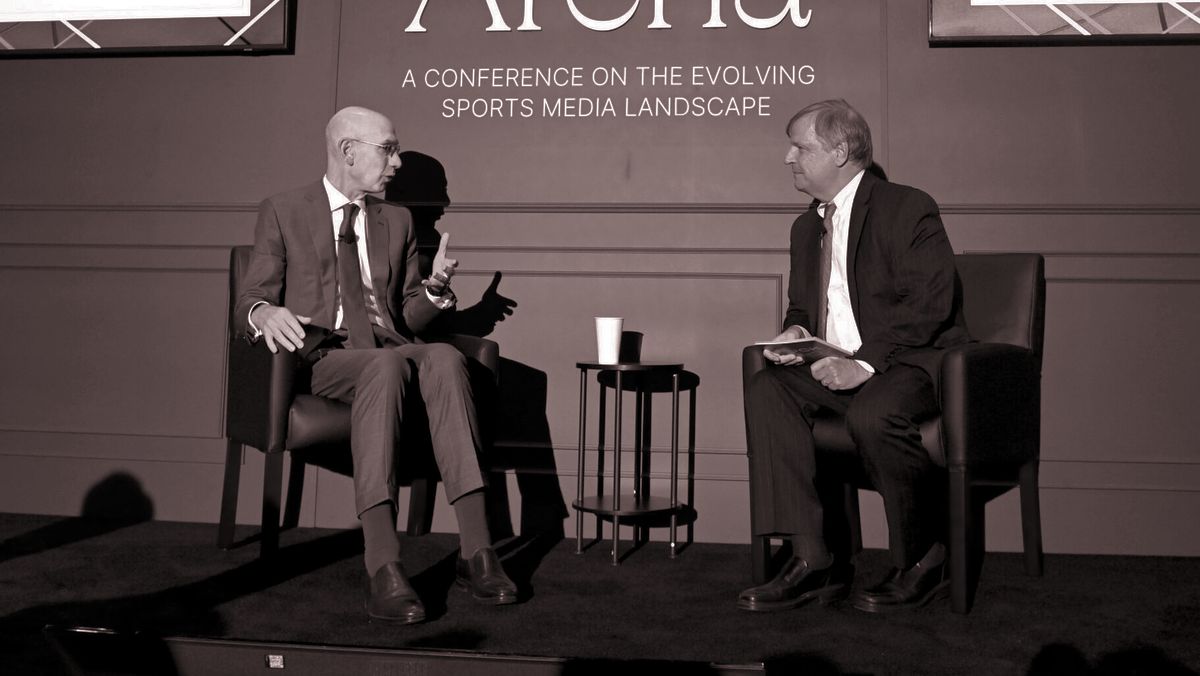
analyst Michael Nathanson for putting together yesterday’s exceptional summit on the business of sports. Thanks to Adam Silver, Michael Rubin, Josh Harris, Gerry Cardinale, Derek Chang, and everyone else who joined us. Great to see you all.
Top talker in the green room: The $140 million-a-year Apple–F1 deal, which I first
reported back in July (I had the number at $150, sorry!), was formally announced today. The five-year deal brings every F1 race to Apple TV starting in 2026—and for no extra cost to paying subscribers. Let’s see whether this moves the
needle for either party…
In tonight’s issue, news and notes on the long-overdue second coming of the CNN streaming service—which, as you might imagine, is probably too little, too late. As the network hangs in limbo amid the WBD split and a potential Paramount takeover, one wonders how long Mark Thompson wants to suffer this indignity.
🍸 Plus, on the latest edition of The Grill Room, Julia Alexander and I chewed over the
week’s media mayhem: Netflix’s watershed podcast deal with Spotify, the booming industry of athlete-owned media, RedBird’s unexpected foray into traditional media, the ominous layoffs looming over NBC and CBS News, and much, much more. Follow The Grill Room on Apple, Spotify, or wherever you prefer to listen.
Mentioned in this issue: Peter Chernin, Jeff Zucker, David Ellison, David Zaslav, Marc Benioff, Mark Thompson, Andrew Morse, Bari Weiss, Laurene Powell
Jobs, Theodore Kyriakou, Ron Conway, Chris Licht, and many more…
Let’s get started… |
- Benioff’s
seven-year itch: Marc Benioff’s sudden pro-Trump pivot has unnerved some of his old friends and associates in Silicon Valley. As I’m sure you saw, the Salesforce C.E.O. and Time magazine owner told The New York Times that he now supports Trump and encouraged the deployment of the National Guard to San Francisco—quite the volte-face for a guy who was historically seen as a champion of progressive causes. On Friday, Ron
Conway stepped down from the board of the Salesforce Foundation, telling Benioff in an email: “I now barely recognize the person I have so long admired.” Laurene Powell Jobs also
dinged Benioff in an op-ed for The Wall Street Journal. Many of my sources in Silicon Valley were
not so surprised, privately accusing Benioff of having always been an unprincipled opportunist. (Benioff apologized for his remarks late Friday afternoon, saying he no longer believes the National Guard is needed in San Francisco.)
In any event, this week’s drama did make me wonder whether Benioff
might be moving any closer to a sale of Time. He’d been in talks to sell the company to Theodore Kyriakou’s Antenna Group last fall for around $150 million, though he later said there was “no deal on the table.” That was nearly a year ago, of course, and things could change. His ownership of Time isn’t necessarily earning him any bonus points with
the president. - Chernin the blues: Peter Chernin appears to be winding down his investment vehicle, with Axios reporting that The Chernin Group will not raise a new fund. The conventional wisdom among Chernin’s peers is that he’s inching toward
retirement—hastened, perhaps, by boredom, age, and the alarm bells going off in Hollywood. Others note that Chernin started his TCG journey without a fund, and may have preferred it that way. In any event, TCG will now pivot to a holding company structure managing its existing portfolio, which includes Substack, Omaha Productions, North Road, and Food52 (and, previously, Hello Sunshine, Barstool Sports, and The Athletic). Chernin still has dry powder from his last $2 billion fund, per Axios, so
he could still make a few more moves in the media space, but this portends the beginning of the end.
- Bari watch: Veteran CBS News standards and practices chief Claudia Milne has left the network due to her dissatisfaction with Bari Weiss’s appointment as editor-in-chief, as well as the news network’s broader direction under David Ellison. “We live in complicated times. For our company, for our industry
and for our country,” Milne wrote in a note to colleagues. “And it’s times like this that what we do matters most.” While the first executive departure under Bari is sure to invite some scrutiny, the truth is this one’s pretty straightforward: Milne obviously isn’t aligned with the new leadership, her contract was up, and she decided to leave. She probably won’t be the last.
- And finally…: President Trump has refiled his $15 billion lawsuit
against The New York Times after the first was dismissed by Judge Steven Merryday, who deemed it “improper and impermissible” because of its length, “vituperation,” and “invective” (a linguist after my own heart). The new lawsuit similarly accuses the paper of defamation, albeit with greater pith—the initial filing was 85 pages, this one is 40. The Times, meanwhile, has issued an updated version of its original statement claiming that the lawsuit “has no
merit.”
|
And now, to Hudson Yards… |
|
|
The imminent launch of Mark Thompson’s “All Access” streaming service recalls all the
familiar questions that plagued CNN+: Can subscriptions save CNN from its post-linear malaise? Does anyone really want this? And is it all too little, too late? |
|
|
On Thursday morning, CNN C.E.O. Mark Thompson joined the 9 a.m. editorial call and announced
an October 28 launch date for the network’s new “All Access” streaming service—a $6.99-a-month tier that gives subscribers access to CNN’s live and on-demand programming, including a feed of the network’s linear broadcast. The news was both long-awaited—nearly four years earlier, former CNN president Jeff Zucker and his team had tried to stand up a very similar offering in CNN+—and unremarkable. When CNN+ launched, then-digital chief Andrew Morse
described it as “the most important launch for CNN since Ted Turner launched the network in June of 1980.” This time around, no one even pretended to be under such illusions.
In private, members of the current regime contend that this is a better product because it offers the live linear feed. Of course, members of the previous regime counter that the original plan was to include the live feed starting in 2026—and that, had David Zaslav
not killed it in the crib, CNN+ would now have at least 6 million subscribers by the most conservative estimates. That may or may not have been a pipe dream then, but the salient detail is that it certainly would be now—which may explain why many CNN insiders are reacting to this week’s announcement with a collective shrug.
I’ll spare you the now all-too-familiar history of how we arrived here. Suffice to say that CNN lost a lot of its D.T.C. momentum during the last few
years, as Chris Licht’s mismanagement hastened the decline of the core linear business and Mark failed to fulfill his reputation as a digital transformation artist. In brief, Licht all but decimated CNN’s brand equity and hemorrhaged ratings, turning would-be digital subscribers away at the top of the funnel. Mark had the right digital priorities, but arrived with only the dog-eared playbook he’d been given to execute The New York Times’s own D.T.C.
transformation a decade earlier—and, if we’re being honest, a less valuable product to pull it off with. As he’s surely aware by now, it’s not a one-size-fits-all strategy. |
In any event, the mountain before CNN is now quite steep. The bull case from the front office is
that they need to convert only a small fraction of the 120 million-some users who visit CNN.com each month, and that cord-cutters who can’t get news from Netflix and Amazon will see the appeal of adding an à la carte service. (CNN’s first marketing spot debuted on YouTube during the recent Chiefs–Chargers game, which gives you an idea of the audience they’re going after.) The bear case is that cord-nevers
already watch their version of news on YouTube and X (if they watch news at all), and the world needs CNN a whole lot less than anyone inside the building realizes.
Alas, the headwinds are already evident. ESPN, which recently launched its flagship streamer, has so far amassed fewer than a million subscribers, according to available estimates. (Guggenheim puts the number at half a million, Antenna somewhere between 750,000 and 900,000.) In a best-case scenario, analysts predict it
may one day reach up to 8 million—enough to help drive up ARPU through the Disney bundle, but by no means enough to offset the losses in cable. The difference is that ESPN still has some exclusive live rights to the NFL, college football, the NBA, et al., which still makes it a must-have for consumers.
News, by contrast, is heavily commoditized, and in the post-Zucker era, CNN no longer produces it in a compelling or differentiated way. Its edge in live video is growing
vulnerable to myriad competitors, especially as the Times and others ramp up their own investments in those areas. And indeed, even the very format of buttoned-up anchors at desks reading teleprompters is discordant in an era that rewards authenticity from personable and charismatic creators. Jake Tapper reading Trump’s text messages in his Eagles sweatshirt is not going to solve for that.
Meanwhile, CNN’s effort to achieve differentiation through a
Timesian strategy of niche verticals is also limited by its mass market orientation. This year CNN tapped New York and New York Times veteran Choire Sicha to help develop lifestyle channels, and recently hired The Washington Post’s Rachel Tashjian to serve as a fashion critic. Of course, lifestyle coverage and criticism is now disseminated across digital brands and social media influencers, and it’s hard to imagine millions of
consumers pulling out their credit cards to get fashion tips—or food, or travel, or health and wellness advice—from a cable news network when they can pay for more premium sources or simply get it elsewhere for free. This hire, as good as it might look on paper, is designed to disappoint everyone involved and gesture at the impossibility of CNN’s challenges: It’s both too big for fandoms and too small to superscale.
Presumably, Mark sees that reality, but also knows that at least
having a streaming service in 2025 beats the alternative. And looming over all this is the fact that Zaslav has already consigned CNN to the fate of the soon-to-be-spun-off cable portfolio, which will either ride its decline to a private equity exit or be absorbed by David Ellison’s Paramount, at which point CNN will likely be handed over to Bari Weiss—who will then have to decide whether she wants to kill off a subscale news streamer, as Zaz once did.
Indeed, one wonders how much longer Thompson intends to stick around and suffer this indignity. I suspect the pay is pretty good, and given how fast things change in this business, maybe he’d like to keep his options open.
For now, most CNN insiders remain nonplussed. “The ghost of the CNN+ flop still haunts everyone, the fact that it’s taken this long to get to the streaming launch hasn’t helped, and the so-far lack of a clearly communicated plan to deal with [the challenges] of
streaming is feeding a sense of, Sure, let’s see what happens, maybe,” one CNN journalist said. “It would be really nice if it works, and there’s reason to believe it can, that CNN is at least decently positioned to be stronger than others in the next phase of the multiplatform future.”
Meanwhile, members of the previous regime are just happy to see the fruits of their labor finally come to fruition: “I think launching a global direct-to-consumer service sounds like a
really smart idea,” Morse told me on Friday. “I wish we’d thought of it.” |
|
|
Puck fashion correspondent Lauren Sherman and a rotating cast of industry insiders take you deep behind the scenes of this
multitrillion-dollar biz, from creative director switcheroos to M&A drama, D.T.C. downfalls, and magazine mishaps. Fashion People is an extension of Line Sheet, Lauren’s private email for Puck, where she tracks what’s happening beyond the press releases in fashion, beauty, and media. New episodes publish every Tuesday and Friday. |
|
|
A professional-grade rundown on the business of sports from John Ourand, the industry’s preeminent journalist, covering the
leagues, players, agencies, media deals, and the egos fueling it all. |
|
|
Need help? Review our FAQ page or contact us for assistance. For brand partnerships, email ads@puck.news. You received this email because you signed up to receive emails from Puck, or as part of your Puck account associated with {{customer.email}}. To stop receiving this newsletter and/or manage all your email preferences, click here. |
Puck is published by Heat Media LLC. 107 Greenwich St, New York, NY 10006 |
|
|
|