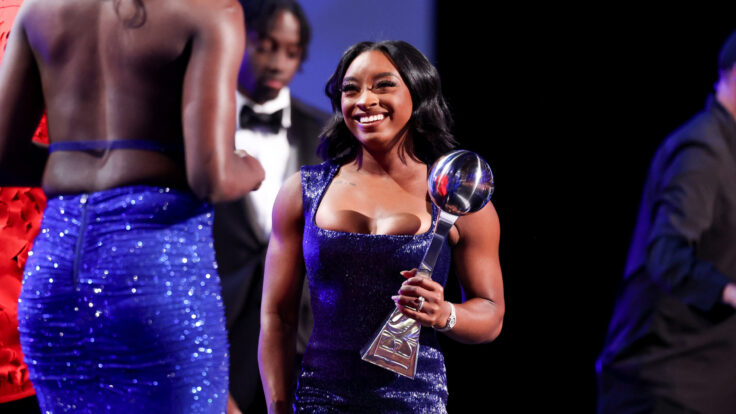
Welcome to The Varsity. I’m John Ourand, back in New York for the Sports Emmys and Sports Business Awards.
Meanwhile, I’m thinking about Indianapolis, where NCAA president Charlie Baker offered his view of how the college sports landscape will change—in a way that confers even more influence to the power conferences—once the House settlement takes effect. Baker envisions a scenario where the power conferences create a “College Sports Commission” to enforce rules on everything from salary caps to N.I.L. It’s not a huge leap to view it as the first step toward the two largest power conferences running college sports. ( Ross Dellenger has a good piece on this.)
Tonight, as part of our weekly Inner Circle edition of The Varsity, Julia Alexander goes deep on what Jimmy Pitaro needs to do to make ESPN’s new streamer a success. Here’s a hint: It involves much more than simply signing effective rights deals. Julia’s stories are so smart, and they’ll make you smarter, too. If you’re not already in our highest tier of membership, click here to upgrade. It’ll pay for itself in no time.
Now here’s Julia…
|
Stat of the Week: 1.6 Million
|
|
That’s the number of fans who came through the turnstiles for the MLB’s inaugural Rivals Weekend, beating the previous record for pre-Memorial Day weekend attendance, set in 2012. In-person attendance was accompanied by strong TV ratings as fans tuned in to watch Aaron Judge’s Yankees host Juan Soto’s Mets for the first time since the generational right-field talent jumped boroughs for $750 million. Sunday’s game averaged 2.54 million viewers on ESPN, the highest number for a Sunday Night Baseball game since 2018.
|
|
|
|
A MESSAGE FROM OUR SPONSOR
|
PERFORMANCE UNLEASHED
Agile, powerful, iconic. The Range Rover Sport is a dynamic SUV with a distinct take on sporting luxury.
EXPLORE
|
|
|
|
Trying to juice interest in a sport by highlighting rivalries isn’t exactly groundbreaking, but part of the MLB’s problem is that its product can sometimes feel a little… bland. If the MLB can figure out how to build personality-driven narratives around several matchups each season, it will be that much easier for the league to attract the younger fans it so desperately needs to get a national streaming product off the ground.
|
Trend I’m Watching: The Caitlin Clark Effect
|
|
There’ll be plenty of time later to debate whether increased viewership of the WNBA is singularly the result of Caitlin Clark’s ascent. For now, though, it’s evident that Caitlinsanity isn’t abating. The opening weekend showdown between Clark’s Indiana Fever and Angel Reese’s Chicago Sky drew an average of 2.7 million viewers, peaking at 3.1 million. That’s the highest-rated regular season WNBA game in 25 years. Breaking records isn’t new for Clark or Reese; their LSU-Iowa national championship game in 2023 drew 9.9 million viewers. One of my personal favorite stats: YouTube views related to the WNBA jumped from just under 500 million to more than 1.5 billion between 2023 and 2024, which is when Clark entered the league.
And now, on to Bristol…
|
|
|
|
ESPN hopes its new D.T.C. streaming service… err, app… will become the first stop for sports fans looking to watch a game, place a bet, play fantasy, and anything else sports-related. But it’s a lot harder than it looks—just ask Netflix.
|
|
|
|
Perhaps the most important thing we learned last week, when Jimmy Pitaro formally announced ESPN’s new streaming service, is what this long-awaited product is not. For one, it won’t be called Flagship. More importantly, it won’t be the next Netflix. Indeed, the decision to simply name the new service ESPN befits Disney’s appropriately cautious ambitions for its new direct-to-consumer product.
Certainly, the world has changed in the years since Bob Chapek promised to triple the growth that analysts had expected for Disney+ subscribers to 260 million. Not only was it bad business to sacrifice whatever real money was coming in in order to hit self-imposed and wildly optimistic growth targets, but those projections also suggested that Wall Street had fundamentally misunderstood the TAM for streaming. Now we know better. The median household can sustain only so many subscriptions per month. One-click cancellation has supercharged churn (40 percent of all subs last year came from re-subscribers, per Antenna). Live sports increase engagement and retention, but they’re not a silver bullet, either. Even Peacock, which broadcasts the Olympics and other sports year-round, can’t seem to budge from its 1.5 to 2 percent share of TV streaming in the U.S.
Anyway, this is the new, somewhat chastened streaming world into which Pitaro’s ESPN app will be born. The analysts I speak to are confident that a robust streaming offering—priced at $29.99 per month for unlimited access, and $11.99 for a skinny option—will help ESPN survive the ongoing death of cable. While the number of pay TV homes in the U.S. just dropped below 50 million in Q1, ESPN is one of the networks that keeps people paying. Virtual TV providers, like YouTube TV or Fubo, also rely on the ESPN suite of channels to entice cord-cutters to sign up. As we’ve learned, the future is hybrid.
The real question for ESPN 2.0 was never about survival; instead, it’s coalesced around whether the business can thrive in this post-TV era. Pitaro’s team must achieve what no other streaming platform, including Netflix, has yet managed to pull off—transforming itself into a multifaceted, multi-operational service, combining live games with betting, fantasy sports, articles from trusted reporters, and live updates from ESPN personalities. And that’s much easier said than done, even with ESPN’s impeccable branding.
|
Think Globally, Fail Locally?
|
As Pitaro told my partner Dylan Byers yesterday on his podcast, The Grill Room, ESPN wants to be in that business. But after spending tens of billions of dollars over the past several years on premium sports rights, the company is entering its austerity era—no more renting content just for the sake of it. Combating fragmentation doesn’t require acquiring more rights. Instead, the company would be better served by creating the simplest discovery funnel for fans who are attached to their phones.
Indeed, as regional sports networks collapse and teams experiment with free streaming services in their local markets, the problem for ESPN is discoverability. A group like the New England Sports Network (NESN) offers in-market audiences the ability to watch live programming via a free app—but that app is distributed through aggregators like Roku and Samsung TV. And that doesn’t require, say, a local Boston sports fan to open ESPN.
|
|
|
|
A MESSAGE FROM OUR SPONSOR
|
PERFORMANCE UNLEASHED
Agile, powerful, iconic. The Range Rover Sport is a dynamic SUV with a distinct take on sporting luxury.
EXPLORE
|
|
|
In non-sports streaming, this pain is addressed by apps like JustWatch, which collect and constantly update their database to direct people trying to find a specific title. Pitaro wants his ESPN app to offer that solution for sports. Back in August, Pitaro floated the idea of making ESPN a nexus point—thereby allowing local games to be watched via other services that exist on top of ESPN, and directing fans to those games when ESPN doesn’t have the rights.
It’s a good idea. Close to 80 percent of U.S. sports fans prefer watching sports through a typical broadcast network, because finding games has grown so tedious. As Hub Research confirmed earlier this year, 70 percent of audiences say it’s too difficult to find a game, up six percentage points from the year before. Pitaro hopes pissed-off consumers will drive additional revenue to ESPN. Consider an aggregator like Apple, which takes a 15 percent cut of any subscription purchase in the App Store during the first year. If ESPN can replace Apple as the go-to mechanism for signing up for a service, the business can negotiate a specific cut of the subscription fee.
Meanwhile, ESPN’s over-the-top advantage for partners is relatively easy to comprehend: Customers who use aggregators, like Prime Video Channels, are likely to subscribe to twice as many subscription services on average, per new Hub research. Indeed, ESPN’s potential ability to do more for a customer than simply broadcast a game—to direct them to a local favorite team, facilitate a bet, convey all the sports they can peruse, and provide ancillary phone activity—is just as important in this new era of streaming.
|
Central to Pitaro’s lifestyle sales pitch is that advertiser-friendly phrase, the “second screen experience.” How do you get a 22-year-old to spend more time inside the ESPN app instead of losing their eyeballs to Instagram or TikTok? Pitaro’s attention flywheel requires two ingredients: increasing engagement in a certain activity, like betting, and being the dominant app in the sports space.
Last year saw more than $13 billion in sports betting revenue, up 20 percent compared to 2023, according to the American Gaming Association’s annual report. But ESPN Bet sorely lags behind the competition. DraftKings and FanDuel maintain a combined 71.5 percent share of the sports betting market, per numbers released in March. ESPN and Penn’s original goal upon their $1.5 billion licensing deal announcement two years ago was to hit a market share of close to 20 percent by 2027. At the moment, ESPN Bet hovers around 3 to 5 percent.
You can see other attempts from Pitaro and team to catch just a little bit more of your time each and every day. The company has deals with Rich Eisen and Pat McAfee, two digital-first creators who may draw younger viewers away from YouTube and Roku to ESPN’s app. It’s also possible that using A.I. to recap games, or generate quick-hit articles on niche sports, may lead to new engagement.
ESPN’s cross-platform business gets stronger when we look at fantasy. More than 13 million people played fantasy football on ESPN’s app last year, with 9.3 million visitors signing up in the preseason, per the network. That’s 3.7 million more than Yahoo Fantasy, the second-leading fantasy app, according to Comscore. People are creatures of habit. We like the places we know, and the apps we use. That’s why changes to user interface, such as Netflix’s recent one, generate significant press coverage and, often, grief from customers. ESPN has the fantasy market cornered, but betting isn’t a surefire activity. If the ESPN subscription service is to become the all-encompassing place for sports fans, the flywheel has to grow stronger. That’s what turns a product from a nice-to-have into a can’t-live-without.
Flywheels are great businesses. No one understands that more than Disney. All the ingredients are in place for Pitaro to create the solution to a growing problem: ESPN owns the most sports rights; the company has the number one fantasy app; sports betting is a growing industry; and creators like McAfee and Eisen are eating up more time. But all of these need to work effortlessly within one system, and they’re competing against incredibly powerful algorithmic machines powered by the biggest tech companies in the world.
|
|
Thanks, Julia. Great piece, as always.
See you all on Thursday,
John
|
|
|
|
Puck sports correspondent John Ourand and a rotating cast of industry insiders take you inside the executive suites and owners boxes where the decisions that shape the entire sports business are made. You’ll hear interviews with players, network execs, and everyone in between. The Varsity is an extension of John’s private email for Puck by the same name. New episodes publish every Wednesday and Sunday.
|
|
|
|
Ace media reporter Dylan Byers brings readers into the C-suite as he chronicles the biggest stories in the industry: the future of cable news in the streaming era, the transformation of legacy publishers, the tech giants remaking the market, and all the egos involved.
|
|
|
Need help? Review our FAQ page or contact us for assistance. For brand partnerships, email ads@puck.news.
You received this email because you signed up to receive emails from Puck, or as part of your Puck account associated with . To stop receiving this newsletter and/or manage all your email preferences, click here.
|
|
Puck is published by Heat Media LLC. 107 Greenwich St, New York, NY 10006
|
|
|
|