Greetings from Los Angeles, and welcome back to In the Room. I’m looking forward to
seeing many of you at next week’s Puck Private Conversation event at the Hotel Chelsea in New York, where I’ll be joining Orchestra C.E.O. Jonathan Rosen and Puck founder Jon Kelly to preview the year ahead in media. It’s already shaping up to be a
great room. If you’re interested in joining, R.S.V.P. at PuckEvents@puck.news ASAP. Limited space is available.
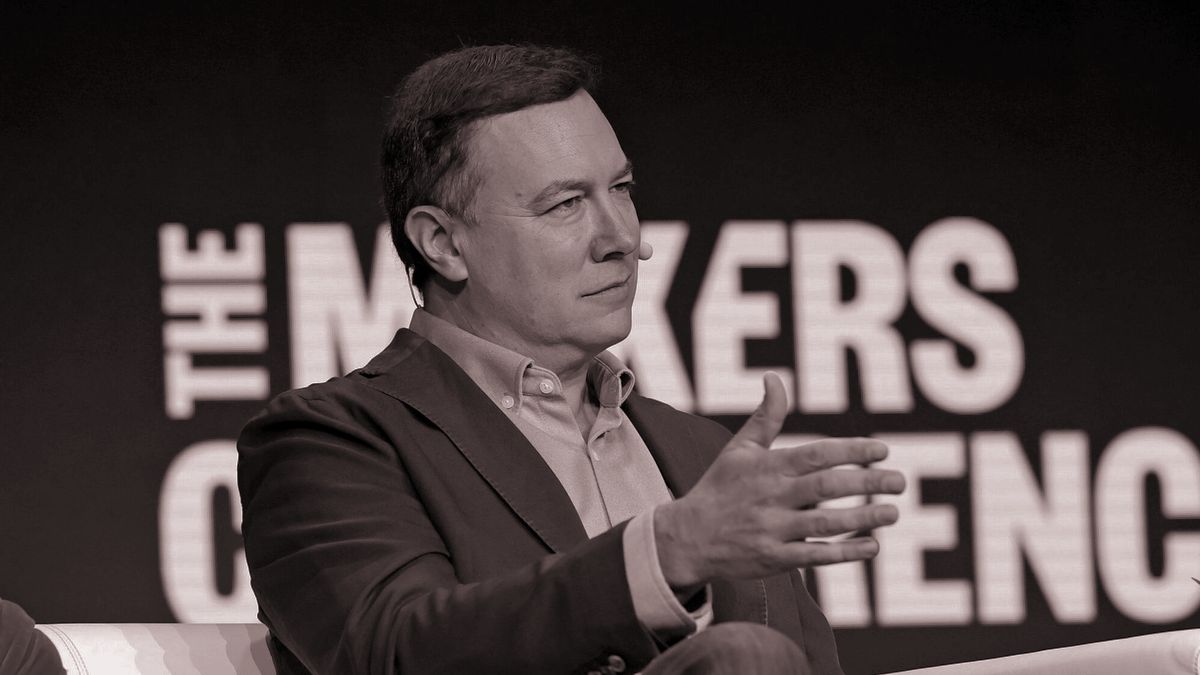
In tonight’s issue, Yahoo C.E.O. Jim Lanzone discusses his turnaround of the erstwhile internet powerhouse. Four years after being acquired by Apollo for a mere $5 billion, Yahoo still maintains enviable scale, distribution, and engagement—it’s actually one of the
sneaky feel-good media stories of the year. The company even recently hired former Snap executive Sean Mills, which might suggest that Yahoo Finance wants to become the CNBC of the A.I.-enabled internet before the leadership team at Versant can get there. Anyway, Lanzone argues that a highly valuable rebooted business is hiding in plain sight under the comical rodeo-holler name.
🍸 Plus, on the latest episode of The Grill Room,
Julia and I chewed over Disney’s new deal with OpenAI, which will pump more than 200 of the company’s historical characters into Sora so that fans can generate their own content with its most valuable I.P. We also checked in on the WBD sweepstakes: how Paramount and Netflix stack up, what each company’s contingency plans look like, the regulatory headaches ahead, and much more. Follow The Grill Room on
Apple, Spotify, or wherever you prefer to listen.
Let’s get started… |
-
The Iger-Altman bromance: On Thursday, in what has been described as a watershed moment for Hollywood’s acceptance of artificial intelligence, Bob Iger announced that Disney would be taking a $1 billion stake in OpenAI and allowing the shortform video platform Sora to use its characters: Mickey Mouse, Cinderella, Yoda, Iron Man, etcetera.
There’s been ample debate about who got the better deal here—don’t forget, OpenAI has a private valuation more than
2.5x larger than Disney’s market cap—but most intriguing is what this signals for the future of entertainment writ large. As I noted on TBPN this week (thanks for having me, guys), the industry is moving toward more interactive experiences wherein audiences don’t just passively consume content, but actively engage with it and dictate the creative experience. Indeed,
even David Ellison has suggested that we’re mere years away from children being able to converse with the characters from Paw Patrol. The Disney-OpenAI deal seems like a notable step toward that future. - Meanwhile, back in the fever swamps: On The Grill Room last week, while reflecting on the latest plot twists in the Olivia Nuzzi–Ryan Lizza saga, Julia rightly noted
that none of the attention surrounding the star-crossed lovers would end up converting to profit, revenue, or long-tail capital. As I’ve noted from the beginning, the real tragedy here is that both Olivia and Ryan have only one story left to tell (their own) and neither is telling it that well—or entirely
truthfully, as it turns out. Anyway, earlier this week, BookScan released the sales numbers for Olivia’s book, American Canto. In its first week, it sold 1,165 physical copies. Lizza’s Substack has risen to No. 30 on the platform’s U.S. politics leaderboard—one spot above Pantsuit Politics.
|
|
|
Don’t waste your tears on Yahoo, the Internet 1.0 relic that collapsed
into Verizon and then the warm embrace of private equity. C.E.O. Jim Lanzone explains how the Apollo-owned company is poised to make the most of its post-search distribution, and why niche is the new scale. |
|
|
For nearly two decades, Yahoo has been seen as both a relic and a running joke—a
once-great internet power now preserved in amber, stuck somewhere between dial-up modems and the Google Search box it inadvertently helped midwife. And yet, despite its absurd rodeo-holler moniker, Yahoo maintains an enviable position: hundreds of millions of logged-in users, category-defining franchises in finance and fantasy sports, one of the largest email footprints on the web, and a performance advertising business that quietly outconverts nearly everyone but Google and Amazon.
That
disconnect is what has driven Jim Lanzone’s four-year effort to rebuild the company after Apollo scooped it up from Verizon for roughly $5 billion—a rounding error relative to its $125 billion dot-com peak, and a fun turnaround idea for a P.E. firm with nearly $1 trillion in assets under management. Lanzone, a consumer-internet turnaround artist, doesn’t talk about Yahoo like a legacy media brand or a tech antique. For him, it’s a startup hiding in plain sight. And at a
moment when A.I. search is threatening to starve the open web and much of the media industry is going niche, Yahoo is betting—almost heretically—that scale, habit, and utility still matter. |
|
|
A MESSAGE FROM OUR SPONSOR |
|
|
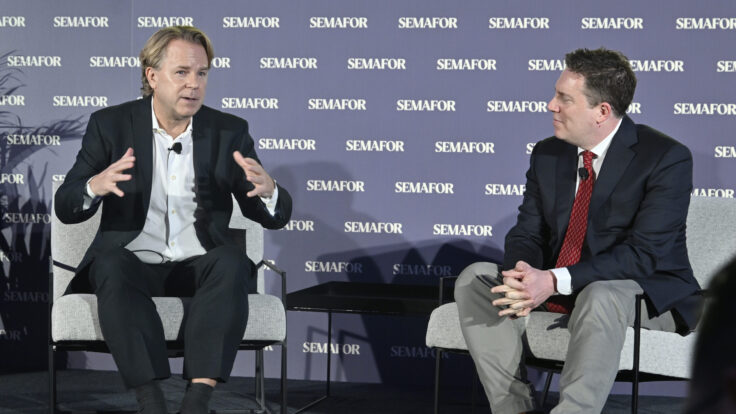
In a wide-ranging conversation with Julia Alexander and me on
The Grill Room, Lanzone made the case that Yahoo’s future isn’t about reclaiming its past glory—it’s about leaning into what the internet, in its infinite loops and regressions, seems to be circling back toward anyway. Herewith, some highlights from that conversation, edited lightly for clarity. |
The
Post-Marissa Mayer Drag
|
Dylan Byers: When Apollo bought Yahoo for $5 billion—a
significant discount from its $125 billion heyday—what did they see? What were those early conversations like, about the goal and the turnaround strategy? What were you trying to achieve on day one?
Jim Lanzone: Yahoo had all the bones of a great internet turnaround: massive traffic, a company that had seen better days, and a team that had been through the wringer—inside a telecom company for five years after having been
a struggling public company for many years before that. There had been a lot of industry whiplash. But the hardest thing to get in this industry is distribution.
The key was not comparing Yahoo to the trillion-dollar companies that it’s not, but appreciating it for what it is. We were lucky to do that in September 2021, without the hangover of losing search to Google or relitigating every past mistake. When you look at it clearly, you see hundreds of millions of very loyal users,
top-ranked properties in incredibly important categories, first-party relationships with a huge percentage of those users, and a revenue engine that needed to be modernized. If you do those things right, you can have a great outcome. So that was the thesis.
Dylan: Let’s talk about what Yahoo is. It’s a conglomerate of different services. From a consumer perspective, what are the greatest strengths of that suite
of products?
Yahoo is still strongest where it started: being the guide to the internet. Whether it’s finance, sports, or news, those are three categories where we’re still number one or number two. We’re number two in email. Yahoo Mail has hundreds of millions of users. It’s obviously smaller than Gmail, but to operate and build a company like this, you have to appreciate it for what it is: a massive footprint in email with extremely loyal,
active users. We’re also number three in search, which is an incredibly lucrative category. And again, we don’t get those users because they choose Yahoo over Google—we get them because they’re already in our network.
We do get traffic in distributed ways—you don’t reach this scale without that—but more than 75 percent of our visits are direct, and over 75 percent of our ad impressions come from logged-in users. Everyone brings their own bias about what Yahoo is to them. Someone will say,
“I don’t use Yahoo,” and then realize, “Wait, I use Yahoo Finance all the time.” They just don’t think about it that way. It’s the same way people use other major networks: Facebook, Instagram, WhatsApp; Google, YouTube, and their other properties. We’re a network in the same sense. We’re smaller, but still extremely large relative to most companies. And that’s really the opportunity. |
Julia Alexander: Yahoo started as the front page of
the internet. Then the web shifted to social and mobile, and eventually into closed platforms. What’s interesting about Yahoo now is that it sits in the middle—you aggregate, you link out, you still send traffic downstream. Where does growth come from next?
From the beginning, Yahoo’s role has been as the guide to the web. Even early search engines like Inktomi and AltaVista were cataloguing the web—Google just did it better, and Yahoo
essentially handed it over. At the time, that looked like good user service and terrible business strategy. But linking out has always been part of Yahoo’s DNA. We’ve historically sent enormous amounts of traffic downstream through partnerships and revenue-share deals. After losing search, the company tried to become a first-party content company—even a Hollywood company for a while—but the core strength was always aggregation. We’ve doubled down on that. We’re not chasing scoops. Journalism
happens elsewhere. Where we create content, it’s contextual—fantasy analysis, market wrap-ups, tools that help people make decisions. And we’re proud of our role in the ecosystem as a distributor.
Julia: Do you see “Google Zero” as a threat or an opportunity?
It’s definitely a threat. We’re already seeing the traffic impact on publishers. Content companies won’t be able to rely on micro-payments after
their work has been scraped—that doesn’t scale. Subscription works for some, like what you guys do, but free content still needs an economic model. That chapter still has to be written, but I think people have to prioritize it.
The open web could be under threat, especially with A.I. interfaces that look more like academic papers with citations than a true exchange of value. For the web to survive, publishers have to survive. Those sites need traffic and sustainable businesses—or else the
whole system collapses into synthetic data and slop. |
Dylan: Let’s talk about monetization. Programmatic
advertising isn’t exactly a growth story. What’s the monetization strategy?
Programmatic works only if you have performance at scale—and that comes from first-party relationships. We see trillions of user events a year, and that data converts. That’s why we built the Yahoo DSP. Advertisers, from Netflix to Spotify, use it to target Yahoo users across the internet. We win about 90 percent of head-to-head DSP tests because we actually convert.
We’ll always be smaller than Google and Amazon, but we’re bigger than everyone else—and that’s a very good business. The scale is extremely rare to be able to have an audience that performs on advertising. Otherwise, you’re in the realm of just branding. |
|
|
A MESSAGE FROM OUR SPONSOR |
|
|
Dylan: What comes next, especially on
A.I.?
We’ve already rolled out a lot—news summaries, automated audio digests, A.I. tools in email and fantasy sports, and more coming in finance. If you’re building consumer internet products, A.I. becomes the spine of everything. Search is especially interesting for us. We’ve had a partnership with Microsoft since 2008, and we’re starting to see places where A.I. can add real incremental value.
Julia:
You’ve partnered with Polymarket. How are you thinking about prediction markets and other ways to give users a reason to open Yahoo instead of another app or site? Where do you see the biggest opportunities?
Yahoo Sports is a core property for us. About half of our audience is Millennial or Gen Z, which surprises people, and that’s driven by Yahoo Finance being the standard in its category and Yahoo Fantasy being deeply embedded—essentially Yahoo
and ESPN. On an NFL Sunday, the average user opens the app 19 times. That’s enormous engagement.
We’ve been expanding the sports content slate accordingly. We now produce about 60 hours of original programming a week, focused on analysis rather than scoops. We’ve launched FAST channels in sports and finance, and nonfiction video is very much on the table.
On monetization, we inherited a legacy sports-betting deal [with MGM] from Verizon that limited our participation, and that deal
expires at the end of Q1. As a result, Yahoo is now the largest sports property without a long-term betting agreement, which has drawn significant interest given our audience and distribution. The Polymarket partnership operates in markets where BetMGM doesn’t. Prediction markets have expanded how people think about the category. There’s nothing new to announce yet, but we’re right in the middle of those conversations. It’s a meaningful upside vector that simply hasn’t existed for Yahoo over the
past several years. |
Dylan: What’s the endgame here? Is there an exit
strategy for investors?
Like any pre-I.P.O. company owned by private equity, there are really two options: You go public, or you get sold. Apollo isn’t doing this to hold it forever. But the only way we can operate is by assuming Yahoo should be here for another 30 years. There’s no sign that people don’t want these products. We’re growing. If you treat users and products right, you keep growing.
What we’re building is rare and valuable.
We’re not eager for any outcome right now—we’re focused on building leverage and value. Good things follow from that.
Dylan: Who might Yahoo be valuable to?
The great thing with Yahoo is that the verticals we operate in are both incredibly valuable on their own and are great distribution launch points for people to build on what they’re trying to accomplish. So, without naming companies, on the consumer
internet front, on the media front—even on the utilities front and ad tech, things like that—it is incredibly valuable to all of them. But the way we talk about it internally, we’re not eager for any outcome right now. We’re heads down, building leverage, building value. The only way to operate a big consumer company—or a small one—is to be entrepreneurial. You always have to be building, or you’re gonna die. So that is what we focus on. |
|
|
Join Emmy Award-winning journalist Peter Hamby, along with the team of expert journalists at Puck, as they let you
in on the conversations insiders are having across the four corners of power in America: Wall Street, Washington, Silicon Valley, and Hollywood. Presented in partnership with Audacy, new episodes publish daily, Monday through Friday. |
|
|
A professional-grade rundown on the business of sports from John Ourand, the industry’s preeminent journalist,
covering the leagues, players, agencies, media deals, and the egos fueling it all. |
|
|
Need help? Review our FAQ page or contact us for assistance. For brand partnerships, email ads@puck.news. You received this email
because you signed up to receive emails from Puck, or as part of your Puck account associated with {{customer.email}}. To stop receiving this newsletter and/or manage all your email preferences, click here. |
Puck is published by Heat Media LLC. 107 Greenwich St., New York, NY 10006 |
|
|
|