 |
|
Welcome back to The Varsity, my twice-weekly private email on the sports media business––Puck’s very own politics-free zone. Today, let’s ignore the forthcoming election (the most consequential in our lifetime!), and instead revel in the slow-motion collapse of the cable TV business, shall we?
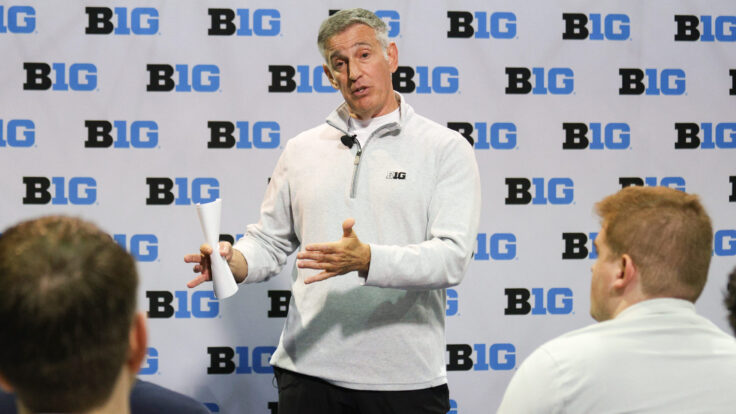
First, congratulations to Big Ten Network comms executive Pat Kenny, who won The Varsity’s first-ever World Series Viewership Contest. Pat offered the lowest guess out of all the predictions that were submitted: 15.5 million viewers. In fact, Fox averaged 15.8 million viewers over the five-game series, the network’s biggest World Series audience in seven years. Pat told me that he assumed the Dodgers would win in five or six games, which is why he kept his guess low. In any event, Puck swag is on its way! And Pat is allowed one Marchand joke—unless it’s a good one, in which case we will extend the offer.
🎧 Programming alert: I appreciated NASCAR president Steve Phelps’s candor on my podcast, also artfully titled The Varsity. (These Puck editors must really be geniuses…) Phelps knows that he has to break some eggs while trying to grow his sport. In our conversation, he outlined his expansion strategy and also flicked at the Jordan lawsuit, which I noted last week. Listen to it here. And be sure to tune in on Wednesday, too. Ben Strauss of The Washington Post rejoins the pod to pick through a candy bowl of topics.
Let’s get to it…
|
The Brady Meter: Week 9
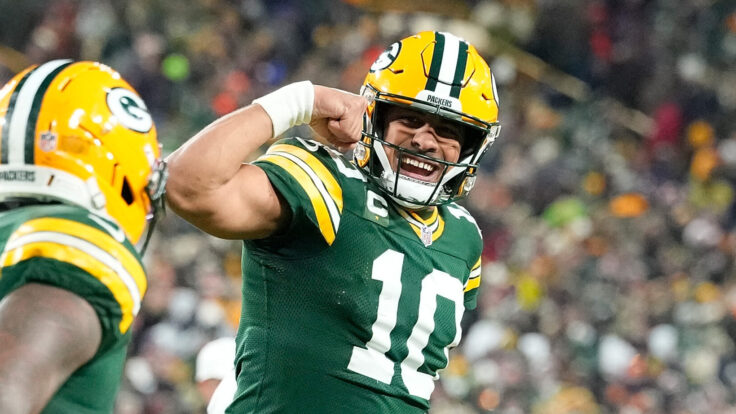
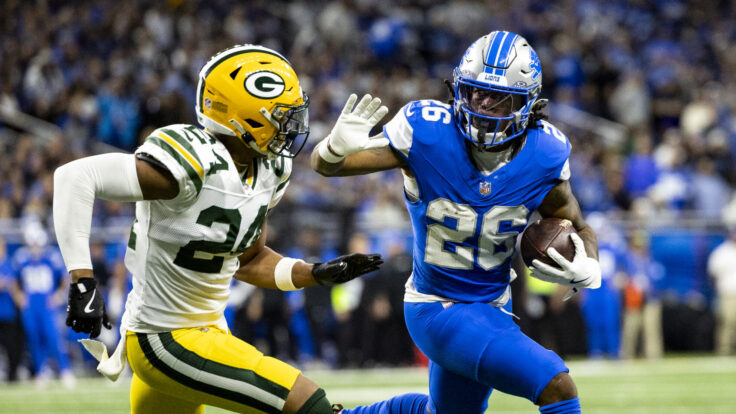
Lions 24-Packers 14
Grade: C |
|
| Fox’s $37.5 Million Man is ostensibly settling into his new role and appearing more comfortable each week, but Tom Brady sure doesn’t sound like an elite announcer, and it’s hard to imagine he’ll have cleared that threshold in time for the Super Bowl. Even his criticism of the officials during the Lions-Packers game, which all the blogs jumped on, was milquetoast: “I don’t love that call at all,” he said after referees ejected the Lions’ Brian Branch for a helmet-to-helmet hit. Come on, Tommy, tell us how you really feel!
Of course, in his new role as an NFL owner, Brady is prohibited from criticizing officials or opposing teams. While he certainly won’t be punished for that remark, there’s legions of people waiting for him—praying for him, really—to cross a line. |
|
|
- The Fox strategy: It’s been easy to question Fox’s video strategy over the past five or so years. Ever since Bob Iger paid a staggering $71 billion for the 21st Century Fox entertainment assets (following a grinfucking bid-up from Brian Roberts), Disney, NBCU, and Paramount Global have all tried to dive headlong into streaming. For its part, Fox opted to stay on the sidelines and dabble with an ad-supported service called Tubi. While those competitors used sports to drive streaming growth, Fox opted to schedule its broadcast channel with live programming.
That’s why it was so impressive to see financial analysts gush about the company after it reported its quarterly earnings today. MoffettNathanson’s Robert Fishman described Fox’s strategy to focus on news and sports as “one step ahead of the pack,” and said the company is undervalued. Guggenheim’s Michael Morris raised his price target based in part on confidence in the company’s NFL deal. Of course, part of the appeal is tied up in both its composition of assets and the mishegas among the Murdoch heirs. “We continue to believe, however, that Fox’s collection of assets could best be utilized within a larger company, and see the company as a prime target for M&A. With control over Fox currently the subject of litigation with the estate, there may be a catalyst for change in the not-too-distant future.”
- Super Bowl sellout: It’s hardly a surprise that Fox sold out of all of its advertising inventory for Super Bowl LIX at record prices—more than $7 million per 30-second spot. But my sources have suggested that the current ad sales market for live sports is unprecedented, driven up by election season price gouging. Fox, in particular, announced that its ad revenue for the quarter increased by 11 percent. On today’s earnings call, Lachlan Murdoch jokingly apologized “to anyone who was enjoying their football over the weekend and was bombarded with political ads.”
- Hail to the suits: Yes, that was CBS Sports president David Berson and NBC Olympics president Gary Zenkel running out onto the Big House field on Saturday before Michigan’s game with Oregon. The two Michigan alums were named honorary captains for the game, which Oregon won 38-17. I’m told that Fox Sports president and C.O.O. Mark Silverman, who got his M.B.A. from Michigan, wasn’t able to make the trip.
CBS carried the game, and just before the second-half kickoff, the network showed a video montage that included a pep talk Berson gave the team after Friday’s practice. According to sideline reporter Jenny Dell, Berson invoked legendary Wolverines coach Bo Schembechler in emphasizing a team-first concept. “A very familiar message that we at CBS Sports hear regularly from David,” Dell quipped. Announcer Brad Nessler then brought up a Friday night party he’d attended with Berson and his fraternity brothers where he “found out what he was really like at 19 and 20.” Alas, Nessler did not spill any more of that tea during the second half.
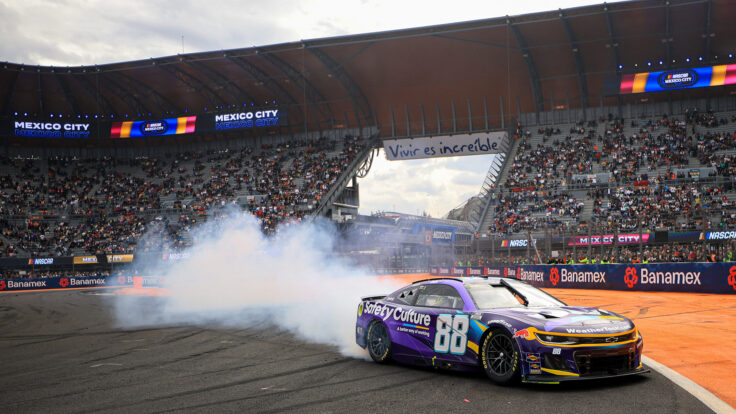
- NASCAR’s Mexico push: NASCAR surprised the sports industry when the circuit announced that it would hold a Cup Series race in Mexico City next year. On the Varsity podcast, I asked NASCAR president Steve Phelps how he picked the location as the sport’s first international market. He noted the size of the fan base, and the grassroots racing series that operates in the region. “Daniel Suárez, who races at our top level, is from Monterrey, Mexico, and came through that series,” Phelps told me. He talked about his wish to create ownership opportunities for people outside the U.S. as a way to grow the sport. “New owners are interested in coming here,” he said. “I would suggest it won’t be the last race we have internationally for our Cup Series.” He also predicted that Mexico City will be a sellout. “We want to have sellouts at every single race,” he said. “That’s an attainable goal. We have to just be smart about how that growth looks.”
- An NBA riddle: Yes, we all know that ESPN, NBC, and Amazon will carry NBA games starting in 2025, and that TNT will be out of business with the league next season, regardless of how Warner Bros. Discovery’s lawsuit fares. But we still don’t have any idea what will happen to NBA TV or NBA Digital, two businesses where WBD and the league have long been intertwined. NBA Digital, which includes League Pass and the NBA App, is a joint venture between the entities. And while the NBA owns all of NBA TV, WBD has been operating it since 2008. WBD handles ad sales, oversees production, hires the talent, and produces everything out of its Atlanta studios.
Indeed, this is one of the thorny entanglements that makes it difficult for the NBA to unwind a relationship that started with TNT nearly 40 years ago, and the uncertainty has led to an unmistakable sense of angst among NBA TV staffers, who are NBA employees even though they work out of WBD’s studios. My sources tell me that the league still has not decided how (or if) the channel will continue. Just like all the other league-owned channels and regional sports networks, NBA TV has seen a dramatic drop in its distribution during the past decade. Only 10 years ago, NBA TV was in 60 million homes. Today it’s in just 35 million homes… and dropping.
Even with that stunning 42 percent drop, however, the channel has punched above its weight. Thanks to an annual schedule of live regular season games and a handful of playoff games, NBA TV’s viewership belies its size. But tons of questions surround the future of NBA TV’s live-game schedule. The network’s current contract allows it to pick up any local feed on a night when there isn’t a nationally televised game on ABC, ESPN, or TNT. NBA TV supplements those games with studio shows produced out of Atlanta. Much of that inventory is moving to Amazon and NBC next season, including NBC’s Sunday night package that was once featured on NBA TV. Simply put, there aren’t enough games to go around, and all these mediacos paid so much that they won’t accept any leakage.
By contract, NBA TV also carried a handful of first-round playoff games, but in the new deal, those playoff games are spread across Amazon, ESPN, and NBC. The NBA decided that playoff games are too valuable to place on its own network, especially given its massive distribution cuts.
|
| And now, for something different. I got a zillion questions last week after Comcast president Mike Cavanagh floated a trial balloon suggesting that Comcast might ship off its cable networks. My partner Bill Cohan has the definitive take on the news. Herewith… |
 |
| The Comcast Cable Prenup |
| Mike Cavanagh’s earnings call mic drop about the future of Comcast’s cable networks has the industry—and the denizens of 30 Rock, in particular—looking for tea leaves to read about what the executives in Philly are apparently “studying.” |
|
|
|
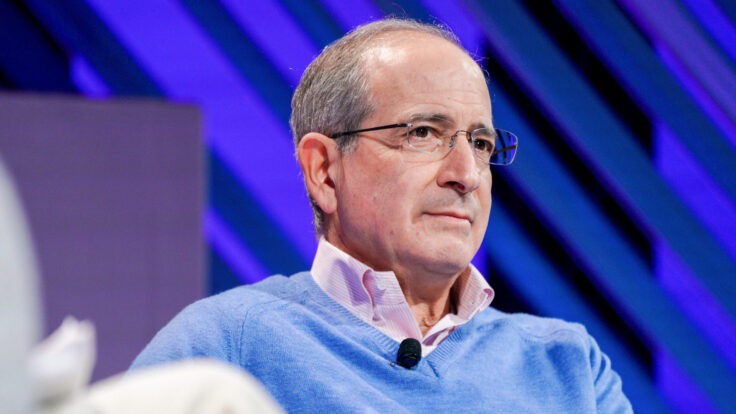
| Mike Cavanagh’s bombshell announcement on Thursday morning seemed almost like an afterthought. There he was, the former JPMorgan Chase investment banker and C.F.O. turned senior Comcast executive—and the interim C.E.O. of NBCU since Jeff Shell exited the business—babbling on about “convergence” and Epic Universe, the company’s forthcoming $150 million Orlando theme park, when he nonchalantly dropped the news that Comcast was studying the idea of sending out to sea its increasingly forlorn set of cable TV channels. “We are now exploring,” he said, “whether creating a new well-capitalized company, owned by our shareholders and composed of our strong portfolio of cable networks, would position them to take advantage of opportunities in the changing media landscape and create value for our shareholders.”
Is Comcast—which acquired NBCU some 15 years ago from GE for $30 billion—really getting ready to spin off a new company composed of Bravo, Syfy, USA, CNBC, and MSNBC, along with some debt, and allowing it to fend for itself? Was this Cavanagh’s equivalent of Bob Iger’s “Everything’s on the table” comment at Sun Valley? (Alas, nothing ever came of Iger’s ponderous thought bubble…) Comcast, at least in my experience, doesn’t float trial balloons; the company really is studying the spin-out idea—as they must, I hasten to add, as responsible fiduciaries for their shareholders. A Comcast spokesman declined to tell me the firms Comcast has engaged for the assignment, but I bet it’s the usual Comcast lineup of Paul Taubman, from PJT Partners, and Morgan Stanley, his former firm, plus Davis Polk.
I suspect most of the consternation, if there is any, will be coming from the folks at CNBC and MSNBC, who are now wondering if they’ll suddenly find themselves untethered from the mothership at NBC News. (My partner Dylan Byers previewed some of this vexation on Friday.) This would be a major breakup, given the fact that both CNBC and MSNBC sprung from the womb back when GE owned NBC. They were the brainchildren of a group of then GE executives including Jack Welch, Bob Wright, Tom Rogers (a CNBC regular now), and David Zaslav, now the C.E.O. of Warner Bros. Discovery. I’m not an expert on the back-office links between NBC, CNBC, and MSNBC, or whether their technology and operating teams are fundamentally independent of one another. But obviously, there is a lot of cross-pollination there—talent, branding, negotiating power, real estate, etcetera—and there almost certainly exists more synergies within the news division than between MSNBC and CNBC and the other cable assets. Indeed, all of NBC News, CNBC, and MSNBC roll up to Cesar Conde.
Unscrambling this egg will be particularly complicated. And while Comcast executives are evasive about which networks and scenarios are being studied, and by whom, it’s hard to see how CNBC and MSNBC slip the knot. “We are not ready to talk about any specifics yet, but we’ll be back to you as and when we reach firm conclusions,” Cavanagh said on the call. On the other hand, as one industry observer told me, “Brian Roberts hates MSNBC.” So we’ll see, won’t we? (A Comcast spokesman called this assertion “completely false.” By the way, post spin-out, should it occur, Brian would still own the same amount of the spinco as he does of Comcast, so he’d still be owning the cable channel.)
Cavanagh demurred when Ben Swinburne, a research analyst at Morgan Stanley, asked him to unpack his vague and surprising announcement. “There are a lot of questions to which we don’t have answers, so we want to do the work,” he told Ben. “And we want to do the work with transparency around it, so that as rumors fly—we expect that—we want our shareholders to understand what we’re willing to look at. … I think we’ve got a very strong hand given the strength of the businesses.”
Later, Caavnagh added a few additional thoughts: One, that Comcast would be open to combining Peacock, its money-losing streaming business, with another streamer. He said such a partnership “could be interesting,” but “they are very complicated.” (That’s for sure). And, second, he acknowledged that with the linear assets going downhill fast, tossing them overboard would allow Comcast’s topline growth to look even better than it already does. |
|
|
| Comcast does not break out the financials individually for its “cable networks,” so there is no way for outsiders to know the revenue and profitability trajectory for those businesses. What we do know is that all of Comcast’s “media” businesses generated $25.4 billion of revenue in 2023 and $3 billion of “adjusted EBITDA” (make it stop, please), down from $26.7 billion in revenue and $3.5 billion of “adjusted EBITDA” the previous year. So things are headed south relatively quickly, it seems—hence the need for the “study.” (It was $5.1 billion of “adjusted EBITDA” in 2021.) Thanks to NBC broadcasting the Paris Olympics, Comcast’s “media” segment generated $20.9 billion of revenue in the first nine months of 2024, up 14 percent over the same period of 2023, but “adjusted EBITDA” for the segment was down slightly, at $2.8 billion.
Interestingly, Cavanagh’s announcement that Comcast was studying the spinco idea took the air out of the earnings announcement, which may have been the point. Comcast C.F.O. Jason Armstrong explained that in the third quarter of 2024, Comcast’s “total EBITDA” decreased 2 percent to $9.7 billion. EBITDA at Comcast’s Universal theme parks business decreased 14 percent in the third quarter, to $1.8 billion, as compared to last year’s third quarter, which was an all-time high. (Comcast is hoping Epic Universe will change that trajectory, to say nothing of Donkey Kong Country, in Osaka, and the Fast & Furious roller coaster at Universal Studios Hollywood.)
Comcast’s media division EBITDA in the third quarter decreased 10 percent, to $650 million, while EBITDA at Comcast’s movie studio businesses increased 9 percent. With overall EBITDA down for the quarter, why not drop the news that the company was thinking ahead and exploring a spinco—a notion that might just change the narrative from the current declines, to how to position the company for future growth? When I pressed this observation on one top Comcast source, the notion was flatly rejected. “We felt really good about this quarter,” this person said, adding that the spinco announcement “wasn’t a distraction from the numbers.”
I rang up our friend Rich Greenfield at LightShed Partners for further clarity. He was skeptical, to say the least. His first question was why the study is happening now, when the ship appears to be sinking, instead of years ago when the ship was still afloat? “Everybody wants to get out of the same thing,” he said. “Iger wants to get out of it. Zaslav wants to get out of it. Roberts wants to get out of it. Why didn’t they get out of these businesses five years ago, when they were still healthy?” Greenfield reminded me that he was pushing the #GoodLuckBundle hashtag eight years ago. “This seemed pretty obvious: Consumers weren’t going to pay for big bundles of linear cable networks,” he said. “But they could have levered these things up and exited them years ago. Now, when it’s really problematic and there’s no hope, now they’re ready to get rid of them, and it’s a lot harder.”
Rich thinks it could all be just a big head fake. “Is this just meant to show investors, Hey, we’re thinking of lots of things. We have no idea what’s possible, but we’re going to explore it. And six months later, nothing’s happened, and no one’s talking about it. ESPN took a lot of meetings with people to make an investment and nothing happened.” The more we talked about it, the more incredulous he became. “I’m calling bullshit,” he said. “I love that they’re exploring ideas, right? But when you actually put pen to paper and say, Well, how would this functionally work? Just because you’re open to possibilities doesn’t mean you’re actually going to do anything.”
On the one hand, the strategic imperative is there, finally, to do something with these assets that are rapidly losing steam, and have been for a long time. But most likely, nothing will happen with Comcast, either. It all just gets too complicated with shared rights agreements and debt covenants and cross-branding. (Look at the problems Lionsgate has had with its creditors while trying to jettison Starz.) How do you unwind something that has been intertwined for decades? GE managed to do it with GE Capital—a fatal decision which led to the splitting up of GE into three separate companies and the end of one of our greatest corporate experiments. So, we’ll see what Paul Taubman’s analysis shows, especially as months go by and memories fade. Who else, besides me, is wondering what’s taking so long for Iger and Roberts to get the Hulu deal done?
Before we concluded our conversation about Comcast’s spinco trial balloon, Rich, unprompted, echoed exactly what I’d been thinking: “It definitely distracted the press from writing about earnings, though.” |
|
|
| A bullish take on Cosm: “I gotta step in on the Cosm debate. I was skeptical and turned into an evangelist. The whole thing works once they hit scale and get to 20 venues. The technology is the moat, and scale is what will set them apart and cement the business ahead of anyone being able to catch up. It truly is innovative with them figuring out sports. The technology has the same wonder early cinema must have had. It also fostered the same sense of community long gone from the cinema experience. You should go. It doesn’t make sense otherwise.” —A serial entrepreneur
A bearish take on Cosm: “They’re reliant on the networks and leagues providing rights to the games for Cosm’s distribution. Other than for initial experimentation and learning, how willing are the networks going to be to continue providing the rights, from which Cosm benefits and drives its business, for relatively marginal fees, when they’re already paying hundreds or millions or billions of dollars themselves for the rights?” —A media executive
On Comcast potentially spinning off its cable networks: “Doesn’t this smell like Comcast prepping to replace WBD in Venu? Adding NBA, NFL, NASCAR, EPL, Olympics… Just saying, it’s easier to maximize opportunities for Peacock when [the cable assets] are untethered from the mothership since there will be less conflict with the M.V.P.D. and broadcast side of the house.” —A cable guy
On celeb row at the World Series: “1) No love for Pat Sajak or Pitino, who were dominating the Legends seats, is bullshit. 2) I thought I saw Jimmy Pitaro right behind home plate in the Bronx, although I may be mistaken because the suspect in question looked a bit more John Turturro-ish than Mr. Pitaro normally does. 3) Sincere thank-you for not shouting out Mario Lopez, who was behind home in L.A. I am sure his P.R. team will be reaching out if they have not already. 4) In other celeb row news, Steve Cohen was back courtside at MSG promptly after the Mets were eliminated.” —A voyeur |
|
|
See you Thursday,
John |
|
|
|
| FOUR STORIES WE’RE TALKING ABOUT |
 |
|
 |
|
 |
| Comcast’s Stunner |
| Assessing the viability of Comcast’s spinco concept. |
| WILLIAM D. COHAN |
|
 |
|
|
|
|
|
 |
|
|
|
Need help? Review our FAQs
page or contact
us for assistance. For brand partnerships, email ads@puck.news.
|
|
You received this email because you signed up to receive emails from Puck, or as part of your Puck account associated with . To stop receiving this newsletter and/or manage all your email preferences, click here.
|
|
Puck is published by Heat Media LLC. 227 W 17th St New York, NY 10011.
|
|
|
|