{{ 'now' | timezone: 'America/New_York' | date: '%b %d, %Y' }} |
|
|
|
Greetings from Los Angeles, and welcome back to In the Room. Congrats to Bob
Iger on a historic run at Disney, to Josh D’Amaro on making it to day one—many would-be Iger successors tried and fell short!—and to Deb OConnell, the infamously tireless ABC News chief who has been elevated to chairman of Disney Entertainment Television. So many more people are about to start getting texts at 2 in the morning.
In tonight’s issue, news and notes on Robert Allbritton’s return to
the Washington media scene five years after his billion-dollar Politico exit. Amid The Washington Post’s identity crisis, Robert is poaching some over-the-hill and disaffected journalists in the name of an old-fashioned newspaper war. Of course, newspapers are dead, and—as the Politico kremlinologists know—it takes more than money and a brunch to build a successful media company. Even if this defection has D.C. aflutter, is his effort to scale up NOTUS a good idea or just the
sign of another restless billionaire entering a market that has become far more unforgiving since his first go-round?
🎙️ Plus, on the latest episode of The Grill Room, Julia and I assessed the increasingly uncanny world of generative A.I., whether tech companies are sleepwalking toward a regulatory reckoning, and why the Oscars may soon look a lot like a sportsbook thanks to the rise of prediction markets. Follow The Grill Room on
Apple, Spotify, or wherever you prefer to listen.
Also mentioned in this issue: Jeff Bezos, Jeff
Shell, Jim VandeHei, Mathias Döpfner, Maggie Haberman, Almar Latour, Ali Velshi, Ana Cabrera, Ben Smith, Jonathan Martin, John Harris, Jimmy Finkelstein, Lynn Forester de Rothschild, Megyn Kelly, Mike Allen, Piers Morgan, Rashida Jones,
Rebecca Kutler, Robert Thomson, Stephen Smith, Stephanie Ruhle, Theo Von, Zanny Minton Beddoes, David Ellison, David Zaslav, and more… |
-
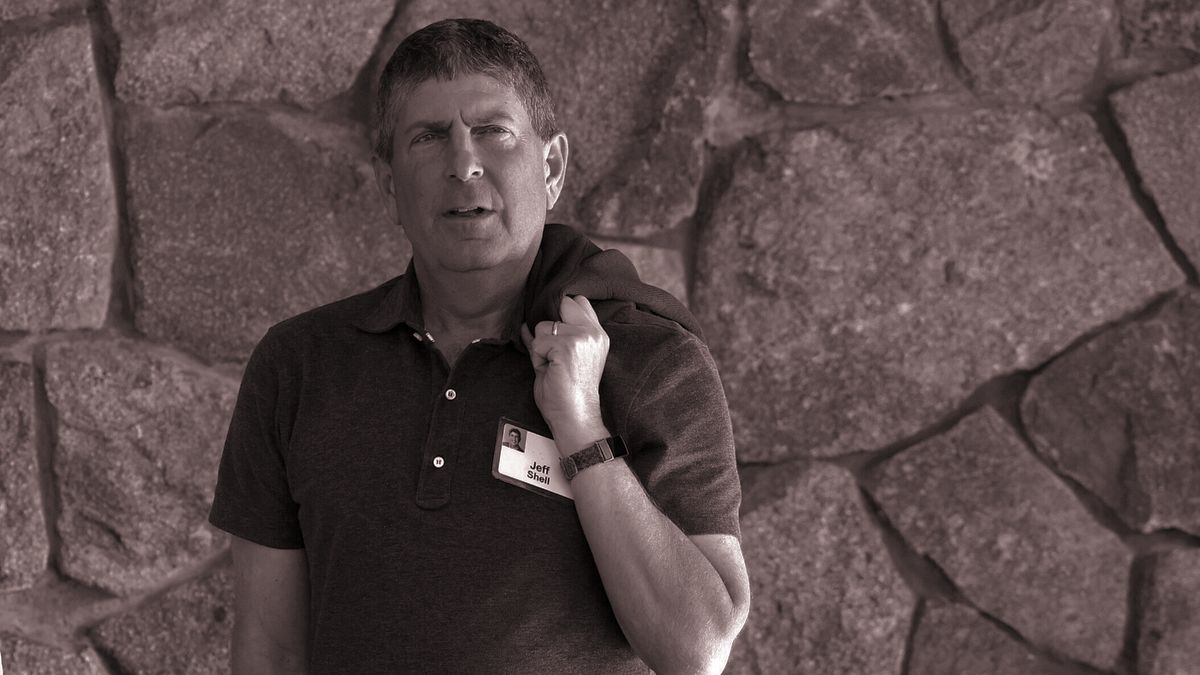
Shell games, cont’d: Jeff Shell has returned fire on R.J. Cipriani, the Vegas gambler and federal whistleblower who accused him of divulging company intel and sued him for $150 million. In a cross-complaint filed this week, as you already know, the Paramount president accused Cipriani of orchestrating a “shakedown”—which is more or less how David Ellison views Cipriani’s complaint, even if he and the rest of the front office are miffed
at Jeff for getting himself into this situation in the first place.
Cipriani’s lawsuit is flawed, as Puck’s resident legal expert, Eriq Gardner, recently observed. But the truly telling detail lies in Paramount’s response, which seemed designed to delicately nudge Shell toward the door. Earlier this month, I
reported that the Cipriani drama had exacerbated David’s misgivings about Shell, and that he is unlikely to survive at Paramount after the WBD merger. Instead of dismissing Cipriani’s complaint, the company hired Gibson Dunn to conduct an internal investigation and held back from commenting until Cipriani roped Paramount itself into the conflict.
“Why the initial
pause by Paramount?” Eriq asks. “Sure, you could read that as a company dutifully respecting the process. But when a corporation passes up an easy opportunity to swat down a flimsy lawsuit against its own president, it doesn’t scream confidence.” - The Economist, eh?: Lynn Forester de Rothschild has sold her family’s 27 percent stake in The Economist to Stephen Smith, a Canadian billionaire who made his fortune
in mortgage lending. Financial terms were not disclosed, but the Financial Times reports that Smith paid around £300 million, or roughly $400 million, which would value the company at around $1.5 billion. The Economist, which is now owned by a consortium of billionaires, including members of the Agnelli family from Italy and England’s Cadbury and Schroder families, occupies an unusual position in the media firmament. I spoke to
its editor, Zanny Minton Beddoes, on The Grill Room last year. (The Rothschild Investment Trust, an unaffiliated entity, is an investor in Puck.)
- MS shuffle: Rebecca Kutler has overhauled MS NOW’s dayside lineup. Among the changes: Morning Joe, which had been
overstretched to four hours, will return to the standard 6–9 a.m. time slot. (No one needs that much Jon Lemire…) Stephanie Ruhle will anchor a new two-hour show from 9–11 a.m., vacating The 11th Hour, which will now be hosted by Ali Velshi. Velshi’s three-hour weekend show will be taken over by Jake Soboroff. As part of the changes, midday anchor Ana Cabrera will leave the network.
Sure, it’s
all deck chairs on the Titanic, etcetera, etcetera. But Rebecca is a programmer at heart, and this is perhaps the best way to structure the roster given the available talent. The thing to keep an eye on is MS’s new licensing deal with Crooked Media, which initially will air on Saturday nights but could eventually move into weekdays. - And finally…: The Times’s Jessica Testa
profiled Piers Morgan on the occasion of his raising $30 million for Uncensored and hiring former MSNBC president Rashida Jones as C.E.O. (This has all the appearances of a trophy hire that will backfire—TV executives tend not to make ideal startup operators—but only time will tell…) Piers now has more than 4.3
million subscribers on YouTube, “ranking him just below the manosphere mascot Theo Von but above Megyn Kelly.”
|
$1 billion: The projected EBITDA that Robert Thomson and
Almar Latour expect News Corp to net within five years.
$887 million: The total comp David Zaslav is expected to walk away with at the close of
Warner Bros. Discovery’s sale to Paramount.
Less than 4 million: The average viewership for CBS Evening News last week—a stat that has historically tended to induce panic. |
“A.I. can write. But it can’t do what you’re doing right now. It can’t show up and ask questions.
Not yet. Maybe not ever.”
—The “Dario Amodei” A.I. chatbot that Vanity Fair’s Joe Hagan created using Claude after the Anthropic chief ducked an interview.
And now, the main event… |
|
|
|
As the son of a yesteryear D.C. media baron, and the moneyman behind Politico,
Robert Allbritton is still fighting for credit. Now he’s rebranding NOTUS, his post-Politico plaything, by hiring reporters and once again going after The Washington Post. |
|
|
|
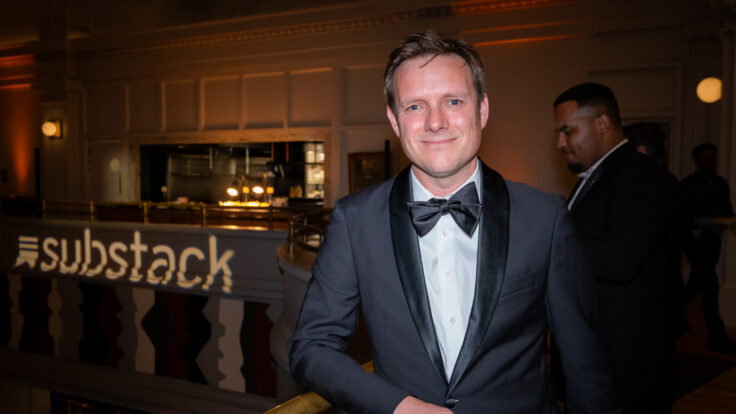
This week, Robert Allbritton, the boyishly ebullient Washington media heir and
former proprietor of Politico, revealed a plan to aggressively increase his investment in NOTUS, the fledgling political news startup that he launched two years ago from inside his 501(c)(3), the Allbritton Journalism Institute. The plan includes doubling NOTUS’s 50-person staff this year, starting with three reporters he poached this week from The Washington Post—which, as you
know, has been going through some considerable shit. Taking on a floundering Post was the animating insight of Politico, of course. Now Robert is at it again.
In an interview with The Guardian, Robert said he’d been inspired to accelerate NOTUS’s growth plan because of the Post’s recent layoffs and rolling identity crisis. “Opportunity knocks, and you’re going to decide if you’re going to answer the door or not,” he said. “We don’t want to be The
Washington Post, but I think there’s a place for the journalism of the Post and the mission of the Post without a lot of the legacy expenses that were necessary when [that] organization was a print-based organization.” (Robert, who has been talking to press, did not respond to my requests for interviews.)
Rumors of Robert’s new investment had been percolating for weeks on the D.C. social circuit, where better gossip can be hard to come by. Semafor’s
Max Tani recently reported that Robert had applied to trademark “The Washington Sun,” which portends a merciful rebrand—NOTUS, which is pronounced “notice,” stands for “News of the United States” (sigh)—and suggested his desire to rekindle the sort of newspaper war that his father, the proprietor of The Washington Star (as well as WJLA-TV and News Channel 8) once attempted to engage in with Kay Graham.
Wishful thinking, alas, but amid
the Post’s contraction and the general ennui of the D.C. news industry, the prospect of any media proprietor telegraphing ambition and doling out checks inspired considerable interest. At a recent party in Kalorama, a group of beat reporters asked one another whether anyone knew what Robert might be paying. (I’m told some reporters are fetching north of $300,000 a year.) Meanwhile, Washington’s executive establishment focused on Robert’s motivations: What was the thesis? What
was the endgame? Why was he investing in another media outfit? And who would be his Jim VandeHei—the visionary and hustler who was going to operate this thing and put his family’s money to work? |
Bankrolling
the Visionaries
|
Robert’s previous claim to fame is bankrolling Politico, which sold for $1 billion to
Mathias Döpfner’s Axel Springer in 2021. The deal netted him a significant pile to place on top of the fortune he’d already inherited from his family. But as everyone in the Beltway knows, Politico’s success was really driven by its disruptive and visionary founders: VandeHei, John Harris, and the perpetually in motion Mike Allen. Robert’s real achievement was backstopping their vision—and continuing to fund it for 15 years, even
during the fits and starts and some heavy cash burn years. Had Jim and John attempted to start their company in today’s investment landscape, it’s safe to say they would have reaped their own substantial pile. (In the end, despite the public narrative, both realized material cash proceeds from their equity in the enterprise.)
In any event, Robert was the money, not the operator. Indeed, in two instances along Politico’s journey, he caught the entrepreneurial bug and underwrote
sister startups—which quickly failed. In 2010, he launched the hyperlocal news site TBD, which folded two years later. In 2020, he launched a tech-news site called Protocol, which also shuttered two years later. Inside Politico, Robert was seen as an oblivious-but-harmless Mr. Magoo type, the kind of guy who enjoyed owning a news company and the prestige it conferred but wasn’t interested in the management or production of a daily news report—or even wielding the political
influence of the institution. He has a social discomfort that is Newhousian—both weird and a little off-putting, but also sometimes rather disarming and even charming. He delighted in hosting the most coveted brunch on the White House Correspondents’ Dinner circuit. He could talk at length about his multiple planes and the joys of piloting. “His one digital success was a brainchild of others and his TV success was inherited from his father,” observed one media executive, perhaps slightly
unschooled in the principles of investing. “He has a knack for stumbling into both spectacular flops, like TBD, and successes, like hiring Jim and John.”
Most Georgetown insiders who know Robert believe that he has missed the relevance he enjoyed at Politico, and that he sees NOTUS, or “The Washington Sun,” as a ticket back to the dance. Some posit that he may feel like he never got enough credit for Politico’s success and still has something to prove. Given his father’s legacy, the
prospect of going head to head with The Washington Post once again may simply be irresistible. Plus, he has nothing but money and time—a potent combination—on his hands.
On some level, though, Robert may have missed the point of the Post’s demise. Building a political news business is hard—even in a town with seemingly limitless budgets for influence campaigns and advocacy advertising. You can’t simply spend your way to success. Young journalists may envy the
$300,000 salary, but it’s worth recalling that Jimmy Finkelstein paid even more to lure reporters to The Messenger. True success depends on the ambition and metabolism of people like Jim and John and Mike—and Jonathan Martin and Maggie Haberman and Ben Smith in their reportorial prime. As every executive knows, those people are very hard to come by.
More importantly, markets aren’t static: There are more
competitors and less differentiated talent than ever. Jim and Mike took the formula they developed at Politico and wove it into Axios, which exited at a $525 million valuation. Jake Sherman, their disciple, started Punchbowl in the same image. Semafor, led by Ben, is playing an events-weighted version of this game, too. (Of course, Puck is also deeply engaged in this market.) Meanwhile, JMart has a Where’s Waldo sinecure at Politico, Maggie is on book leave,
and Bezos effectively dismissed half his newsroom. Allbritton, the restless operator, might think it’s a great time to meet his destiny. Alas, any media investor would almost certainly disagree.
Robert may have made waves on D.C. media Twitter, if such a thing still exists, by hiring three Post reporters at once. But, at the risk of never eating lunch in that town again, these reporters probably aren’t going to usher in the dawn of Washington’s next great media
company, and their moves are really only relevant to parochial Beltway denizens who fail to see that the Post’s vacuum was already filled years ago. Does the town need another media company? Obviously not. But Robert does, and bless his heart for it. |
|
|
|
Puck fashion correspondent Lauren Sherman and a rotating cast of industry insiders take you deep behind the scenes of
this multitrillion-dollar biz, from creative director switcheroos to M&A drama, D.T.C. downfalls, and magazine mishaps. Fashion People is an extension of Line Sheet, Lauren’s private email for Puck, where she tracks what’s happening beyond the press releases in fashion, beauty, and media. New episodes publish every Tuesday and Friday. |
|
|
|
Puck’s daily political newsletter from Washington on what’s really happening in this town, from the White House to
the Pentagon to Capitol Hill, K Street, and the campaign trail. |
|
|
|
Need help? Review our FAQ page or contact us for assistance. For brand partnerships, email ads@puck.news. You received this email because you
signed up to receive emails from Puck, or as part of your Puck account associated with {{customer.email}}. To stop receiving this newsletter and/or manage all your email preferences, click here. |
Puck is published by Heat Media LLC. 107 Greenwich St., New York, NY 10006 |
|
|
|
|