Welcome to The Varsity. I’m John Ourand, back in
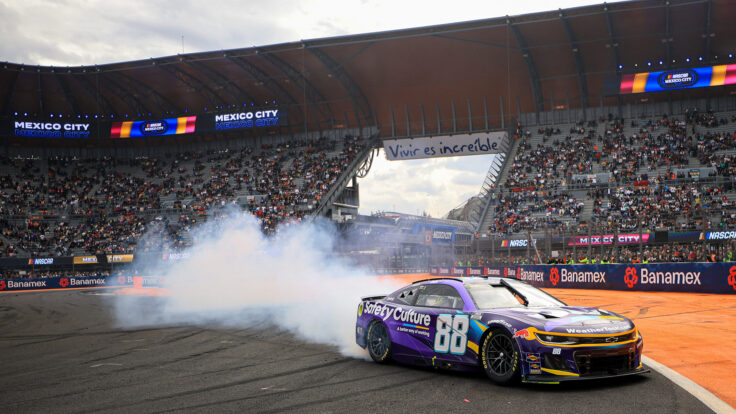
D.C. after spending the weekend in Madison watching my Terps thrash Wisconsin. Yes, I overdid it on cheese curds and brats and Marchand jokes. I’m making a quick New York trip this week to participate in a NASCAR partner event. Let me know if you’re around to say hello.
🚨 In the Arena: We’re just a few weeks away from In the Arena, our inaugural sports media conference
with MoffettNathanson, on October 16 in New York. The event is almost fully booked, but there are still a few tickets left, which you can claim here. It’s going to be an extraordinary day of candid conversation: Alongside the NBA’s Adam Silver, RedBird’s Gerry Cardinale, and Prime Video’s Jay Marine, we’ve recently added Fox Sports C.E.O.
Eric Shanks, senior Altice executive Keith Bowen, and NWSL C.O.O. Sarah Jones Simmer to the list of august speakers offering their intimate thoughts on the sports media landscape. Click here or contact me directly if you want a ticket or a small tranche for your team.
🎧 Pod alert: Former Merrill Lynch
executive Dany Garcia is an investor in the UFL spring football league, and her firm, The Garcia Companies, owns Seven Bucks Productions, which produces everything from feature films to digital shorts. Garcia joined me on The Varsity for a fascinating discussion about her investment strategy for an episode that goes up Wednesday. In the meantime, catch up on yesterday’s pod: Charlie Neiman, Amazon’s head of sports partnerships, discussed the company’s
evolving play for tier-one sports rights. Listen here and here.
Finally, before we begin, several friends texted me about how much they liked CBS Sports’s retro NFL Today pregame show that aired yesterday. After all, it was an homage to the
O.G. pregame show, which started with Brent Musburger, Irv Cross, Phyllis George, and Jimmy “The Greek” Snyder. CBS dusted off its old graphics and music, and had its current analysts dress with wigs, mustaches, and sideburns, à la 1975. Check out the open here.
|
|
|
A MESSAGE FROM OUR SPONSOR |
Forever at the top of its game, the trailblazing BMW 7 Series. Engineered to win. Learn more at
BMWUSA.com |
|
|
- The
tennis conundrum: If you chat with any tennis executive, they’ll tell you that the sport needs to make fundamental changes to grow the business. Right now, the prevailing wisdom is that the sport has far too many governing bodies and a glut of tournaments. That was one of the buzzy topics at the IMG x RedBird event in the Cotswolds last week. ATP chairman Andrea Gaudenzi, WTA Ventures C.E.O. Marina Storti, and
former USTA C.E.O. Lew Sherr offered their candid thoughts and potential remedies for the problem.
Both Gaudenzi and Storti spoke of the need to put men’s and women’s professional tennis under one roof, making it easier to develop tournament schedules, sell sponsorships, and attract investors. Of course, tennis executives have debated the idea for years. So what’s taking so long? In short, tennis bureaucracy is almost comically unending.
“There are
just too many stakeholders,” Sherr explained, referencing the ATP, WTA, USTA, and LTA. “Within those, you’ve got boards and boards of tournament owners and players, and different classes of each. If I’m No. 400 in the world, I have one point of view on the sport. If I’m in the top 10, I have a different view. Everyone has a voice, and the voices aren’t necessarily weighted to the commercial economics of the sport. Those that move the needle don’t necessarily have the stake commensurate with
their weight in the sport, and so it tends to hold back.” - Goodbye, Sunday Night Baseball: Thirty-five years after it launched Sunday Night Baseball, ESPN ended its final telecast on Sunday night without any fanfare or acknowledgement that the primetime series will move to NBC next season. Major League Baseball was also eerily quiet about the transition—which was weird, since commissioner Rob Manfred
acknowledged last week that the league has deals in hand with ESPN, NBC, and Netflix that will last for three years. Varsity readers have known about these deals for weeks—term sheets were signed about a month ago.
Alas, even though most deals are announced at this stage—a decent way to preempt links and bind the parties to one another publicly—MLB wants to wait until the long-form is completed before making an announcement. In fairness, it takes many months for lawyers representing three
mediacos to comb through those long-form docs. As usual, they are the big winners in all of this. - Was The Athletic worth $550 million?: New York Times Company C.E.O. Meredith Kopit Levien joined the Grill Room podcast last week, where my partners Dylan Byers and
Julia Alexander asked her about the company’s decision to buy The Athletic in 2022. She was as bullish as ever. “There are aspects of The Athletic that are upside to the whole enterprise we didn’t even conceive of,” Kopit Levien said. “It’s a great ad business. I came out of the news ad business, and it’s just a different game to be in the sports ads business.”
When asked about The Athletic’s potential growth areas, Kopit Levien was quick to gesture toward its focus on
fandom. It’s not a pleasant point to make aloud, but the old Times sports section had bled out over the years with its focus on big-picture, wonky sports stories that real fans eschew; for every Snowfall, there was excess coverage of NESCAC football, paragliding, etcetera. In many ways, The Athletic was acquired to entice fans of the Warriors or Eagles, just as Maureen Dowd caters to a variety of liberal Boomer. “The full story has not been written yet of all
the ways we’ll serve sports fans,” Kopit Levien told Dylan and Julia. “Beat coverage is the core of The Athletic, but we’ve layered on national coverage, product quality, live coverage. We’re conscious of what ESPN does, what fantasy and betting mean. There are lanes for the Times to play in that will be uniquely ours. More to come.” - Amazon’s A.I. embrace: During Thursday Night Football telecasts, a green arrow will occasionally hover
over a defensive player who’s expected to blitz. On its NASCAR productions, Amazon’s graphics predict how much fuel remains in each given car. As most of you know, NBC Sports produces these NFL and NASCAR telecasts, but Amazon is using A.I. to develop these stats—a move that, according to Amazon sports partnerships head Charlie Neiman, has enhanced the way the announcers tell their stories. “We’re not innovating for innovation’s sake,” Neiman said on yesterday’s Varsity
podcast. “We are innovating because we think it is a way to better educate customers and make their viewing experience better. Plus, it helps our talent and our production crew tell better stories.”
Neiman continued: “Everything I’m talking about is really an opt-in experience. We test these things in the Prime Vision feed. When we get customer feedback and
feel like we have enough data points, we’ll bring some of that into the main broadcast. But we’re not putting it on every play. We’re being very surgical about how we introduce it.” - Fire Fickell: I was in Madison on Saturday during Maryland’s 27–10 win, and witnessed firsthand the growing unrest among Wisconsin fans regarding Luke Fickell, their football coach who took over the program after an extraordinary run at
Cincinnati. Several loud and prolonged “Fire Fickell” chants erupted during the game. Fickell, of course, is signed through 2031, and the school would have to pay $25 million to buy out his contract. Now that schools are paying players, committing to such a big buyout has become much more complicated.
Before the season, when I asked college football analyst Josh Pate to name the top off-field storyline to watch, he brought up precisely this type of scenario. “No
one is firing people anymore,” he said on the Varsity podcast. “Coordinators aren’t being fired, and the reason is because they’ve got to pay the players now. So money is real—money is not Monopoly money.” Pate also referenced Florida’s coach, Billy Napier, who started out poorly last season before turning things around—only to end up on the hot stove again this season. “In a previous era, he would have lost his job. Napier never would have
even been given that length of rope in a previous generation.”
It’s possible that Wisconsin could move on from Fickell, especially if fan anger turns into fan apathy and Camp Randall Stadium ends up half-full. But nothing of that sort feels imminent: Recent history suggests the school will be extra patient to avoid paying such a hefty buyout.
|
And now for the main event… |
|
|
The sports media world erupted last month when word leaked that
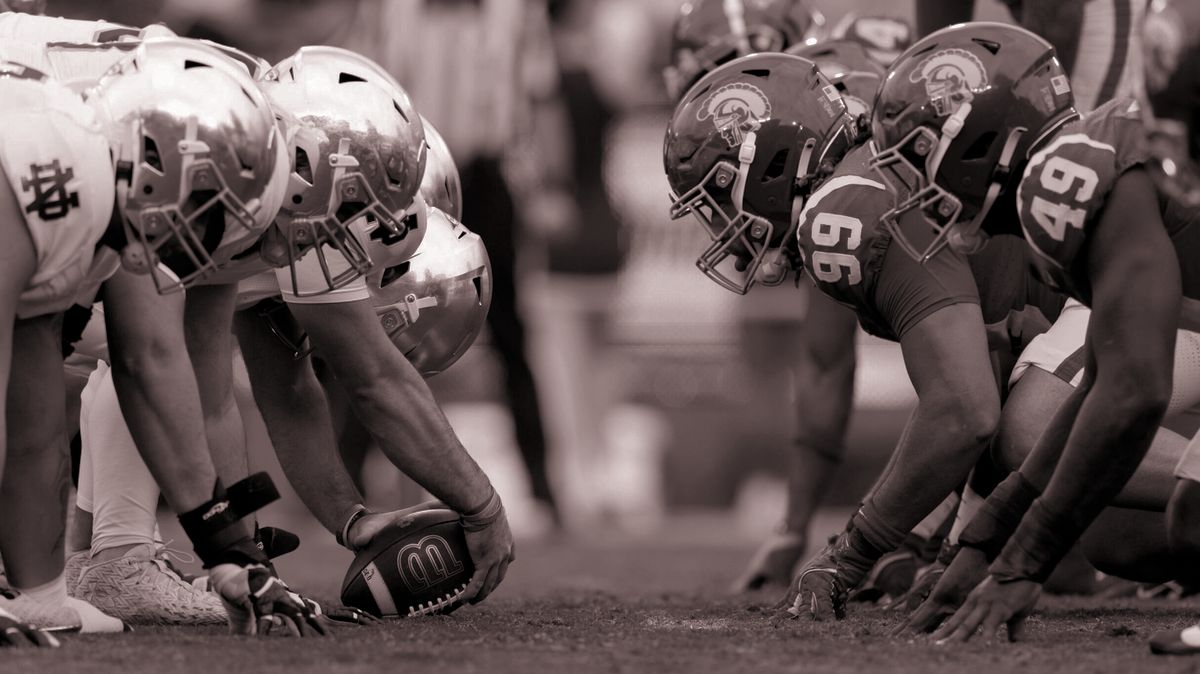
Netflix was looking at ways to stream the Notre Dame–USC game—despite the fact that Notre Dame is under contract with NBC, and USC’s rights are tied up with the Big Ten. The saga, more than anything, spotlighted Netflix’s aggressive plan to “eventize” sports. |
|
|
Last month, Netflix set off a firestorm in the world of sports media when news leaked
that the streamer was looking to pick up the rights to a Notre Dame–USC game. As you know, college football draws huge viewership numbers—second only to the NFL among U.S. TV audiences—which is why Netflix executives were interested in one of the sport’s most enduring rivalries. The problem was, Notre Dame is currently and perennially under contract with NBC, which owns the rights to all of its home games. Plus, as a recent addition to the Big Ten, USC games are included in deals with Fox, CBS,
and NBC. The networks hold the rights to all the home games for Big Ten schools, even the out-of-conference ones.
Both Netflix and USC considered ways to circumvent these arrangements, and homed in on the idea of scheduling the game at a neutral site, like Mexico City or Las Vegas. The traditional partners went berserk when they learned about the subterfuge—a flurry of phone calls, as one source described it. Big Ten officials almost immediately shut down the idea, and the conference made
clear that USC was not allowed to sell media rights to individual, non-conference games on their own, regardless of where they are played. |
|
|
A MESSAGE FROM OUR SPONSOR |
Forever at the top of its game, the trailblazing BMW 7 Series. Engineered to win. Learn more at
BMWUSA.com |
|
|
I guess you can’t blame the Trojans for trying to make an extra buck, especially
given this unregulated landscape—though it seems extraordinarily naive that the school thought it had the rights to get this kind of deal done. Perhaps more than anything, though, the saga underscored how Netflix envisions its sports strategy.
Indeed, much has been made of Netflix’s plan to eventize live sports. In short, that means the streamer is much more interested in big-ticket events, like Christmas NFL games, than a full-season package of contests. It’s the same
deal with MLB: Netflix agreed to carry the Home Run Derby, a one-off event, rather than a full season’s worth of Sunday Night Baseball games. Plus, Netflix already carries the Any Given Saturday series on SEC football, which helped fuel their interest in carrying a college football game.
In any case, big-time college football rights are locked up for a long time. The Big Ten’s deals, for example, run through 2030. And that simple fact also explains why
traditional mediacos felt so much animus toward the streamer when the news leaked. Many increasingly—and rightfully—view Netflix as a competitor, which is one reason why Fox and ESPN, in particular, have decided to stop sharing onscreen talent with the streamer.
Finally, the saga added to the early-season frustration about the Big Ten’s non-conference schedule, which is among the lightest in all of college football. The Trojans’ first game this season was a 73–13 blowout against Missouri
State of Conference USA; their second game was a 59–20 win over Georgia Southern of the Sun Belt Conference. The revelation that USC was trying to take one of its only good non-conference games and sell it to a competitor was almost too much to countenance—a betrayal of sorts that underscored a level of naivete from a school dependent on their media rights fees. At least the micro-scandal will almost certainly renew calls for Big Ten teams to put better non-conference teams on their
schedule. |
On Iger’s successor: “I absolutely loved Mark
Shapiro on the Varsity podcast. I love his energy and the way he thinks. But I was especially interested in hearing how he answered your question about Bob Iger’s replacement. He’s certainly not ruling himself out!” —A Varsity subscriber
On Paramount’s UFC deal: “I still can’t believe Paramount paid that much for UFC. To think they got more money annually than the SEC or Big Ten—two properties that have multiple
events per year in the 10 million to 20 million viewer range—seems insane.” —A Varsity subscriber
On the Jets’ local ratings: “In Week 1 and Week 2, the Jets and Giants were both in the 1 p.m. ET window. In Week 1, the Giants lost in a one-sided game to the Commanders, while in Week 2 they played a close game with the Cowboys. That difference in the Giants games may have played a big part in those Jets numbers.” —A network executive |
|
|
Ace media reporter Dylan Byers brings readers into the C-suite as he chronicles the biggest stories in the
industry: the future of cable news in the streaming era, the transformation of legacy publishers, the tech giants remaking the market, and all the egos involved. |
|
|
Join Emmy Award-winning journalist Peter Hamby, along with the team of expert journalists at Puck, as they let you
in on the conversations insiders are having across the four corners of power in America: Wall Street, Washington, Silicon Valley, and Hollywood. Presented in partnership with Audacy, new episodes publish daily, Monday through Friday. |
|
|
Need help? Review our FAQ page or contact us for assistance. For brand partnerships, email ads@puck.news. You received this email because you signed up to receive emails from Puck, or as part of your Puck account associated with {{customer.email}}. To stop receiving this newsletter and/or manage all your email preferences, click here. |
Puck is published by Heat Media LLC. 107 Greenwich St, New York, NY 10006
|
|
|
|