|
Welcome back to another limited-time special Wednesday edition of WIH+, starring data analyst Julia Alexander.
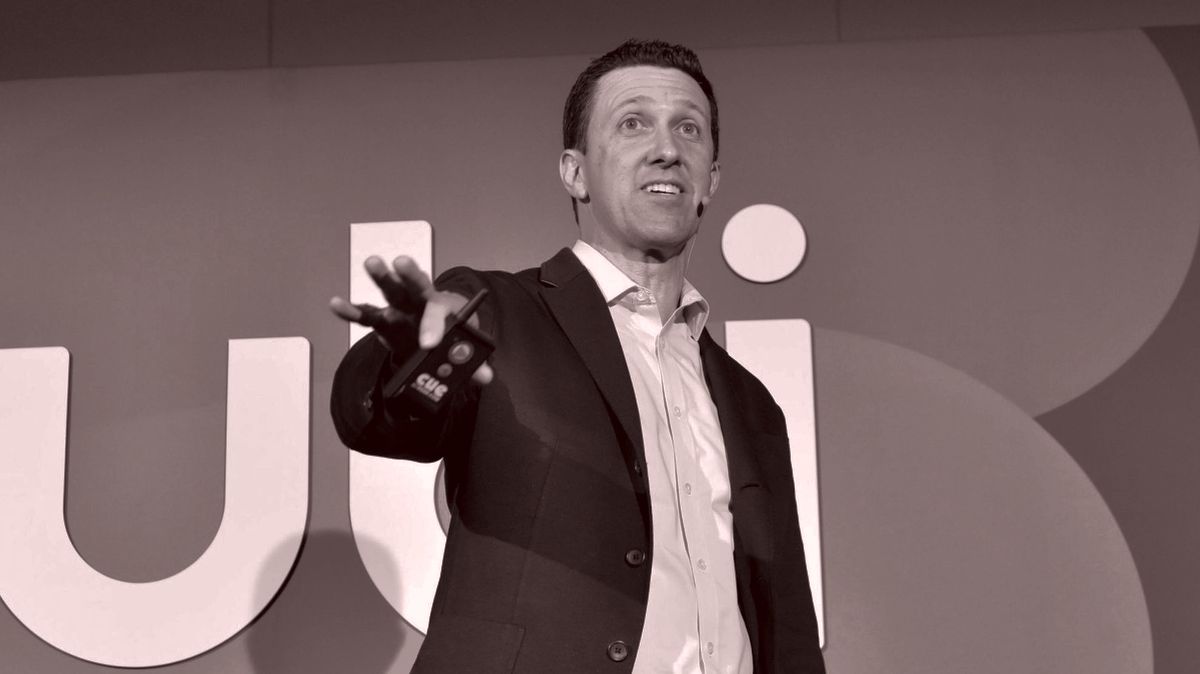
Tonight, Julia digs into YouTube’s latest trend report, reveals Netflix’s retro TV play in France, and sits down with Adam Lewinson, chief content officer at Tubi, to discuss its recent milestone and how free ad-supported streamers are taking advantage of the shocking fact that people like getting stuff for free.
|
|
|
|
A MESSAGE FROM OUR SPONSOR
|
|
|
 |
Julia Alexander |
|
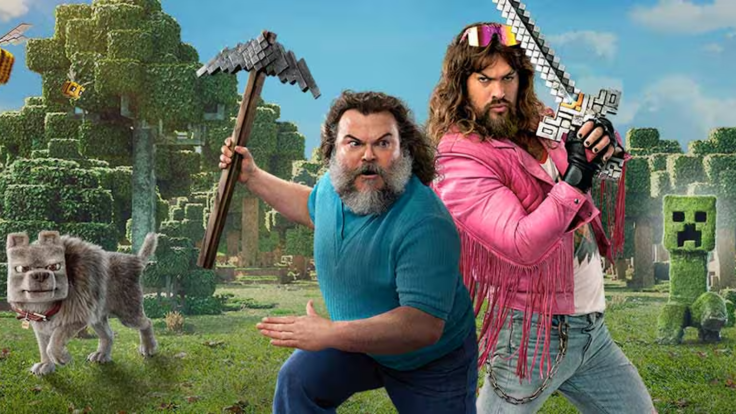
- YouTube’s reign of terror: The celebratory “20th anniversary” edition of YouTube’s trends report should do nothing to reduce heartburn among the film and television executives still coming to terms with its dominance. Among the vertigo-inducing statistics: Videos related to Minecraft, which is having a bit of a cultural resurgence thanks to Jack Black’s film adaptation, have now surpassed 2 trillion total views on YouTube, making Minecraft the most-watched topic of all time.The growth curve for Minecraft videos was literally exponential. It took about a decade, between 2011 and 2021, for them to surpass 1 trillion views, but less than half that time to grow by another trillion, according to YouTube. No surprise there: YouTube has always been a gaming-centric platform. Sixty percent of its 1,000 most-watched channels have uploaded at least one gaming video, per the company. Even Jimmy “MrBeast” Donaldson got his start with gaming videos before pivoting to Fear Factor–esque stunts, such as paying people to sit in a tub of snakes and burying himself alive.
- Another YouTube bombshell: The report also underscored how YouTube’s biggest strength isn’t the MrBeasts or Cocomelons of the world—it’s the niche channels that pull in merely tens of thousands of views and are hyper-targeted toward the most specific interests. (According to YouTube, the combined view count of all videos with less than 100,000 views exceeds the combined view count of videos with more than 100 million views, simply because there are so many more of the former.) Not only do these videos keep more than 2 billion people engaged each month—YouTube now represents one-eighth of all streaming activity on TV sets in the U.S., per Nielsen—but they also add to YouTube’s overall advertising revenue. Also, unlike other streaming competitors, YouTube pays zilch for these videos.Smaller, niche channels won’t replace the audience that MrBeast or Hot Ones deliver, but they also won’t run off and partner with Netflix, Hulu, or Prime Video. These creator hubs are arguably more committed to YouTube because it’s their only publishing avenue. It isn’t difficult to see a world in which YouTube represents the vast majority of passive viewing, while the premium streamers lean into the type of irreplaceable, hard-to-replicate, big I.P. titles that act as their sole differentiator. Actually, we’re sort of careening toward that reality at warp speed.
- Netflix is becoming TV… in France: Netflix has spent the past few years finding entry points into the very businesses it’s been disrupting for a decade. Advertising is one example. Here’s another: Netflix’s new partnership with France’s TF1 Group will bring broadcast content and linear channels to Netflix subscribers in France.TF1 Group’s channels give Netflix the upper hand as a central hub for all TV viewing in France. Big, premium originals that audiences associate with Netflix, like Wednesday or Stranger Things, now sit in the same one-stop shop as traditional broadcast shows like The Voice. Instead of securing licensing deals for individual shows, Netflix in France can bring in the entire offering as part of an add-on experience. Subscriptions will continue to stall as saturation is hit, but overall engagement and ad revenue have plenty of room to grow.
Interestingly, Netflix reportedly won’t control the ad sales for TF1 content on the platform, though I presume it’s getting a cut, as advertisers look to reach the streamer’s younger audience. (Netflix declined to reveal the deal terms.) Everyone wants to know whether this type of arrangement will eventually come to the U.S. It certainly seems unlikely at the moment, since ABC, CBS, and NBC all have streaming partners that rely on access to broadcast content. That said, France has always been an experimental ground for Netflix’s ambitions.
|
|
|
|
And now, on to the main event…
|
|
|
|
A wide-ranging chat with Tubi content chief Adam Lewinson about the spectacular growth of free ad-supported streaming, how Tubi got the Super Bowl, and the surprising breakout success of Sidelined.
|
|
|
|
The entertainment industry recently crossed a monumental threshold: As of last month, according to Nielsen data, the total monthly share of streaming-service viewing on televisions surpassed those of broadcast and cable viewing combined. YouTube, of course, is the fastest-growing platform, but one of the most compelling, and less covered, narratives is the rapid growth of free streamers.
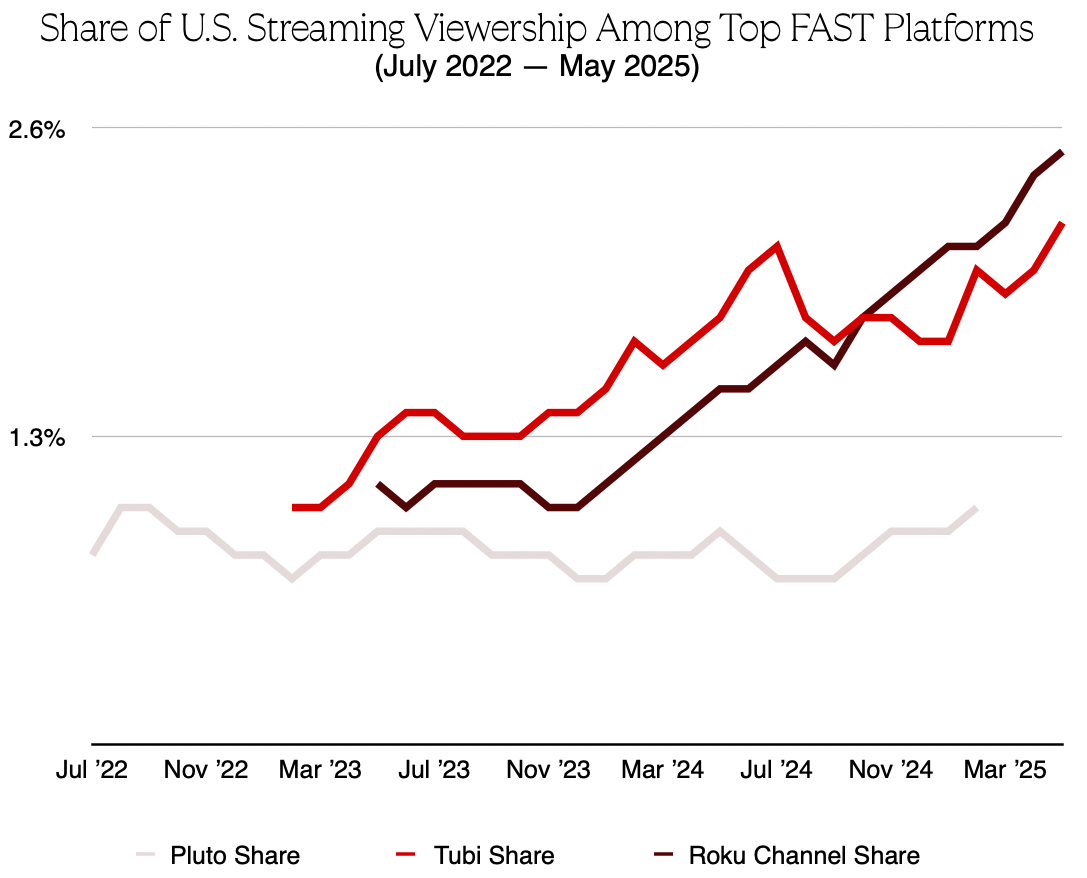
Free, ad-supported TV (FAST) platforms like Pluto TV, The Roku Channel, and Tubi are gaining market share. In May 2023, those three services made up 3.1 percent of all TV streaming in the U.S. By last month, that number had jumped to an estimated 5.7 percent. (Add in YouTube, and free TV streaming jumps to 18.2 percent.) Meanwhile, Netflix’s share of total TV viewing has declined somewhat, and the other premium streamers’ shares have mostly plateaued. That’s not particularly surprising: Free TV and movies are, well, free, which certainly lowers the barrier to customer acquisition.
But among the FAST players, Tubi is particularly interesting. Launched in 2014 and acquired by Fox Corporation in 2020, the service just passed 100 million monthly active users. Over the past decade, it’s launched more than 400 originals across film and TV alongside a library of old-school TV shows and films. That combination of more than 275,000 movies and TV episodes has helped Tubi steadily grow its share of total monthly TV-viewing minutes from 1.7 percent to 2.2 percent in the past year alone—a faster rate of growth than Netflix, Prime Video, or Disney streaming—as more people flock to FAST options. It also helps that Tubi streamed the Super Bowl this year—the first time the game was available for free on a streamer. The partnership, which was facilitated by Fox’s rights to the game, drove an additional 13.6 million views, helping to make it the most-watched Super Bowl ever.
|
|
|
|
A MESSAGE FROM OUR SPONSOR
|
|
|
|
For a long time, Tubi was Fox’s only streaming plan. Similar to Sony, Fox stayed out of the streaming game over the past several years. Instead of spending billions of dollars to potentially build the next Netflix, the company acquired Tubi for $440 million in cash in 2020, and grew its video-on-demand business by focusing on different communities (like Black audiences and horror fans), as well as Gen Z. Tubi still isn’t profitable, but the business is expected to surpass $1 billion in revenue this fiscal year. As C.E.O. Lachlan Murdoch gears up to launch Fox One, his company’s forthcoming sports and news streamer, the future of Tubi’s role within the Fox empire has become a much more relevant question.
I recently sat down with Tubi’s chief content officer, Adam Lewinson, to dig into the D.N.A. of Tubi’s success, its challenges, and the eternal, looming shadow of YouTube. We discussed all of this and more, including the era of “personalized TV,” working with creators, and why he put James Van Der Beek in a movie. The following has been lightly edited for length and clarity.
|
The Future Is Free… and Niche
|
|
Julia Alexander: You’ve discussed how we’re moving past peak TV and entering the era of niche TV. What’s your thesis?
Adam Lewinson: Our culture is no longer a monoculture. Unless it’s live sports, everything is fractionalized. You have to laser focus on personalization and making sure the viewers are watching what’s really, actually, relevant to them. I was at FX for a decade, and I learned first-hand from John Landgraf—the C.E.O. who popularized the concept of peak TV—that there was a sense of “just too much” as SVOD was building, and that the bubble burst was coming. It certainly had an economic impact on our business, but viewers reacted to peak TV, too. There are obviously still some big, outsize hit shows, but it really is more niche overall. People are watching what’s within their own fandom.
How do you balance delivering this type of niche, personalized content and broader general entertainment?
“Niche,” to some, has this [connotation] of small. Certainly for Tubi, we’ve had pieces of content that speak to a more narrow audience, but they’re still massive successes within those fandoms. That’s the opposite of niche. We’ve gone from the era of peak TV to the era of personalized TV.
|
|
If you think about YouTube, they have nearly endless user-generated content—for free. If you look at the other major player, Netflix, it’s premium entertainment behind the paywall. Where we see Tubi’s space in this ecosystem is somewhere in between: Tubi is the home of free, premium entertainment. What you’ve been seeing in the trends is free TV having a moment, which is kind of funny, because the history of television is mostly free, right? The pay tier makes up maybe 10 to 15 percent of the ecosystem. Things are rightsizing.
Part of the conversation around niche in the video space is now focused on podcasts. Do you look at some of these longer-form video podcasts and think, There’s an overlap that we can pursue for our audience?
We’re not focused on podcasts at the moment. But having said that, our company, Fox, acquired Red Seat Ventures, which is a podcast company. [It sits within the Tubi Media Group.] They do a lot of video podcasts, and it is an interesting space. If you see us going down that road, it would similarly be at that intersection of video podcasts and traditional talk shows. There’s a middle ground there that’s very interesting.
|
|
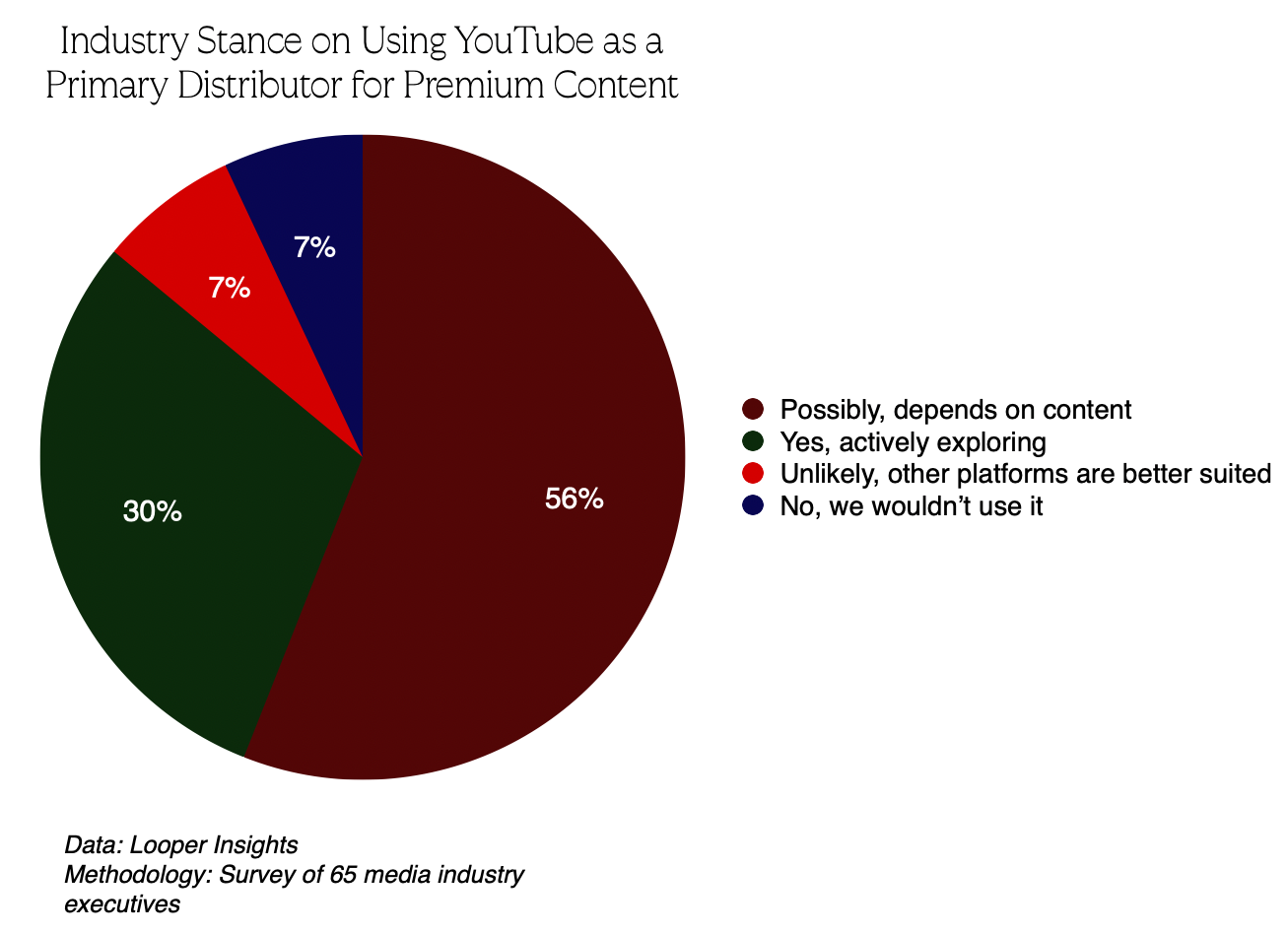
Everyone is trying to figure out their YouTube strategy. You guys are leaning into the U.G.C. space with your “Stubios” initiative, which is one way for popular creators from YouTube, TikTok, and elsewhere to find an audience on Tubi. Where’s the balance between working with creators in this kind of premium space versus leaning into the audience already on YouTube?
We’re working with a lot of creators these days. We use Noah Beck—star of Tubi’s Sidelined, which is the platform’s most-watched title ever—as an example. A moment from the movie went viral on TikTok, which is Beck’s primary platform. That kind of engagement creates an exponential effect. That tells you a lot about our creative strategy. We’re not in short form; we’re not in U.G.C. We’re not looking to just replicate what others are doing on YouTube.
But is working with Tubi a real differentiator, or is it just an attempt to claw back some of the attention away from the YouTubes and TikToks of the world?
As a programmer, you always have to understand your platform. You have to understand your audience, and know really well what your audience wants to watch and what they don’t. There is an intersection between the creator economy and Hollywood, and we’re investing in it heavily. We announced another movie with Chase Hudson—who’s a similarly huge creator on TikTok—which starts filming very, very soon. We’re going to continue to do those types of things, which I think is very different from what people are doing on
YouTube.
What sometimes gets lost in translation when we talk about YouTube is not so much the platform, but the increasingly difficult fight for tinier slivers of attention. Once you’ve captured some of that attention, the next challenge is converting that curious viewer into a habitual viewer. We know how YouTube does it—by leaning into your every obsession, and serving up video after video. How does Tubi convert those curious viewers?
There’s an old-school programming technique from the days of linear: scheduling. We still schedule a lot, but it’s very different. It’s not about what someone will watch at 8 o’clock. It’s understanding the cadence of how often a viewer in a particular demographic or a particular fandom is looking for something new, and understanding how best to serve them the next title after that one. With our originals, what we found is it’s a great way to bring in new viewers, but also to retarget viewers and bring them back into
our ecosystem.
A big part of the programming strategy at Tubi is understanding that you’re optimizing for engagement. If a viewer isn’t watching content on Tubi, they’re not watching ads, and we’re not making money, right? If I’m in an SVOD, I’m really more focused on churning, and that’s a very different way to approach programming. If people don’t churn, even if they’re not watching, you’re still making money, that’s fine. We always have to focus on hyper-engagement.
|
Tubi’s Future: Bigger Movies and Sports
|
|
Sidelined was a breakout success that, bluntly, I don’t think a lot of people were expecting from Tubi. What surprised you about the success of that movie, and what was something that didn’t necessarily work that you’re taking into account for the next big movie you do?
I’ve done a few things over time with creators, putting them into longform content—before Sidelined, it was not always successful. You do it because you want their audience to come over with you, and sometimes they do and sometimes they don’t. Any piece of original content is going to be risky, but creators add an extra layer sometimes.
I did add James Van Der Beek to play Noah’s dad. I did that because, well, if Noah doesn’t bring the audience, I know Dawson will. The audience he brings in may be older, but that’s fine. Turns out they both brought their audiences. We had millions of Gen Z women watching that movie, and we had their moms—maybe even some of their grandmas.
|
|
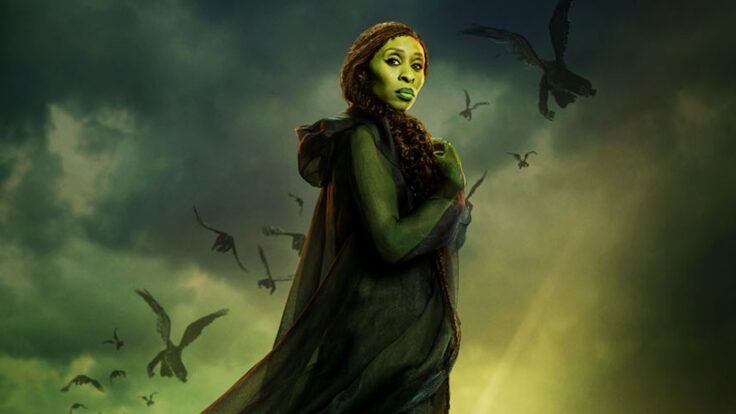
When we were doing Sidelined, a lot of people came to me and said, “Well, you know, Gen Z doesn’t watch movies. They don’t watch longform.” I understand the conventional wisdom is that young people have no attention span. Well, let’s take a look at the evidence. You can look at Wicked, where young adults did go to the theaters, and then they watched it again on streaming. Certainly we’ve proven that if you have the right content, Gen Z wants to watch longform. They crave longer-form experiences. You just have to build it in a way that’s relevant to them.
Speaking of Gen Z attention spans, we know they’re at least watching a lot of football. Nearly 70 percent of Gen Z point to the NFL as their favorite league, per the league’s own data. Tubi broadcast a very successful Super Bowl. It’s one of the benefits that comes from working under Fox. Lachlan is gearing up to launch his own streaming service, but are there any more plans for sports down the line on Tubi?
We’ll see what the future brings. In Mexico, we do have live sports on Tubi. We’ve got the Premier League, we’ve got La Liga. Obviously that’s proven to be really tremendous engagement. I’ll say we work very closely with Fox Sports and its C.E.O., Eric Shanks. We always look for opportunities to promote each other, so we’ll see what happens.
|
|
Thanks Julia. I’ll see everyone tomorrow.
Matt
|
|
|
|
Puck founding partner Matt Belloni takes you inside the business of Hollywood, using exclusive reporting and insight to explain the backstories on everything from Marvel movies to the streaming wars.
|
|
|
|
A professional-grade rundown on the business of sports from John Ourand, the industry’s preeminent journalist, covering the leagues, players, agencies, media deals, and the egos fueling it all.
|
|
|
Need help? Review our FAQ page or contact us for assistance. For brand partnerships, email ads@puck.news.
You received this email because you signed up to receive emails from Puck, or as part of your Puck account associated with . To stop receiving this newsletter and/or manage all your email preferences, click here.
|
|
Puck is published by Heat Media LLC. 107 Greenwich St, New York, NY 10006
|
|
|
|