Every year, awards contenders and pretenders have been mounting unbridled and financially unchecked press campaigns in the hopes of boosting their chances. A new data analysis reveals that they maybe shouldn’t have bothered.
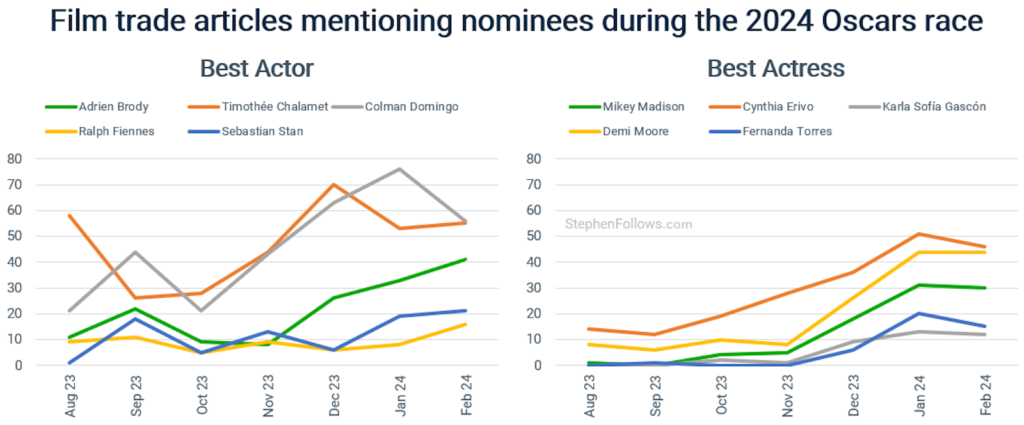
In last year’s race, the most intense month of coverage for all five lead actress nominees (Cynthia Erivo (pictured), Karla Sofía Gascón, Mikey Madison, Demi Moore, Fernanda Torres) was January, which coincided with Phase One voting and the eventual reveal of nominations.
Photo: Courtesy of Universal Pictures
Back when I was running The Hollywood Reporter, it never ceased to amaze me how downright available stars and filmmakers became this time of year. Leo DiCaprio, Ben Affleck, Jennifer Lawrence… actors whose P.R. teams wouldn’t allow us within smelling distance during most of the year were suddenly clamoring for covers and roundtable slots or, if their race was tight, any coverage, really. “What can we do?” was not an infrequent question.
That’s despite the fact that we were never able to prove that the attention we offered was actually meaningful to their campaigns. Awards media blitzes have been a thing in Hollywood since even before Harvey Weinstein was bringing stars to L.A. for “the season” back in the ’90s. And the goal remains to create “buzz” that convinces the various voting bodies to a) watch your movie, b) talk about your movie, and c) vote for your movie. But THR’s website traffic suggested that, with rare exceptions, the awards coverage during Oscar and especially Emmy season generated relatively little reader interest. Still, it was simply accepted by the various awards consultants and campaigners that more interviews led to being “in the conversation,” and in turn, a better shot at earning a coveted award. Hence the firehose of awards media during “Phase One” of the campaigns, when everyone and their publicist thinks they’re a contender. You almost feel bad for people like the typically media-shy Ryan Coogler, who sat for a Times piece this week as part of the Sinners campaign, or DiCaprio, who always looks like he’d rather be mining coal or socializing with a woman over 30 than doing press.
So let’s ask the question: Is there a correlation between the volume of media coverage and who ultimately wins awards? In short, does more press equal a better shot at an Oscar?
To explore it, I asked researcher Stephen Follows, who was recently on The Towndiscussing whether standing ovations at film festivals lead to better outcomes for movies, to evaluate every acting and directing nominee from 2010 to 2024 and map how often each was mentioned in the press during the six months leading to the Oscars. As a trackable indicator of all media coverage, Follows used the Penske trades (Variety, THR, Deadline), plus London-based Screen International, to capture the international angle. By comparing the nominee’s share of coverage with eventual outcomes, we can attempt to gauge how much that coverage matters. Yes, this might be the most important research project ever undertaken.
The Actors
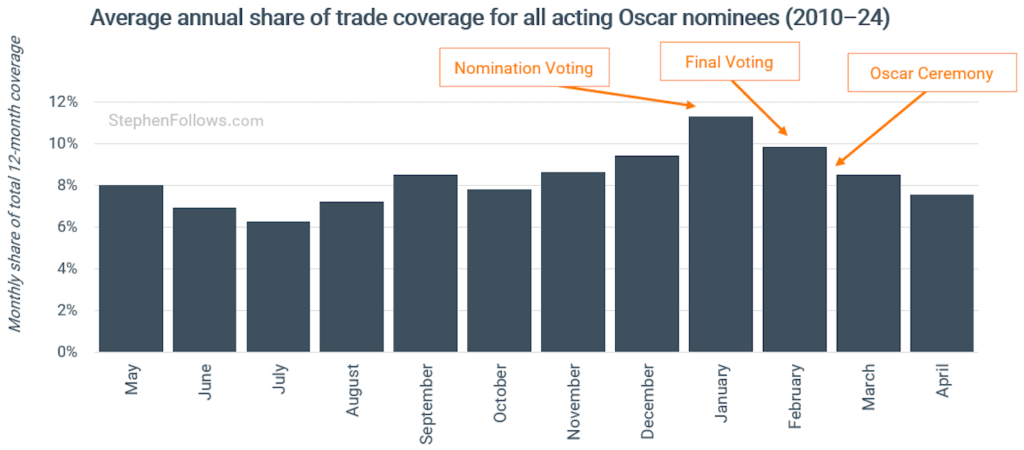
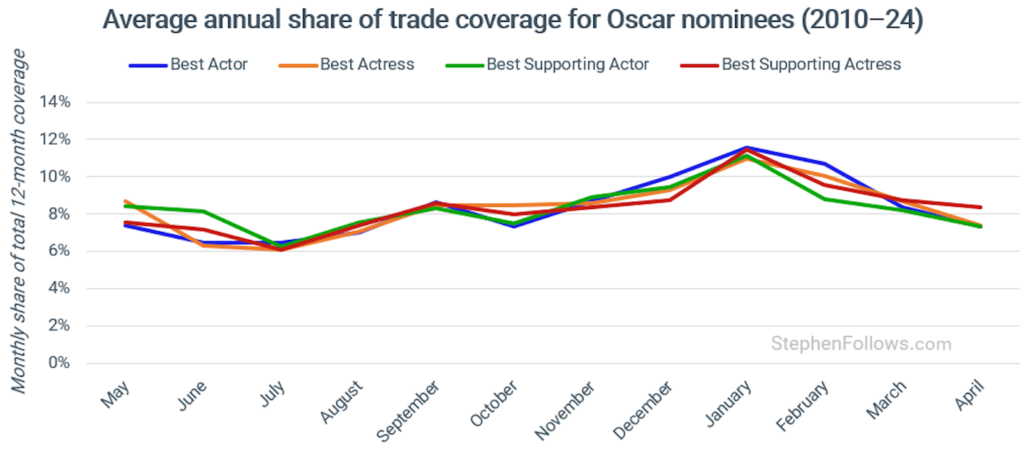
The monthly stats on coverage of each nominee reveal a strong uptick as the ceremony nears, of course. In last year’s race, the most intense month of coverage for all five lead actress nominees (Cynthia Erivo, Karla Sofía Gascón, Mikey Madison, Demi Moore, Fernanda Torres) was January, which coincided with Phase One voting and the eventual reveal of nominations. For lead actors, three generated the most coverage in February (Adrien Brody, Ralph Fiennes, Sebastian Stan), which matches the Phase Two voting for winners; one got the most in January (Colman Domingo); and one in the preceding December (Timothée Chalamet). This pattern repeats each year and is consistent across all four acting categories.
So nominees do more press when it matters to voters—great. We kinda knew that. But is there a useful link between the coverage and outcome?
According to Follows, there are two questions to ask:
1. How often is the most-covered nominee the eventual winner?
Almost never. Over the 15 years, across all four acting categories, it happened just 8.3 percent of the time.
Best Actor: 0 out of 15.
Best Actress: 1 out of 15 (Natalie Portman, 2010)
Supporting Actor: 2 out of 15 (Ke Huy Quan, 2022, and Kieran Culkin, 2024)
Supporting Actress: 2 out of 15 (Anne Hathaway, 2012, and Jamie Lee Curtis, 2022)
So no, we can’t use media coverage to predict winners. For much of last year’s campaign, for instance, Brody did almost no trade press and still won. Same with Frances McDormand during the 2017 season. So maybe the awards consultants should pump the brakes on pitching every possible media interview.
2. Does the eventual winner get a disproportionate amount of coverage in the lead-up to the awards?
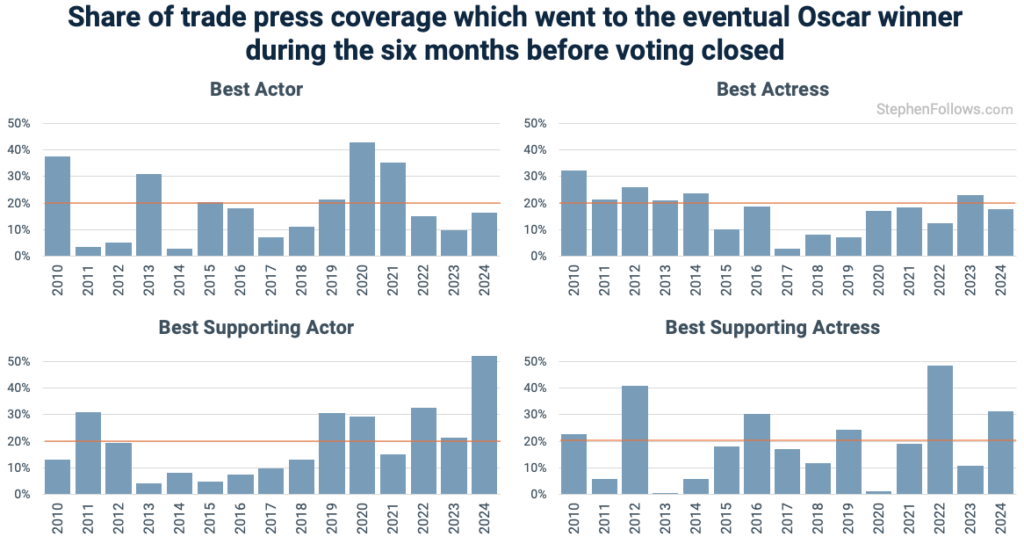
Also no. All things being equal, each nominee should receive 20 percent of all mentions in a five-person field, right? That’s almost never the case, but across all acting nominations, the winners accounted for just shy of their expected share, 18.6 percent of the coverage.
Anthony Hopkins (The Father) dominated the 2020 coverage, as did Will Smith (King Richard) the following year. (No, this study did not track coverage of contenders after their win, which I’m betting would favor Smith, uh, significantly.) Also, congrats to Culkin for crushing more than half of the media mentions during last year’s campaign for A Real Pain, and Curtis for nearly matching him in the 2022 season for Everything Everywhere All at Once. But those are outliers. Gary Oldman (Darkest Hour) won for the 2017 season with less than 10 percent of the coverage. Eddie Redmayne (The Theory of Everything) won the 2014 prize with even less media attention.
The Directors
The correlation for best director is even weaker. The winner generates an average of 15.3 percent of the trade media mentions—way under the 20 percent mark if coverage were evenly distributed. Only twice did the buzziest director go on to win the award—Alejandro G. Iñárritu (The Revenant) in 2015 and Sean Baker (Anora) in 2024. In every other year, the nominee who dominated the coverage did not win.
Clearly that’s because the most coverage is usually given to the most famous filmmakers. Whenever the field of nominees includes a Nolan, a Spielberg, a Scorsese, etcetera, they will generate the greatest amount of coverage. (Though interestingly, Nolan did not spur the most press when he won in the 2023 season.) Put simply, the effect of being an Oscar nominee is not enough to overcome the normal power dynamics of the industry.
Is All Press Worthless?
So, does this mean that doing a mountain of press won’t actually help you win an Oscar? Not necessarily. There’s no evidence suggesting a media blitz hurts a contender’s chances. This study also doesn’t parse the kind of coverage, meaning a general awards season interview with a Penske trade might carry far less influence than a Vogue cover, or something like DiCaprio participating in a Time “Entertainer of the Year” feature that gets picked up everywhere. It also doesn’t account for the messaging of the various campaigns. (Chalamet, currently campaigning for Marty Supreme, might consider shutting up about his “top-level shit” performances over the past “seven or eight years.”) Last year’s Gascón scandal over her racist and Islamophobic social media posts generated a lot of coverage but decidedly did not help her campaign.
But Follows is comfortable saying there is no strong evidence that nominees should seek every media opportunity they can, purely in an attempt to increase their chances of winning. “It’s possible that added coverage has a more subtle effect (raising awareness, sustaining momentum, etcetera) but it’s not evident in the data alone,” he told me. So the lesson for Oscar contenders and the teams that guide their campaigns is pretty simple: Do press if you want, but press alone is not gonna win you that Oscar.
Didn't get an email? Check your spam folder and confirm the spelling of your email, and try again. If you continue to have trouble, reach out to fritz@puck.news.
Didn't get an email? Check your spam folder and confirm the spelling of your email, and try again. If you continue to have trouble, reach out to fritz@puck.news.
Member Exclusive
Get access to this story
Create a free account to preview Puck’s full offering, including exclusive articles, private emails from authors, and more.