{{ 'now' | timezone: 'America/New_York' | date: '%b %d, %Y' }}
|
|
|
Welcome back to What I’m Hearing+. If you’re like me and you subscribe to both Hulu and
Disney+, you’ve likely noticed that the two app interfaces look increasingly similar. By the end of 2025, Hulu will be fully integrated into D+, a move that I first predicted early last year and that Disney now believes will benefit both services. Will it? Julia Alexander, our streaming video analyst, is here today to discuss. All yours, Julia…
Mentioned in this issue: Eddy Cue, Vince Gilligan, Jason Segel,
Brad Pitt, Phillip Schindler, Alisa Bowen, Bob Iger, Dana Walden, and many more…
|
|
|
A MESSAGE FROM OUR SPONSOR
|
|
|
 |
Julia Alexander |
|
- Apple dodges again
on Apple TV viewers: As someone who spends more time than I’d like trying to glean any meaning from press releases touting vague viewership records, this latest one from Apple caught my eye. Did you know that Apple “eclipsed” all past “viewership records” in December? It’d make sense if you missed it, buried in a letter from Eddy Cue, the company’s head of services, boasting about a record-breaking 2025 across much of his division. Fantastic news, Eddy! But what exactly
were those viewership records? As usual, Apple won’t say, and Cue’s letter didn’t offer any real sense of how much time TV subscribers spent with critically acclaimed shows like Vince Gilligan’s Pluribus and Jason Segel’s Shrinking, or movies like Brad Pitt’s F1. Nor did he point to any meaningful third-party data.Maybe that’s because there isn’t much to boast about: In six years, Apple has never exceeded
1 percent of total TV viewing time in the U.S., per Nielsen’s Gauge report. And Cue has never shared subscriber numbers—though he told Matt on The Town in October that Apple has “significantly more” than 45 million worldwide. It is true that more of Cue’s shows are appearing on Nielsen’s top 10 list in the U.S., even
if the service still trails all of its competitors…
- Shortform comes for the TV: Blame TikTok or last year’s Adderall shortage, but shortform video is taking over the world. Last year, videos less than a minute in length accounted for close to 80 percent of global YouTube views, according to new data from Tubular Labs. (Caveat that if someone watches a Short for even one second, it counts as a view, which isn’t the case for, uh, non-Shorts.) The
platform has been trending this way for some time: Views for videos under one minute nearly doubled, from 24.5 trillion in 2023 to 41.5 trillion in 2025, and views for videos longer than 20 minutes fell from 7 percent of total views in 2023 to just 4 percent last year.Hollywood should be paying attention. Philipp Schindler, Google’s chief business officer, said last February that 15 percent of YouTube Shorts viewing happens on TV sets, and that revenue per hour watched
had already surpassed that from longform videos. Each new report showing YouTube’s dominance in any format—longform video, Shorts, podcasts—is enough to spur legacy media companies into action. Just last week at CES, Disney doubled down on its plans to add a shortform, vertical feed to Disney+ in an attempt to capture any of that potential attention lost to YouTube. It’s not exactly the most compelling move, and I have sincere doubts that it’ll take off, but at least Bob Iger
and Disney+ president Alisa Bowen are trying something.
|
|
|
Now on to the main event…
|
|
|
The long-ordained integration of Disney’s two streaming services is being heralded
inside Burbank as a transformational moment for both. But will the merged platform really be more than the sum of its parts?
|
|
|
Six years after Disney gained operational control over Hulu—and about six months after taking full
ownership of the asset—C.E.O. Bob Iger is finally bringing their two streamers together. Sometime this year, all of the content on Hulu will be fully integrated into Disney+, even if the stand-alone Hulu app isn’t retired immediately.
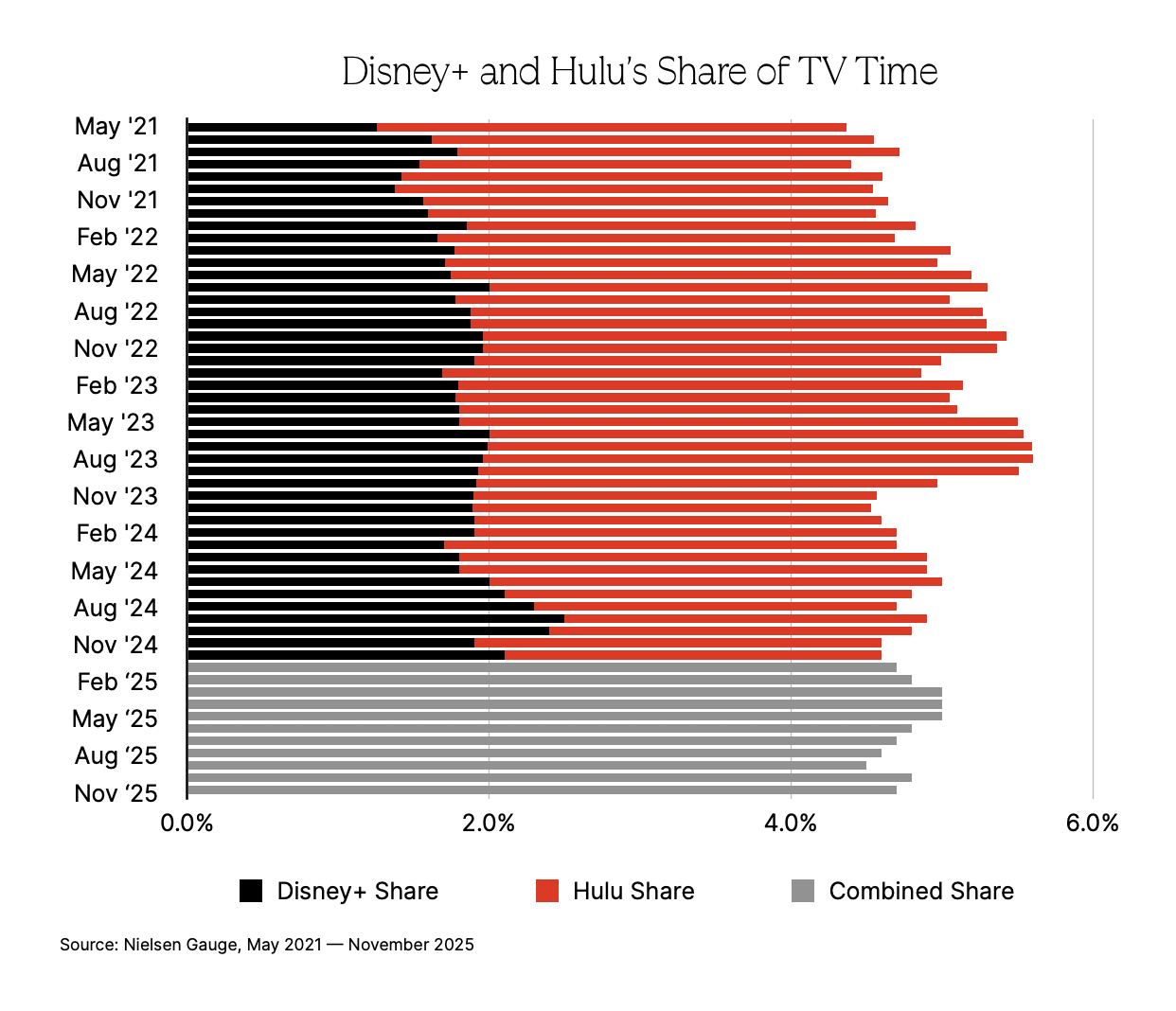
The challenges that the merger will attempt to address are fairly well known. Disney+ and Hulu’s combined share of U.S. TV viewing time has been stuck below 5 percent since November 2023, according to Nielsen Gauge. And while Hulu shows have
begun appearing more frequently in Nielsen’s weekly top 10 over the past five years, Disney+ shows have receded. Meanwhile, Hulu added more than 10 million subscribers in the U.S. and Canada between Q4 2024 and Q4 2025 while Disney only grew by about 4 million. Fully unleashing their synergies, and bringing together their combined 120 million or so U.S.
subscribers, would ostensibly create a legit contender to Netflix—or at least a viably competitive product.
But will folding Hulu content into the Disney+ app be accretive, or merely additive? Right now, bundle customers can access a Hulu title through the Disney+ app; those without a Hulu subscription can explore the content inside D+ but will encounter an upsell message when trying to click on a Hulu show or movie. Once the apps are combined, customers can
still choose to have only Disney+ or only Hulu, but there’s been no announcement yet about how one combined app may change the discovery process.
Of course, the two units have been trying to make one plus one equal three for some time. Disney started putting Hulu content on Disney+ for subscribers with access to both platforms in March 2024. But the data suggests there’s still room to grow. At the moment, about 22.5 million people in the U.S. pay for both Hulu and
Disney+, according to Antenna. (Though this doesn’t include telecom or cable deals, like the one with Charter.) Based on Antenna’s estimates of each service’s subscriber base, roughly 55 percent of Hulu subscribers have Disney+ and 56.5 percent of Disney+ subscribers have Hulu. Some 77 percent of the subscribers who came in through Disney+ access Hulu through the bundle. And about 67 percent of the Hulu-first subscribers get Disney+ through their bundle.
|
Notably, the demographics of the two platforms are also relatively similar. Disney+’s audience is
51 percent male while Hulu is 54 percent female. Generationally, both Disney+’s and Hulu’s audiences are close to 50 percent Millennials, making them the two youngest-skewing major streaming platforms after Netflix, according to Parrot Analytics. (Disclosure: I previously worked at Parrot and later at Disney.)
Disney executives may argue that the roughly 45 percent of Disney+ and Hulu’s respective subscriber bases that do not subscribe to the sister service, per Antenna’s findings,
may simply be unaware of what’s available on the other platform. Indeed, both Disney+ and Hulu saw a large drop in consumer awareness of which titles streamed on each platform between 2024 and 2025, according to Hub Entertainment Research—dropping 6 percentage points and 5 percentage points, respectively. And while merging into one app could help, putting those titles all in one place doesn’t necessarily mean that audiences are going to spend more time streaming them.
|
|
|
A MESSAGE FROM OUR SPONSOR
|
|
|
In fact, despite the similar demographics, the respective services seem to have divergent
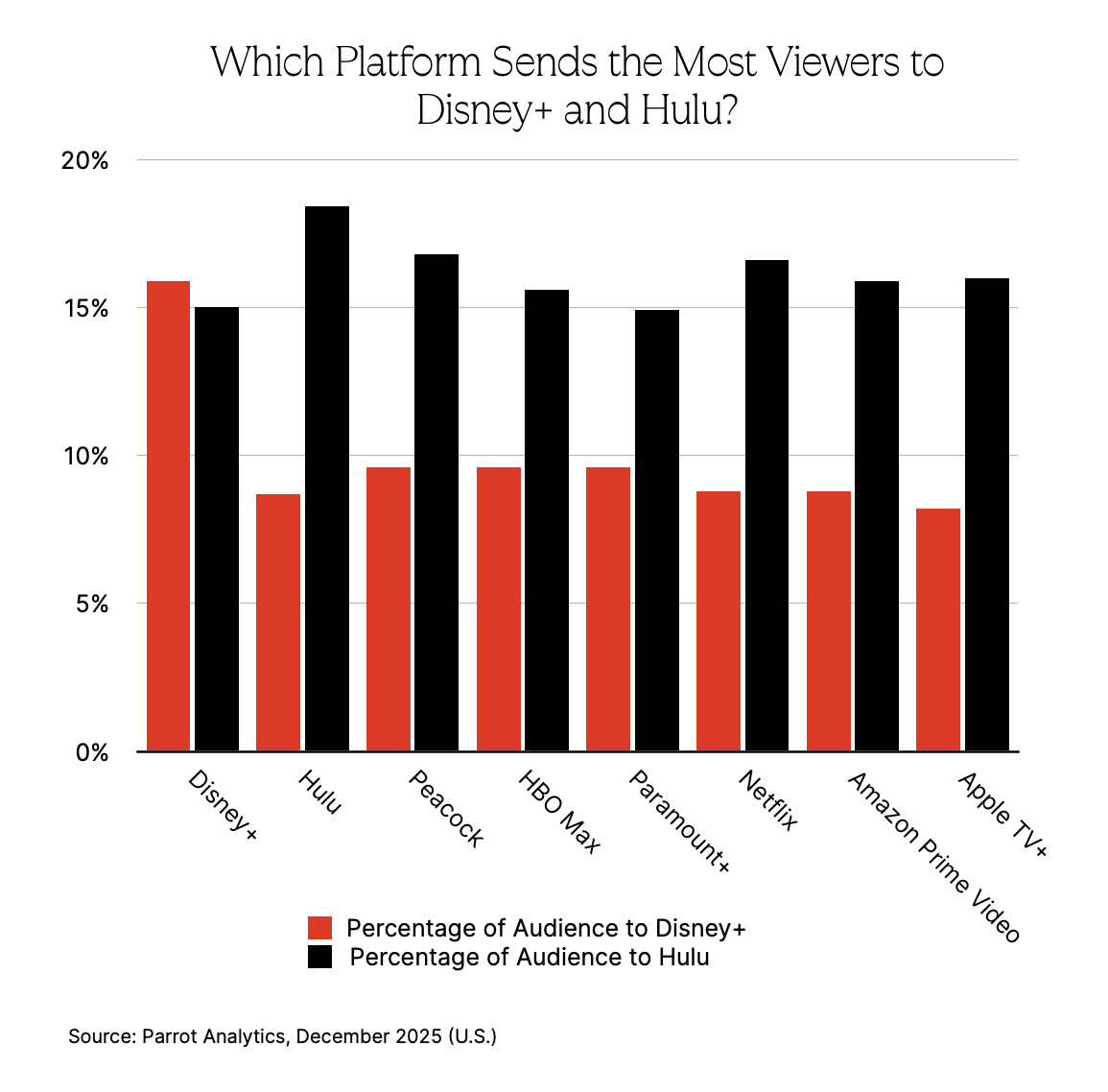
audiences. According to Parrot Analytics, which uses peer-to-peer data to track where viewers go after finishing a TV show or movie, Hulu actually sends the second-lowest percentage of viewers to Disney+ after they finish watching a title on the service. Those findings match similar results from Antenna, which found that, among all Disney+ viewers who watched any title on the service in November, very few of them stuck around for a Hulu show—some 4 percent also watched The Secret Lives of Mormon Wives and 3 percent streamed Only Murders in the Building.
For what it’s worth, that’s not unprecedented. Analysts I spoke to noted that Showtime didn’t drive substantial activity to Paramount+, either, while Discovery arguably diminished HBO’s prestige. Similarly, platforms with the highest level of audience affinity for Disney+ came from outside of the company’s ecosystem, too.
|
Peter Supino, the Wolfe Research analyst, has echoed many of these same concerns.
“We see limited scope for acceleration of Disney’s DTC sales growth,” he wrote in a recent note. “The recovery of theaters seen in 2024-25 didn’t drive much sub growth [for titles coming to the platform after theatrical release]. Password sharers seemed mostly unwilling to subscribe. The Hulu integration hasn’t done much. ESPN helped Hulu subs last quarter, but we expect little follow through near-term. Subs should continue to benefit from bundling and streaming’s demographic tailwinds, but we
don’t see a lot of sizzle in the outlook.”
|
Whether or not the combination is accretive—Iger claimed last August that since offering Hulu
content on Disney+, the company “saw engagement increasing”—there’s no doubt that Hulu will boost the metrics for Disney+, itself. In the first nine months of last year, Disney+ viewership dropped nearly 55 percent compared to the same period in 2022, according to Luminate, ending the quarter with just over 20.2 billion minutes streamed.
A significant part of that dropoff was tied to the dearth of new original content: More than 40 original Disney+ series premiered in 2022, but only
16 premiered in the first three quarters of 2025, according to Luminate’s calculations. On the flipside, Hulu has maintained its market share with originals like Mormon Wives and Tell Me Lies, as well as popular library content like Family Guy and Bob’s Burgers, which routinely top Nielsen’s weekly rankings. If these shows can drive incremental engagement for Disney+ among the roughly 45 percent of customers who haven’t had access to Hulu, it will be a win
for Iger’s successor.
Perhaps more importantly, Hulu content could give TV and streaming co-chiefs Dana Walden and Alan Bergman the breathing room to better manage Disney’s biggest franchises. Outside of Andor, whose finale topped Nielsen’s weekly streaming list, other originals have struggled. Daredevil: Born Again, billed as one of Disney+’s biggest shows of the year, became the first Marvel streaming show to not chart on Nielsen. The second season of
Percy Jackson is trending well behind the first, according to Luminate. If Hulu’s originals continue to perform, maybe Disney can be more thoughtful, and selective, in how it greenlights and markets its blockbuster I.P. plays.
Meanwhile, the cost savings of consolidation should be reinvested into technology that can compete with Netflix’s and YouTube’s algorithmic discovery tools—a key component of the business that Iger has talked about on virtually every recent earnings call.
Right now, it takes the average viewer close to 12 minutes to find something to watch, up from 10 minutes in mid-2023, according to Gracenote—pushing frustrated users to platforms that are better at doing the thinking for them. If Disney can successfully combine multiple content catalogues within one app experience, aided by a truly powerful discovery algorithm, perhaps it can find a way to keep its combined 123 million users from leaving the platform.
|
Thanks, Julia. I’ll see everyone tomorrow.
Matt
|
|
|
Puck founding partner Matt Belloni takes you inside the business of Hollywood, using exclusive reporting and insight
to explain the backstories on everything from Marvel movies to the streaming wars.
|
|
|
Unique and privileged insight into the private conversations taking place inside boardrooms and corner offices up and
down Wall Street, relayed by best-selling author, journalist, and former M&A senior banker William D. Cohan.
|
|
|
Need help? Review our FAQ page or contact us for assistance. For brand partnerships, email ads@puck.news.
You received this email because you signed up to receive emails from Puck, or as part of your Puck account associated with {{customer.email}}. To stop receiving this newsletter and/or manage all your email preferences, click here.
|
Puck is published by Heat Media LLC. 107 Greenwich St., New York, NY 10006
|
|
|
|