{{ 'now' | timezone: 'America/New_York' | date: '%b %d, %Y' }} |
|
|
Welcome back to a special bonus Wednesday edition of What I’m Hearing+, coming from brisk
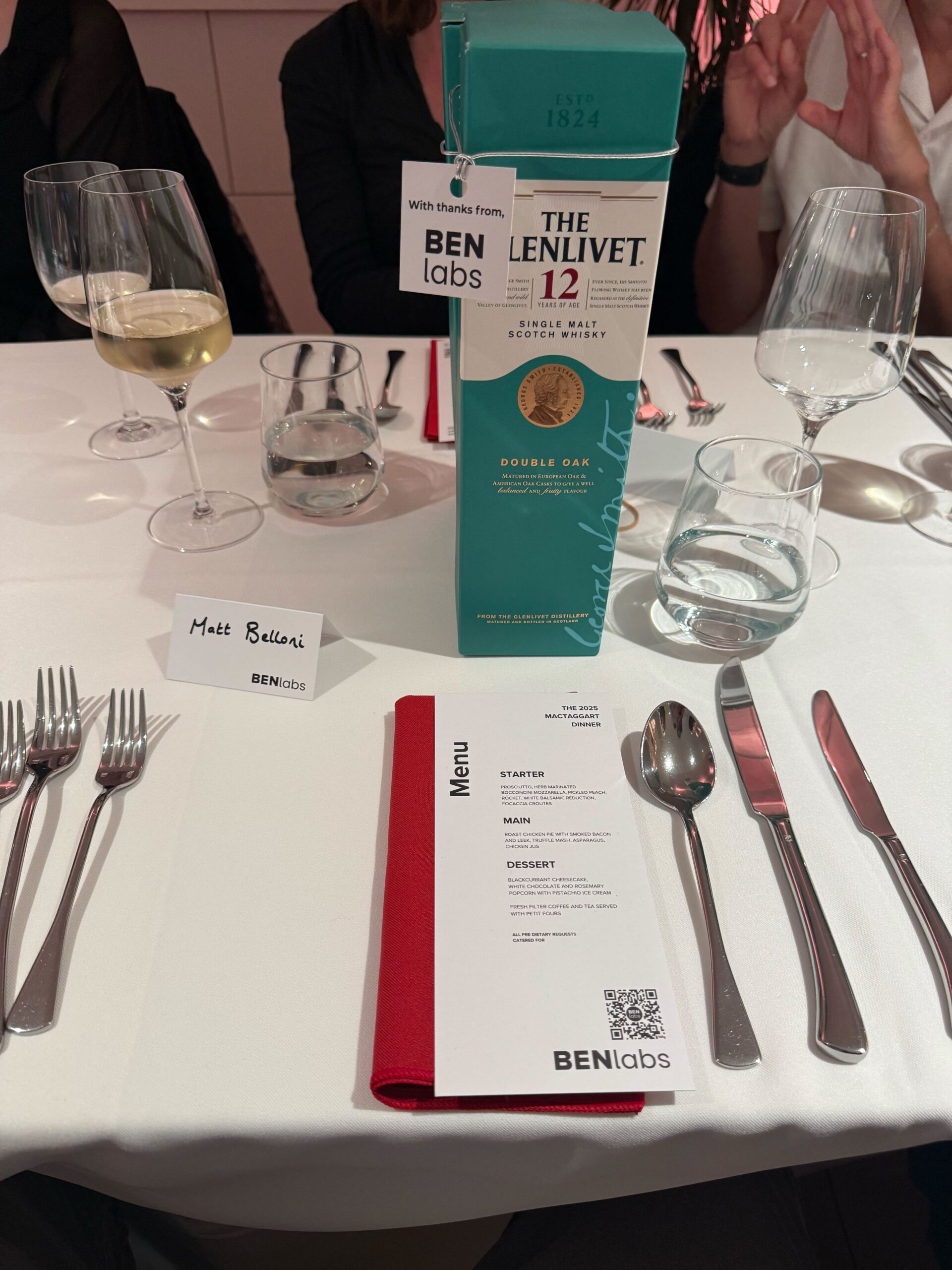
Scotland and the Edinburgh TV Festival. (Scotch count: 0, but Guinness count: 2, and I was pleased to discover that the marketing company Ben Labs, a sponsor of tonight’s annual MacTaggart Dinner at the National Museum, placed a full bottle of The Glenlivet 12 Double Oak in front of every guest’s menu card, though I couldn’t tell if Shonda
Rhimes or Richard Gadd took theirs home with them. I certainly did.)
Anyway, tonight, our streaming guru, Julia Alexander, is here with her take on those disappointing Starz subscriber numbers, whether another streamer will buy the newly separated-from-Lionsgate platform, and what C.E.O. Jeffrey Hirsch can do if they don’t. Plus some news and notes on Netflix, Tubi, YouTube, ESPN, and Fox One…
Also, Julia hosted a great
panel in WeHo last week with casting directors behind three Emmy-nominated Apple TV+ shows. Click here to read a lightly edited transcript of the conversation.
Okay, let’s get started… |
|
|
A MESSAGE FROM OUR SPONSOR |
Emmy® Nominee · Outstanding Comedy Series |
Outstanding Lead Actress In A Comedy Series · Kristen Bell Outstanding Lead
Actor In A Comedy Series · Adam Brody |
“Bell & Brody Are A Marvelous Pair.” – New York Times [WATCH] The Secret to Their Spark: Kristen Bell & Adam Brody Dive into the undeniable chemistry of Emmy® Nominees Lead Actress Kristen Bell and Lead Actor Adam Brody
as they reveal what made their on-screen pairing in NOBODY WANTS THIS so captivating. |
|
|

| Julia Alexander
|
|
Wednesday Thoughts: Streaming Edition
|
- Netflix and Tubi go YouTube
hunting: The analyst chatter last year about whether more streamers would partner with YouTube creators, following the success of Cocomelon and Ms. Rachel, appears to have been directionally correct. Netflix has announced a deal with science video YouTuber Mark Rober (north of 70 million subscribers) to create a competition game show set to be released next year and co-produced with Jimmy Kimmel’s Kimmelot. There’s some kismet
here: Rober is a former NASA engineer, and Netflix just signed a deal with the space agency to stream its live events. Meanwhile, Tubi recently announced a licensing arrangement with a number of YouTube creators (including MrBeast, Jomboy, and Steven He), bringing some 5,000 old YouTube videos to its platform.
Obviously, these are two different approaches: Netflix is testing whether YouTube creators can produce exclusive TV hits for a
subscription audience, while Tubi pursues a more traditional licensing strategy, which should provide interesting data on audience appetites for old YouTube content on TV. Let’s see if either can grab back some of the attention that YouTube has stolen. - What to know about New ESPN: Tomorrow, Jimmy Pitaro will launch ESPN’s new streaming service, which is expected to combine all of the network’s live sports with personalized analysis,
statistical overlays, ticketing and merchandising, etcetera. More importantly, and perhaps controversially, it will integrate sports betting, too.
To transform ESPN into more than just a $30-a-month alternative to watching games on cable, Pitaro wants the app to be a daily habit. Younger fans, in particular, are drifting away to other platforms: YouTube for game highlights, TikTok for commentary, FanDuel for gambling. ESPN still has the most popular app for fantasy sports, but
Pitaro needs to provide all those things in one, and own the second-screen experience too, if he wants to win. - Murdoch’s quiet win: Meanwhile, tomorrow also marks the launch of Fox One, Fox Corp’s streaming service for cord-nevers who want access to Sunday football and also maybe Greg Gutfeld. It’s strategically positioned to not steal cable subscribers… or so C.E.O. Lachlan Murdoch hopes. Of all the major
streaming launches, Fox One is debuting to the least fanfare, but don’t think of this as an example of Fox being late to the party. It’s a testament to the family’s business smarts.
Rupert sold his studio and linear networks (minus Fox, Fox News, and the ever-important sports assets) to Disney in 2019 for the outrageous sum of $71.3 billion, then found smaller ways into streaming through the cheap-to-run Fox Nation service, courting Fox’s evangelical Christian audience
with programming such as a Martin Scorsese documentary series on saints. Tubi, the free, ad-supported service that Fox acquired for less than $450 million, now accounts for 2.2 percent of all TV time in the U.S. (higher than SVODs Peacock, Apple TV+, and HBO Max) and reaches more than 150 million monthly active users, per Nielsen.
|
|
|
Now for the main attraction… |
|
|
Since getting spun out of Lionsgate in May, Starz has struggled with
high churn, low pricing power, and better-positioned competitors. Does its diverse audience still make it an acquisition target? |
|
|
So… how long can Starz last? Back in 2021, a few years after its launch as a stand-alone streaming service,
C.E.O. Jeffrey Hirsch and Lionsgate leader Jon Feltheimer predicted that Starz was on track to reach 60 million global subscribers by 2025, with more than 80 percent coming from its digital business. That turned out to be a pandemic-era fever dream. Last week, during the company’s first earnings call since being spun out of Lionsgate in May, C.F.O. Scott MacDonald announced that total subs (linear and streaming) had fallen to about 19
million—less than one-third of what Hirsch once predicted—with streaming subscribers sitting around 12.2 million, down 120,000 from last quarter. Starz barely operates outside the U.S. anymore, after past attempts at global expansion didn’t pan out.
Executives and analysts have described the decision to separate Starz and Lionsgate as a hybrid offense-defense play, giving both entities the flexibility to pursue partnerships and M&A on their own. But it certainly looks as if
Starz is more likely to be a seller than a buyer. On Thursday, Starz reported revenue of just $319.7 million in the second quarter, down nearly 7.5 percent year over year, though the company is still profitable. While leadership was optimistic about recent signups tied to Outlander prequel Blood of My Blood, subscriber retention continues to be an issue. On average, Starz is churning about 8.7 percent of its audience every month, according to Antenna research, or more than four
times the rate at Netflix. (A rep told me that churn for the service has dropped for the third consecutive quarter and improved by 40 percent over the past two years, but didn’t provide any data.)
Still, the niche Starz portfolio—which skews toward women and Black and Hispanic viewers—could make it a compelling acquisition target for larger streamers. Black audiences were 33 percent more likely to have Starz than other audiences, according to a PQ Media report last year. Starz is one of
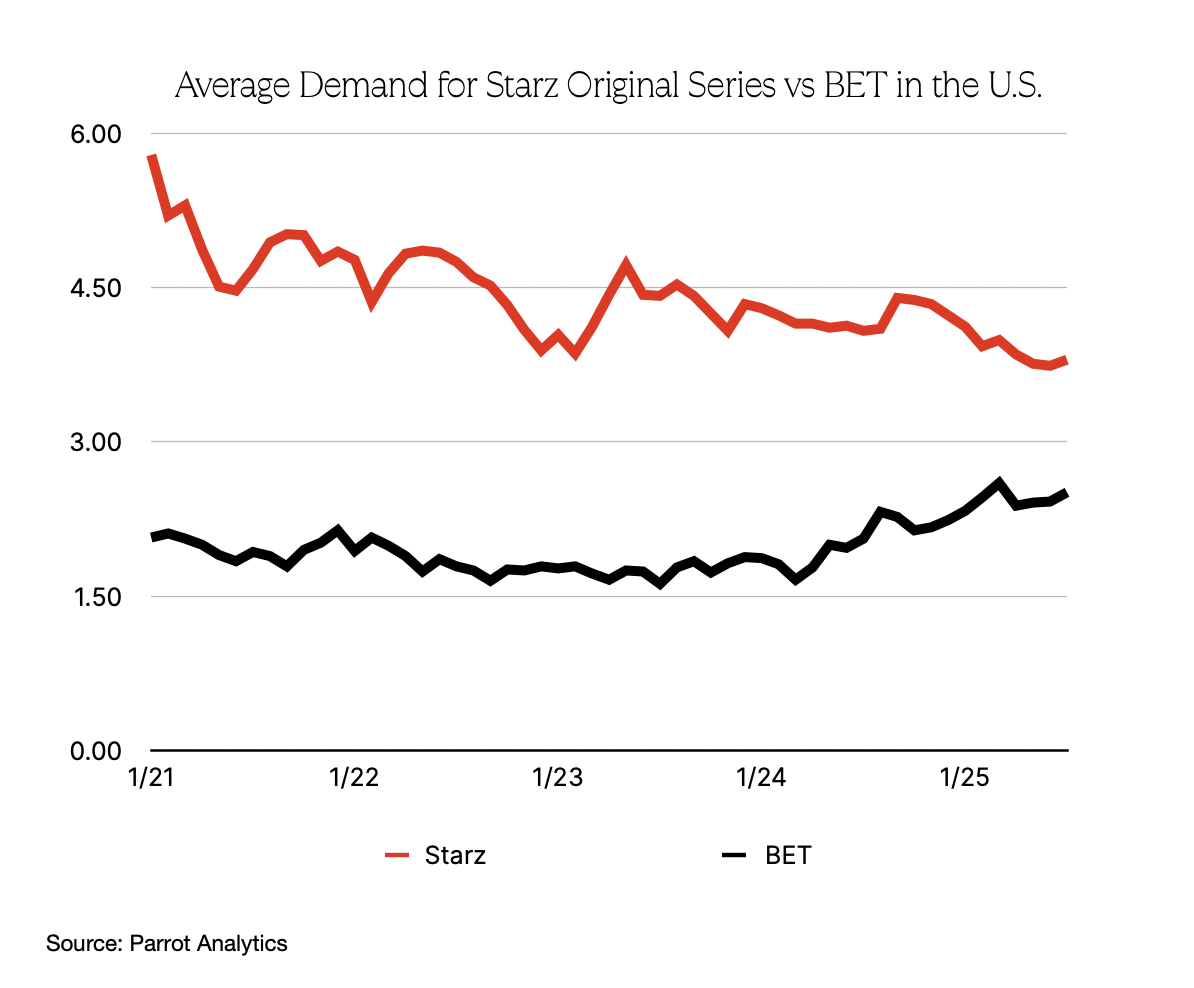
three premium streaming services that overindex for Spanish speakers—who represent about 14 percent of the U.S. population—along with Disney+ and HBO Max, per Samba TV. And demand for Starz originals—measured as a combination of audience interest and viewership—also beats out comparable programming on BET+, according to Parrot Analytics, although Starz is starting to see a dropoff. |
Hirsch clearly believes that the Starz audience and portfolio is worth more than its $220 million market cap.
A few months ago, he predicted during an appearance on Yahoo Finance that the streaming industry was about to enter a period of programming reshuffling, spinoffs, and consolidation. We’re halfway there, of course, with NBC Universal separating out its cable businesses as Versant, Warner Bros. Discovery preparing to do the same, and Disney at least contemplating an independent ESPN. Once the shedding stops, Hirsch said, M&A activity would ramp up. The question is, who would want Starz?
|
Alas, Starz isn’t the only streamer these days focusing on specialized audiences. As of December, Black
people accounted for close to 45 percent of all viewing on Tubi—the free, ad-supported service owned by Fox—per Nielsen, as reported by Business Insider. That same month, Tubi maintained a 1.7 percent share of all TV viewership in the U.S. (it now sits at 2.2 percent), while Starz has never crossed the 1 percent threshold required to appear on Nielsen’s
Gauge report. And with more than 100 million active monthly users, Tubi’s audience is five times the size of Starz’s. |
|
|
A MESSAGE FROM OUR SPONSOR |
Emmy® Nominee · Outstanding Comedy Series |
Outstanding Lead Actress In A Comedy Series · Kristen Bell Outstanding Lead
Actor In A Comedy Series · Adam Brody |
“Bell & Brody Are A Marvelous Pair.” – New York Times [WATCH] The Secret to Their Spark: Kristen Bell & Adam Brody Dive into the undeniable chemistry of Emmy® Nominees Lead Actress Kristen Bell and Lead Actor Adam Brody
as they reveal what made their on-screen pairing in NOBODY WANTS THIS so captivating. |
|
|
Of course, Hirsch & Co. will argue that their most popular shows, like 50 Cent’s Power
franchise and Ronald D. Moore’s Outlander, represent the type of prestige television that audiences can’t get on Tubi. And now that Starz owns its own series, the revenue it can make licensing those titles internationally without having to worry about Lionsgate will theoretically be higher. But all that really matters is scale and engagement. Put another way: Starz may have large Black and female audiences, but services like Netflix, Hulu, and Prime Video have
way more Black Americans and way more women watching overall. And despite Starz having more shows targeted at these audiences, subscribers are canceling, engagement is low, and the gap with the biggest streamers continues to grow.
But while Starz might be too subscale to punch up, its content and audience might be valuable to other streamers. In the first half of 2025, Peacock and Hulu originals had the lowest number of onscreen Black and Hispanic talent among major
general entertainment streamers, according to Samba TV. Roughly 13 percent of onscreen talent in Peacock originals was Black, and just 2 percent was Hispanic. Likewise, 12 percent of onscreen talent in Hulu originals was Black, and 3 percent was Hispanic. Although Samba’s study didn’t include Starz, research conducted by UCLA found that people of color comprise more than 60 percent of Starz’s onscreen talent, and more than half of showrunners come from underrepresented groups. Importantly, Samba
TV also found that Black households are 74 percent more likely to watch a show with Black leads. In general, 59 percent of all nonwhite households are more likely to watch a show if there are nonwhite actors onscreen.
Could Starz find an interested buyer? Netflix is famously not in the acquisitions business, and there’s no real incentive for Disney or Comcast to purchase Starz right now. Sure, Comcast has a fresh $9 billion from Disney thanks to the sale of its Hulu stake, but C.E.O.
Brian Roberts may be more interested in talking to David Zaslav at Warner Discovery. Neither Amazon nor Apple needs to own Starz because it’s already available as an added subscription through their apps, where they take a cut of every transaction. The most interesting potential buyer is Paramount Global, which is focusing on sports, movies, and streaming, with BET a key part of the new company’s future. David Ellison might have his eyes on
Warner Bros., as my colleague Kim Masters has reported, but considering he’s in his big boy billionaire bucks era, kicking the tires on Starz isn’t out of the question either way.
In the meantime, Starz will likely continue to double down on bundling with other services, as it has been doing with rival niche streamers during
high-traffic periods. Hallmark and Starz have a “Christmas in July” bundle, and Starz works with BET+ during Black History Month. These kinds of deals can also introduce different audiences to Starz’s programming when viewership is low. To wit: Hirsch argued that Starz partnered with HBO Max earlier this year to air The White Lotus at a time when it didn’t have any other high-profile shows, while HBO Max aired Starz’s Power Book III: Raising Kanan.
Hirsch understands
that bundling is critical to everyone’s business: the big guys who need more premium content but don’t want to make it themselves, and the small players who need more scale. Earlier this year, Hirsch forecasted that the industry will move from “onesie, twosie bundles” into “multi-company bundles” that include “two, three, or four products together, … with us at the center of that.” Hirsch has also articulated a desire to become a distributor for linear channels that don’t yet have a streaming
partner, although it’s hard to imagine why they wouldn’t choose a platform with more scale, like Roku.
If you ask Hirsch, he might wax poetic about the intentionality of a Starz streaming customer, who is on the platform for specific series, versus a Roku customer stumbling on niche content amid a sea of other offerings. But there’s no getting around the fact that Starz is small. That’s not the end of the world for higher-margin streamers, like Crunchyroll, but Starz could
struggle to raise prices since customers have more cost-effective options. Perhaps the most likely outcome is that a scale player simply licenses Starz’s best content, like Netflix already does with Outlander, and absorbs its audience through a long war of attrition. That means Starz’s days as a stand-alone service may be numbered, something Hirsch has to know in the back of his mind. |
Thanks, Julia. I'll be back tomorrow. Matt |
|
|
Puck founding partner Matt Belloni takes you inside the business of Hollywood, using exclusive reporting and insight to explain
the backstories on everything from Marvel movies to the streaming wars. |
|
|
A professional-grade rundown on the business of sports from John Ourand, the industry’s preeminent journalist, covering the
leagues, players, agencies, media deals, and the egos fueling it all. |
|
|
Need help? Review our FAQ page or contact us for assistance. For brand partnerships, email ads@puck.news. You received this email because you signed up to receive emails from Puck, or as part of your Puck account associated with {{customer.email}}. To stop receiving this newsletter and/or manage all your email preferences, click here. |
Puck is published by Heat Media LLC. 107 Greenwich St, New York, NY 10006 |
|
|
|