 |
|
Welcome to What I’m Hearing+, back in Brooklyn for a week. I’m doing a special mailbag issue next Tuesday, so reply to this email with burning streaming questions and I’ll try to include thoughtful responses in the next WIH+. (Don’t worry: names will be kept anonymous!)
And as a quick reminder for subscribers: This Thursday, November 2, Puck is hosting a New York screening of The Holdovers, a new film from director Alexander Payne. There are only a few seats still available, so if you’re interested click here to RSVP for the 7 p.m. showing.
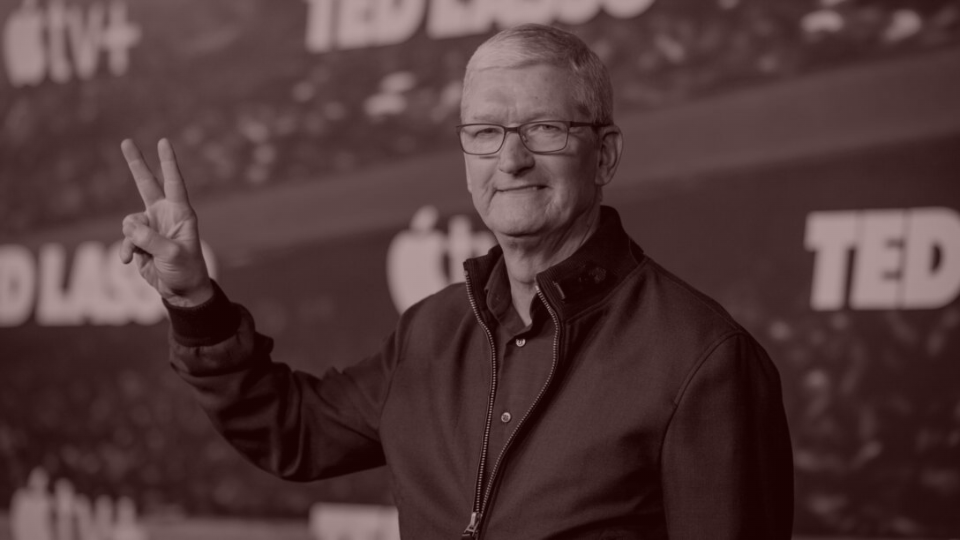
Meanwhile, yesterday was a spooky fun day for Apple, which announced new hardware products during its Halloween showcase. Absent from the event, however, was an explanation for the second Apple TV+ price hike in two years—an increase of more than 45 percent. Today’s issue is dedicated to the rationale (beyond making more money) and some potential consequences. But first…
- YouTube’s Movie Value: A couple of weeks ago, I was on a panel during New York Advertising Week discussing how to harness the nebulous phenomena called fandom, and the ways to best predict and support a hit. My standard answer: Much of the popular culture that kids love today (or even a decade ago) emerges on YouTube, which reigns as the top cultural hitmaker, even as the traditional Hollywood studios try to attract the very same audience. Those fandoms are also willing to explore their favorite franchises in a new way, like in a theatrical movie, so long as it feels like their culture is understood.
Producer Jason Blum and Universal seem to understand this better than most studios, and it explains why Blumhouse’s Five Nights at Freddy’s, an adaptation of Scottgames’ beloved cult video game, has become such a hit. The film grossed nearly $80 million in its opening weekend, dethroning Taylor Swift and scoring one of the largest ever opening weekends in October. It was also the most-watched debut film on Peacock, according to NBCUniversal, which didn’t provide any actual numbers.
The film’s success was hardly a surprise. Demand for Freddy’s pre-release, based on social media chatter and consumer research, was on par with D.C. titles like The Batman at between 65x and 70x the demand of an average film in the U.S. In fact, the anticipation goes all the way back to 2014, after the game became a phenomenon on Tumblr. At the height of the Five Nights at Freddy’s hype, between 2015 and 2016, top platform creators like Markiplier and MatPat generated tens of millions of views through their gameplay videos.
Amid all the Freddy’s hype, there was measurable demand for certain YouTube talent, including Matthew “MatPat” Patrick and Cory Kenshin, to make appearances in the film. (That demand has doubled in the last 14 days.) Blumhouse smartly noted in a press release that this film essentially belonged to fans and the fans only. Indeed, that’s how it knocked out Swift’s Eras Tour doc—by hyper-engaging that niche yet dedicated fandom.
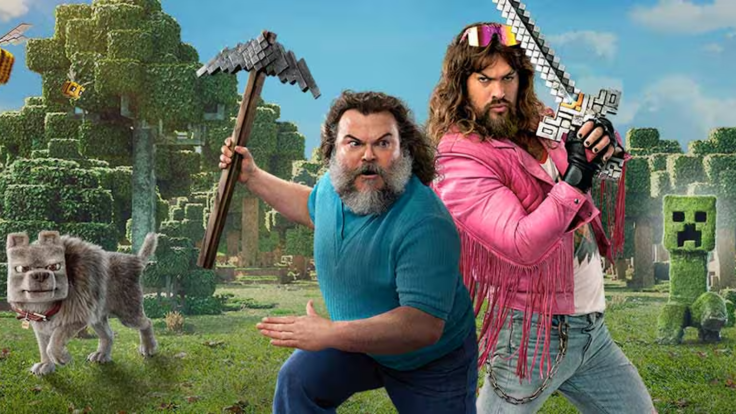
As recent opening numbers suggest, gaming is the next frontier of big I.P. adaptation. Uncharted: $44 million domestic; Super Mario Bros.: $146 million; and now Freddy’s: $80 million. For the next example of this trend, look no further than Warner Bros.’ upcoming Minecraft movie, which is based on a game that YouTube also popularized—and whose parentco eventually sold to Microsoft for $2.5 billion.
|
 |
| Apple’s Price Hike Economics |
| Industry people like to say that Prime Video’s business model is about making movies to get people to buy more toilet paper. But what if the Apple TV+ model is, in part, about getting everyone to sign up for Apple One? |
|
|
|
| During its rocket ship ascent to become the world’s largest company, with a market cap of some $2.7 trillion, Apple has segued from hardware to services provider to, most recently, an owner of services—namely Apple Music, Apple News+, Apple Fitness+, Apple Arcade, and, of course, Apple TV+. It’s a natural progression, befitting the business realities. Apple’s gross margin for its hardware division is just over 34 percent, according to third party analysis. The margin for its services business sits at 70.5 percent.
I was thinking about those margins when the company announced the most recent price hike for AppleTV+, raising the video service from $7 to $10 a month. Currently, Apple TV+ has between 15 and 20 million subscribers domestically, according to my team’s analysis at Parrot Analytics, where I work as director of strategy. Its global demand share—a measure of viewing consumption, social media chatter, and consumer research—sits at 7.6 percent in Q3, up from 7.2 percent in Q2, according to Parrot. It stands in fourth place for originals demand share when compared to Netflix (33.3 percent), Prime Video (11.6 percent), and Disney+ (8.6 percent). AppleTV+ also has the second lowest corporate demand share (demand for titles based on their ownership), meaning AppleTV+ licenses a lot of its content, and the lowest catalog demand share, which isn’t all that surprising for a new service.
Between March and May of this year, Apple saw a 147 percent increase in its week-over-week viewing ratings, according to Nielsen, thanks mostly to Ted Lasso, its biggest hit, but also Shrinking, and Silo. Yet despite those obvious successes, the vast majority of Apple TV+’s titles have not broken into the zeitgeist. In fact, many recent decisions—such as cutting ties with Jon Stewart; ending its deal with Skydance Animation; canceling The Afterparty, City on Fire, and Suspicion—suggest that the top programmers Zack Van Amburg and Jamie Erlicht are still figuring out what kind of platform they want TV+ to be. Apple, of course, has the financial freedom to provide this sort of test-and-learn latitude. Barclays analyst Tim Long has suggested that Apple TV+ contributes just 2 percent of Apple’s services revenue.
But all the executives I speak to point out that Apple, despite its fortress balance sheet, isn’t idly investing in film and TV because Tim Cook likes attending the Oscars or Emmys. Apple ruthlessly pursues profits, but its business is more complex than others in the space. Just as Amazon entered streaming video in order to sell more toilet paper on Prime, Apple’s investment in entertainment, at least for now, levels up to its Apple One business. |
|
|
| Apple One is a Prime-like subscription package that allows Apple hardware customers to combine several go-to apps in one monthly or annual subscription package. For Apple, this equates to higher customer lifetime value through decreased churn and incremental price increases. By itself, Apple TV+ doesn’t have a substantial hold on many of its customers—but within the Apple One bundle, it becomes a key driver of retention. And, as Cook suggested back in 2019, it can also further interlock the hardware and software services, noting that, “...there are customers today that essentially view the hardware like that because they’re on upgrade plans and so forth… my perspective is that it will grow in the future to larger numbers. It will grow disproportionately.”
Companies like Netflix are increasing the delta between premium plans and basic plans to separate customers into two categories—cheaper tiers full of ads, and expensive tiers that don’t include ads—to ensure the strongest average revenue per user. Apple is arguably trying to push more people to its sticky One package, which provides consumers both with features that they need and also others that they covet—additional iCloud storage space, for instance, and entertainment via TV+, Music, and Arcade. TV+ isn’t likely the main reason that people get Apple One, but the better TV+ becomes as a platform, the more it retains those customers, and the higher the margins for Apple.
And this is where traditional pricing strategy comes in… by increasing Apple TV+ to $10 per month, Apple is highlighting the better value of Apple One—which now offers TV+, Music, Arcade and iCloud+ for a base price of $19.95 per month. If it sounds familiar, it’s the same strategy Disney is using for its Hulu and Disney+ bundle. So jacking Apple TV+ is merely a way of persuading people to spend more on the bundle, which raises overall margins and improves lifetime value, no matter how much the consumer values the video offering. |
|
|
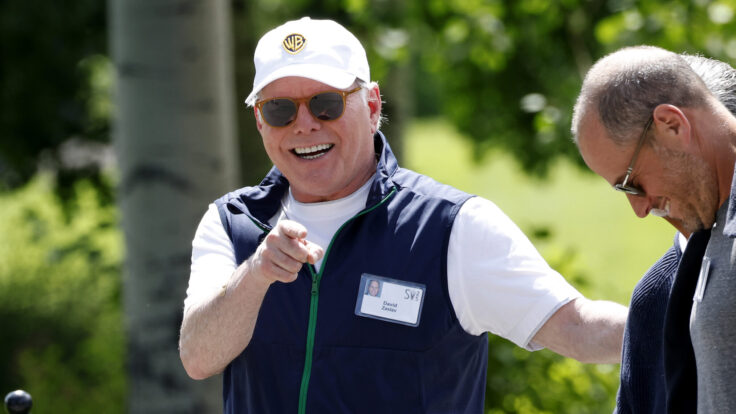
| As the media industry metamorphosizes, Fortune 500 executives appear to be playing a game of follow the leader. Warner Bros. Discovery signaled that it would sell its content to other services and kill off expensive shows—once heretical strategies that gave other executives a chance to mimic C.E.O. David Zaslav. Netflix raised prices and cracked down on password sharing, and then Disney, Paramount, and Apple followed suit. Unlike Netflix, however, Disney, Paramount, and Apple are coming from a similar place—their products were underpriced compared to perceived value of their offerings, and the cost of those products.
Yes, Disney and Apple are different. Disney is an I.P. factory that can offer subscribers decades of films and TV series for a relatively low price; Apple TV+, on the other hand, has a batch of appealing original titles. I was talking to someone who works on content deals at a major streamer just last week who noted that he was surprised it took Apple this long to increase prices again, considering the quality of its original programming. Consumers on subreddit boards and Twitter/X have also expressed bewilderment that Apple TV+ was priced so low compared to the competition.
But original programming can only go so far in acquiring subscribers. About 35 percent of customers who canceled a premium SVOD service returned within a 12 month period between Q1 2021 and Q1 2022, according to Antenna. Apple TV+ doesn’t have many subscribers in the first place; to spend money on re-engaging those who cancel and acquiring new customers with a comparatively small content offering is an expensive bet. Apple reportedly spent $6 billion on programming between 2019 and 2022, but it certainly hasn’t made anywhere near that amount in subscription revenue.
So price hikes are inevitable. They often occur before a strong slate. For Apple TV+, that can include Martin Scorsese’s Killers of the Flower Moon and Ridley Scott’s Napoleon, which should hit Apple TV+ in the fourth quarter. Like HBO, Apple TV+ executives know that their content isn’t for everyone, but those who love it will pay a premium for it. Price hikes for services that don’t have a sizable subscriber base, however, are more at risk of strong churn. But Apple’s hope is that the One bundle will capture more of its other service customers and new subscribers, particularly as they continue to invest voraciously in content.
Exactly 10 years ago, Cook triumphantly declared that Apple was no longer a hardware company. The unspoken acknowledgement, of course, was that Apple couldn’t be. iPhone sales have steadily declined since 2018, from representing 63 percent of Apple’s total revenue to just over 45 percent as of Q3 2023. Services, however, have tripled from about 9 percent of revenue to just over 25 percent. In fact, Apple has increased its services revenue from $3 billion in 2012 to $21.2 billion in 2022—more than 600 percent. If the trajectory continues, Apple executives will be able to do what they need to do most—justify to Wall Street why they’re continuing to invest in expensive, premium content. |
|
|
| FOUR STORIES WE’RE TALKING ABOUT |
 |
|
 |
|
 |
|
 |
| Endeavor Fever |
| Ari’s take-private bid, Jamie’s stock sale, and more. |
| WILLIAM D. COHAN |
|
|
|
|
|
 |
|
|
|
Need help? Review our FAQs
page or contact
us for assistance. For brand partnerships, email ads@puck.news.
|
|
You received this email because you signed up to receive emails from Puck, or as part of your Puck account associated with . To stop receiving this newsletter and/or manage all your email preferences, click here.
|
|
Puck is published by Heat Media LLC. 227 W 17th St New York, NY 10011.
|
|
|
|
|