 |
| Welcome back to What I’m Hearing, and happy Passover to those who are celebrating…
Programming note: On The Town, Lucas Shaw and I debated the potential impact of Netflix hiding its subscriber numbers, consultant John Peters explained a “Thrive Index,” and Nathan Hubbard defended Taylor Swift from my TikTok critique. Subscribe here and here. And while you’re at it, sign up for Fashion People, the new pod from Puck’s perpetually best-dressed author, Lauren Sherman.
Not a member yet? Click here to fix that problem. Got a news tip or an idea for me? Just reply to this email.
Discussed in this issue: Shari Redstone, Joanna Coles, David Bonderman, Taylor Swift, Pete Micelli, John Malone, Lucian Grainge, Steve Cohen, David Ellison, Lauren Sánchez, and… Triumph the Insult Comic Dog.
But first… |
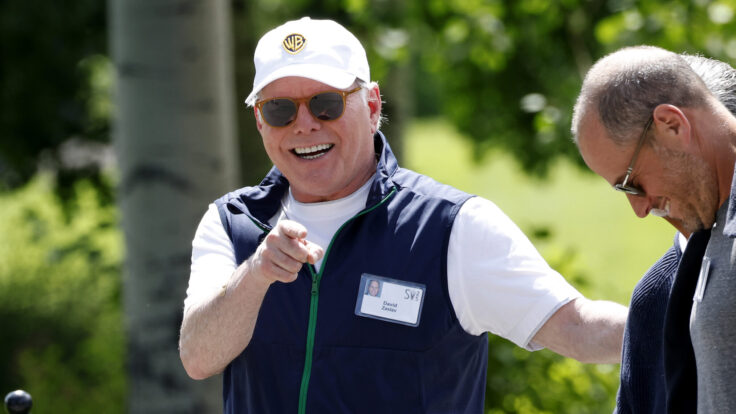
| Who Won the Week: David Zaslav |
|
| Sorry, Taylor, but it’s here! The Warner Bros. Discovery C.E.O.’s 2023 pay was finally revealed on Friday, and it did not disappoint. A package worth a comically high $50 million, up $10 million from 2022, despite WBD shareholders having lost two-thirds of their stock value since launch. It’s a truly grotesque flex for Zaz—even if his actual take-home will be lower— because the WBD board had to change his bonus metric to “free cash flow” to generate such an outsize number. A hall-of-fame head-shaker, even for traditionally overpaid Hollywood C.E.O.s.A little more on this…
But… the vitriol in my inbox this weekend was largely misdirected. Come on, people, the free cash flow thing may be a fresh and especially villainous twist on executive piggery, but the shamelessness with which Zaslav extracts money from his shareholders is not new. The dude made $156 million at a little cable company called Discovery Communications back in 2014! He’s always been one of the most overpaid C.E.O.s, as have many in the John Malone orbit. (See also: Maffei, Greg, and Fries, Mike, both of Malone’s Liberty companies).
The real culprits here, of course, are Paul Gould, Richard Fisher, Debra Lee, Ken Lowe, and Geoff Yang, the board members who make up the WBD compensation committee. They’re independent directors, but it probably won’t shock you to learn many of them have long ties to Malone and Zaslav. Gould, chair of the committee, has been at Zaz-friendly bank Allen & Co. for decades and was on the Discovery board. Lowe is a longtime Discovery and Scripps guy, and Fischer and Yang were on the AT&T board pre-WBD transaction. Malone’s media empire, with its stakes in various companies, has always seemed especially incestuous and cronyish. So much so that the federal government just pressured two WBD directors to step down, and Malone himself is giving up his director emeritus role at Charter Communications, citing potential violations of antitrust rules.
Against that backdrop, of course Zaslav is gonna take an outsize comp package, when peers at struggling companies, like Bob Iger and Bob Bakish, both settled for about $31 million. (I know, the Bakish number is pretty gross, too.) At least so far this year, only Netflix co-C.E.O. Ted Sarandos earned what Zaz did, and if given the choice, which company’s stock would you buy right now, Netflix or Warner Bros. Discovery? But so far, no big uprising among WBD shareholders. We’ll see if there’s a reaction similar to last year, when Zaslav’s $39 million in pay barely passed a shareholder vote, which was seen as a rebuke—if only advisory. Malone doesn’t seem to care, though, and in many ways, he’s really the only one who matters here.
Speaking of John Malone…. |
|
|
| I’m told Malone’s Liberty Global is making an eight-figure investment in Range Media Partners, the management/production company founded by Pete Micelli, Jack Whigham, and various defectors from CAA and other rep firms. Range is already backed by Steve Cohen, via his Point72, and A+E Networks, which are both staying in the company, per sources. Also in the round is Playground Productions, Chicago financier Lindsay Barnett’s kids TV company, as well as the family office of TPG co-founder David Bonderman. That last name is interesting because Bonderman was involved in TPG’s acquisition of CAA, which the private equity firm offloaded last year to the Pinault family. (Usual disclosure: TPG is an investor in Puck.)More: The Range raise is definitely good news for an entertainment deal market that seems stuck in a post-strike malaise. Bloomberg just noted the relative standstill, and a few people reached out after my Participant Media shutdown postmortem to sound the alarm on other independent production-finance companies. “My prediction is you’re going to see a lot more of this in the next 18-24 months,” one finance source texted. Wouldn’t be surprising. It’s also been five or six years since there was a new billionaire in town on the level of a Teddy Schwarzman or Ken Kao or Dan Friedkin or Manoj Bhargava or Megan Ellison, backing movies like they’re art, not commerce. It’s just so much harder to make the numbers work these days unless you’ve got reliable distribution or are willing to greenlight cash bonfires. |
|
|
| “It’s as impactful as if one of the Soros sons started writing huge checks to Trump.”
—Charles Myers, the former Evercore exec and a Biden bundler, telling CNBC how big a deal it is that David Ellison, son of G.O.P. kingmaker Larry Ellison, gave nearly $1 million to Biden last quarter.A little more on Ellison…
Man, the media jockeying for Shari Redstone’s media empire is really getting aggressive now that Ellison’s Skydance/KKR/RedBird Capital bid is facing off against the Apollo/Sony Pictures overture. Someone leaked Skydance’s financials to the Journal on Friday, revealing the company that would like to be valued at $5 billion in an all-stock merger with Paramount Global generated only $25 million in EBITDA in 2023, due to the strikes. Not great, but Skydance is projecting $1 billion in revenue and $90 million in EBITDA for this year, with a “huge surge” (of course) in 2025. Without pointing a finger here, the Bob Bakish faction at Paramount is really lining up behind the Apollo/Sony pitch, and I’m not totally sure why. Ellison and his would-be C.E.O. Jeff Shell will almost certainly fire Bakish & Co. the day the transaction closes, but the Apollo/Sony guys would probably also clean house. That’s especially likely since the synergies/redundancies of Sony/Paramount would be massive—and not favorable to Paramount— if the government ever allowed the two companies to merge (still a huge if).
Side note from that CNBC story: Katzenberg’s political operative Andy Spahn is really earning his money here: “The move to gain David Ellison’s support was largely orchestrated by Hollywood mogul Jeffrey Katzenberg, according to a person with direct knowledge of the matter.” |
|
|
| My colleague Bill Cohan explains the Apollo-Sony rationale for jointly pursuing Paramount. [Puck]Congrats to all the publicists who got their clients on the Time 100 list! (No, you will not be invited to the party.) [Time]
Speaking of publicists, this Tree Paine write-around succinctly describes her evil genius: “At almost every turn, Paine presents Swift—arguably the most famous woman on the planet, a billionaire with a private jet—as a relatable underdog fighting for her voice to be heard.” [WSJ]
Ari Emanuel may have been forever un-invited to Allen & Co., but the Journal says Ari’s rival “The Weekend” get-together in Aspen is now “the king” of the circle-jerk executive get-togethers. [WSJ]
If Joanna Coles is really looking to hire a “senior Lauren Sánchez correspondent” at The Daily Beast, she could do worse than the author of this amusing breakdown of the Keith McNally drive-by. [Slate]
Speaking of Sánchez: Remember the movie she and Jeff Bezos were self-financing that went horribly (and hilariously) off the rails? I wrote about The Golden Door last year, including that it featured a role for Bezos’s teen daughter and that Sánchez demanded a “new twist” well into the shoot. Now, I’m sad to report the movie has died a quiet death, left unfinished after the director and several key crew members were fired.
A full report from the Trump hush money trial, from the only correspondent who matters, Triumph the Insult Comic Dog. [YouTube]
Abigail hit the over on $10 million this weekend, but barely, and it did nothing to boost the terrible second-quarter comps at the box office. “In our view, all three months are likely to decline versus the same months last year,” and probably significantly, Roth MKM analyst Eric Handler told clients. It’s also the latest horror movie to underperform, but Scott Mendelson has a not-scary explanation for the mini-recession… |
 |
| American Horror Story |
| Horror flicks simply aren’t performing at the box office with the potency they demonstrated as recently as last year. But is this the result of oversaturation or simply a natural come-down from previously unsustainable highs? |
|
|
|
| The underwhelming $10.2 million domestic debut of Universal’s well-reviewed and well-received Abigail is a disappointment, but perhaps not a shock. Sure, the movie had a fun hook (kidnappers realize that the 12-year-old girl they snatched is a vampire), the cast was filled with geek-friendly names (Melissa Barrera, Kathryn Newton, and Dan Stevens), and it came from the directors of Ready or Not and the past two Scream flicks (Matt Bettinelli-Olpin and Tyler Gillett). But that only meant so much to general audiences, especially for a film that carried a $28 million production budget.Vampire-specific horror films have been on a losing streak of late, as evidenced by Universal’s 2023 flops Renfield ($26 million worldwide on a $65 million budget) and The Last Voyage of Demeter ($22 million/$45 million). The Invitation, Sony’s summer 2022 sleeper, earned $38 million globally on a $10 million budget because it mostly hid the Dracula connection. And beyond blood-suckers, Abigail’s mediocre launch amplifies the concerns in Hollywood that there are too many horror films, or that general interest audiences have (comparatively) turned against them, or both.
All at once, starting in the mid-2010s, it seemed as though audiences had suddenly decided that comedies and awards movies were best watched at home. And now we sit and wonder if the previously surefire horror genre is no longer as theatrically viable, either. The early 2023 offerings—M3GAN, Cocaine Bear, Scream VI, and Evil Dead Rise—grossed $585 million worldwide on a combined budget of near-$100 million. Thus far, the major 2024 horror titles—Night Swim, Imaginary, Late Night With the Devil, Immaculate, The First Omen, and Abigail—should end their combined runs with $235 million on a combined near-$100 million budget.
And yet, horror isn’t slumping so much as it isn’t over-indexing like it used to. Before, during, and after the worst months of the pandemic, the genre juiced the overall marketplace with semi-regular breakouts like Get Out ($256 million in 2017), The Nun ($366 million in 2018), or even The Black Phone ($161 million in 2022). Now, there aren’t any standout hits in a genre that may have been diluted by too many titles, many of which seem similar, all at once. The reasons for each respective performance are understandable on a movie-by-movie basis. And the prospect of low- or lower-budget horror movies merely performing like low-budget horror movies puts further pressure on what is already a light year at the box office. |
|
|
| As horror became such a surefire genre at a comparatively discounted price, Hollywood slightly oversaturated the marketplace. To wit: There were four R-rated, adult-skewing horror films scheduled in March and April. Two of the better-performing mainstream titles this year were the spaced-out PG-13 offerings: Blumhouse’s Night Swim, released by Universal, earned $54 million on a $15 million budget after opening during the first weekend of January; debuting precisely two months later, Blumhouse’s Imaginary, released by Lionsgate, grossed $39 million on a $13 million budget. Meanwhile, First Omen was undercut by the $15 million grossed domestically by Neon’s Immaculate, which offered up Sydney Sweeney in essentially the same plot/premise. Quality notwithstanding, The Omen is not red-hot I.P. any more than was The Exorcist, another flop, late last year, and few are currently salivating for an origin story prequel to The Strangers, which is due on May 17.Horror cinema benefits from a motivated fan base and a genre-specific media ecosystem that excels at maintaining awareness. But even the most passionate horror fans don’t have the time or money to go to the multiplex for a new movie each week. Immaculate’s over-indexing performance, alongside IFC’s Late Night With the Devil ($9.6 million domestic after a studio-record $2.8 million debut), took market share from the major studio horror films, as well as (tangentially related) Dev Patel’s R-rated actioner Monkey Man. That Alex Garland’s Civil War became a buzzy and unconventionally terrifying hit ($45 million domestic in ten days) didn’t help in terms of the major studio fright flicks positioning themselves as the main events.
Most of these films, including Monkey Man (which Universal snatched from Netflix for just $10 million), will make money for their respective distributors. In terms of likely financial outcome, though, Night Swim was never going to be the next M3GAN. Smaller, less explicitly commercial movies, with or without brand awareness or I.P., tend to deliver smaller grosses. |
|
|
| Is horror inevitably a fading box office format, or is this trend ephemeral and reversible? Ti West’s trilogy capper MaXXXine could be a relative breakout sequel following the cult popularity of X and Pearl, although those two earned just $25 million combined. Warner Bros. has two Shyamalan chillers this summer: The Watchers, from Ishana Night Shyamalan, in June, and Trap, in August—the latter of which could be her dad M. Night Shyamalan’s youngest-skewing flick since Split, which earned $276 million in 2017.This summer’s tentpole slate, including presumptive A-level hits like Despicable Me 4, Deadpool & Wolverine, and Inside Out 2, will likely struggle to earn theatrical revenue—even presuming that the likes of Twisters, Bad Boys: Ride or Die, and Furiosa are respectively profitable— anywhere near as high as last summer’s slate led by Barbie and Oppenheimer. Amid this challenging year, the fright flicks offered aren’t overperforming just because they are horror movies. Nor are they overperforming in relation to budget or conventionally commercial variables such as I.P. or star power. They are still paying their own way, so it’s not like Hollywood will stop making them. However, the industry is used to having them pitch in for everyone else, too, which isn’t yet happening. And, unfairly but perhaps fittingly, that makes the reaction to their results scarier than ever. |
|
|
| Taylor Swift fans let me have it for suggesting her return to TikTok amid the boycott by her label UMG is akin to crossing a picket line. (It’s a metaphor, people!). A few highlights…“Your piece feels weirdly vindictive. While you mention her support for artists’ rights, you seem to forget that she was notoriously hounded and deemed greedy for standing up in 2014 for songwriters. No one in the music industry, especially not the UMG artists you now suggest she’s bigfooting, supported her or stood with her at that time. Sorry, but she does not owe them anything, nor to Lucian Grainge and UMG. Her agreeing to put off her music for a while was generous—why should she be penalized for their inability to negotiate with TikTok?” —An executive
“While I’m not an expert, it isn’t clear if artists blame the stand-off on TikTok or UMG right now. In 2014, it was obvious who the little guy supported; in this case, it isn’t as clear. Additionally, to say she’s crossed a picket line suggests that artists voted to do this UMG boycott (like how SAG actors voted for the SAG strike), when, in reality, the individual artists have very limited say in UMG’s actions.” —An investor
“You there? Just checking in to make sure you’re still alive after going after Taylor.” —An agent |
|
|
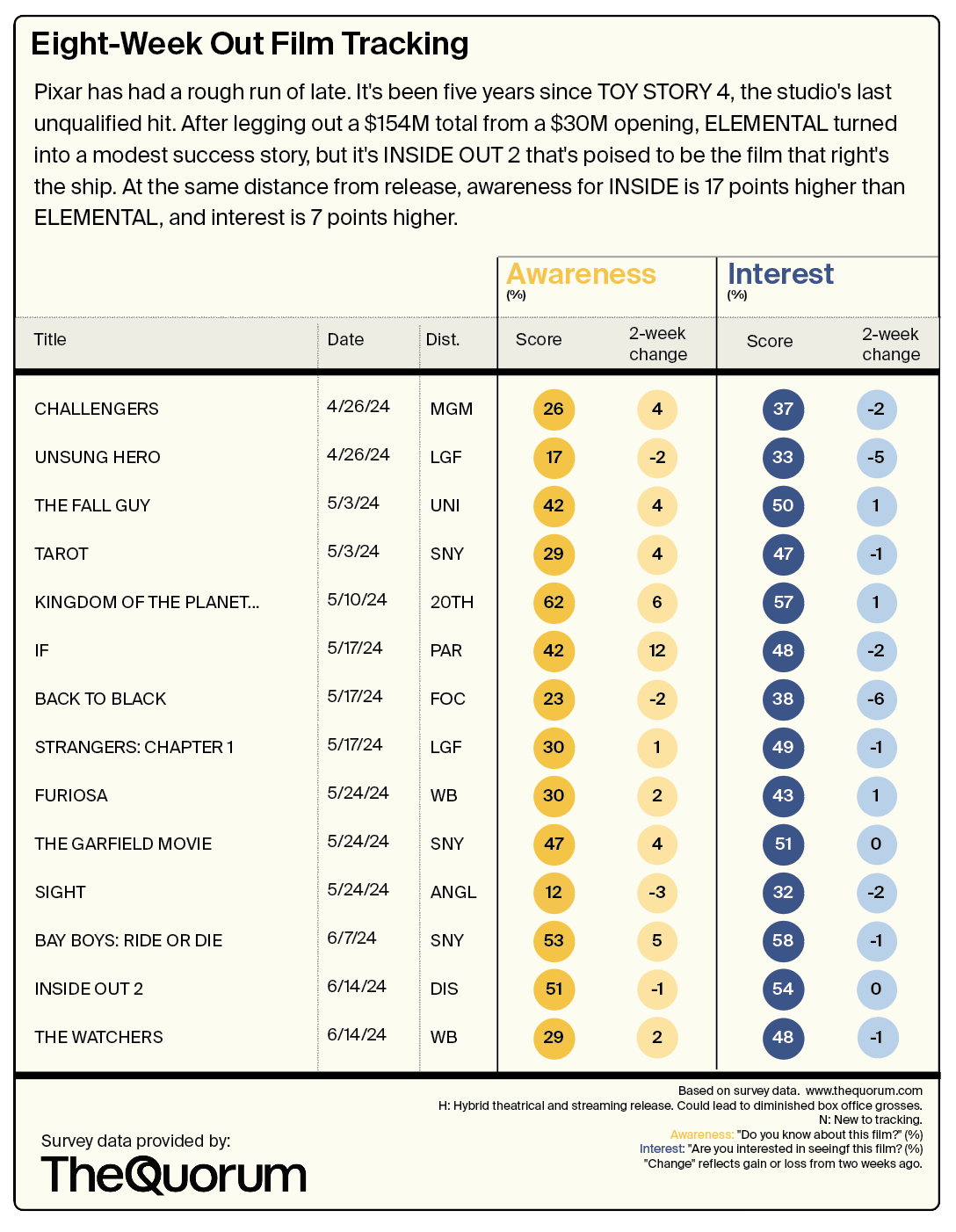
| Inside Out 2 is looking like it will right the Pixar ship, with especially high interest and awareness nearly two months from release, according to the new Quorum early tracking chart… |
|
|
| Have a great week,
MattGot a question, comment, complaint, or some new D.C. restaurant recs? Email me at Matt@puck.news or call/text me at 310-804-3198. |
|
|
|
| FOUR STORIES WE’RE TALKING ABOUT |
 |
|
 |
| Three Women |
| Six artworks electrifying the May auction season. |
| MARION MANEKER |
|
 |
|
 |
|
|
|
|
|
 |
|
|
| Need help? Review our FAQs
page or contact
us for assistance. For brand partnerships, email ads@puck.news. |
| You received this email because you signed up to receive emails from Puck, or as part of your Puck account associated with . To stop receiving this newsletter and/or manage all your email preferences, click here. |
| Puck is published by Heat Media LLC. 227 W 17th St New York, NY 10011. |
|
|
|