 |
 |
|
Welcome back to What I’m Hearing from soggy Los Angeles, a little earlier tonight because my wife and I are taking a rowboat to the Grammys. Great seeing so many music people last night at Clive Davis… music parties are objectively better than Hollywood parties.
🚨🚨 Super Bowl ratings contest! It’s been a while since we gave away status-defining Puck merch. Reply to this email by next Sunday morning with your best guess of the Live + Same Day viewership on CBS and all simulcasts. Closest without going over wins.
More Super Bowl 🚨🚨: I’m doing another LIVE episode of The Town, this one with Bloomberg’s Lucas Shaw and maybe a surprise guest, on Feb. 10 at 3 p.m. at the Endeavor/TKO Lounge near the Aria in Las Vegas. We’ve got a few spots for WIH readers, click here to request one!
Programming note: This week on The Town, Lucas and I dissected the Netflix/WWE deal, filmmaker Ed Zwick told fun movie star anecdotes from his new book, and Rolling Stone’s Ethan Millman and I debated whether TikTok needs Universal Music or vice versa. Subscribe here and here.
Was this email forwarded to you? Click here to become a Puck member. Got a news tip or an idea for me? Just reply to this email.
Discussed in this issue: Byron Allen, Chris McCarthy, Joe Rogan, Shari Redstone, Issa López, Cord Jefferson, Taylor Sheridan, Yorgos Lanthimos, Michelle Pfeiffer, Kelly Reilly, David Ellison… and Scientology’s latest atrocity.
But first…
|
|
|
The Smartless Guys
With their new $100 million SiriusXM distribution/ad sales deal, Will Arnett, Jason Bateman, and Sean Hayes have now made more than $200 million on a podcast they started for fun during the pandemic—without giving up ownership or being exclusive to one platform. Pretty remarkable.
Runners-up: Jason Sudeikis and Bill Lawrence for Ted Lasso topping Nielsen’s most-streamed original shows list for 2023, which I still can’t believe, given the small Apple TV+ footprint.
It’s been a while since I checked in on the behind-the-scenes maneuvers on linear TV’s No. 1 show… |
 |
| Another Shootout at the ‘Yellowstone’ Corral |
| Kevin Costner isn’t the only star in a financial standoff over TV’s No. 1 show. Now, Cole Hauser, Kelly Reilly, and Luke Grimes are looking for increased paydays in advance of the new spinoff, and Paramount has set a take-it-or-leave-it deadline. |
|
|
|
| How much does the Yellowstone franchise need its original stars? We’re about to find out. This week will likely bring to a head a heated back-and-forth over the past few months as to whether Cole Hauser, Kelly Reilly, and Luke Grimes will return for the anticipated Yellowstone spinoff that will pick up after the flagship series. It’s getting ugly.
Yes, I know, another actor standoff on TV’s No. 1 show. It seems like only yesterday that I first revealed the assholic stylings of Kevin Costner, who informed Paramount executive Chris McCarthy and creator Taylor Sheridan about a year ago that script delays were causing his Yellowstone schedule to inconveniently bleed into his plans for Horizon, Costner’s two-part Western opus that will hit theaters this summer. After many overtures and ultimatums, Sheridan, in the parlance of the show, drove Costner to the train station, and wrote the upcoming post-strike back half of Season 5 without John Dutton. Costner, seemingly shocked that a television writer would stand up to him, then announced last summer at a hearing in his divorce litigation that he will “probably go to court” over the exit.
No, that lawsuit has not materialized, and behind the scenes, I’m told, one of Costner’s reps is still asking that Sheridan bring him back to finish his arc. We’ll see if that happens, but Sheridan is said to be super happy with how he currently wraps up the show—without Costner—and with shooting set for this spring and summer, the clock is ticking on any reconciliation. (Paramount and the reps involved declined to comment on any of this.)
In the meantime, plans are afoot for the Yellowstone spinoff series, which is set up in the final episodes of Yellowstone O.G., beginning in November. Matthew McConaughey is still the top choice to star, but reports of his commitment to the project are overstated; he won’t sign on until he sees a script, which hasn’t happened yet, per his agent. But producers are much closer on Michelle Pfeiffer, who is in negotiations for the female lead and should either close a deal or walk away in the next week or two.
That leaves original stars Hauser, Reilly, and Grimes. Sheridan didn’t actually conceive the spinoff with the three of them in mind, I’m told. He’s now made two Yellowstone prequel series, 1883 and 1923, without any of the original cast, and more of those are on the way. But when the idea was raised of incorporating the trio as a bridge to the new show, Sheridan bought in. After all, they are fan favorites—Google “Rip and Beth” for a slightly creepy taste of their following—and unlike the prequels, the spinoff is set in present-day. Plus, while the prequels do well on Paramount+, the success barometer will be higher for an official spinoff. Season 5 of Yellowstone debuted on Paramount Network (and sister nets) in November 2022 to 12.1 million viewers, an unreal number for any show these days, let alone a show airing on an obscure linear cable channel. Yellowstone is truly a unicorn in TV, and the spin-off will escape the much-regretted deal that sends the original to Peacock for streaming, so anything Paramount can do to help it succeed at that level would seemingly be a no-brainer.
But at what cost? Because the problem is money, of course. Sheridan shows are already expensive, and the original stars—mostly Hauser and Reilly, actually, Grimes is much more mellow on money—are insisting on massive pay increases to return. Reilly, in particular, initially asked for a whopping $1.5 million an episode, according to two sources, at or above the very top tier of TV stars, though in recent communications that number has come down to $1.2 million an episode. Still a huge increase. (Dar Rollins, one of Reilly’s agents at CAA, even produced a lengthy deck of Beth Dutton memes and social media activity to evidence how important she is to the franchise.) Hauser, I’m told, had asked for $1.25 million an episode, up from the $700,000 an episode he currently makes, and Paramount is at $850,000 an episode in Season 1 and $950,000 in Season 2 (with a two-season guarantee). Oh, and Reilly and Hauser also asked to be in first position on the call sheet—above McConaughey and Pfeiffer (or whoever play the leads). That’s probably never happening.
I do get the lofty asks. While Yellowstone was greenlit as a Costner vehicle, Reilly and Hauser quickly became quasi-leads and the heart of the show. Plus, Hauser does a ton of promotion, appearing at rodeos and conventions and bull-riding events as the face of the Yellowstone “lifestyle,” as it were. Still, none of the Yellowstone actors have done much of note outside the show since it launched in 2018, reducing their incentive to walk and thus their leverage. And does the spinoff really need them? Maybe not. As in the Costner situation, I’d bet on Sheridan over any one piece of talent—or in this case, three pieces—any day of the week.
So I do think this will get resolved. Complicating matters, however, the actors are all pay-or-play for the Season 6 of Yellowstone that isn’t happening, meaning Paramount must pay the talent for one season even if they don’t do the spinoff. In negotiations, I’m told Paramount and producer 101 Studios have proposed applying that money to the pay increases for the spinoff—which, remember, is considered for contractual purposes an entirely new show—but the actors have resisted, arguing that that’s like paying them with their own money. Paramount and the producers have countered that the pay-or-play money would be peanuts compared to the higher salaries on the new show, which could conceivably go for years and years.
And here we are. Paramount and 101 Studios have set a take-it-or-leave-it deadline of this week for the actors to come to an agreement. A harshly worded letter was sent tonight, actually. The actors are not a package deal, and they aren’t negotiating together, though the reps at CAA and AIG (for Hauser) are in contact with each other, so maybe one or two end up returning for the spinoff. (Though would it even make sense to bring back Beth without Rip?) And if there are no deals at all, look for Yellowstone to continue on next year without this branch of the Dutton family. |
|
A MESSAGE FROM OUR SPONSOR
|

|
“A deeply felt portrait of togetherness, brotherhood and survival.”
-The Playlist
In 1972, the Uruguayan Air Force Flight 571, chartered to fly a rugby team to Chile, catastrophically crashes on a glacier in the heart of the Andes. Only 29 of the 45 passengers survived the crash and finding themselves in one of the world’s toughest environments, they are forced to resort to extreme measures to stay alive.
WATCH ON NETFLIX
-
->EXPLORE The Digital Book: A behind-the-scenes look at the making of the film.
WATCH An in-depth look at the creative process behind the Academy Award® Nominated International Feature Society of the Snow, featuring Director J.A. Bayona, the cast, and the real-life survivors.
-
For more on Society of the Snow, go to film.netflixawards.com
|
|
|
|
|
“Can’t blame me.”
—Nic Pizzolatto, the True Detective creator, ripping Issa López’s new horror-tinged season as “so stupid.” (Uh, for those keeping score, Night Country’s 93 percent critical rating and a 67 percent audience rating on Rotten Tomatoes are much higher than for the past two Pizzolatto-penned seasons.)
With Poor Things and American Fiction trying to leverage their Oscar noms into box office, does that strategy still work? Box office contributor Scott Mendelson analyzes… |
| The Oscar Bump May Be Gone for Good |
|
| It’s been a dark winter at the box office. The total haul for this first weekend in February totaled just $59 million, down 27 percent from $81 million last year. With all the chatter about Dune: Part Two “rescuing” the theatrical industry in March, part of the current hurt comes from the absence of anything resembling, commercially speaking, an Oscar season at the box office.
As recently as 2020, in the weeks before the world shut down, Universal’s 1917 opened to $37 million domestically. The World War I thriller, which director Sam Mendes constructed to resemble a single take, would ultimately gross $159 million domestic and $359 million worldwide. In 2011, the season was filled with honest-to-goodness mainstream nominees like True Grit ($170 million domestic and $252 million worldwide), Black Swan ($330 million global), The Fighter ($95 million/$130 million), and The King’s Speech ($139 million/$484 million). They packed auditoriums alongside the best picture-nominated summer tentpoles like Inception and Toy Story 3.
From A Beautiful Mind, in 2001, to American Hustle, in 2013, $150 million-plus domestic runs were expected for these films. Clint Eastwood’s American Sniper went wide in early 2015 for a whopping $350 million domestic haul. Even smaller-scale contenders like Good Night, and Good Luck or Lion could crawl to $50 million domestic. In 1996, Richard Dreyfuss’s Mr. Holland’s Opus earned $82 million domestically ($196 million adjusted for inflation) amid wide expansion.
This year, we’ve got two unapologetic summer blockbusters in Barbie and Oppenheimer in the thick of the best picture race. Searchlight’s Poor Things has earned $28 million domestically and $68 million worldwide, which means it could very well match the $34 million/$95 million total of director Yorgos Lanthimos’ last awards darling, The Favourite in 2017-18. But American Fiction, Cord Jefferson’s satirical comedy from Amazon, is more indicative of the flaccid bump given to Oscar-nominated films these days. The movie, which would have once constituted a fun night at the theater, will barely hit $20 million domestically.
This decline of the Oscar season isn’t precisely the result of our fractured content industrial complex. Some credit must go to Amazon’s recent embrace of theaters, which is giving a boost to films like Jason Statham’s The Beekeeper and the George Clooney-directed The Boys in the Boat, both of which are now just under $50 million domestic, and diluted the receipts of other films. Also, A24’s family melodrama The Iron Claw has earned $34 million despite surprisingly falling flat with Academy voters. Otherwise, “success stories”—Anatomy of a Fall (Neon) and Zone of Interest (A24)—are nearing just $5 million domestically. Heck, by default, the biggest Oscar bump may be for Godzilla Minus One, which has parlayed rave reviews and word of mouth, plus a best visual effects nomination, into a $59 million domestic gross, behind only best picture-nominated Crouching Tiger, Hidden Dragon ($128 million in 2000-01) on the list of top-performing foreign-language films in North American theaters. |
|
|
| Sure, some of these results come down to the fact that the Academy nominates films that are out of line with mainstream tastes. And the February box office numbers were also surely negatively impacted by the fact that Barbie, Oppenheimer, and Past Lives opened this past summer. Concurrently, the best picture-nominated Maestro was a Netflix original, as were Nyad and Rustin. Killers of the Flower Moon earned a middling $159 million globally before going to Apple TV+, and The Holdovers opened in late October and, after earning under $20 million domestic, was already on PVOD well before the nominations. But the reality is that theatrical audiences have so aggressively pivoted to a smaller and smaller number of “event films,” Oscar nomination or not, films that would have been mainstream a generation ago are now fortunate just to exist in the theatrical ecosystem.
The data bears out how much the box office depends on a smaller number of films. In 2001, the top six earners accounted for 16 percent of the total domestic box office. By 2018, thanks to a mid-2010s demographic shift to streaming for casual filmed entertainment consumption, it was up to 26 percent; by 2019 and onward (not remotely due to just Covid or shrinking theatrical windows), it was around 40 percent. As such, what was once a mainstream audience picture—almost any star-driven, adult-skewing, non-franchise title—is now a commercial question mark.
The Oscars’ own hosts obnoxiously made fun of the Academy during the 2022 telecast for daring not to nominate Spider-Man: No Way Home on account of its $1.9 billion global box office run. However, the bigger problem for the Academy, and for Hollywood, is that films like Steven Spielberg’s West Side Story, or a $165 million-budgeted adaptation of Dune, or a superbly acted family drama like CODA are no longer considered mainstream studio movies. Moreover, the star-studded apocalypse comedy Don’t Look Up would have been a late-season hit instead of a Netflix original.
It’s not the movies that changed, or even the influence of the platforms on our tastes; instead, it’s the audiences’ tastes that have evolved amid a more fractured pop culture. It now seems quaint and anachronistic that films like Traffic, As Good as It Gets, A Beautiful Mind, or Mystic River could become both Oscar-nominated critical darlings and box office blockbusters. While the tentpole has been more-or-less back since Godzilla vs. Kong in April 2021, the Oscar season as we know it may be gone for good. —Scott Mendelson |
|
|
|
|
| After the embarrassing Killers of the Flower Moon coverage, congrats to the trades for discovering that when a $200 million-plus movie like Argylle opens to around $20 million, it’s a major flop, regardless of its streaming window. [IndieWire]
Joe Adalian parses the recent wave of Max cancellations and concludes that yeah, they’re clearing the decks, but it’s not quite as bad as it looks. [Vulture]
Take a trip through the past 25 years of the music business in this detail-rich profile of Universal Music’s Lucian Grainge. [New Yorker]
A sad victory: Charter passed Comcast as the largest cable TV provider, mostly because Charter is hemorrhaging subscribers slightly more slowly. [WSJ]
The Academy is trying to figure out who wrote this anonymous evisceration of its diversity initiatives. Former C.E.O. Dawn Hudson takes a lot of flak, and I agree with some of the criticisms of the empty posturing, but can you imagine if the Oscars had not diversified its membership? [Substack]
Shocker: A very Trumpy judge is behind the dismissal of Disney’s free speech claims against Florida and Gov. Ron DeSantis. [L.A. Times]
You’re not gonna believe this, but a nine-month investigation into a Scientology-backed rehab center revealed some shocking and abusive practices. [The Guardian]
WIH typically doesn’t concern itself with the smoldering dumpster fire of the journalism industry, but this first-person account by a film critic at The Messenger would be darkly funny if it weren’t so tragic. [N.Y. Mag] |
| A Moment of Truth for the TV Ad Market |
|
| Did you see those Big Tech earnings this week? Meta profit tripled, and revenue in the fourth quarter topped $40 billion, up 25 percent. Amazon’s ads business hit $14.7 billion in the quarter, up from $11.6 billion in Q4 of 2022 (and that’s before this week’s Prime Video push). Google’s ad segment hoovered up $66 billion in revenue, up 11 percent, with huge gains at YouTube. The takeaway: The ad market is back… at least for the tech companies. But what about Hollywood? Warner Discovery and Paramount Global, in particular, have been talking for two years about the “cyclical” ad market being down for their linear networks. Now, with their earnings coming up, along with Disney, we may get a sense of whether the ad market will ever come back for these legacy companies. The market seems to think not. |
|
|
| Byron Allen, ladies and gentlemen. The mogul’s public offer for Paramount definitely generated strong feelings. Some examples…
“Byron Allen is a good guy, but he neither has the cash nor the financing. Making a public offer for a subsidiary of a company (e.g., his bid on BET) is not a strategy to make an acquisition, it’s a strategy to get in the New York Post. Same thing when you make a public offer for a public company (e.g., Paramount) where the votes are controlled by one entity (e.g., National Amusements). ‘Bear hug’ letters like his only work when you have real and actionable financing and a target where there isn’t a controlling shareholder.” —An executive
“You allude to it, but a team-up with [David] Ellison or another buyer seems like the only path. If Byron wants the loser assets, let him be a loser.” —An agent
“Whenever someone mysteriously has billions of dollars these days to buy stuff and is cagey about it, I feel like a good chunk of the time it’s money from the Saudis or other oil nations. Didn’t he have a big deal putting his networks in the Middle East a couple years ago?” [Editor’s note: He did.] —Another executive
“Even money is that Byron knows he can’t get the whole thing but is positioning himself to be first called when whoever does buy it wants to spin off the linear assets. His rise began by splitting ad revenues with Podunk affiliates in exchange for low-budget programming. He’s good at making $$ one nickel at a time, and that’s the thing those assets can still do.” —A producer
“I want Byron to be a respected media owner as much as he wants it for himself. But he makes himself look silly with the hollow offers and public posturing… I’m afraid he hurts all Black entrepreneurs in this industry who want to be taken seriously.” —A (retired) executive
“Studio executives literally stop working when a company puts itself up for sale. Paramount gets more and more damaged every day. No one wants to bring projects there because if a new team comes in, usually the new team writes off almost everything in development. Shari has to get a deal done soon or she will damage the value of the studio.” —Another executive |
| Finally… the Chart of the Week |
|
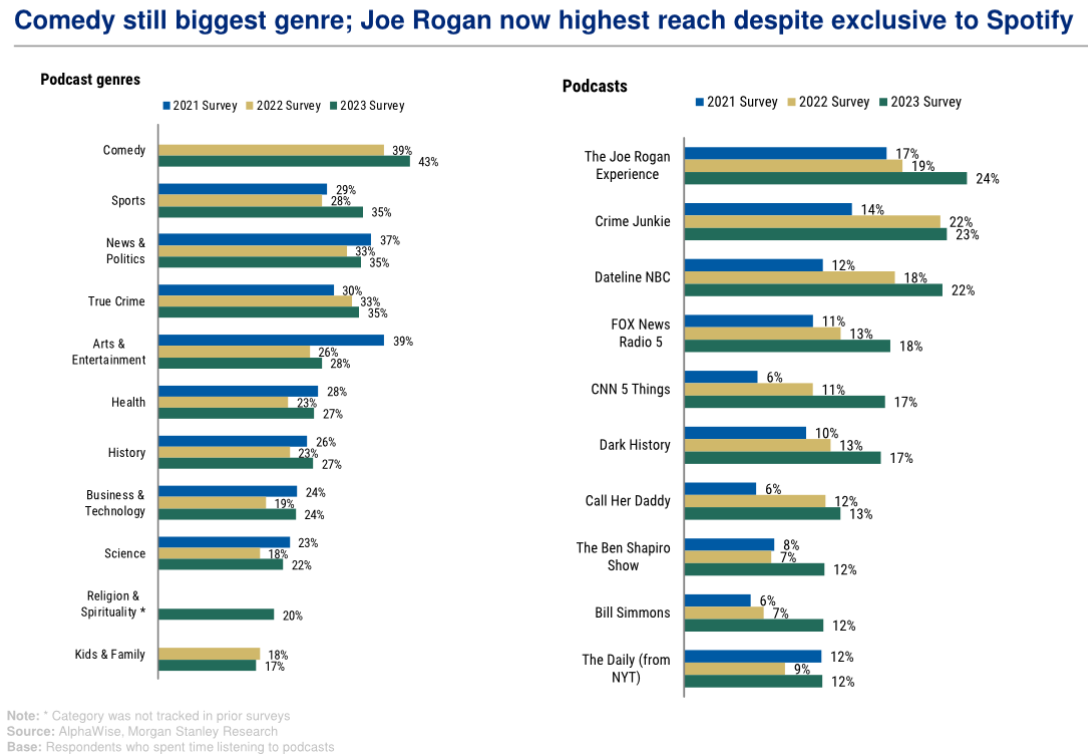
| Joe Rogan re-upped at Spotify this week, but on a non-exclusive basis, which seems like a win-win for both sides. He can broaden his audience while keeping existing subscribers, and Spotify gets a rev share on other platforms while not paying for exclusivity. It’s almost like podcast exclusives never made any sense in the first place! Despite being exclusive, Rogan is tops in reach, per Morgan Stanley research: |
|
|
Have a great week,
Matt
Got a question, comment, complaint, or a fake track list for Taylor Swift’s new album? Email me at Matt@puck.news or call/text me at 310-804-3198. |
|
|
|
| FOUR STORIES WE’RE TALKING ABOUT |
 |
|
 |
|
 |
| Nowhere to Ronna |
| A dispatch from the R.N.C.’s winter gathering in Vegas. |
| TARA PALMERI |
|
 |
| Law & Border |
| On the G.O.P. strategery surrounding the border crisis. |
| TINA NGUYEN |
|
|
|
|
|
 |
|
|
|
Need help? Review our FAQs
page or contact
us for assistance. For brand partnerships, email ads@puck.news.
|
|
You received this email because you signed up to receive emails from Puck, or as part of your Puck account associated with . To stop receiving this newsletter and/or manage all your email preferences, click here.
|
|
Puck is published by Heat Media LLC. 227 W 17th St New York, NY 10011.
|
|
|
|