 |
|
Welcome back to What I’m Hearing from blustery Los Angeles, where I’m currently in second to last place in Puck’s March Madness pool. Today I’ve got a mixed mailbag of reader questions, and a look at how Sony avoided using the C-word (comedy) when marketing Ghostbusters.
Programming note: On The Town, Lucas Shaw and I named (and fought over) the 10 most powerful people in Hollywood, Dylan Byers broke down the Don Lemon/Elon Musk debacle, and MARZ co-founder Matt Panousis updated the latest moves in A.I. Subscribe here and here.
Was this email forwarded to you? Click here to become a Puck member. Got a news tip or an idea for me? Just reply to this email.
Discussed in this issue: Bob Chapek, Kevin Costner, Greg Peters, Kristen Welker, Scott Rudin, Dan Lin, Jennifer Lawrence, Bob Iger, Jeff Zucker, David Greenbaum, Nelson Peltz, and… Elisabeth Moss’s big Scientology coming-out party.
But first…
|
| Who Won the Week: Oprah Winfrey |
|
| Who else could take a burgeoning scandal over her use of weight-loss drugs while sitting on the board of Weight Watchers, and turn it into Shame, Blame and the Weight Loss Revolution, an ABC special about the obesity epidemic that drew mostly praise and lured more than 4 million live viewers? |
|
|
| It’s a tie!...
“Why do I have to have a Marvel that’s all women? Not that I have anything against women, but why do I have to do that? Why can’t I have Marvels that are both? Why do I need an all-Black cast?”
—Nelson Peltz, the 81-year-old Disney shareholder and aspiring comic book movie critic, citing Captain Marvel (two movies, $1.3 billion in box office) and Black Panther (two movies, $2.2 billion) as major problems that he could help fix, to the Financial Times.
And…
“I’m not ready to say that, but I question his record.”
—Also Nelson Peltz, in the same profile, questioning whether Marvel’s Kevin Feige, probably the most successful producer in Hollywood history, should be fired.
Too many good quotes this week, so…
First runner-up: “Strategically, I don’t really see a benefit in bringing on yet another minority partner into ESPN.”
—Bob Chapek, the fired C.E.O., using his first post-Disney interview (in a CNBC documentary) to criticize predecessor/successor Bob Iger’s search for another strategic partner at ESPN. Classy!
Second runner-up: “Our bosses owe you an apology for putting you in this situation.”
—Chuck Todd, ripping his own network to Meet the Press host Kristen Welker, after NBC News hired the election-denying former R.N.C. chair Ronna McDaniel as a contributor, adding: “There’s a reason why there’s a lot of journalists at NBC News uncomfortable with this.”
Now on to a mailbag of questions from readers, sources, and random people online… Apologies if I didn’t get to yours, I’ll do another soon… |
|
|
| It’s spring-cleaning time at What I’m Hearing HQ, so today I’m scouring my inbox (and tweet replies) to answer some reader questions. (I’ve edited them for clarity.) Let’s start with one of my favorite topics… |
|
|
| What’s going on with the Yellowstone sequel/continuation show? Last you reported, Rip (Cole Hauser) and Beth (Kelly Reilly) were holding out for more money, and the studio was about to pull their offers. What’s up?
The temperature cooled, as I suspected it would. But neither Hauser nor Reilly has signed on yet. They’re still pushing for more money, around $1 million an episode. (Remember, Reilly initially asked for $1.5 million and Hauser wanted $1.25 million, and Paramount was at $850,000.) They’re closer now, but not there. The Yellowstone follow-up, which will likely shoot in late summer and air after the back half of Yellowstone Season 5 hits Paramount Network at the end of the year. (It’s still funny, by the way, that TV’s No. 1 show airs on such an obscure linear network.) Creator Taylor Sheridan has figured out the story for the successor show, I’m told, and he’d still like Matthew McConaughey and Michelle Pfeiffer to star alongside returning cast Hauser, Reilly, and Luke Grimes, though the new stars aren’t on board yet, either.
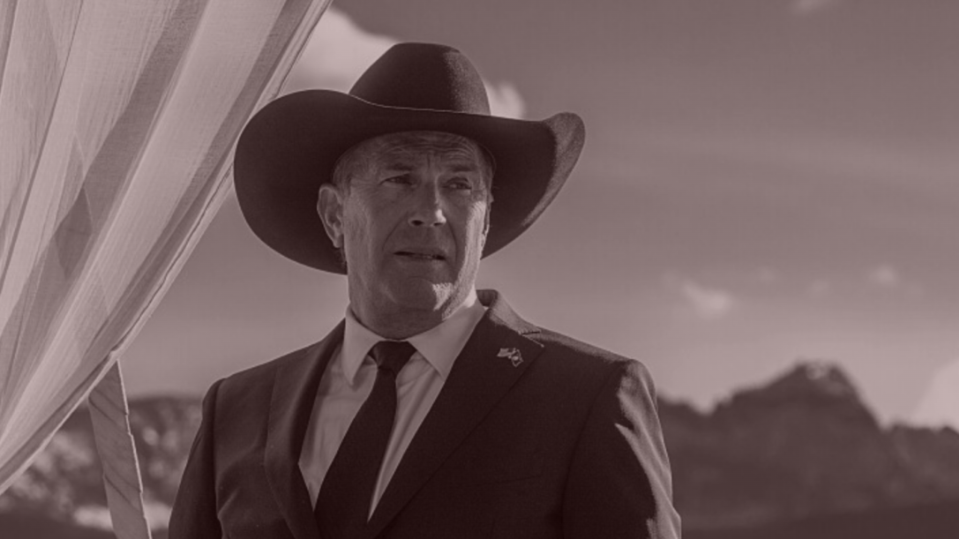
As for the final episodes of Yellowstone O.G., they’re already written, and shooting is set to begin in a few weeks. Kevin Costner has been telling people he’s planning to return for at least a cameo and possibly more, but there are currently no discussions for him to do that. Even if Costner significantly lowers his financial and time commitment demands, Sheridan may not want to bother reopening his finished scripts to accommodate a send-off for John Dutton. But the Yellowstone fans would certainly love it, which Costner knows and hopes to leverage, as he always does.
I agree with you that Disney’s Bob Iger is winning the battle for shareholder love in this proxy fight. My question is whether there is anything Nelson Peltz could do to swing momentum before April 3?
Well, there’s one possibly influential person who has so far remained silent on the Disney proxy war: Elon Musk. It’s kinda surprising, given that Elon used the DealBook conference in December to tell Iger to “go fuck yourself” for not advertising on Twitter/X. And he’s apparently funding the fired Mandalorian star Gina Carano’s discrimination lawsuit against Disney. I’m not sure how much Musk could even sway shareholders, but it would certainly generate news coverage and possibly momentum.
Until that happens, Peltz has pulled together support from mostly retired directors of non-entertainment companies like Heinz, Home Depot, P&G, Janus Henderson, and Mondelez. Plus the proxy advisory firm ISS, and, of course, his Palm Beach mahjong buddy Ike Perlmutter. By contrast, Team Iger includes Michael Eisner, George Lucas, Laurene Powell Jobs, the Disney family (including Abigail!), Jamie Dimon, the other proxy firm, Glass Lewis, and, perhaps most importantly, a guy in the check-out line at Trader Joe’s who recognized my voice from The Town and told me he owns some Disney stock from his aunt and just voted the white slate.
As an agent, this is how I know the movie business is in trouble: I’ve never seen the high caliber of talent willing to do the low caliber of studio movies being offered to them since the strike. It’s been brutal for a while, but there was the Netflix volume and you could still sell the big packages with the right talent. Now it’s just, Is this movie actually happening?
I got that email a couple months ago, but I fished it out on Friday when I heard that Jennifer Lawrence’s team had engaged on the new Jurassic World movie at Universal. That kind of aging franchise fare seemed waaaay beneath an Oscar winner and major movie star who’s still only 33. But the more I thought about it, at least Jurassic 7 is a go movie, at a full-freight studio price, and with an A-level global franchise release in theaters to juice the worldwide Q factor that fuels endorsements and her ability to get made the kind of movies she actually wants to make. No shame there.
Alas, JLaw isn’t doing it; instead, Scarlett Johansson is in talks to star, but even she shouldn’t need a big franchise like this to get a studio movie made. I guess the point is that these days, almost everyone does, or at least everyone who wants to continue to have the most opportunities at the highest fees.
You make fun of the lower viewership on Apple TV+ but you don’t offer any solutions. They’re a young service. What should Apple be doing here?
If the goal is even to get people to watch the service (debatable), Apple should buy or license a big library of content and put it on Apple TV+. It’s not like money is an issue for Apple. More people will watch if there’s more to watch. Pretty simple.
It’s funny to see the David Greenbaum and Dan Lin hires at the film divisions of Disney and Netflix praised as the “next generation” of executives. They’re both about 50! Why is Hollywood so unwilling to hand things off to us “kids” in our 30s?
It’s mostly fear. More seasoned executive hires elicit less fear. Think about it. Business leaders feel emboldened to take more risks when they are confident in the state of their businesses. When Barry Diller was put in charge of Paramount at age 32, it was because a) the studio needed fresh, youthful ideas, but also because b) the fundamental underlying business of a movie and (especially) television studio in 1974 was not under attack. If Diller failed, Gulf & Western could just find someone else and move on.
Nowadays, of course, there’s no guarantee that these studios—and especially Paramount—will exist in three to five years. Disney is fighting a proxy war with an investor who surely would have pounced on an eyebrow-raising hire at Disney Studios. And Netflix, the company you’d think would be more likely to make unorthodox decisions, is increasingly looking and acting like one of the traditional majors.
Combine that with the fact that people are living and working longer, the older generation increasingly refuses to leave their jobs, and it’s harder to get the kind of experience and make the kind of meaningful decisions that justify big job promotions. Just look at all the agents waiting for the CAA leadership to retire and hand off the agency, just like Mike Ovitz and his crew did in the ’90s to the Young Turks, then in their 30s. Not gonna happen.
I keep hearing that Scott Rudin is “back.” True? And what does that mean?
I think it’s yes and no. Rudin, one of the most successful lower-budget movie producers of the modern era, has essentially been banished from public engagement with the business since his decades of awful behavior were detailed in THR in 2021. Rudin’s offenses weren’t sexual or especially violent (unless you count throwing phones at assistants…which I guess I should), but the berating and bullying finally caught up with him, and his business partners publicly cut ties.
For a while, Eli Bush, Rudin’s second in command, was essentially acting as his puppet, but their relationship soured. And Rudin remains close with the executives at A24, which has made tons of Rudin projects—everything from Lady Bird to Uncut Gems to this year’s Oscar nominee Past Lives, which was developed and championed by Rudin. The way it works, I’m told, is that Rudin is still attached to tons of projects, and when they eventually get made, he negotiates a “passive” stake or fee to stand down. So, for instance, Rudin was paid on Past Lives even though his name was taken off and filmmaker Celine Song avoided mentioning his involvement during awards season.
Rumors still circulate in New York that Rudin is becoming more active in theater, where he was also a force. I haven’t seen evidence of that, but I’m less knowledgeable about that world. He was definitely super-involved in To Kill a Mockingbird in 2022, after he claimed to be “stepping back.” That play’s Broadway incarnation imploded, but it continues to tour—and generate money for Rudin.
You have theorized that Netflix began releasing its “engagement report” viewership data because it wants to shift to a pay model based more on performance rather than simply shelling out as if every movie or show is a hit. Has that started yet?
The conversations have started, definitely. Netflix is staying quiet about it, but one producer that has sold a couple projects there told me last week that it’s been made clear to him: change is coming. Which makes sense. Netflix overpaid to enter the market and upend an established oligarchy. Now that it is dominant in streaming, it can afford to be stingier. Things are further along on the movies side, I’m told, where new film chief Dan Lin will inherit a division that won’t automatically buy out every project that executives get excited about. The details aren’t set, and obviously the magic viewing number to generate contingent compensation will vary by project. Plus, Lin will still be able to take projects off the table if he wants, like Netflix did with the pricey Ben Affleck-Matt Damon package Animals earlier this year. But paying less up front could provide Apple and Amazon, the two rivals that regularly overpay to secure big packages, a leg up when big projects hit the auction block. Amazon is still ponying up for things like the Bradley Cooper-Christian Bale package Best of Enemies in December. And on the TV side, I’m told Netflix refused to bid higher as the price for the MrBeast reality-competition show neared $100 million. Amazon got that one.
Before he changed his story, Shohei Ohtani’s interpreter said Ohtani personally wired $4.5 million to an illegal bookie. Ohtani later said he didn’t wire the money and was instead the victim of a “massive theft.” Regardless of who sent it, my first reaction was to question the representatives. How in the world would CAA, Ohtani’s business managers, his money managers, and his lawyers, all not know about this?
I don’t typically discuss sports scandals, and clients obviously don’t include their representatives in every move they make. But I do know it is difficult for high-profile people—especially entertainers and sports stars—to move that kind of money from their accounts without at least their wealth managers knowing about it. Ohtani is repped by CAA Sports, where Nez Balelo tightly controls the star MLB player. And I’m told Ohtani has long been a client of the L.A.-based wealth management firm LourdMurray, which shares many showbiz and sports stars with CAA, and whose founder, Blaine Lourd, is the brother of CAA C.E.O. Bryan Lourd. Among the questions Ohtani might want to answer at his press conference tomorrow: How did he and his reps not notice that $4.5 million was sent from his account to a bookie? |
|
|
| Seven weeks after its exclusive NFL playoff game, Peacock had retained 71 percent of the 3 million subscribers who signed up to watch. Peacock’s one-month survival rate across all 2023 sign-ups was 78 percent, so the game was slightly less sticky than usual at much higher volume. Not bad! [Antenna]
OpenAI has set meetings around town to sing the praises of its Sora text-to-video program that will one day replace everyone sitting naively in these meetings. [Bloomberg]
Bill Cohan has more on the Apollo/Legendary bid for Paramount, including that Apollo is open to possibly buying more than just the studio, including maybe CBS and its affiliates. [Puck]
Greg Peters, Netflix’s other C.E.O., clashed with Ted Sarandos, who wanted to overrule the algorithm and artificially promote shows from favored creators. That’s very Ted. Peters is also a “health nut” who brings “vitamin gels and a thermos of tea to meetings.” [WSJ]
Eriq Gardner updates the legal war on Bravo by Bryan Freedman and Mark Geragos, including their potentially groundbreaking push to classify long-running reality show participants as employees. [Puck]
Casey Newton has a concise breakdown of the landmark Apple antitrust lawsuit. [Platformer]
MediaLink is charging clients $850,000 for prime meeting spaces at the Cannes Lions ad event, even if its deposed leader, Michael Kassan, might be setting up his own spite store down the street. [Adweek]
Michael Wolff goes long on Jeff Zucker’s embarrassing debacle in the U.K., and the hubris required to think British regulators would be cool with selling The Daily Telegraph and The Spectator to a foreign owner fronted by an American TV executive and backed by Arab money. [NY Mag]
Pete Davidson killed about 150 jobs when he decided to bail on Bupkis Season 2, but at least the ferry he bought with Colin Jost is still happening. [Curbed]
Elisabeth Moss, who has always publicly downplayed her Scientology affiliation and avoided being photographed at events, sat front row (next to Travolta) at L. Ron Hubbard’s lavish 113 birthday bash in Florida. Yes, there are pics. [Tony Ortega]
Fake Carol Lombardini wrote a Succession spec script. I’d suggest the AMPTP studios read it, but they’d probably prefer A.I. coverage. [Script]
Now box office expert Scott Mendelson has an underreported aspect of Sony’s Ghostbusters revival… |
| Sony’s Ghostbusters Horror Story |
|
| There were any number of reasons to expect that Ghostbusters: Frozen Empire would open well below Ghostbusters: Afterlife, which relaunched the franchise with $204 million worldwide on a $75 million budget in Covid-plagued 2021. After all, the latest entry enjoyed far less hype than its Jason Reitman-directed predecessor; comedy sequels (from Gremlins II to Ted 2) often underwhelm; and it received comparatively worse reviews. But Sony Pictures somehow avoided the sophomore slump with its Gil Kenan-directed follow-up, which nabbed a $45.2 million domestic debut, slightly higher than Afterlife’s $44 million opening weekend. What went right?
Sure, Frozen Empire benefited from a general lack of kid-friendly alternatives, a generally consistent fan base (2016’s Ghostbusters: Answer the Call, Afterlife, and Frozen Empire all opened between $44 million and $46 million), and a well-liked predecessor. Yet Sony also deserves credit for its packaging choices. The posters and various TV spots emphasized not a knee-slapping supernatural comedy but a (literally) bone-chilling horror movie—they emphasized Dan Aykroyd gravely explaining an ancient phantom god “with the power to kill from fear itself.” This was offset with some humorous asides from the likes of Patton Oswalt and Paul Rudd, but potential audiences also saw grisly images of frozen corpses and carnage in present-day New York. Add in a few key glimpses of the imposing Garraka, and Frozen Empire teased very real supernatural menace. Meanwhile, for kids, it looked like a fun adventure that did not condescend to an audience old enough to watch Netflix’s often gruesome Stranger Things.
In short, Sony sold this $100 million sequel not as a horror-comedy but as a kid-friendly scary movie populated by funny actors. A distinction without a difference? Maybe, but live-action theatrical comedies have struggled amid the push to streaming, while horror has remained one of the safest and most reliable theatrical genres. Over the past four years, as the superhero industrial complex somewhat imploded, it has become the safest box office bet. |
|
|
| The demise of the comedy has been much-debated in Hollywood. But the discussion often sidesteps that every other genre often now offers big laughs as a quasi-added-value element. Why settle for “just” a comedy when you can get comedy+adventure (Dungeons and Dragons: Honor Among Thieves), comedy+superhero fantasy (Guardians of the Galaxy Vol. 3), comedy+animation (The Super Mario Bros. Movie), comedy+horror (Scream VI) or comedy+nostalgia IP (Barbie)? Conversely, horror movies tend to offer comparatively uncompromising thrills, chills, and carnage that most other all-quadrant genre films don’t try to approximate. If you want the genre-specific tropes, you generally must seek out the genuine article.
In fact, horror is mostly money in the bank unless it is marketed as a horror-themed comedy, like Lisa Frankenstein or Renfield. Studios selling a screams+laughs combo (like M3GAN or Cocaine Bear) must assure audiences that they, or at least the characters, will be fearful of what transpires onscreen. So marketing Ghostbusters: Frozen Empire amid the realities of today’s theatrical marketplace required selling the scares first (“It’s called the Death Chill!”) and the laughs (Kumail Nanjiani playing to type) second.
Ghostbusters: Frozen Empire is another example in the recent line of films, like Late Night With the Devil, that can survive in theaters if they are positioned within the prism of a horror movie. That’s not to say that every upcoming major release should be sold as scary-good fun—cue a spooktacular red-band second trailer for The Garfield Movie—but if you’ve got it, flaunt it. We’ll see if Warner Bros. markets September’s Beetlejuice Beetlejuice as a “scary for kids” fantasy rather than a nostalgic comedy. |
|
|
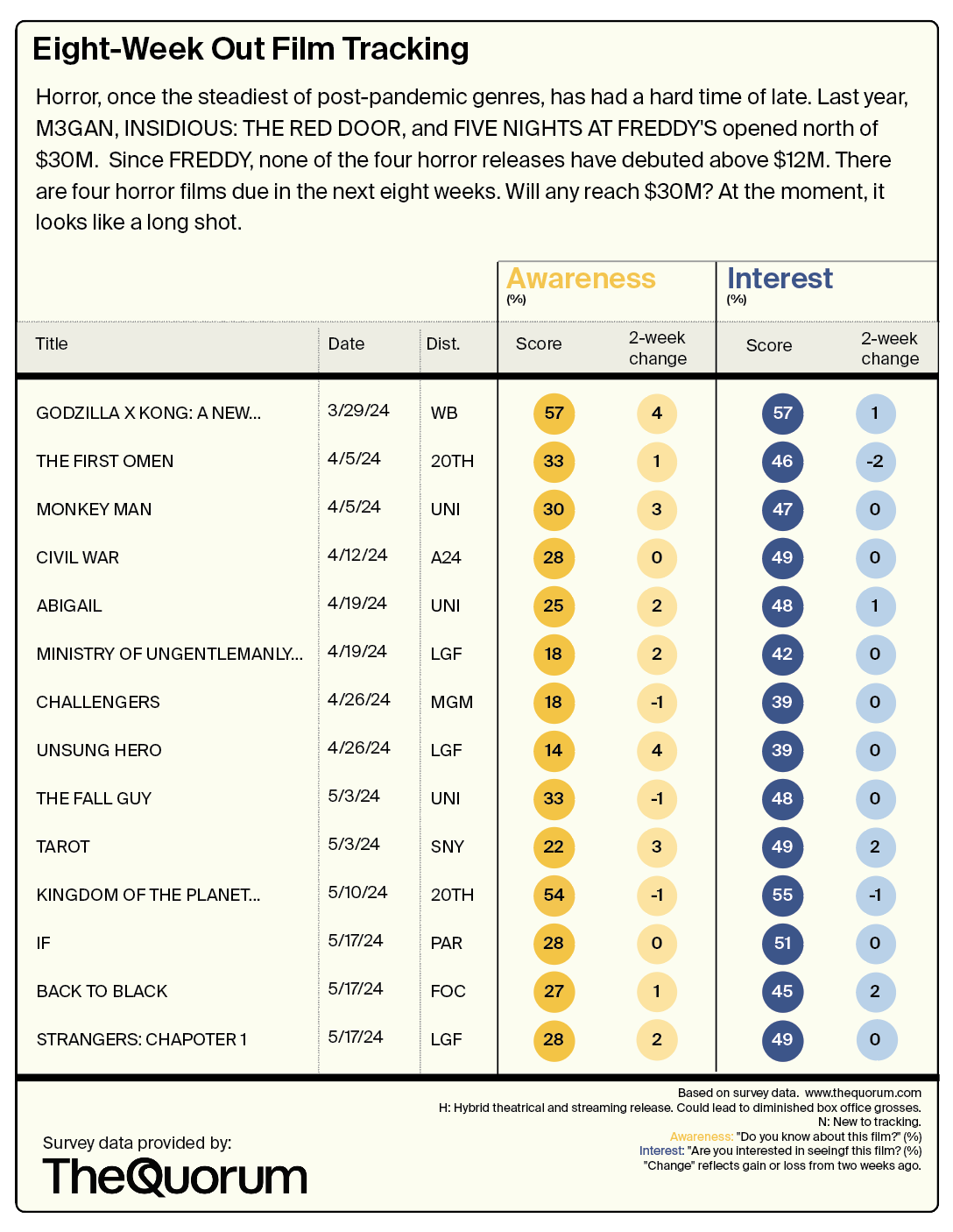
| Speaking of horror, after a fantastic 2023, slasher titles haven’t performed especially well this year, and the upcoming offerings need to improve their numbers, according to The Quorum’s new chart… |
|
|
Have a great week,
Matt
Got a question, comment, complaint, or a Scott Rudin story you’ve never told anyone? Email me at Matt@puck.news or call/text me at 310-804-3198. |
|
|
|
| FOUR STORIES WE’RE TALKING ABOUT |
 |
| Shari’s Choice |
| A captivating twist in Apollo’s offer for Paramount. |
| MATTHEW BELLONI |
|
 |
| Ronna Maddow |
| Diving into Ronna McDaniel’s post-R.N.C. reality. |
| DYLAN BYERS |
|
 |
|
 |
| DustinBucks |
| On the Facebook co-founder’s renewed interest in money-bombing D.C. |
| TEDDY SCHLEIFER |
|
|
|
|
|
 |
|
|
|
Need help? Review our FAQs
page or contact
us for assistance. For brand partnerships, email ads@puck.news.
|
|
You received this email because you signed up to receive emails from Puck, or as part of your Puck account associated with . To stop receiving this newsletter and/or manage all your email preferences, click here.
|
|
Puck is published by Heat Media LLC. 227 W 17th St New York, NY 10011.
|
|
|
|